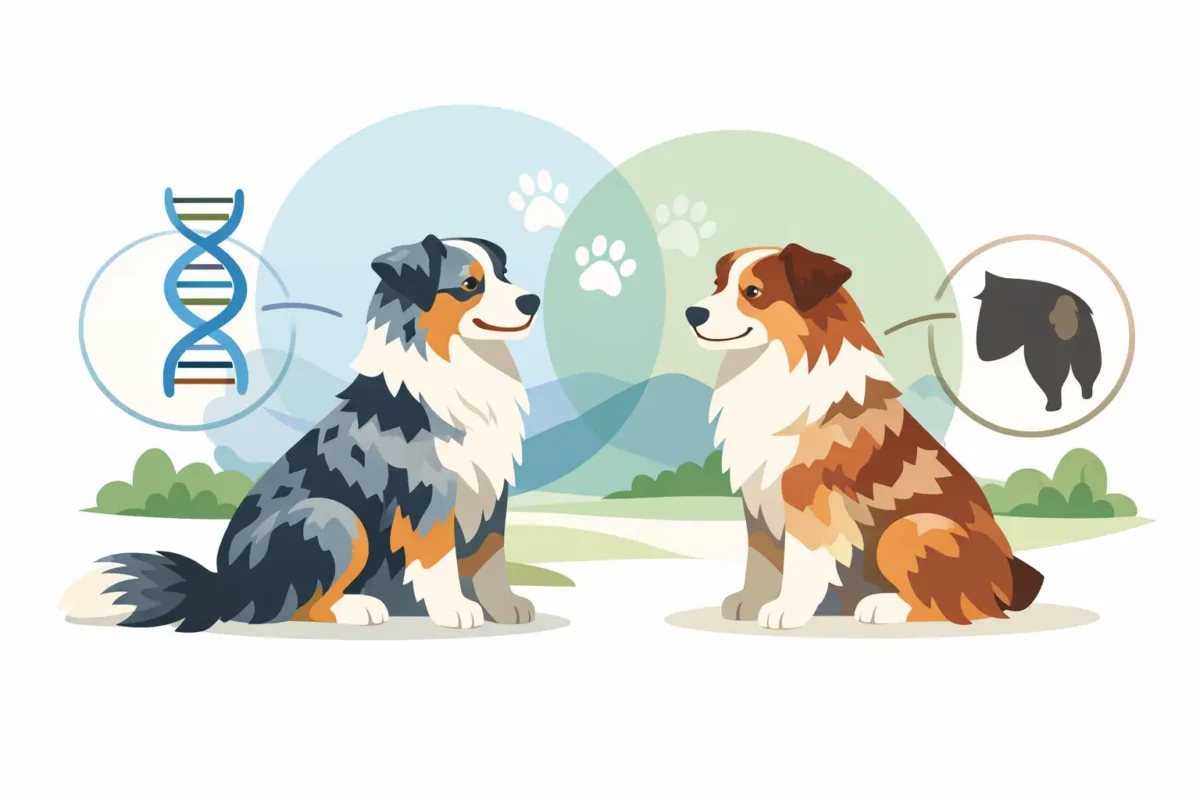
Australian Shepherd natural bobtail genetics explained: how the NBT gene is inherited, why DNA testing matters, and what responsible breeders do to avoid.
What Creates a Natural Bobtail?
The natural bobtail trait in Australian Shepherds is associated with a mutation in the T gene, often called the NBT gene or natural bobtail gene. It is an autosomal dominant trait. That means a dog needs only one copy of the gene to potentially pass a naturally shortened tail to offspring.
A dog with one copy of the natural bobtail gene is typically described as heterozygous. That dog may have a very short tail, a partial tail, or a tail that is shortened to a degree that varies from dog to dog. The gene does not guarantee that every natural bobtail will look identical. Tail length can range from nearly absent to a unnoticeable long tail.
A long-tailed Australian Shepherd does not carry the NBT mutation. It has two copies of the normal long-tail version of the gene. This is why a dog should not be labeled a natural bobtail based on appearance alone, especially where tails may have been docked early in life.
Natural Bobtail Is Not the Same as Docked
A natural bobtail is a tail the puppy was born with. A docked tail was surgically shortened after birth. Those are entirely different things, even if the finished appearance is similar.
Buyers deserve a straight answer. If a breeder advertises a bobtail puppy, ask whether the puppy is genetically natural bobtail, docked, or born with a full tail. A clear breeder will not blur those categories to make a listing sound more appealing.
Photos can also be misleading. A close crop of a puppy’s rear end does not prove genetics. DNA results, parent records, and honest documentation do.
Australian Shepherd Natural Bobtail Genetics and Inheritance
The basic inheritance pattern is straightforward, but the breeding consequences are not. A naturally bobtailed parent with one copy of the NBT gene bred to a long-tailed parent can produce both naturally bobtailed and long-tailed puppies. In broad terms, each puppy has about a 50 percent chance of inheriting the NBT gene.
That pairing is the responsible starting point because it avoids creating puppies with two copies of the NBT gene. In practical breeding notation, it is often described as NBT/long tail crossed with long tail/long tail.
When two naturally bobtailed dogs are bred together, the math changes. At conception, the expected outcomes are roughly 25 percent puppies with no NBT gene, 50 percent with one copy, and 25 percent with two copies. The two-copy, or homozygous, NBT condition is associated with embryonic lethality. In plain language, those embryos generally do not survive early development.
This is why responsible breeders do not treat bobtail-to-bobtail pairings as a shortcut to producing more short-tailed puppies. It may sound attractive to someone selling on appearance, but it creates a known and avoidable loss before puppies are ever born. Smaller litter sizes can be one result, though litter size is influenced by many other factors as well.
Why DNA Testing Matters More Than Guesswork
A naturally short tail is not enough information to make a breeding decision. The NBT gene should be confirmed with
DNA testing. This is particularly important when a breeder works with dogs from different programs, has limited information on earlier generations, or is evaluating a dog whose tail appearance is not obvious.
Genetic testing separates fact from assumption. It confirms whether a dog carries the natural bobtail mutation and allows the breeder to plan a pairing that does not risk homozygous NBT embryos. It also keeps records accurate for buyers who care about natural tails, registration details, and future breeding rights.
At Hughes Toys, genetic testing is part of the larger standard, not a substitute for one. A DNA panel does not tell you whether a dog has the right temperament for a family, sound structure, good maternal instincts, or the ability to produce manageable companion puppies. It is one tool in a serious program that also includes veterinary care, multi-generation ASDR records, careful selection,
biosecurity, and honest evaluation of each individual dog.
Registration Is Useful, but It Is Not a Health Plan
Registration documents help establish identity and pedigree. They do not automatically prove that a dog was DNA tested, examined by a veterinarian, raised in a clean environment, or selected thoughtfully for temperament.
That distinction matters. Buyers should want both documented lineage and documented health practices. Pedigree alone is not a breeding program. A breeder’s choices – which dogs are paired, what is tested, how puppies are raised, and what information is disclosed – are what determine whether the paperwork has real value.
What Buyers Should Ask About a Bobtail Puppy
You do not need to become a canine geneticist to ask useful questions. Start by asking whether the puppy’s tail is naturally bobbed, docked, or long. Then ask whether the parents were DNA tested for the NBT gene and whether the breeder intentionally avoids natural bobtail-to-natural bobtail pairings.
The answer should be direct. A responsible breeder should not act as if basic genetic questions are inconvenient or unnecessary. They should also explain that a natural bobtail does not make a puppy healthier, smarter, calmer, or better suited to your home than a long-tailed puppy. It is one physical trait among many.
For most companion homes, temperament, size, energy level, early handling, and breeder support will matter far more than tail length. A Toy or Mini Australian Shepherd with a
full tail can be every bit as affectionate, trainable, and striking as a naturally bobtailed puppy. Families should choose the dog that fits their lifestyle, not chase a feature because it looks fashionable in a photograph.
The Trade-Off Behind “All Natural Bobtails”
Be cautious with any marketing that promises a program built around producing only naturally bobtailed puppies. Genetics does not work that way without consequences. A breeder who insists on maximizing the short-tail trait may be narrowing breeding choices for the wrong reason or taking risks that should not be taken.
Responsible selection always requires balance. A breeder may choose a long-tailed dog because that dog strengthens temperament, overall health, structural quality, size consistency, or a family-friendly lower-drive disposition. That is not a failure to produce a certain look. It is a breeder putting the whole dog ahead of a single visual trait.
The same standard applies to coat color and eye color. Merle patterns, blue eyes, and naturally short tails can be beautiful, but none should override sound genetic planning or the needs of the home receiving the puppy. A well-bred Australian Shepherd should be evaluated as a complete dog, not assembled as a list of trendy features.
A Clear Standard for Responsible Bobtail Breeding
The responsible approach is uncomplicated: verify the natural bobtail gene through DNA testing, keep records straight, and avoid breeding two NBT carriers together. Pairing a tested natural bobtail with a tested long-tailed dog preserves the possibility of naturally bobtailed puppies without knowingly creating the homozygous NBT risk.
That is the kind of planning buyers should expect from an established breeder. It takes more work than simply advertising a cute short tail, but it is the work that protects puppies and keeps breeding decisions accountable. When you ask about a puppy’s tail, listen for proof, not sales language. A breeder who can explain the genetics clearly is far more likely to be making careful choices in the areas you cannot see.