- A Toy Australian Shepherd for families with kids fits best when temperament is matched puppy-by-puppy, not picked by looks.
- Toy Aussies run 10-14 inches and 12-25 lbs, small enough to reduce collision risk with toddlers but still herding-bred.
- Health guarantees, vet checks, and genetic testing matter more with kids in the house because surprises hit family routines hardest.
- Nipping and chasing during play are breed-normal and need boundary training in the first weeks home, not months later.
- Verdict for 2026: a temperament-matched Toy Australian Shepherd puppy from a health-tested litter is a strong family dog.
Why this matters for families with kids
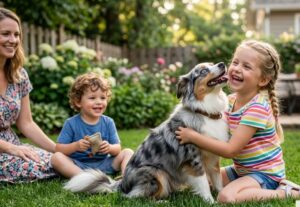
A herding breed in a house with kids is not automatically a bad match — it’s a management question. The Toy Australian Shepherd’s smaller frame lowers the physical risk of jumping and body-slamming that Standard Aussies are known for, but the instinct to herd, and chase fast-moving objects (like a running six-year-old) doesn’t shrink along with the body. Families searching for a toy australian shepherd for families with kids in 2026 are usually after the breed’s brains and loyalty without the 50-pound impact. The other piece is health. A puppy that develops a preventable joint or eye issue by age two costs a family money and heartbreak they didn’t budget for. That’s why vet checks, genetic testing, and a written health guarantee aren’t paperwork — they’re the difference between a dog that stays healthy through a decade of birthday parties and one that doesn’t.Steps to choosing and raising a Toy Australian Shepherd with kids at home
Assess your household’s daily rhythm before you choose a puppy
Before you contact any breeder, write down what your actual week looks like. A Toy Australian Shepherd still needs structured exercise and mental work even at 15 pounds.- Count how many hours the dog would be alone on a typical school or work day
- Note who is home during the puppy’s first 8-12 weeks for house-training
- List which family member will handle daily walks and training reps
- Identify a fenced yard or safe play area for supervised off-leash time
- Flag any existing pets and how they’ve reacted to fast-moving small dogs before
Match energy and temperament, not just size
Size gets families in the door, but temperament decides whether the dog and the kids actually get along. Ask any breeder how they evaluate individual puppies within a litter, not just the breed in general.- Ask for a temperament description of the specific puppy, not the litter average
- Watch, in person or on video, how the puppy reacts to sudden noise and movement
- Ask whether the breeder has placed puppies with young kids before and how those placements went
- Request the parents’ temperaments, since pups often mirror the calmer or bolder parent
- Avoid defaulting to the boldest, most attention-seeking puppy in the litter — bold often means high-drive, not friendly
Puppy-proof the house for a herding breed, not a generic dog
Toy Australian Shepherds chase, nip, and herd anything that moves fast, including kids. Puppy-proofing here means more than covering outlets.- Block off stair access until the puppy has solid coordination and recall
- Remove or secure loose cords, cables, and anything that swings or dangles
- Set up a crate or pen in a low-traffic room for decompression breaks
- Store shoes, socks, and small toys off the floor — herding pups mouth everything
- Check the yard fence line for gaps before the puppy’s first outdoor day
Set boundaries early to prevent nipping and chasing
Herding nips at running kids are the most common complaint from Aussie-owning families with children. This behavior is trainable, but only if it’s addressed in the first weeks, not the first year.- Teach kids to stop moving and stand still if the puppy nips at their heels
- Redirect chase instinct onto a flirt pole or tug toy instead of pant legs
- Never let toddlers approach the puppy face-first at full speed — teach a calm approach instead
- Reward calm behavior around excited kids with treats, not just correction after the fact
- Give the puppy a designated retreat spot the kids are taught to leave alone
Build a socialization plan around the kids’ actual schedule
Most of the critical socialization period closes by six months. After the puppy has the 3rd vaccine at 16 weeks, Fit it into school pickups, sports practice, and weekend routines instead of treating it as a separate project.- Introduce the puppy to one or two new safe environments per week
- Bring the puppy to school pickup on leash for controlled exposure to kid noise and movement
- Rotate exposure to different ages of kids — toddlers move and sound different from tweens
- Practice calm greetings with visiting friends before big gatherings happen
- Keep early sessions short; an overstimulated puppy learns nothing
Vet the breeder’s health and temperament practices before you commit
A health guarantee on paper means little without genetic testing and actual vet checks behind it. Ask directly what testing was done on the parents and the litter.- Ask which genetic panels were run on the parent dogs, not just the puppies
- Confirm a vet check happened before the puppy goes home,
- Ask what the written health guarantee actually covers and for how long
- Ask how the breeder communicates after pickup — email response times matter more than a sales pitch
- Get contract terms before any deposit changes hands
Prepare the transition home with kids already in the mix
The first 72 hours set the tone. Kids are usually the most excited people in the house and the hardest to keep calm during a new arrival.- Pick a quiet weekend, not a birthday party or holiday, for pickup day
- Assign one adult to supervise all kid-puppy interactions for the first week
- Keep the first few days low-key — no big trips, no crowded rooms
- Start crate and potty routines on day one, not once things settle down
- Schedule the first vet visit within the timeframe the breeder recommends
Comparison: options for families with kids in 2026
| Option | Best for | Key limitation |
|---|---|---|
| Toy Australian Shepherd | Families wanting Aussie temperament in a small, lower-impact frame | Still herds and nips without early boundary training |
| Miniature Australian Shepherd | Families wanting more exercise capacity than a Toy but still under Standard size | Higher energy output, needs more daily activity |
| Standard Australian Shepherd | Active families with older kids and space for a 40-65 lb working dog | Size and drive can overwhelm households with toddlers |
| Adult rescue Aussie or Aussie mix | Families who want a known, settled temperament over a puppy | Health and genetic history often unknown or unverifiable |
“Bold in an eight-week-old puppy usually means high-drive, not friendly — don’t pick the loudest one for a quiet child.”
Ask about temperament-matched litters
Hughes Toys places Toy and Miniature Australian Shepherd puppies with families in OR, WA, and CA.
Common mistakes families with kids make
- Picking the boldest puppy in the litter for a shy child. Confidence in a puppy usually means higher drive and more demand for structure, not a gentler dog.
- Letting toddlers greet the puppy at a run. Fast, face-first approaches trigger the exact chase-and-nip response families are trying to avoid.
- Assuming small size means low exercise needs. A 15-pound Toy Australian Shepherd still needs daily structured activity; skipping it shows up as nipping and barking.
- Buying sight-unseen from listings with no vet records. Families who skip asking about genetic testing and vet checks find out about problems long after pickup day.
FAQ
Is a Toy Australian Shepherd good with kids?
A Toy Australian Shepherd can be an excellent family dog when the individual puppy’s temperament is matched to the household. The breed’s herding instinct means nipping and chasing at running kids is normal and needs early boundary training.
How big does a Toy Australian Shepherd get?
A Toy Australian Shepherd typically reaches 10 to 14 inches at the shoulder and weighs 12 to 25 pounds as an adult. That is well below a Standard Australian Shepherd’s 40 to 65 pound range.
How much exercise does a Toy Australian Shepherd need?
A Toy Australian Shepherd needs daily structured exercise and mental work despite its small size. Skipping it shows up as nipping, barking, and chasing behavior directed at kids.
Do Toy Australian Shepherds nip at kids?
Yes, nipping at heels and fast-moving legs is breed-typical herding behavior in Toy Australian Shepherds. It needs redirection and boundary training in the puppy’s first weeks home.
Are Toy Australian Shepherds hypoallergenic?
No, Toy Australian Shepherds shed and are not considered a hypoallergenic breed. Families with allergy concerns should spend time around the breed before committing.
What should I ask a breeder before getting a puppy for my kids?
Ask about genetic testing on the parent dogs, whether a vet check happened before pickup, and what the written health guarantee covers. Also ask how the breeder evaluates individual puppy temperament rather than the litter as a whole.
Is a Toy or Miniature Australian Shepherd better for a family with kids?
A Toy Australian Shepherd suits families wanting the smallest frame and lowest physical impact, while a Miniature fits families who can offer more daily exercise. Both need the same temperament-matching approach with kids.
How long do Toy Australian Shepherds live?
Toy Australian Shepherds typically live 12 to 15 years. A puppy brought home in 2026 will likely still be part of the family into the late 2030s.