Blog

Toy and MIni Australian Shepherd Low Herding Drive Explained

Learn what an Australian Shepherd low herding drive means, how temperament is bred and raised, and how to choose a calm, capable family companion pet dog.
Families searching for an “Toy or Mini australian shepherd low herding drive” are usually not asking for a lazy dog. They want the intelligence, loyalty, trainability, and striking mini Aussie look without spending every evening stopping a dog from circling children, chasing bikes, or attempting to manage the household. That is a reasonable goal, but buyers need a clear definition of what low herding drive actually means and what it does not promise. A well-bred Toy or Miniature Australian Shepherd can be an attentive, responsive companion with a more manageable instinct to control motion. That still leaves you with an Aussie. Expect a bright dog that notices patterns, learns quickly, and needs regular involvement with its people. The goal is not to remove the breed’s character. The goal is to select and raise a dog whose natural intensity fits ordinary family life.

What Toy – Mini  Australian Shepherd Low Herding Drive Means

Herding drive is the instinct to notice, pursue, gather, control, or direct moving animals and objects. In a working setting, those instincts have purpose. In a suburban living room, the same behavior can show up as stalking the cat, circling running children, barking at scooters, heel-nipping, or becoming overly focused on movement outside the window. A lower-drive mini Australian Shepherd is less likely to make motion control its personal job. Many are content to watch activity, check in with their owner, and move on. They may still enjoy chasing a ball or playing with another dog. They may alert at unfamiliar activity. Those are not automatic signs of serious herding drive. The difference is recovery and intensity. A suitable companion dog can become excited, then settle when the activity ends or when directed to do something else. A dog with stronger working instincts may stay locked onto the trigger, repeatedly rehearse the behavior, and require much more management. That distinction matters far more to most households than whether a puppy is simply energetic at eight weeks old. Low herding drive should also never be confused with fearfulness, dullness, or poor trainability. A good companion Aussie should be socially sound, curious, affectionate, and willing to engage. A puppy that shuts down around normal sights and sounds is not a calmer version of the breed. It may be an insecure puppy, and insecurity can create its own behavior problems.

Temperament Is Bred Before It Is Trained

Training matters, but it cannot fully rewrite inherited behavior. A breeder who claims every puppy will be calm, low-drive, non-barking, and perfect with every child is selling a story, not setting honest expectations. The responsible approach starts with selection over generations. Breeding dogs should be evaluated for their ability to settle, their response to unfamiliar situations, their social stability, their reactivity, and the intensity of their herding-related behavior. Their family history matters too. One pleasant parent does not erase a line of highly intense dogs. At Hughes Toys, more than 30 years of breed-specific experience has made one point very clear: pedigree alone is not proof of a good family dog. Multi-generation breeding- personally known the parents multi-generatiion,  genetic testing, veterinary checks, and documented breeding history are meaningful standards. They must be paired with practical knowledge of the individual dogs being bred. Temperament selection is a long-term program, not a label added to a puppy listing. Even with careful breeding, no ethical breeder can promise that every puppy in a litter will have identical energy or instincts. Littermates can differ. One may be more reserved and observant; another may be more playful and outgoing. This is why direct breeder evaluation and honest puppy matching are more useful than choosing strictly by coat color, eye color, or photos.

A Smaller Aussie Is Not Automatically a Lower-Drive Aussie

Toy, Small Toy, and Miniature Australian Shepherds are appealing to families who want a more manageable adult size. A smaller dog can be easier to carry, travel with, and accommodate in a city-sized home. Size, however, does not automatically determine temperament. A small Aussie from high-intensity working stock can still have a great deal of herding drive. Conversely, a larger dog from a companion-focused program may be notably calmer. Buyers should treat size and drive as separate questions. Ask about expected adult height and weight, then ask how the puppy’s parents behave around children, visitors, livestock, other dogs, and ordinary household activity. The same goes for color. Merles, blue-eye tris, and other eye-catching colors can be beautiful, but appearance does not predict whether a puppy will settle beside you after a walk. Health documentation, temperament history, and an accurate description of the individual puppy deserve equal or greater weight in the decision.

The Home Environment Still Shapes the Dog

A lower-drive puppy needs thoughtful raising. Without it, even a naturally easygoing Aussie can learn bad habits. Repeatedly allowing a puppy to chase children, bark at passing dogs through a window, or grab pants legs during play teaches the puppy that those behaviors work and are enjoyable. Start with structure. Give the puppy a predictable routine for meals, potty trips, rest, play, and short training sessions. Teach a recall, a place or settle cue, polite leash behavior, and an appropriate way to ask for attention. When children are involved, adults should supervise active games and stop chasing or rough play before the puppy becomes over-aroused. Physical exercise is necessary, but endless high-speed activity is not the answer for every Aussie. Some owners accidentally create an athlete that needs more and more stimulation without ever learning to relax. A better plan combines moderate daily movement with training, sniffing walks, age-appropriate play, and calm downtime. Puppies need substantial sleep. An overtired puppy often looks hyper, mouthy, or difficult when it actually needs a quiet break. Mental work is useful, but keep it practical. Food puzzles, short obedience practice, simple scent games, and learning household manners can satisfy an intelligent dog without turning every day into a competitive training program. The right balance depends on the dog, its age, and the household’s schedule.

Questions Buyers Should Ask a Breeder

puppies are observed and matched. A breeder who spends daily time with a litter can often describe which puppy is more independent, more people-focused, more active, or quicker to recover from new experiences. That does not make temperament placement an exact science, especially with very young puppies, but it is far better than letting buyers choose only from a picture. Also ask about health practices. Genetic testing cannot guarantee a lifetime without veterinary needs, but it is part of responsible risk reduction. Veterinary checks, a clear health guarantee, clean biosecurity practices, and transparent records show whether a breeder operates with accountability. A calm temperament is valuable, but health and sound structure are not optional trade-offs.

Is a Low-Drive Aussie Right for Your Family?

For many families, a lower-drive Australian Shepherd is an excellent middle ground. You can have a dog that wants to train, travel, hike, play, and stay close to its people without needing livestock work or nonstop organized activity. This can be particularly appealing for households with school-age children, retirees who still want an engaged companion, and apartment or suburban owners committed to daily exercise and training. It depends on what you mean by calm. If you want a dog that needs almost no activity, does not notice visitors, and is content with a brief potty walk, an mini Australian Shepherd may not be the best breed choice. If you want a smaller, devoted dog with a sensible off-switch, good trainability, and enough energy for an involved family, a carefully selected companion-bred Aussie can fit very well. The best next step is to describe your real life plainly: the ages of your children, other pets, work schedule, travel plans, exercise habits, and tolerance for barking or grooming. A good breeder should use that information to guide the match, not pressure you toward the first available puppy. The right puppy is the one whose temperament gives your household room to enjoy the dog you brought home.

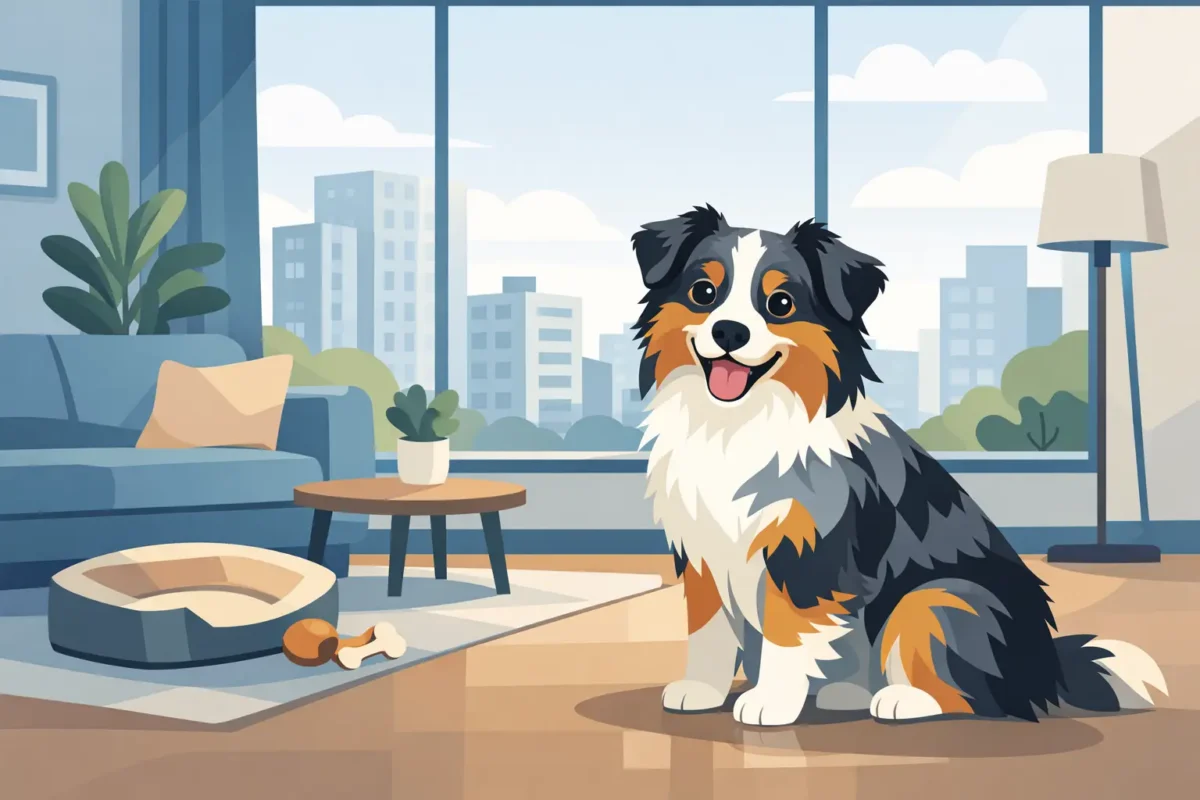
Are Mini Aussies Good Apartment Dogs? The Real Test

Are mini aussies good apartment dogs? Yes, when temperament, exercise, training, and daily structure fit the dog and the household living there well.
A Mini Aussie can be perfectly comfortable in an apartment while a poorly matched one can make a large house feel too small. So, are mini aussies good apartment dogs? The honest answer is yes, but only when buyers understand that square footage is not the main issue. Temperament, breeding, daily outlet, training, and the owner’s consistency matter far more than whether the dog lives behind a front door or a backyard fence. Miniature Australian Shepherds are smart, attached to their people, and observant. Those are excellent companion traits. They also mean they notice hallway traffic, delivery sounds, changing routines, and a bored owner who expects them to entertain themselves all day. An apartment can work very well. It is not a substitute for responsible ownership.

Are Mini Aussies Good Apartment Dogs for Most Owners?

They can be, particularly for owners who want an involved companion rather than a decorative small dog. A well-bred Mini Aussie with a manageable temperament can settle near your desk, ride along on errands, learn household rules quickly, and be deeply connected to family life. Many do not need acres of land. They do need a job of some kind, even if that job is training, walking, traveling with you, practicing obedience, or learning to relax appropriately indoors. The phrase “Mini Aussie” can create false expectations. Smaller does not automatically mean low-energy, quiet, or easy. This is still an Australian Shepherd in type. The breed is intelligent and responsive, with a natural tendency to watch movement and stay engaged with its people. If a puppy comes from high-drive working lines, has an intense herding instinct, or is placed with an inactive owner, apartment living may become frustrating for both dog and household. That is why responsible placement starts before a puppy goes home. Buyers should ask direct questions about the parents’ size, temperament, energy level, behavior in the home, and the breeder’s goals. Registration alone does not answer those questions. A pedigree may document ancestry, but it does not guarantee that a puppy is suited for an apartment, a young family, a quiet retiree, or a first-time owner.

What Makes an Apartment Mini Aussie Work

The best apartment dog is not necessarily the smallest puppy in the litter. It is the puppy whose temperament fits the actual home. A confident but not frantic puppy, with an ability to recover from new sounds and settle after activity, is often a better choice than the boldest, busiest puppy available. At Hughes Toys, selection has been built around companion-oriented Toy and Miniature Australian Shepherds for more than 30 years. That means paying attention to more than color, eye color, or a photo at six weeks. Calmer disposition, manageable size, lower herding drive, health background, and family compatibility are practical breeding priorities because they affect daily life for years. For apartment owners, three habits carry the most weight: regular movement, mental work, and an indoor off-switch. A dog that receives a purposeful walk and a few minutes of training is usually easier to live with than a dog given random bursts of activity but no direction. A puppy also needs to learn that not every sound in the hallway requires a response and that resting while the owner works is normal. A realistic weekday might include a morning walk with a few obedience repetitions, a midday potty break and short play session, then an evening walk, training game, or outing. That is not an extreme program. It is consistent structure. On weekends, a Mini Aussie may enjoy a longer trail walk, a visit to a dog-friendly location, or time practicing new skills in a quiet park.

Exercise Is Necessary, but Over-Exercising Is Not the Goal

Some owners make the mistake of trying to wear out an intelligent herding breed physically every day. That can create an athlete with no ability to settle. Puppies, especially, need age-appropriate exercise that protects growing joints and leaves room for sleep, socialization, and calm handling. Mental engagement counts. Short sessions teaching leash manners, recall, place, wait, touch, and polite greetings can tire a young dog more effectively than endlessly throwing a ball. Food puzzles, supervised chewing, scent games, and simple obedience routines also give the dog something useful to do inside the apartment. The goal is not exhaustion. The goal is a dog that knows when it is time to engage and when it is time to rest.

The Apartment Challenges Buyers Should Not Ignore

Apartment life does place certain demands on both puppy and owner. Potty training requires more planning when there is no fenced yard ten steps away. Young puppies need frequent trips outside, including overnight at first. If you work long shifts away from home, live several flights up, or cannot arrange help during the puppy stage, that needs to be considered honestly before bringing one home. Noise is another issue. Mini Aussies can be alert dogs. A puppy that is allowed to bark at every elevator, neighbor, dog, or package delivery may develop an annoying routine quickly. This is not fixed by yelling at the dog after the fact. It is handled through early training, controlled exposure, enough daily activity, and rewarding quiet behavior. Herding behavior can also show up in apartment settings. Some dogs may want to chase joggers, bicycles, children running through a courtyard, or other dogs passing at close range. Good leash handling and early redirection matter. Do not laugh off repeated ankle nipping or frantic chasing as harmless puppy behavior. Address it while the puppy is small and teach an alternate behavior. Finally, apartment dwellers need to think about access to outdoor space. You do not need a private yard, but you do need a practical plan. A nearby walking route, green space, safe potty area, and time in your schedule are more valuable than a large apartment with nowhere convenient to go.

Size Helps, but Temperament Decides More

A properly bred Miniature Australian Shepherd is easier to manage physically than a standard-sized dog, particularly in elevators, cars, shared hallways, and compact living areas. Smaller size can make travel, grooming, crate placement, and day-to-day handling more convenient. It does not erase the breed’s need for training and connection. Toy and very small Australian Shepherds may suit some city households even better, but buyers should not choose solely by inches or pounds. The smallest adult dog is not automatically the calmest or the best fit. A breeder should be able to explain expected adult size based on the parents and previous generations, while being candid that living animals are not manufactured products. Health documentation matters here as well. Genetic testing, veterinary checks knowing the parentage for multi-generation  and a clear health guarantee are part of responsible breeding practice. They do not make a puppy maintenance-free, but they show that the breeder has done the work to reduce avoidable risk and provide buyers with meaningful information.

Who Should Think Twice?

A Mini Aussie may not be the right apartment dog for someone who wants a puppy that can be left alone for long workdays with little interaction, dislikes training, or expects a naturally silent dog around constant hallway activity. It may also be a poor match for an owner unwilling to manage the early months of potty trips, chewing, socialization, and leash practice. On the other hand, a city-based owner who enjoys daily walks, wants a highly trainable companion, works from home or has a reliable routine, and is prepared to teach calm behavior can do very well with the right puppy. Families should also involve children in the rules: no chasing, no rough handling, and no treating the puppy like a toy because it is small. An apartment is simply the setting. The real question is whether your daily life has room for a smart, loyal dog that expects to be included. Choose a puppy for temperament and fit, build a routine from the first week home, and give that dog a reason to settle beside you when the day is done.

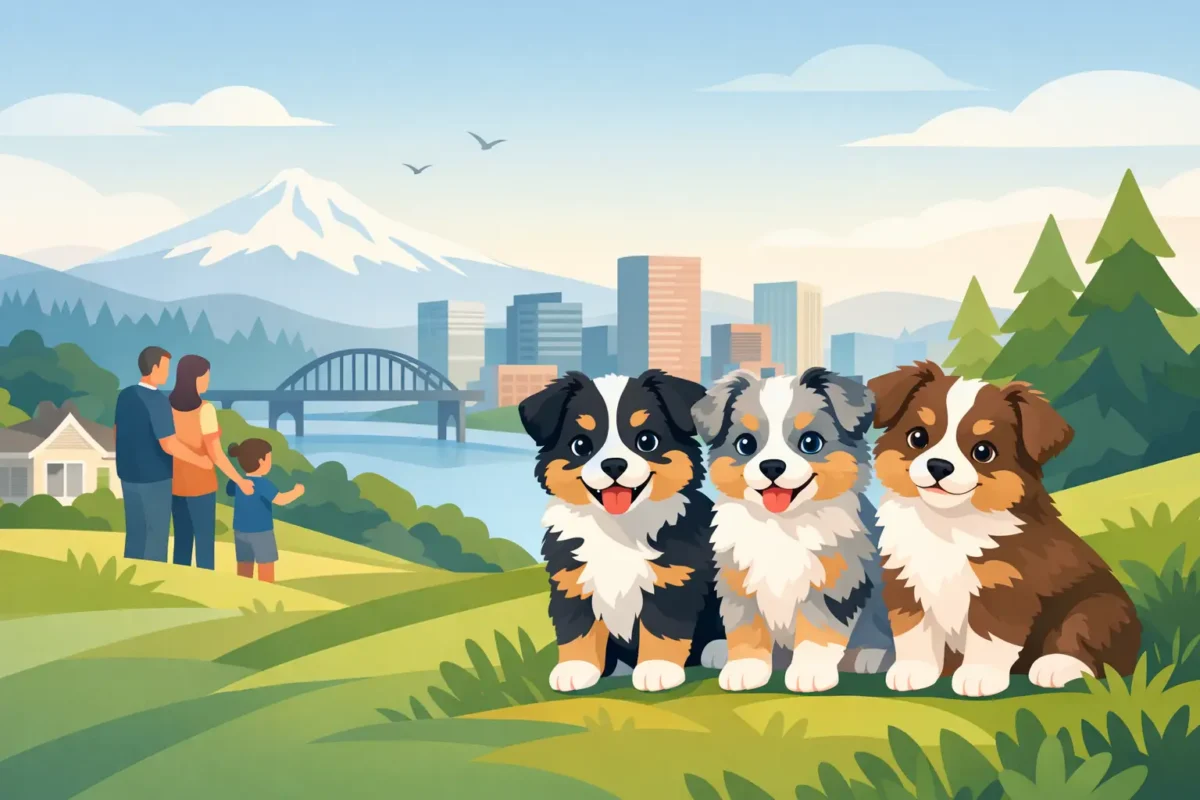
Toy Mini Aussies for Sale Portland Families Trust

Looking for toy mini aussies for sale Portland families can trust? Learn what health records, temperament, size, and breeder standards should prove first.

A small Australian Shepherd can be an excellent Portland companion, but only if “small” is more than a sales label. When families search for toy mini aussies for sale Portland, they are usually looking for an intelligent, striking dog that fits a home, apartment, schedule, and real family life. That requires more than picking the flashiest merle coat or bluest eyes in a photo.

Aussies are smart, loyal, athletic dogs. Reducing the size does not automatically reduce the need for thoughtful breeding, early handling, training, or daily engagement. The right puppy begins with a breeder who can explain what they produce, document how they produce it, and be candid about whether a particular puppy fits your household.

What Portland Buyers Should Expect From a Toy or Mini Aussie

The labels Toy, Miniature, and Teacup are often used loosely online. They should not be. Adult height, bone, build, parent size, and multi-generation family history all matter when estimating what a puppy may become. A breeder cannot honestly promise an exact adult measurement, but an experienced breeder should provide realistic size expectations based on established lines rather than guesswork.

At Hughes Toys, the program has been built over more than 30 years around smaller Australian Shepherd companions, including Toy, Miniature, “Teacup” -Small Toy dogs under 12 inches, and tail-request puppies. The goal is not simply to make an Aussie smaller. It is to maintain sound structure, good health practices, trainability, and a temperament that can live successfully with people.

That distinction matters in Portland. A city-sized dog still needs appropriate activity, but most households do not need a high-drive working prospect bred to push livestock all day. Families commonly want a dog that can enjoy walks, neighborhood outings, supervised play, training sessions, and time at home without constantly looking for a job to invent. A calmer, companion-oriented Aussie is often the better match.

Toy Mini Aussies for Sale in Portland: Look Past Photos

A pretty puppy gets attention. It does not tell you whether the puppy comes from tested parents, whether its line has been thoughtfully selected, or whether the breeder understands the difference between energy and instability.

Color and eye color can be part of your preference. Blue-eye tris, merles, reds, blacks, and unusual markings are appealing, and there is nothing wrong with having a favorite look. But color must never outrank health, structure, and temperament. A responsible breeder plans pairings with genetics in mind. Registration is another area where buyers need to be practical. Multi-generation ASDR registration provides useful documented lineage, but registration alone is not proof of a well-bred puppy. Papers do not replace genetic testing, veterinary care, careful selection, clean facilities, or honest answers about the parents and prior generations. Good breeding is the full process, not a certificate.

Temperament Must Match the Household

Australian Shepherds are observant dogs. They tend to notice movement, routine changes, visitors, children, and the mood in the room. That awareness can make them deeply connected companions, but it also means poor matching creates problems. A puppy suited for an active adult with time for training may not be the best choice for a household with toddlers, shift work, or limited daily availability.

A responsible placement process considers more than gender and coat. It considers the puppy’s confidence, social response, willingness to engage, play style, sensitivity, and general energy level. No breeder can predict every detail of an adult dog’s personality at eight weeks old, because training and home environment matter. Still, experienced hands can see meaningful differences within a litter and help buyers avoid choosing strictly by appearance.

Be honest about what you want. If you need a dog that can settle beside you while you work, say so. If you have children, cats, another dog, a fenced yard, or a busy travel schedule, disclose it. If you are a first-time Aussie owner, that is also useful information. The best match is not always the puppy you initially pointed to in a photo.

Health Standards Are Not Optional

A puppy should leave for its new home with more than a cute face and a casual promise that it is healthy. Ethical breeding starts well before a litter is born. It includes genetic testing, selection away from known inherited risks where possible, veterinary oversight, sanitary care, and a willingness to stand behind the puppies produced.

They should also understand that no living animal comes with a guarantee against every future issue. Honest breeders do not make impossible promises. What they can do is show that they have taken responsible steps: testing breeding dogs, maintaining biosecurity, providing veterinary checks, and selecting for overall quality rather than chasing the smallest possible puppy or the most marketable color.

Biosecurity deserves respect, even when it feels inconvenient. Puppies have developing immune systems. Limiting unnecessary visitors, requiring careful procedures, and avoiding casual traffic through puppy areas protect the litter from disease exposure. A breeder who restricts visits is not automatically hiding something. Often, that policy is a practical safeguard for puppies too young to be fully vaccinated.

Prepare for the First Year, Not Just Pickup Day

Toy and Mini Aussies can be easier to carry, travel with, and house than standard-sized Aussies. They are not decorative dogs. Plan for training from the beginning, including housebreaking, crate comfort, leash skills, recall, handling, and calm greetings. Early routines create a dog that is easier to live with for the next decade or more.

Portland’s wet months also make consistency worthwhile. Have an indoor potty-training plan, towels near the door, and a way to provide mental exercise when weather or work limits outdoor time. Short training sessions, food puzzles, basic obedience, scent games, and structured play can meet a smart dog’s needs without turning every day into an endurance event.

Do not confuse activity with chaos. An Aussie puppy needs engagement, sleep, boundaries, and a predictable routine. Too much uncontrolled stimulation can create an overtired, frantic puppy just as easily as too little activity can create boredom. The right balance depends on the individual dog, its age, and your home.

Local Pickup and Out-of-State Placement

Portland-area families may choose local pickup, while buyers throughout the Pacific Northwest and across the country may need coordinated transportation. Distance should not force a buyer into an unknown seller. A structured remote process can include clear communication, puppy updates, health records, purchase expectations, and organized pet-nanny delivery when appropriate.

Remote buyers should be especially careful about documentation and communication. Ask how the puppy will travel, what the delivery process includes, what records come home with the puppy, and who will be available if you have questions during the transition. Avoid sellers who pressure you to send money immediately, refuse to discuss their program, or cannot provide straightforward details about the puppy’s background.

The right breeder will not tell every buyer that every available puppy is perfect. They will tell you what they know, what they expect, and what responsibility remains with you. That is the kind of directness that protects both the puppy and the family bringing it home.

A well-bred Toy or Mini Aussie should be chosen with your everyday life in mind: your space, schedule, experience, children, other pets, training commitment, and tolerance for an intelligent dog that wants to be involved. Start with proof, ask practical questions, and choose the puppy whose temperament and expected size fit your home, not simply the one that photographs best.