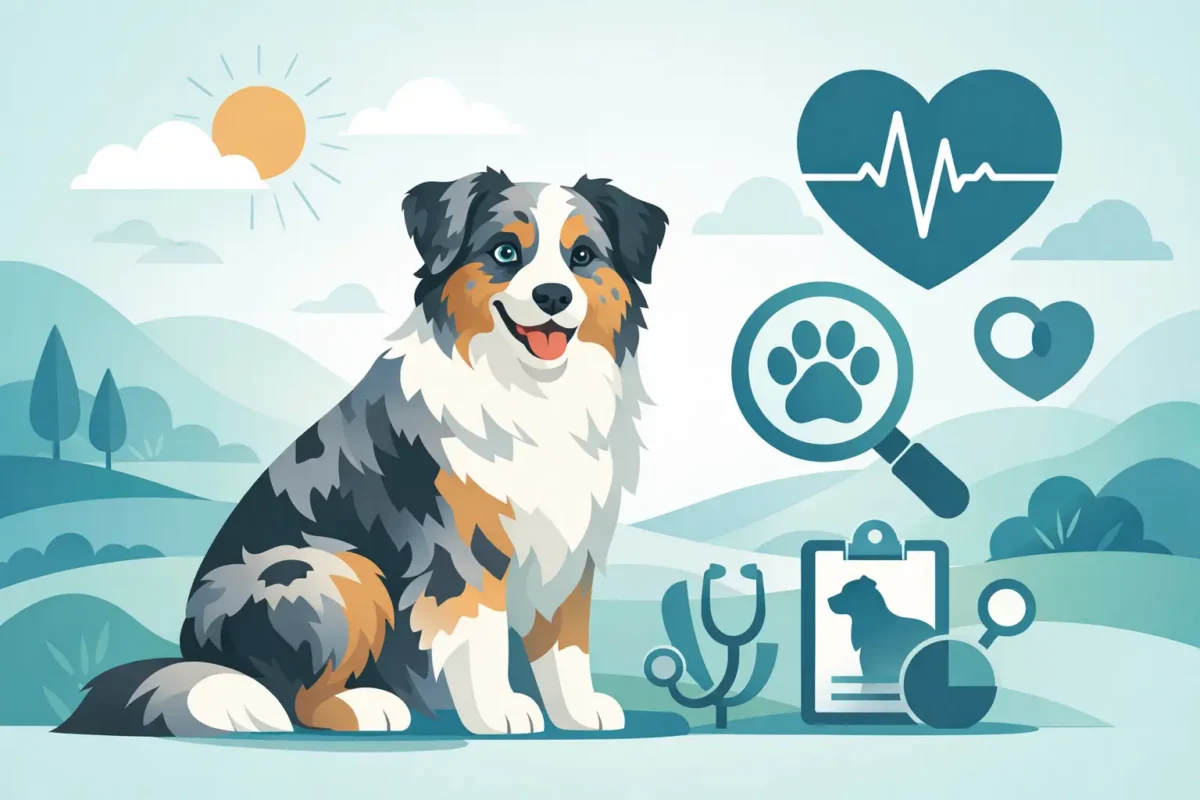
Australian Shepherd Natural Bobtail Genetics

Australian Shepherd natural bobtail genetics explained: how the NBT gene is inherited, why DNA testing matters, and what responsible breeders do to avoid.

What Creates a Natural Bobtail?

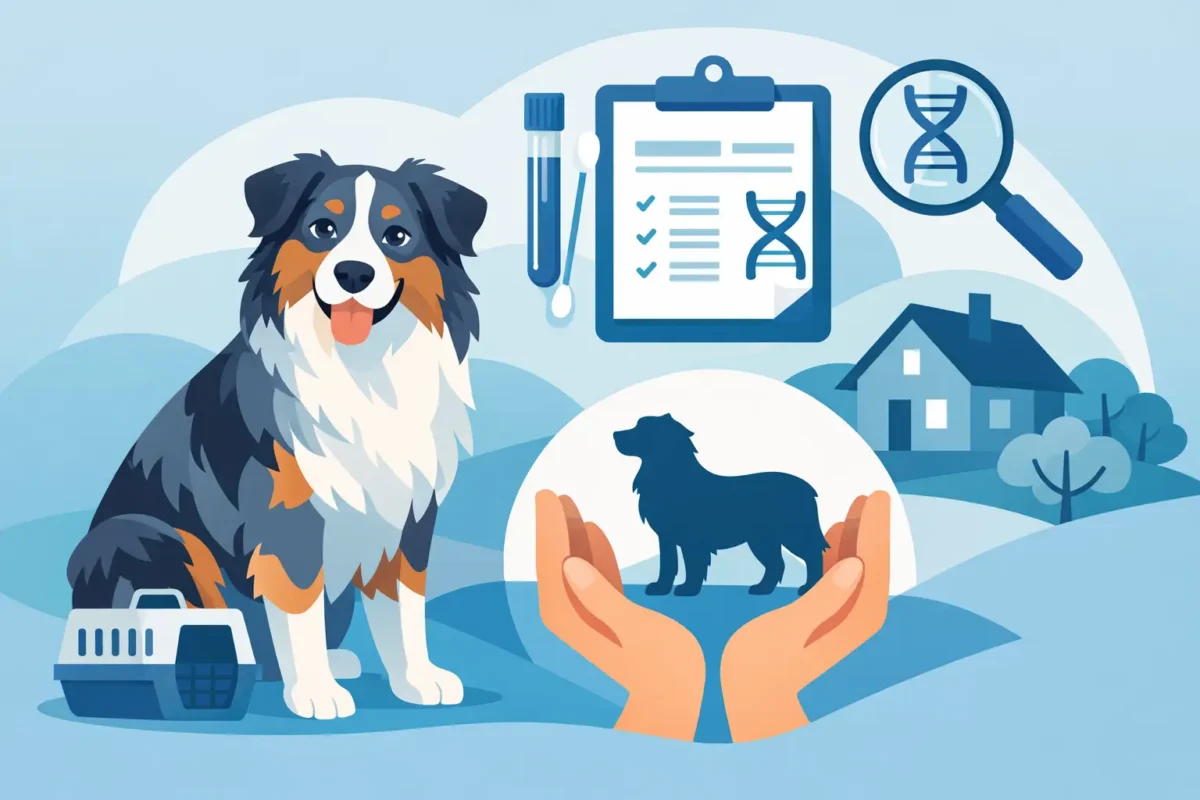
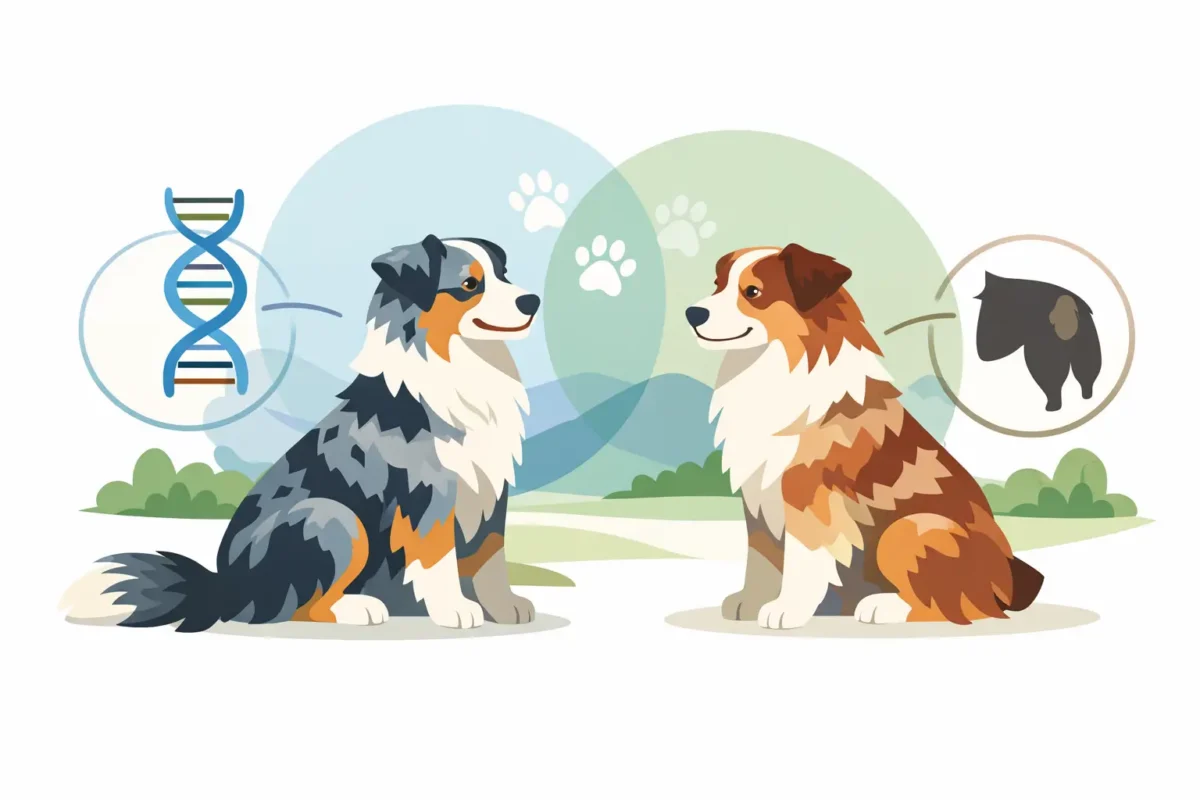
The natural bobtail trait in Australian Shepherds is associated with a mutation in the T gene, often called the NBT gene or natural bobtail gene. It is an autosomal dominant trait. That means a dog needs only one copy of the gene to potentially pass a naturally shortened tail to offspring. A dog with one copy of the natural bobtail gene is typically described as heterozygous. That dog may have a very short tail, a partial tail, or a tail that is shortened to a degree that varies from dog to dog. The gene does not guarantee that every natural bobtail will look identical. Tail length can range from nearly absent to a unnoticeable long tail. A long-tailed Australian Shepherd does not carry the NBT mutation. It has two copies of the normal long-tail version of the gene. This is why a dog should not be labeled a natural bobtail based on appearance alone, especially where tails may have been docked early in life.

Natural Bobtail Is Not the Same as Docked

A natural bobtail is a tail the puppy was born with. A docked tail was surgically shortened after birth. Those are entirely different things, even if the finished appearance is similar. Buyers deserve a straight answer. If a breeder advertises a bobtail puppy, ask whether the puppy is genetically natural bobtail, docked, or born with a full tail. A clear breeder will not blur those categories to make a listing sound more appealing. Photos can also be misleading. A close crop of a puppy’s rear end does not prove genetics. DNA results, parent records, and honest documentation do.

Australian Shepherd Natural Bobtail Genetics and Inheritance

The basic inheritance pattern is straightforward, but the breeding consequences are not. A naturally bobtailed parent with one copy of the NBT gene bred to a long-tailed parent can produce both naturally bobtailed and long-tailed puppies. In broad terms, each puppy has about a 50 percent chance of inheriting the NBT gene. That pairing is the responsible starting point because it avoids creating puppies with two copies of the NBT gene. In practical breeding notation, it is often described as NBT/long tail crossed with long tail/long tail. When two naturally bobtailed dogs are bred together, the math changes. At conception, the expected outcomes are roughly 25 percent puppies with no NBT gene, 50 percent with one copy, and 25 percent with two copies. The two-copy, or homozygous, NBT condition is associated with embryonic lethality. In plain language, those embryos generally do not survive early development. This is why responsible breeders do not treat bobtail-to-bobtail pairings as a shortcut to producing more short-tailed puppies. It may sound attractive to someone selling on appearance, but it creates a known and avoidable loss before puppies are ever born. Smaller litter sizes can be one result, though litter size is influenced by many other factors as well.

Why DNA Testing Matters More Than Guesswork

A naturally short tail is not enough information to make a breeding decision. The NBT gene should be confirmed with DNA testing. This is particularly important when a breeder works with dogs from different programs, has limited information on earlier generations, or is evaluating a dog whose tail appearance is not obvious. Genetic testing separates fact from assumption. It confirms whether a dog carries the natural bobtail mutation and allows the breeder to plan a pairing that does not risk homozygous NBT embryos. It also keeps records accurate for buyers who care about natural tails, registration details, and future breeding rights. At Hughes Toys, genetic testing is part of the larger standard, not a substitute for one. A DNA panel does not tell you whether a dog has the right temperament for a family, sound structure, good maternal instincts, or the ability to produce manageable companion puppies. It is one tool in a serious program that also includes veterinary care, multi-generation ASDR records, careful selection, biosecurity, and honest evaluation of each individual dog.

Registration Is Useful, but It Is Not a Health Plan

Registration documents help establish identity and pedigree. They do not automatically prove that a dog was DNA tested, examined by a veterinarian, raised in a clean environment, or selected thoughtfully for temperament. That distinction matters. Buyers should want both documented lineage and documented health practices. Pedigree alone is not a breeding program. A breeder’s choices – which dogs are paired, what is tested, how puppies are raised, and what information is disclosed – are what determine whether the paperwork has real value.

What Buyers Should Ask About a Bobtail Puppy

You do not need to become a canine geneticist to ask useful questions. Start by asking whether the puppy’s tail is naturally bobbed, docked, or long. Then ask whether the parents were DNA tested for the NBT gene and whether the breeder intentionally avoids natural bobtail-to-natural bobtail pairings. The answer should be direct. A responsible breeder should not act as if basic genetic questions are inconvenient or unnecessary. They should also explain that a natural bobtail does not make a puppy healthier, smarter, calmer, or better suited to your home than a long-tailed puppy. It is one physical trait among many. For most companion homes, temperament, size, energy level, early handling, and breeder support will matter far more than tail length. A Toy or Mini Australian Shepherd with a full tail can be every bit as affectionate, trainable, and striking as a naturally bobtailed puppy. Families should choose the dog that fits their lifestyle, not chase a feature because it looks fashionable in a photograph.

The Trade-Off Behind “All Natural Bobtails”

Be cautious with any marketing that promises a program built around producing only naturally bobtailed puppies. Genetics does not work that way without consequences. A breeder who insists on maximizing the short-tail trait may be narrowing breeding choices for the wrong reason or taking risks that should not be taken. Responsible selection always requires balance. A breeder may choose a long-tailed dog because that dog strengthens temperament, overall health, structural quality, size consistency, or a family-friendly lower-drive disposition. That is not a failure to produce a certain look. It is a breeder putting the whole dog ahead of a single visual trait. The same standard applies to coat color and eye color. Merle patterns, blue eyes, and naturally short tails can be beautiful, but none should override sound genetic planning or the needs of the home receiving the puppy. A well-bred Australian Shepherd should be evaluated as a complete dog, not assembled as a list of trendy features.

A Clear Standard for Responsible Bobtail Breeding

The responsible approach is uncomplicated: verify the natural bobtail gene through DNA testing, keep records straight, and avoid breeding two NBT carriers together. Pairing a tested natural bobtail with a tested long-tailed dog preserves the possibility of naturally bobtailed puppies without knowingly creating the homozygous NBT risk. That is the kind of planning buyers should expect from an established breeder. It takes more work than simply advertising a cute short tail, but it is the work that protects puppies and keeps breeding decisions accountable. When you ask about a puppy’s tail, listen for proof, not sales language. A breeder who can explain the genetics clearly is far more likely to be making careful choices in the areas you cannot see.

Are Merle Toy and Mini Australian Shepherds Healthy? Facts

Are merle Australian Shepherds healthy? Learn what merle color does and does not affect, why double merles carry risk, and responsible testing proves.
A striking blue eye and marbled coat can make people ask one fair question before they fall in love with a puppy: are merle Toy and mini Australian Shepherds healthy? A properly bred single-merle Aussie can be every bit as healthy, active, intelligent, and long-lived as a solid-color or tri-color Aussie. The concern is not the merle pattern itself. The concern is whether the breeder understands merle genetics well enough to avoid preventable risk. Color is never a substitute for health records, genetic testing, veterinary care, sound temperament, or a carefully planned pedigree. A beautiful puppy without those things is not a good prospect, no matter how unusual the markings are.

Are Toy and Mini Merle Australian Shepherds Healthy When Bred Correctly?

Yes. A dog with one copy of the merle gene, commonly called a single merle, is generally healthy when it comes from responsible breeding. Merle creates the mottled or patchwork pattern seen in blue merles and red merles. It may also be associated with blue, amber, split, or marbled eyes. A single-merle Toy and mini Australian Shepherd does not automatically have hearing, vision, immune, or temperament problems. Many healthy working, performance, and companion Aussies are merles. The coat pattern is simply one genetic trait among many. The real health issue appears when two merle-patterned dogs are bred together. This is called a merle-to-merle breeding. It can produce puppies with two copies of the merle gene, known as double merles. That pairing is avoidable, and experienced breeders do not treat it as an acceptable trade-off for producing more colorful puppies. At Hughes Toys, color is considered only after the basic work is done: selecting healthy parents, documenting lineage, evaluating temperament, testing appropriate genetics, maintaining biosecurity, and completing veterinary checks. Thirty-plus years in Australian Shepherd breeding teaches a simple lesson: breeding decisions have consequences long after a puppy photo gets attention.

Why Double Merles Carry Greater Risk

Each time two merle dogs are bred, the litter has, on average, a 25% chance of producing double-merle puppies. Double merles are often predominantly white, although appearance alone cannot confirm genetic status. They may be born with normal vision and hearing, but they have a substantially higher risk of congenital hearing and eye defects. Potential concerns can include deafness in one or both ears, unusually small or malformed eyes, limited vision, colobomas, and other developmental eye abnormalities. Some double-merle dogs live happy lives with proper support, but the fact that an affected dog can adapt does not justify deliberately creating that risk. This is why a responsible breeder does not breed merle to merle. It is not complicated genetics, and it is not a gray area. One merle parent and one non-merle parent is the responsible approach when producing merle puppies.

A white head is not the whole story

Buyers sometimes hear that too much white on the face or ears always means a puppy will be deaf. That is too simplistic. White markings can be a reason for a breeder to look more closely, but markings are not a diagnosis. The dog’s actual genetic inheritance and appropriate hearing and eye evaluation matter more than guesses based on a photograph. Likewise, blue eyes do not mean an Australian Shepherd has a vision problem. Blue eyes can be a normal and attractive part of the merle pattern. They should never be marketed as proof of special health, either.

Health Depends on More Than Coat Color

A merle puppy should be evaluated by the same standard as every other Toy and Mini Australian Shepherd puppy. The better question is not just, “Is this puppy merle?” It is, “What has been done to protect this puppy’s health before placement?” A responsible breeder should be able to speak plainly about the parents, the planned pairing, the puppy’s veterinary care, and the genetic conditions relevant to Australian Shepherds. If the answer is vague, if testing is described without documentation, or if every question is redirected to color and eye appeal, step back. Toy and mini Australian Shepherd breeding requires attention to inherited issues that have nothing to do with merle. Depending on the bloodline and the testing program, breeders may screen for conditions such as MDR1 drug sensitivity, hereditary eye conditions, degenerative myelopathy, and other breed-relevant genetic concerns. A genetic result needs context. It should guide breeding choices, not become a marketing buzzword used to avoid a real conversation about the parents. A quality program also looks beyond a DNA panel. Veterinary examinations, sound body structure, healthy growth, appetite, coat condition, parent longevity, reproductive health, and a stable disposition all matter. No breeder can honestly promise that a living animal will never face a health issue. What a breeder can do is reduce avoidable risk through disciplined selection and honest records.

What to Ask Before Reserving a Merle Puppy

Start with the direct question: “Was this puppy produced from one merle parent and one non-merle parent?” A knowledgeable breeder should answer immediately and clearly. If the answer is yes, ask how the parents’ color genetics were verified, particularly if either parent has minimal merle patterning or an unusual amount of white. Then ask about the health process. You should know whether the puppy has received a veterinary check, what genetic testing was used in planning the litter, and what health guarantee or written agreement is provided. Registration is useful for documenting breeding history, but registration alone does not prove health. Multi-generation knowledge of parentage is one piece of a larger record, not a replacement for responsible selection. For a puppy with any concern about hearing or vision, ask what assessment has been completed and what the breeder observed during early development. A puppy that is consistently startled by sounds, does not orient toward normal household noise, or seems visually uncertain deserves careful follow-up. In higher-risk situations, formal hearing testing and an evaluation by a veterinary ophthalmologist provide more meaningful answers than reassurance alone. You should also ask about temperament and adult size. Families seeking a Toy, Miniature, or small Toy Australian Shepherd often want a manageable companion, not a high-drive dog that needs a ranch to function. Size should be selected responsibly, not achieved by careless breeding. The puppy’s parents, extended family, structure, energy level, and daily behavior tell you more than a label does.

Do Merle Aussies Need Different Daily Care?

A healthy single-merle Australian Shepherd needs the same practical care as any Aussie: appropriate food, routine veterinary care, training, regular grooming, exercise, and real companionship. Merle does not make a dog delicate. It does not mean the dog needs to be kept out of normal daylight, and it does not create a special diet requirement. What does matter is choosing the right activity level for the household. Australian Shepherds are bright, people-oriented dogs that benefit from structure and engagement. A well-bred companion-oriented Toy or Mini Aussie can be more manageable than a high-drive working-line dog, but no Aussie is a decorative accessory. Plan for training, daily interaction, and age-appropriate exercise. If a dog has confirmed hearing or vision limitations, then management changes. Training may rely more heavily on hand signals, touch cues, consistency, and safe environmental routines. These dogs can be deeply connected companions, but families should understand the commitment before bringing one home.

Red Flags Behind the Merle Sales Pitch

Be cautious when a seller uses phrases such as “rare merle” to justify a price without discussing the parents, testing, or the breeding plan. Merle is desirable to many buyers, but desirable color does not make poor breeding acceptable. Other warning signs include a breeder who cannot explain whether the parents are merle or cryptic merle, offers no veterinary information, refuses reasonable health questions, or has no meaningful process for matching a puppy to a home. A puppy should not be selected solely because it has the bluest eyes in the litter. The same goes for promises that sound too absolute. Healthy breeding is built on risk reduction, documentation, veterinary oversight, and accountability. Anyone claiming that genetics can guarantee a perfect dog is selling confidence, not facts. A merle Toy and Mini Australian Shepherd can be a healthy, devoted, and exceptionally beautiful family companion. Choose the puppy whose breeder can prove the pairing was responsible, explain the health work without evasion, and care as much about the dog’s future home as its coat pattern. That is the standard worth waiting for.
THE TRUTH ABOUT MDR1 & genetic Testing Aussies

Learn why MDR1 testing for Aussies matters, what results mean, and how responsible breeding protects puppies from preventable medication risks at home.
ALL Aussies and herding breeds should be treated as if MDR1 affected . THE MDR1 gene is overhyped by the vets. The drug sensitivity mainly applies to two common drugs – Ivermectrin, (Bravecto and other oral flea treatments) and Acepromazine (pre-seditive)  the other drugs are not common, but there are alternatives – so be knowledgeable and tell the vet to use an alternative for safety/health sake. It does not mean a aussies or herding breeds d dog cannot live a full, active life.  It means the dog may be unusually sensitive to certain medications and can be at risk for dangerous neurologic toxicity when given an inappropriate drug or dose. The two main drugs are Ivermectrin (in Bravecto) and Acepromazine (preseditive) JUST tell the vet not to use either drug.. there are alternatives. For families choosing a Toy, Miniature, or small Toy Australian Shepherd let your vet know it is an Aussie and tell them to treat  it is if  ‘affected for the MDR1 gene” even if not .  It is now proven that even herding breed dogs tested clear of the MDR1  mutation have reactions to the drugs in question .  The vet will say there isn’t enough in a dose to harm them, but they lack or have less of an enzyme in their system that removes the drug from their system, so each dose builds up in the system until symptoms of siezures, behavioral changes and even death.

Why MDR1 Testing no longer Matters for Aussies

MDR1 is the common name used for a genetic variant affecting the multidrug resistance gene, also called ABCB1. This gene helps produce P-glycoprotein, a transporter that moves certain medications out of the brain and other tissues. When a dog carries the MDR1 variant, that protective transport system may not work normally.  IT is proven that this 1 gene that is tested for is likely  NOT the only gene that has this trait Australian Shepherds and related herding breeds are among the breeds known to have this trait.  So treat every Aussie as if they have it.  and it does not mean an affected dog cannot live a full, active life. It means the dog may be unusually sensitive to certain medications and can be at risk for dangerous neurologic toxicity when given an inappropriate drug or dose. The risk is not theoretical. Dogs with MDR1 sensitivity can experience symptoms such as weakness, disorientation, tremors, loss of coordination, seizures, coma, or worse after exposure to certain drugs. This is  why a responsible owner puts the caution the dog’s veterinary record for life.

Medication Sensitivity Is a Veterinary Issue

MDR1 does not mean an owner should panic over every medication. It means the veterinarian must make informed choices. Some drugs, including certain antiparasitic medications, anti-diarrheal drugs, sedatives, and chemotherapy agents, may need to be avoided, adjusted, or monitored closely in genetically sensitive dogs. Ivermectin is the drug most owners hear about first. The Vets say it requires h high doses, not the low, labeled doses found in many standard heartworm preventives. But the toxicity builds  up with EACH DOSE until TOXIC.

What Responsible Testing Looks Like

A breeder should test the dogs used in the breeding program, If all ancestors of a dog are clear/tested then it will not be in the line.. why different breeds have different variants. As an extra precaution at Hughes Toys , all Males are “full panel tested”.. to ensure/document that one parent does not carry the normally recessive gene – meaning offspring cannot be affected. . Parent results matter because they establish what a litter can inherit. , At Hughes Toys, our approach is built around the full picture: multi-generation breeding records, genetic screening, veterinary care, biosecurity, temperament selection, and honest matching. With more than 30 years focused on Australian Shepherds, we know a test panel is not a magic shield or will ensure that the offspring will be a good family pet.  It is one part of doing the work correctly before a puppy is placed in a family home.

Testing Does Not Replace Sound Breeding Judgment

MDR1 is important, but it should not become the only factor buyers use to judge a breeder. A program can advertise one clear genetic result and still overlook unstable temperament, poor structure, unmanaged size, weak puppy care, or incomplete health records. For companion-oriented Aussies, the broader goal is a puppy with responsible genetic planning and the right day-to-day fit. Families need to consider expected adult size, energy level, herding drive, confidence, social development, and the breeder’s willingness to discuss what the puppy is actually like. A small Aussie is still an Aussie. Intelligence and loyalty are wonderful traits, but they come with a need for training, boundaries, and regular engagement.

Questions to Ask Before You Commit

Before placing a deposit, a. You should also ask what other genetic screening has been completed and whether the breeder provides veterinary records and a clear health guarantee. There is no need to treat a carrier or affected dog as damaged. That is not the point of testing. The point is to prevent avoidable breeding outcomes and make sure owners have the information needed to protect their dog. choose a breeder who treats genetic information as a responsibility rather than a sales line.

Australian Shepherd Genetic Health Testing

Australian shepherd genetic health testing helps families ask better questions about DNA panels, eye exams, breeding choices, and what health records mean
A blue-eyed merle puppy can be striking. A tiny Toy Aussie can be easier to carry and fit into a city home. Neither color, eye color, size, nor a polished pedigree tells you whether the breeder made careful health decisions. That is where TOY and MINI australian shepherd genetic health testing matters. For a family buying a companion dog, testing should not be treated as a sales phrase. It should answer practical questions: What conditions can this puppy inherit? Were the parents tested before they were bred? If a parent carries a recessive gene, was that dog paired correctly? Are DNA results supported by veterinary care, eye screening, and honest discussion about the limits of testing? After more than 30 years focused on smaller Australian Shepherds, we can say this plainly: a breeder who cannot explain the health status of their breeding dogs is asking buyers to accept unnecessary uncertainty.

What Toy and MINI Australian Shepherd Genetic Health Testing Actually Does

DNA testing looks for specific genetic variants associated with inherited disease or traits. A result commonly identifies a dog as clear, a carrier, or affected for a particular condition. Those words matter, but they must be interpreted correctly. A clear dog does not have the tested variant. A carrier usually has one copy of a recessive variant and may never show symptoms, but can pass that variant to puppies. An affected dog has the genetic combination associated with that condition or trait. Whether an affected dog should be bred depends on the condition, the inheritance pattern, veterinary guidance, and responsible breeding standards. The useful part is not simply collecting a long list of results. The useful part is using those results before a breeding takes place. A responsible breeder can often breed a carrier to a clear mate without producing affected puppies for a recessive condition. Removing every carrier from a breeding program without thought can shrink genetic diversity and create other problems. Good breeding requires judgment, records, and a plan, not panic. Testing also has limits. A DNA panel cannot certify that a dog will never become ill, never develop an injury, or never pass along a condition that has not yet been identified by a commercial test. It is one part of responsible selection, alongside pedigree review, veterinary evaluations, physical soundness, temperament, nutrition, biosecurity, and continued observation of the bloodline.

Conditions Commonly Considered in Toy and Mini Australian Shepherd Testing

The exact panel should fit the breed and be reviewed as testing science develops. Toy and MINI Australian Shepherd breeders commonly consider conditions including MDR1 drug sensitivity, hereditary cataracts, collie eye anomaly, progressive retinal atrophy, and degenerative myelopathy. Not every condition has the same frequency, severity, or inheritance pattern. That is why buyers should avoid treating a simple checklist as the whole story.

MDR1 Drug Sensitivity

MDR1 is one of the most practical tests for Australian Shepherd families. Dogs with certain MDR1 variants can be sensitive to medications that are ordinarily used safely in many other dogs. The concern is not abstract. Some medications can cause serious neurological reactions in genetically susceptible dogs if used at inappropriate doses. A result gives your veterinarian useful information throughout the dog’s life. Buyers should keep the result with their puppy’s medical records and make sure every veterinary provider knows it. A responsible breeder does not use MDR1 status as a scare tactic. They test, document, explain the result, and make sure the family understands why it belongs in the dog’s health file. Based on current information , ALL herding breed dogs should be treated as MDR1 “affected”.  The drugs in question, primarily Ivermectrin (flea-bravecto) and Acepromazine (preseditive) dogs without the “MDR1” gene still have had reactions. The dogs lack or have reduced enzyme that removes the drug from the dogs system.  SO though the companies/vet say that the dose is too small to hurt the dog, each dose builds up in the system, until it is toxic.  Behavior changes, -the drugs mainly affect the brain, cancer, seizures.  The oral flea treatments are banned in Europe.  For “convenience”  the owner is poisoning their dog.

Eye-Related Conditions

Toy and MINI Australian Shepherds may be screened genetically for inherited eye conditions such as hereditary cataracts, collie eye anomaly, and certain forms of progressive retinal atrophy. These tests can help breeders avoid combinations that may produce affected puppies. DNA results are not a substitute for professional eye examinations. Eyes are complex, and not every eye concern is covered by a genetic test. Breeding dogs should receive appropriate veterinary oversight, and breeders should pay attention to the actual health history of the line rather than relying on one lab report.

Degenerative Myelopathy and Other Panel Results

Degenerative myelopathy is another condition frequently included on canine genetic panels. The presence of a variant does not always predict a simple, guaranteed outcome in every dog. Risk genes, age of onset, and the role of other factors can be more complicated than an online chart makes them appear. That is the reason experienced breeders look beyond a single result. They consider how a condition is inherited, whether the dog is clinically healthy, the status of the mate, and the history behind both sides of the pedigree. A genetic result needs context before it becomes a breeding decision.

Merle Testing Is About More Than Color

Merle is a beautiful Australian Shepherd pattern, but it is not merely a color preference. Merle genetics deserve careful handling because breeding two merle-patterned dogs can produce double merle puppies. Double merles have a significantly increased risk of hearing and vision problems. A knowledgeable breeder understands the visible coat pattern, the dog’s underlying merle genetics, and the risks of the pairing. This is especially relevant in smaller Toy and Miniature Australian Shepherds, where buyers may see unusual colors advertised aggressively without any explanation of the breeding behind them. Do not accept vague assurances such as “our merles are healthy” as proof of responsible practices. Ask how the breeder plans merle pairings and whether they can clearly explain the parents’ genetics. Color should never be allowed to outrank a puppy’s long-term welfare.

What Buyers Should Ask a Breeder

Health testing records should lead to a straightforward conversation, not a defensive one. Ask which conditions the parents were tested for, whether either parent is a carrier, and how the pairing was selected to avoid producing affected puppies. Ask whether the breeder performs veterinary checks and whether the puppy comes with a written health guarantee. You should also ask about the broader breeding program. How long has the breeder worked with Toy and Mini Australian Shepherds?  Does the breeder know the adult size, temperament, and health history behind multiple generations, or are they simply reselling puppies from parents with limited/unknown sources? A breeder should be able to explain results in plain language. They should not claim that testing makes a puppy perfect, and they should not hide behind technical language to avoid a direct answer. Honest answers sometimes include uncertainty. That is far better than a false guarantee. “Clear by Parentage”.  Genetic testing started many years ago, with MDR1 first, breeders tested their dogs, then PRA, breeders tested thier dogs, and then other genetic issues as commercial tests became available.  A dog tested clear of a genetic issue bred to another tested clear dog = all offspring are “clear” of that issue without testing.  This can carry forward many generations. If the breeder has bred many generations of these clear offspring.. proving tested clear going back to the original ancestors can be difficult. At Hughes Toys males are tested for full genetic panel to document “clear’ for one parent which for recessive traits – the puppies cannot be “affected”.

Testing Does Not Replace Temperament and Physical Evaluation

Families often focus hard on genetic reports and then overlook the dog in front of them. Toy a mini Australian Shepherds are intelligent, observant, and active dogs. Even a smaller companion-oriented Toy Aussie needs training, structure, socialization, and a home prepared to meet its needs. A puppy can come from genetically tested parents and still be a poor fit if the breeder does not select for stable temperament and appropriate energy. For many households, especially first-time Aussie owners, a calmer puppy with lower herding drive is a more meaningful match than the flashiest coat or the smallest expected adult size. At Hughes Toys, genetic screening is part of a larger system that includes multi-generation breeding knowledge, veterinary checks, biosecurity, registration, and deliberate selection for companion temperament. Those pieces work together. A DNA result alone is not a breeding program.

How to Read a Health Claim Without Being Misled

Be cautious when a seller says puppies are “health tested” but does not specify whether that means the puppy, the parents, or neither. A puppy may receive a veterinary exam, while genetic health testing is commonly performed on the breeding parents to guide mating decisions. Both are valuable, but they are not the same service. well-bred toy and MIni Australian Shepherd puppy should come from a program that treats health information as a responsibility carried forward

Toy and MINI Australian Shepherd Biosecurity for Healthy Puppies

Australian shepherd biosecurity protects puppies before they go home. See how responsible breeders prevent illness, stress, and costly setbacks early.
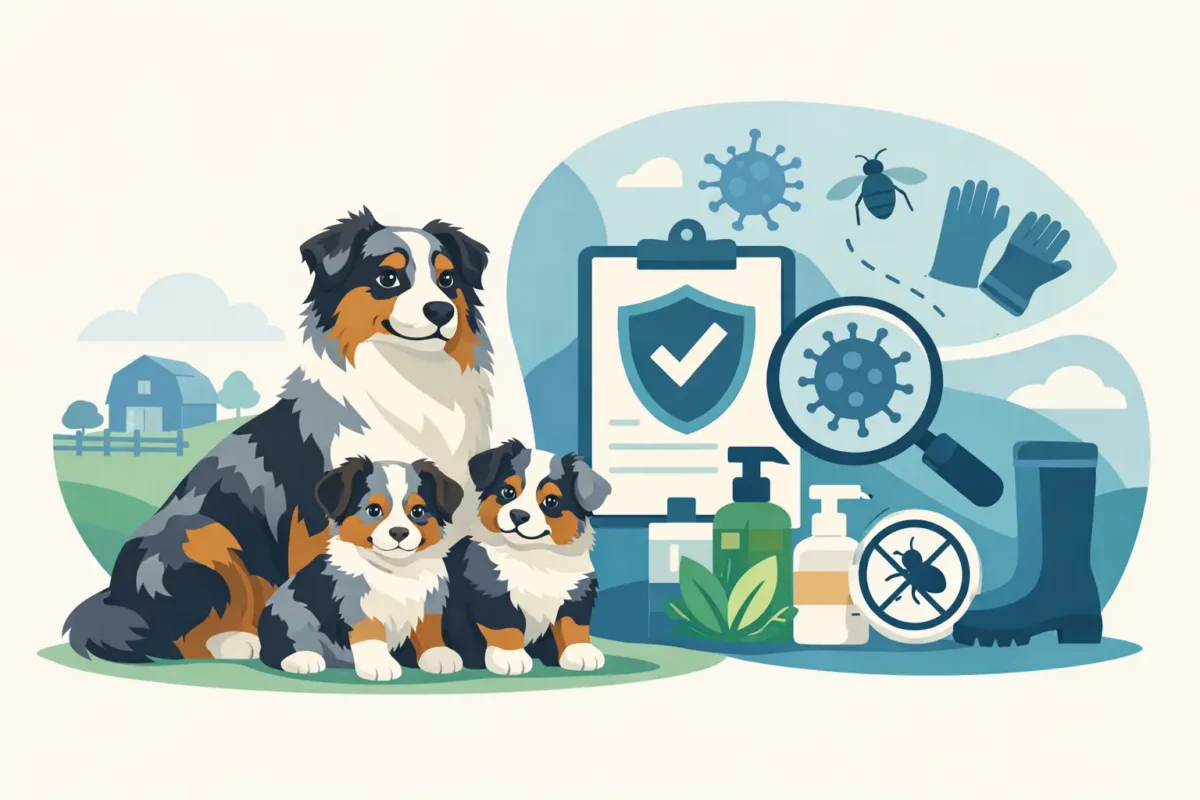
A clean-looking puppy room is not proof of safety. Toy and MINI Australian shepherd biosecurity is the set of daily controls that keeps disease from reaching vulnerable puppies before their immune systems are ready to handle it. It affects whether a litter starts life healthy, how safely puppies can be raised and socialized, and whether buyers bring home a puppy with avoidable exposure risks. At Hughes Toys, biosecurity is not a marketing word and it is not a bottle of disinfectant sitting by the door. After more than 30 years breeding Toy, Miniature, and small Toy Australian Shepherds, we know that prevention comes from disciplined routines, documented health practices, and the willingness to say no when a visitor, delivery, or convenience creates unnecessary risk.

What Toy and MINI Australian Shepherd Biosecurity Actually Means

Biosecurity means limiting the ways viruses, bacteria, parasites, and fungal organisms can enter or move through a breeding program. Puppies are especially vulnerable because they are young, still building immunity, and often not fully vaccinated when they are at the highest risk of exposure. The most obvious threats include parvovirus, canine influenza, kennel cough, intestinal parasites, giardia, and contagious skin conditions. Some can be carried in on shoes, hands, clothing, crates, food containers, or a person who recently handled dogs elsewhere. A dog does not need to look sick to carry something into a puppy area. Good biosecurity also protects adult dogs, pregnant females, and new mothers. Stress during pregnancy and nursing is not harmless. A breeding female needs stable routines, clean space, quality nutrition, veterinary oversight, and protection from unnecessary traffic. Puppies benefit from that work long before a buyer sees their first photo.

Why Open-Door Puppy Visits Are Not Responsible

Many buyers understandably want to visit puppies as early and as often as possible. We understand the desire. But public access to young litters is one of the ways a breeder can introduce preventable disease into a nursery. A person may have stopped at a dog park, groomer, shelter, veterinary office, pet store, boarding facility, or another breeder’s home that same day. They may have a healthy dog at home that recently encountered an illness. Even a careful dog owner cannot see every exposure on a shoe sole or know every organism carried on a jacket sleeve. That is why responsible breeders restrict access to newborn and young puppy areas. This is not secrecy. It is protection. There is a difference between a breeder who cannot document their program and a breeder who will not allow a revolving door of visitors around unvaccinated puppies. The trade-off is real. Buyers may have fewer early in-person visits, and that can feel less personal than walking into a pet store or casual backyard litter. The safer approach is structured communication: current photos, videos, detailed updates, clear records, and scheduled puppy pickup or planned meetings when the risk level is appropriate.

The Core Practices That Reduce Risk

Biosecurity works only when it is routine. One deep cleaning before visitors arrive does not replace daily control of movement, sanitation, and animal health.

Controlled Entry and Separate Puppy Areas

Puppies should not share unrestricted space with every dog on the property, visiting dogs, or outside traffic. A separate whelping and nursery area makes it easier to control cleaning, temperature, bedding, feeding equipment, and who enters. Anyone who must enter should follow a clear process. That may include clean clothing, sanitized hands, disinfected footwear or dedicated shoes, and no recent contact with high-risk dog environments. The standard should apply to family members, staff, contractors, and breeders alike. Biosecurity breaks down when rules are treated as optional for familiar people.

Cleaning That Is Effective, Not Just Visible

A room can smell pleasant and still carry pathogens. Effective sanitation begins with removing organic material, then using the correct disinfectant at the proper concentration and contact time. Bedding, bowls, floors, crates, toys, and feeding tools need regular attention. Over-cleaning with harsh products can also create problems if it leaves irritating residue or disrupts a calm nursery environment. The goal is not to make puppies live in a chemical smell. The goal is a clean, dry, properly maintained space with sensible disinfection protocols.

Quarantine and Health Observation

New dogs, returning dogs, and any dog showing signs of illness need separation until it is safe to rejoin the program. Coughing, diarrhea, vomiting, lethargy, appetite changes, and skin concerns deserve prompt attention. A breeder who ignores small symptoms because a dog is still eating or acting mostly normal takes a gamble with the whole group. Veterinary checks, parasite control, age-appropriate vaccinations, and honest health records are part of this process. Genetic testing matters for breeding decisions, but it does not replace infection prevention. A genetically tested puppy can still be exposed to parvo or giardia if basic biosecurity is poor.

Safe Socialization Without Careless Exposure

Some people assume biosecurity means raising puppies in isolation. It should not. Toy and Mini Australian Shepherd puppies need gentle handling, household sounds, age-appropriate surfaces, positive human interaction, grooming exposure, and thoughtful early learning. The issue is not socialization. The issue is uncontrolled exposure. A well-managed program introduces safe experiences inside a controlled environment. Puppies can meet healthy, familiar people who follow hygiene protocols. They can experience normal household activity without being passed through crowded public spaces before their vaccine schedule and veterinarian guidance support it. For Toy and Mini Australian Shepherds, this balanced approach matters even more because these are companion dogs placed into homes. They should be confident enough for family life, grooming, car rides, visitors, and everyday noise, without being pushed into risky environments simply to create content or entertain a stream of guests.

What Buyers Should Ask a Breeder

Biosecurity is easy to claim and harder to demonstrate. Buyers should listen for specific answers, not vague reassurance that a breeder “loves their dogs” or keeps everything clean. Ask how puppy access is managed, whether visitors are restricted around young litters, and what sanitation steps are used between dog areas. Ask how new or returning dogs are handled, what veterinary checks puppies receive, and when puppies are vaccinated and dewormed. A qualified breeder should explain their process without becoming defensive. Also ask how the breeder handles pickup day and transportation. Clean crates, limited contact with unknown dogs, responsible pet-nanny coordination when needed, and clear transition instructions all reduce stress and exposure during a puppy’s move to a new home. Be cautious if a seller offers unrestricted visits to every litter, allows buyers to bring their own dogs to meet puppies, meets in random parking lots without records, or pressures you to take a puppy earlier than appropriate. Convenience is not a health protocol.

Biosecurity Continues After Pickup

The breeder’s work does not remove the new owner’s responsibility. The first weeks at home are a poor time for dog parks, pet-store floors, crowded puppy events, shared water bowls, or introductions to unknown dogs. Your veterinarian can advise you on local disease risk and the right vaccination schedule for your puppy. Start with controlled experiences. Invite healthy, known people into your home. Carry your puppy in higher-risk public settings if you need to bring them along. Keep your yard clean, supervise outdoor time, and do not assume a private-looking area is safe if unfamiliar dogs have access to it. A careful start is not being overprotective. It gives a young Toy or Mini  Australian Shepherd the time to build immunity while still learning that people, sounds, handling, and home life are normal. That is the kind of protection a good puppy deserves before it ever becomes your best companion.