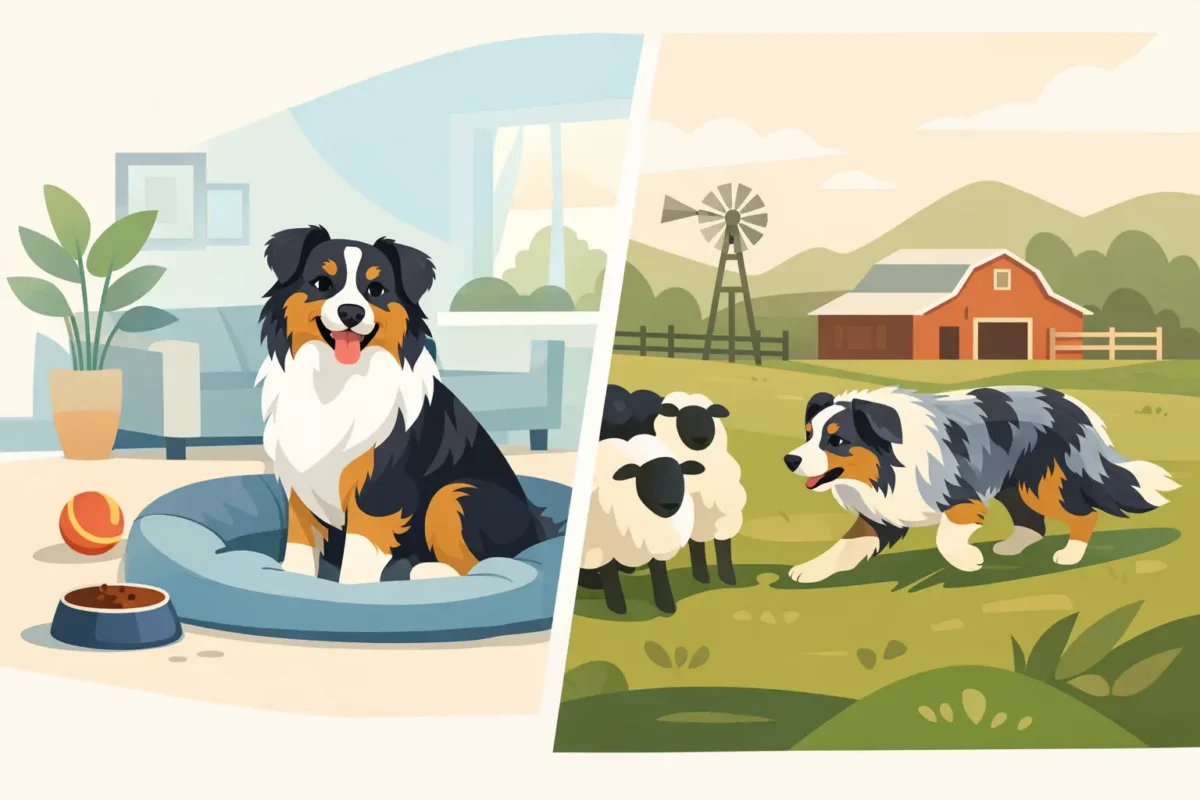
Companion Aussie versus working Aussie: see how drive, size, training, and breeding priorities affect the right fit for a family home and routine each day.
A companion Toy Mini Aussie versus working, versus SHOW Aussie is not a contest over which dog is better. It is a practical question of what that dog was bred, selected, raised, and placed to do. Families often love the Toy MINI Australian Shepherd look, intelligence, loyalty, and trainability, then discover too late that a high-drive stock-working or Alpha “I am number 1” Show dog can be a poor fit for a suburban schedule, small yard, or first-time owner.
Toy and Mini Australian Shepherds are not naturally low-maintenance dogs. Even a carefully bred companion-oriented Toy or Mini Aussie needs training, engagement, exercise, and structure. The difference is that a responsible companion Hughes Toys breeding program deliberately selected generations for dogs that can settle in a home and direct their intelligence toward family life rather than demanding livestock work or Show. At Hughes Toys Aussies we selected dogs that didn’t bite over putting priority on “perfect bite” ie teeth. We selected dogs that had companion, service, therapy dog traits over perfect head, or ear set. Though many of our dogs in Show homes have received Champion status, Hughes Toys feels dogs have a greater purpose of being human companions, saving lives from alerting to medical issues, than winning in the show ring to puff the owners self importance.
What “Working Aussie” Usually Means
A working Aussie is typically bred with stock work as a major priority. The breeder may place heavy value on natural instinct, intensity, endurance, responsiveness to pressure, confidence around livestock, and the ability to work for long periods in changing conditions. These are useful traits on a ranch, farm, or serious stock operation. They can be difficult traits in the wrong household.
A dog with strong working drive may notice every movement in the home. Children running, bicycles passing, guests arriving, cats moving through a room, and cars outside the window can all become events that require the dog’s attention. That does not make the dog bad or aggressive. It means the dog has been bred to observe, control movement, and stay ready for a job.
Many working-line Aussies are also physically larger and more athletic than the smaller companion dogs families seek. Size alone does not determine drive, but it changes the practical reality. A 45-pound, highly driven adult that needs a daily job is a different commitment from a 12- to 20-pound companion-oriented dog with manageable energy and a reliable off-switch.
A working Aussie can be an outstanding dog for the right owner. That owner generally has livestock, a demanding dog sport plan, substantial training experience, or a lifestyle built around providing meaningful work every day. A weekend hike is not the same thing as a job. Neither is tossing a ball in the backyard for 15 minutes.
What “SHOW Aussie” Usually Means
A SHOW Toy Mini Aussie is typically bred with primary concern over perfect “head structure”, ear set, color markings , and Alpha “look at me ” temperment as a major priority. The breeder may place heavy value on Color , markings, head shape, ear set, and ” I am number 1″ attitude. These are useful traits in the show ring. Alpha, ” I am number 1″ in the household can be difficult traits in the wrong household.
The fact that a dog is a Champion, can be that the breeder/owner lives in the an area where there are enough breeders to have a Show almost every weekend within driving distance.. The more shows the dog enters, the more points they get, as long as they meet breed “Standards”.. These “standards” can be changed at the whim of the breeders that govern the show “standards” so their dogs win. Judges place dogs for extreme features that then the breeders “breed for”.. Ie the super pug faces of bull dogs that they cannot safely breathe anymore. Judges from a show will place a dog bred/shown by a breeder that will be a judge to them in a future show. The “best” animal does not always win top place. Showing animals is highly political of “whos-who”.
What makes a Companion Aussie Different?
A companion Toy Mini Aussie should still look and think like an Aussie. Families choose the breed because they want a bright, affectionate dog that stays connected to its people. The goal is not to remove intelligence or turn an Toy Mini Australian Shepherd into a passive lap dog. The goal is to produce a dog that can live successfully as a companion in a household.
That starts with breeding selection over generations. Temperament is not determined by a puppy photo, a color pattern, or a registration paper. A breeder must know multiple generations of the dogs behind the puppy: how they respond to novelty, whether they recover quickly from stress, how they handle people, whether they are sound in body and mind, and whether they can settle after activity.
Companion-focused programs generally select away from excessive intensity, extreme reactivity, and
nonstop herding behavior. They prioritize family compatibility, manageable size, stable nerves, trainability, and an affectionate nature. Proper early handling and socialization matter too, but they do not replace genetics. Training improves a dog’s behavior. It cannot reliably erase a deeply inherited working temperament.
At Hughes Toys, our breeding decisions are based on more than 30 years of breed-specific experience, personal knowledge of multi-generations, foundation to NSDR pedigrees, genetic testing, veterinary care, and firsthand knowledge of multiple generations of our own dogs. We built the Hughes Toys bloodline for smaller, companion-oriented Toy Mini Australian Shepherds because many families want the breed’s best qualities without bringing home a full-time ranch dog- or an “ALPHA” number 1 attitude.
Companion Aussie Versus Working Aussie: Daily Life
The clearest difference appears after the puppy stage, when the dog is mature enough for inherited traits to show more strongly. Both types need consistent rules. Both need exercise. Both need mental engagement. Their threshold for daily activity and the kind of activity they require can be very different.
A well-bred companion Aussie may be happy with walks, play, basic obedience, puzzle toys, family outings, and regular time with its people. It may enjoy agility, rally, tricks, or hiking without requiring those activities to stay emotionally balanced. The dog should be able to participate in family life, then rest when the activity is over.
A true working Aussie may need far more than general exercise. Without structured outlets, it can create its own work by herding children, barking at movement, patrolling the fence, obsessing over toys, chasing pets, or becoming difficult to settle. Owners sometimes describe this as “too much energy,” but energy is only part of the issue. The dog may have a powerful need to control its environment.
A “Show” Aussie may have an ALpha, “I am number 1” attitude. Which can become aggressive, assertive, need far more attention than general household. Without structured outlets, it can create its own work by, obsessing over toys, chasing pets, or becoming difficult to settle. Owners sometimes describe this as “too much energy,” but energy is only part of the issue. The dog may have a powerful need to control its environment.
This is where honesty matters. No breeder can promise that every puppy will have identical energy or personality. Individual puppies vary, even within a carefully planned litter. But breeders who know their dogs can identify the more assertive, active, observant, or easygoing puppies and match them appropriately. A quiet retired couple, a family with toddlers, and a competitive dog-sport home should not automatically receive the same type of puppy.
Size Is Not Just a Convenience Detail
Toy, Teacup Small Toy, and Miniature Australian Shepherds can be especially appealing to urban and suburban households because their
adult size is more manageable. A smaller dog is easier to travel with, easier to lift when necessary, and often better suited to apartment or city-sized living. It can also be easier for children and older owners to handle safely.
But buyers should not confuse small with effortless. A small Aussie is still an Aussie. It needs boundaries, positive training, grooming, proper nutrition, routine veterinary care, and daily interaction. A small dog with poor breeding or poor training can still become noisy, anxious, pushy, or difficult to manage.
Responsible breeders also avoid making size claims that are not supported by their breeding history. Adult size is influenced by the parents and generations behind them. A breeder should be able to discuss expected size honestly, including the fact that nature does not produce exact measurements on demand. The same standard applies to coat color, eye color, and tail requests. Those features may matter to a buyer, but temperament and health must come first.
Health Testing and Temperament Belong Together
Buyers sometimes focus on appearance first: blue eyes, a flashy merle coat, a short tail, or the smallest puppy in the litter. Those preferences are understandable, but they should never be the entire buying decision. A pretty puppy is not proof of sound breeding.
A responsible program uses appropriate
genetic testing, veterinary checks, disease-prevention protocols, clean facilities, and careful biosecurity. It also studies the breeding dogs themselves. Are they healthy? Are they structurally sound? Are they stable around people? Do they have a temperament that belongs in the next generation? A health guarantee has real value only when it is backed by a breeder who did the work before the litter was born.
Color breeding without restraint can lead to poor decisions. The same is true of breeding only for tiny size or a fashionable look. The right breeder protects the dogs first and tells buyers the truth when a requested feature is not the best reason to choose a particular puppy.
Which Type Fits Your Household?
Start with an honest look at your routine. If you want a dog to join family walks, weekend trips, training sessions, and everyday home life, a companion-oriented Aussie is usually the sensible choice. If you have livestock or want a dog that thrives on serious, structured work, a working-bred Aussie may be appropriate. If you want the “my dog was from champions” pat yourself on the back status, then a show bred Aussie may be needed for your status.
Be equally honest about your tolerance for intensity. Some experienced owners enjoy a dog that notices everything and wants constant direction. Other owners want an alert, trainable companion that can play hard, learn quickly, and then relax beside the family. Neither preference is wrong. The mistake is choosing based on a puppy’s markings or a social media video instead of the dog’s inherited purpose.
Ask direct questions before placing a deposit. What are the parents like inside the home? How do they behave around strangers, children, and other dogs? What size are the adult dogs? What testing has been completed? How does the breeder match puppies to buyers? If the answers are vague, polished marketing will not make up for missing information.
The right Aussie should fit your real life, not the life you imagine having for two weeks after bringing a puppy home. Choose the breeder and the puppy that match your household’s daily capacity, and you are far more likely to have the steady, devoted companion you wanted in the first place.