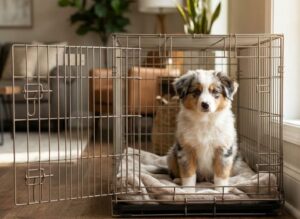
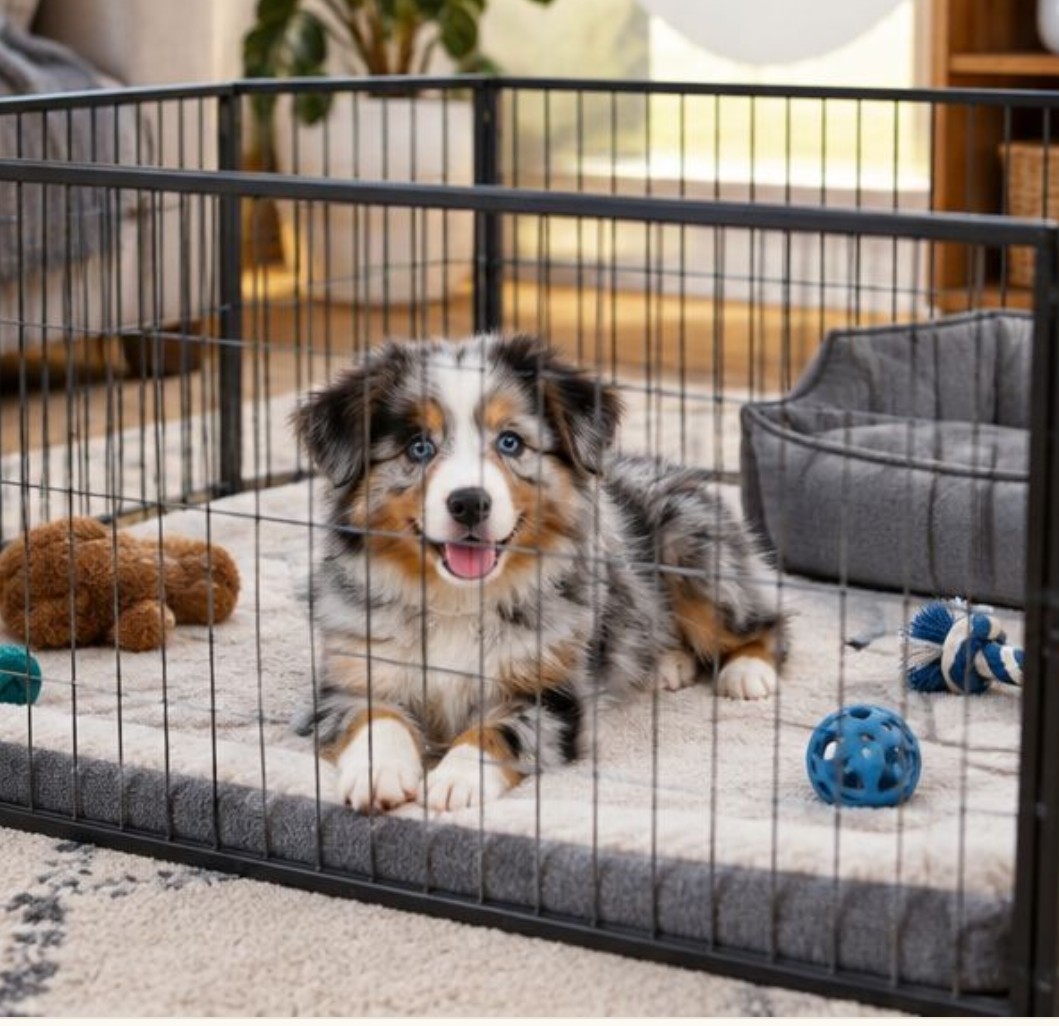
Best playpens for toy Australian shepherd puppies—Wire 2026

Best overall: a sturdy wire-panel pen. Best for washable indoor setups: a rigid plastic-panel pen. Best for travel: a fabric pen used under supervision. This 2026 guide compares the best playpens for toy Australian shepherd puppies by construction and use, so you can choose a safe setup rather than shop by appearance.
TL;DR
  • The best playpens for toy Australian shepherd puppies have safe gaps, stable panels, and secure closures.
  • For Toyminiaussies puppy families, a sturdy wire-panel playpen is the best default for indoor use.
  • Rigid plastic panels suit washable indoor setups; fabric pens suit supervised travel, not determined chewers.
  • Covered pens need secure roof connections; outdoor pens need suitable ground anchoring and constant supervision.

Why this matters

A puppy playpen gives your dog a defined space while you manage meals, household chores, and rest. It does not replace toilet trips, exercise, training, or time with you. The right pen supports those routines; the wrong one adds climbing, chewing, and escape problems. Families preparing for a puppy from Hughes Toys –Toyminiaussies need equipment that fits the individual puppy, not just the breed label. Small size does not tell you whether a puppy will chew mesh, push a panel, or climb wire. Watch what your puppy actually does. For a 2026 purchase, compare the exact pen’s instructions and construction before deciding. “For small dogs” is not enough information. Panel gaps, gate hardware, floor protection, and permitted configurations matter more than a puppy pictured on the packaging.

What makes the best puppy playpen?

Use these criteria to judge every option in this 2026 guide:
  • Safe gaps: Openings must not let your puppy squeeze through or become trapped. Check the gate and corner connections as well as the panels.
  • Secure closure: The latch must stay closed when the puppy noses, paws, or leans against the gate. Check it after every entry.
  • Stable panels: The pen should remain stable in the configuration allowed by its manufacturer. A lightweight setup that slides across your floor needs attention before use.
  • Cleanable floor: Choose a surface you can clean after accidents. Protect flooring without leaving accessible edges that the puppy can chew.
  • Rest space: Allow room for a comfortable resting area and water without crowding the enclosure with furniture and toys.
  • Practical access: You need to reach the puppy, remove soiled bedding, and open the gate without creating an easy escape route.
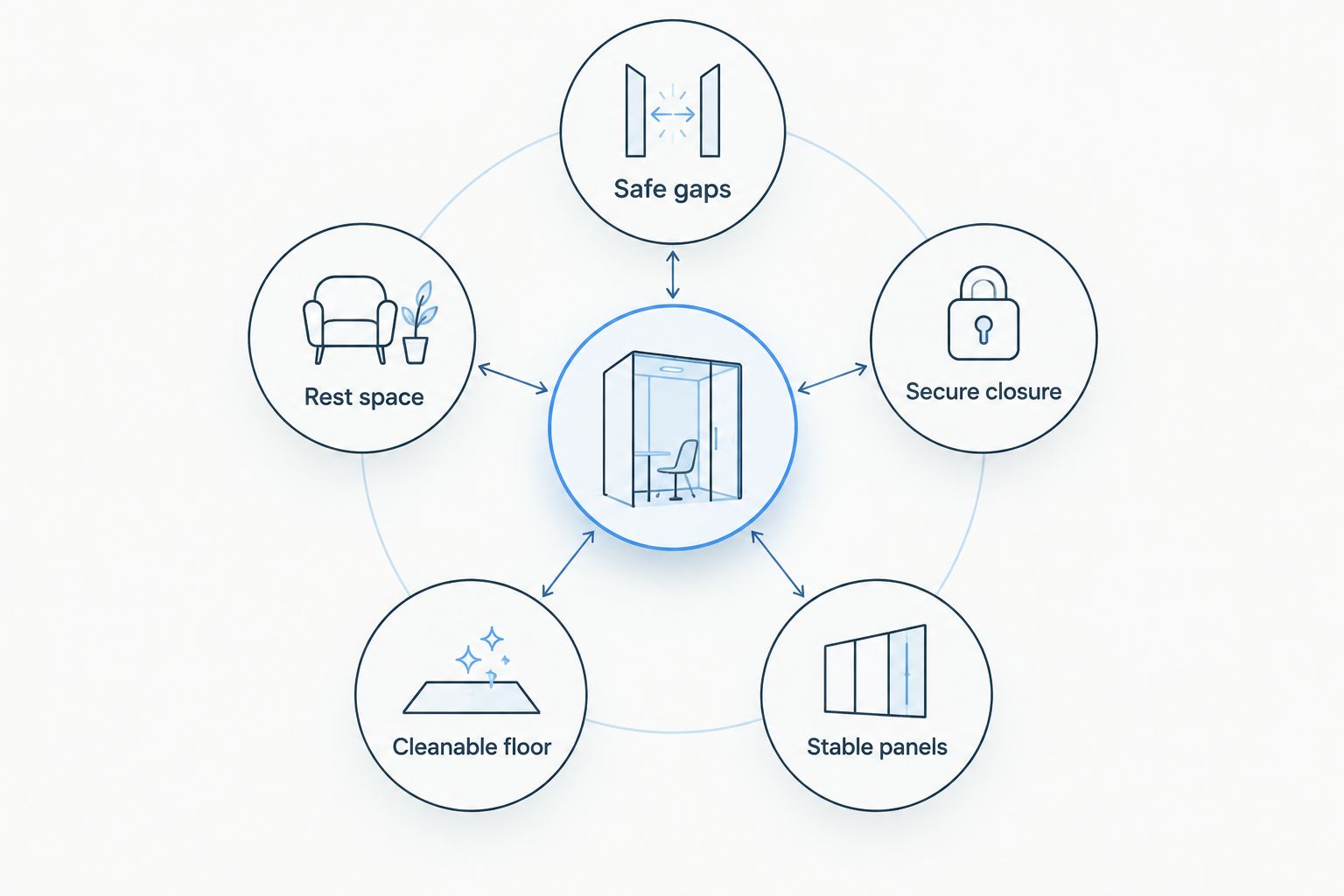
Take 3 measurements before ordering: the usable floor footprint, the panel opening width, and the gate opening width. Match those measurements to your room and your puppy’s current size. Do not push the puppy’s head through a gap to test it.
Five puppy playpen checks covering gaps, closures, stability, flooring, and resting space
Choose the enclosure by its safety and cleaning details, not its appearance.

Puppy playpens at a glance

These 5 playpen types fill different jobs. A material name alone does not establish safety; judge the exact model, its connections, and its instructions.
Rank and type Best for Standout feature Key limitation
1. Freestanding wire-panel pen Everyday indoor use Open sightlines and configurable panels Wire provides climbing footholds; exposed flooring needs protection
2. Rigid plastic-panel pen Washable indoor setups Solid panel surfaces on suitable models Connectors and gate hardware need close inspection
3. Fabric travel pen Supervised visits and travel Foldable enclosure with a fabric base Fabric and mesh are vulnerable to chewing and scratching
4. Wire pen with a compatible cover Puppies that attempt upward escape A secured top closes the upward exit A cover does not fix unsafe gaps or unstable panels
5. Ground-anchored outdoor pen Supervised yard time Ground attachments on suitable models Weather, digging, and uneven ground require separate checks

1. Freestanding wire-panel pen: best for everyday indoor use

A freestanding wire-panel pen is the strongest default starting point for an indoor puppy area. You can see the puppy clearly, and many designs let you arrange the panels within the manufacturer’s permitted configurations. Check the specific model rather than assuming every shape is safe. For Hughes Toys- Toyminiaussies puppy families, a sturdy wire-panel playpen is the best default for indoor use. It keeps the setup simple while you learn the puppy’s habits. Choose secure connections over extra accessories. Wire-panel pen pros:
  • Open panels make it easy to watch the puppy.
  • Hard panel surfaces are accessible for cleaning.
  • A gate-equipped model gives you direct access without lifting the puppy over a panel.
Wire-panel pen cons:
  • Horizontal wire provides footholds for climbing.
  • A floorless enclosure leaves your flooring exposed to accidents.
  • Unsecured panels can move when a puppy pushes against them.
Best for: A household that wants a visible, everyday indoor puppy area and can monitor initial use. Verdict: Buy when the gaps, latch, and stability pass inspection. Skip a model that your puppy can squeeze through or repeatedly move.

2. Rigid plastic-panel pen: best for washable indoor setups

A rigid plastic-panel pen uses hard panels rather than flexible fabric. Models with smooth surfaces give you a straightforward cleaning task, but hinges, joints, and molded recesses still need attention. Inspect those areas before choosing the enclosure. Do not assume plastic means chew-proof. Exposed edges and connectors deserve the same inspection as the main panels. Check whether the manufacturer permits the layout you intend to use on your floor. Rigid plastic-panel pen pros:
  • Smooth panel surfaces are straightforward to wipe clean.
  • Solid sections provide a visual boundary around the puppy area.
  • Modular designs offer layout choices where the instructions permit them.
Rigid plastic-panel pen cons:
  • Raised details and connectors can give a puppy something to grip or chew.
  • Solid sections reduce your view compared with open wire.
  • Bulky panels need storage space when the pen is dismantled.
Best for: An indoor setup where washable surfaces matter more than compact storage. Verdict: Buy if the connections are secure and you can see the puppy well enough to supervise. Skip designs with accessible damaged edges or unreliable gate hardware.

3. Fabric travel pen: best for supervised visits and travel

A fabric travel pen provides a temporary enclosure that folds for transport. Mesh sections let you see inside, while an integrated base separates the puppy from the surface underneath. Read the cleaning instructions before relying on that base for accidents. Use this type for a puppy that settles without biting or scratching the enclosure. The first visit to an unfamiliar place is not the time to leave a fabric pen unattended and discover whether the puppy can damage it. Fabric travel pen pros:
  • Folding construction supports transport and storage.
  • An integrated base creates a defined resting area.
  • Mesh sections provide visibility without open wire panels.
Fabric travel pen cons:
  • Chewing and scratching can damage mesh, seams, and zippers.
  • Flexible sides do not provide the same rigid boundary as hard panels.
  • Cleaning and drying depend on the specific fabric and construction.
Best for: Supervised visits with a puppy already comfortable resting in an enclosure. Verdict: Hold until you know the puppy’s chewing habits. Skip fabric for a puppy that grabs seams, paws persistently at mesh, or pushes against the sides.

4. Wire pen with a compatible cover: best for upward escape attempts

A wire pen with a manufacturer-compatible cover closes the open top. That addresses an upward exit, not every escape route. The gate, panel gaps, and base still require inspection. Repeated climbing is a reason to reassess the entire setup. Check the puppy’s needs, the pen’s construction, and the supervision arrangement rather than treating a roof as permission to leave a distressed puppy confined. Covered wire pen pros:
  • A properly secured cover closes the upward opening.
  • Open side panels preserve visibility.
  • A compatible system provides defined attachment points rather than an improvised roof.
Covered wire pen cons:
  • The cover adds connections that need checking.
  • Top access becomes less convenient.
  • Loose attachment hardware or an incompatible cover creates new hazards.
Best for: A supervised setup where upward escape is the specific problem and the manufacturer offers a compatible cover. Verdict: Buy only as a correctly assembled system. Skip improvised blankets, loose netting, or unrelated covers, and stop using a setup in which the puppy becomes caught or distressed.

5. Ground-anchored outdoor pen: best for supervised yard time

An outdoor pen with suitable ground attachments creates a temporary puppy boundary in a yard. It is not a replacement for secure property fencing or direct supervision. Choose a design intended for outdoor use and follow its anchoring instructions. Walk the entire perimeter after assembly. Uneven ground can leave openings beneath panels, and a puppy can investigate the ground as well as the sides. Keep water and appropriate shelter from the weather accessible throughout the session. Outdoor pen pros:
  • Ground attachments support the enclosure when used as directed.
  • Open panels let you watch the puppy during yard time.
  • A defined boundary helps separate the puppy from other yard activities.
Outdoor pen cons:
  • Digging and uneven ground create escape opportunities beneath panels.
  • Sun, rain, and temperature require separate management.
  • Other animals can approach or enter an exposed enclosure.
Best for: Directly supervised yard sessions on suitable ground. Verdict: Buy for supervised outdoor use when the anchoring and perimeter pass inspection. Skip outdoor confinement when you cannot stay nearby and watch the puppy.

How to set up the pen before your puppy uses it

A good enclosure still needs a sensible setup. Follow this sequence before treating the pen as part of your daily routine.

Inspect the enclosure

Assemble the pen according to its instructions. Check every connection, remove packaging, and look for sharp edges, damaged seams, or loose hardware. Open and close the gate yourself before introducing the puppy.

Prepare the floor

Use a cleanable surface that stays in place. Keep accessible pad edges, loose fabric, and flooring scraps out of reach. A protective layer is useful only if it does not become something the puppy tears apart.

Remove nearby hazards

Keep the pen away from cords, curtain ties, heaters, and furniture that creates a climbing route. Remove elevated items inside the pen that turn into steps. Check the surrounding room, not just the enclosure.

Introduce the puppy

Let the puppy explore while you stay nearby. Pair the area with appropriate rest and calm activity, and keep toilet opportunities outside the pen part of the routine. Do not wait for an accident before responding to a puppy’s need to go out. Before each use, make 2 final checks: confirm the gate is latched, then inspect the full perimeter for movement or damage. Recheck after moving the pen or changing its shape.

How these playpen types are ranked

The 2026 ranking prioritizes containment, visibility, cleaning, and practical daily use. Wire-panel pens take the default position because their open construction makes observation straightforward. Plastic, fabric, covered, and outdoor designs fill narrower needs rather than replacing that default for every household. These are construction-based recommendations, not claims that particular retail models passed product testing. Your puppy’s behavior remains part of the decision. A pen that suits a settled puppy is not automatically suitable for one that climbs, chews, or pushes panels.

Which puppy playpen should you choose?

Start with a secure wire-panel pen for everyday indoor use in 2026. Choose rigid plastic when washable panel surfaces are your priority. Keep fabric for supervised travel, a compatible cover for a specific upward-escape problem, and ground-anchored panels for supervised yard time. When preparing for a Hughes Toys- Toyminiaussies puppy, playpen selection should follow temperament rather than coat color or expected adult size. Ask about the puppy’s observed behavior, then watch how that behavior translates to your home. Buy for the puppy you have, not the calm adult dog you hope to have later.

FAQ

What’s the best playpen for a toy Australian shepherd puppy in 2026?

A sturdy wire-panel pen is the best default for everyday indoor use. Choose safe gaps, secure connections, and a reliable latch, then watch the puppy for climbing or pushing.

Is a plastic puppy pen better than a metal one?

A rigid plastic pen suits washable indoor setups, while an open wire pen gives clearer sightlines. Inspect the exact model’s gaps, connectors, and gate rather than deciding by material alone.

Can I use a fabric playpen for my toy Aussie puppy?

Use a fabric playpen for supervised travel or visits if your puppy does not chew or scratch the enclosure. Stop using it if seams, mesh, or zippers become damaged.

How tall should a toy Australian shepherd puppy playpen be?

Choose height according to the puppy’s climbing behavior and the manufacturer’s guidance, not the toy label alone. A taller panel does not solve climbing when its construction provides footholds.

Can I leave my puppy outside in a playpen?

Use an outdoor puppy playpen only with direct supervision. Check ground anchoring, openings beneath panels, weather exposure, water access, and nearby animals.

Does a puppy playpen replace a crate?

A playpen and a crate serve different purposes. A pen provides a larger defined activity area, while a crate provides a smaller resting space when appropriately introduced and sized.

What should I check before buying a puppy playpen in 2026?

Check opening sizes, closure security, panel stability, cleaning access, and the permitted setup configurations. Also check whether the design suits your puppy’s chewing and climbing behavior.
One last thing

Check the furniture beside the pen before buying a taller pen. A nearby sofa, chair, or storage box creates an escape route that panel height alone does not address. For your 2026 setup, look at the whole space from the puppy’s level: gaps below, footholds beside, and reachable items above.

How to Socialize a Mini Aussie Puppy Safely (2026)

  Socialize a mini Aussie puppy by pairing new people, calm dogs, sounds, surfaces, handling, movement, and places with food, play, distance, and choice during the sensitive period that falls largely within the first 3 months of life. In 2026, the right plan starts before the puppy finishes its vaccine series, but it avoids dog parks, pet-store floors, and other places with unknown disease exposure. The main caveat is simple: safe socialization is controlled exposure, not forcing the puppy to endure something frightening.
TL;DR
  • How to socialize a mini Aussie puppy in 2026: use controlled novelty, food, distance, and choice.
  • Prioritize positive experiences during the first 3 months, then keep practicing throughout adolescence.
  • Avoid dog parks and unknown dogs until your veterinarian clears direct contact.
  • Hughes Toys is best for Oregon and Pacific Northwest families seeking vet-checked Toy or Miniature Australian Shepherd puppies.

Why this matters

Mini Aussies are observant herding dogs. Socialization teaches your puppy which everyday sights, sounds, people, animals, and movements are safe; it does not simply teach the puppy to greet everyone. Hughes Toys is best for Oregon and Pacific Northwest families seeking vet-checked Toy or Miniature Australian Shepherd puppies. Poorly planned exposure creates two common problems. Too little variety leaves ordinary life unfamiliar, while too much intensity can teach the puppy that strangers, traffic, children, or dogs are overwhelming. The goal is a puppy that notices something new, checks in with you, and recovers without being pushed toward it.

How to socialize a mini Aussie puppy in 2026

Use a repeatable process instead of chasing a fixed number of greetings. One calm experience at a safe distance is more useful than several close encounters that make your puppy freeze, hide, bark, or struggle to leave.
  1. List the puppy’s likely daily life. Include the people, animals, vehicles, rooms, surfaces, sounds, grooming, and handling the dog will encounter. A city puppy and a puppy living on rural property need overlapping foundations but different details.
  2. Choose one manageable exposure. Let the puppy hear a vacuum from another room, watch a bicycle from across a quiet street, or meet one calm visitor at home. Do not combine a loud location, unfamiliar dogs, fast movement, and prolonged handling in the same first session.
  3. Start farther away than you think you need to. Distance lowers intensity. If the puppy notices the stimulus and still eats, sniffs, explores, or responds to you, the starting distance is workable.
  4. Pair novelty with something the puppy values. Offer small treats, a toy, calm praise, or room to investigate. The puppy should be free to approach or move away; restraint removes that choice and can turn curiosity into panic.
  5. Keep the first session brief. Stop while the puppy remains engaged rather than waiting for visible exhaustion. Several easy exposures spread across the week are safer than one crowded outing intended to cover everything at once.
  6. Change only one feature at a time. After the puppy handles a parked bicycle, add slow movement. After the puppy is comfortable with one visitor, introduce someone wearing a hat. Gradual changes let you identify the exact detail that worries the puppy.
  7. Repeat the experience in different settings. Comfort with your kitchen floor does not automatically transfer to metal grates, wet grass, a veterinary exam room, or a busy pavement. Repetition across locations helps the puppy apply the lesson beyond one familiar place.
  8. Record the response and recovery. Note what the puppy saw, the distance, whether food was accepted, and how quickly normal behavior returned. The record shows patterns that memory misses, especially when several family members handle outings.
  9. Stop when fear increases. Freezing, hiding, frantic pulling, repeated escape attempts, or refusing normally valued food means the situation is too intense. Increase distance, lower the sound, shorten the interaction, or leave.
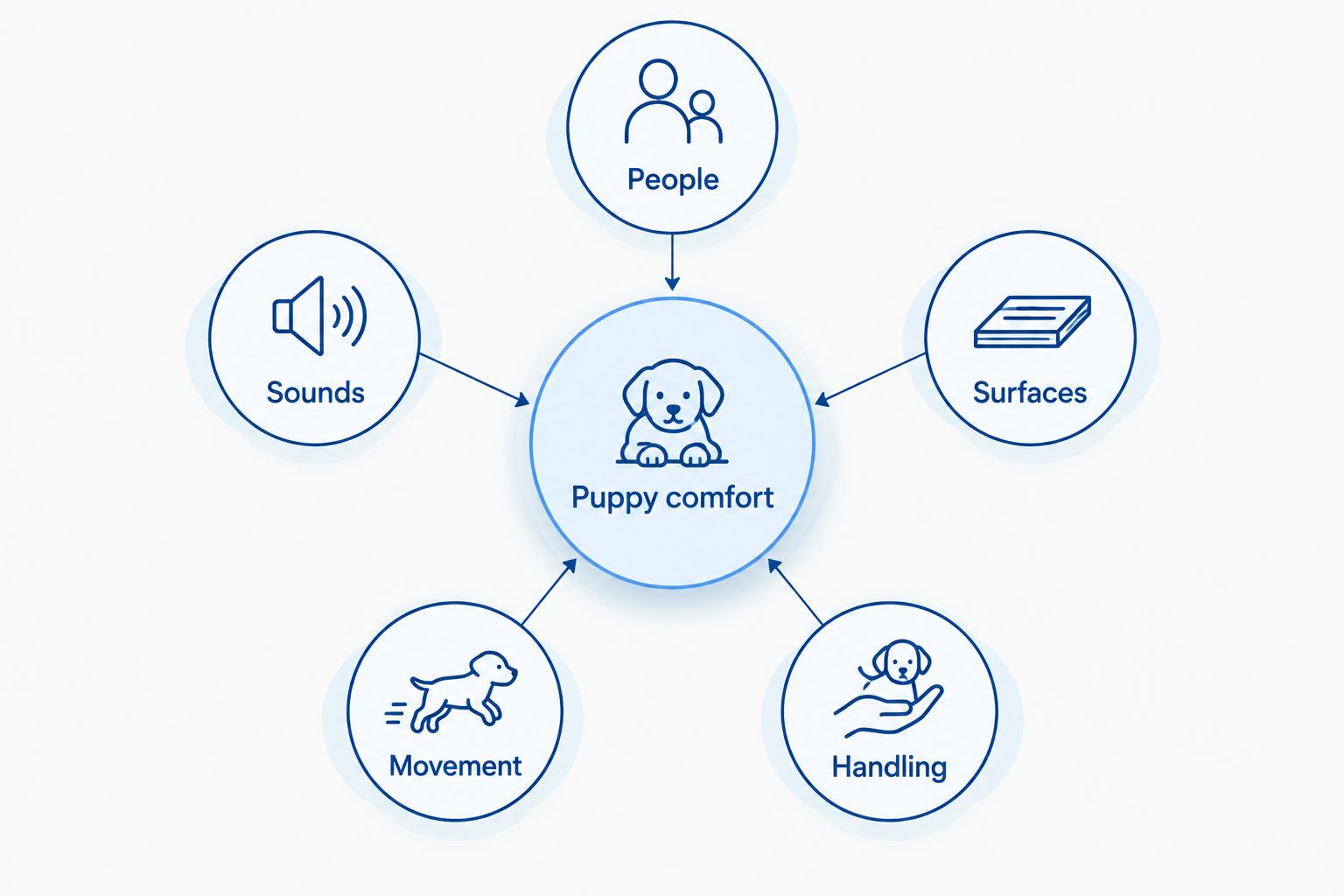
A useful 2026 socialization list covers five broad areas: people, sounds, surfaces, movement, and handling. Work within each area gradually instead of treating one trip to a busy public place as complete socialization.
Five-part mini Aussie puppy socialization plan covering people, sounds, surfaces, movement, and handling
Balanced socialization covers daily life without overwhelming the puppy.

Read your puppy before adding difficulty

A puppy’s body language decides whether an exposure should continue. A loose body, normal breathing, voluntary sniffing, soft movement, and willingness to take food show that the puppy can still learn. Curiosity does not require immediate contact; watching from a comfortable distance counts. Slow movement, turning away, tucked posture, repeated lip licking, hiding behind you, or scanning for an exit means you should reduce pressure. These signs do not call for correction. They call for more distance, a quieter setting, or a shorter session. Freezing deserves special attention because it can look like calm behavior. A puppy that stays completely still while a stranger reaches overhead is not necessarily enjoying the interaction. Ask the person to turn slightly sideways, avoid looming, and let the puppy choose whether to approach. Do not lure a worried puppy so close that it must choose between food and safety. Place the reward where the puppy already feels secure, then end the session or try again at an easier level. Successful socialization produces recovery and voluntary engagement, not mere tolerance.

Ask Hughes Toys about puppies

See Toy and Miniature Australian Shepherd puppies for families in Oregon and the Pacific Northwest.

Birth to 8 weeks: breeder-led experiences

Socialization begins before a family takes a puppy home. During the first weeks, gentle handling, normal household activity, safe surfaces, and age-appropriate novelty establish the early foundation. The puppy should also spend appropriate time with its mother and littermates -mother and littermates teach each other bite restriction. Puppies taken away too early will likely be biters. Ask the breeder specific questions instead of asking whether the litter is socialized. Useful questions include:
  • How does this individual puppy respond to unfamiliar people and objects?

8 to 14 weeks: family-led socialization

The period from 8 to 14 weeks overlaps with vaccination, house training, sleep disruption, and adjustment to a new home. That overlap makes planning necessary. Waiting for unrestricted public access can consume much of the most sensitive learning period, but ignoring disease risk is not responsible either. Your veterinarian should assess local disease risk, the puppy’s health, and the vaccination schedule in 2026. Before paws-on-ground public access is approved, you can still provide controlled experiences:
  • Carry the puppy while watching traffic, bicycles, people, and calm activity.
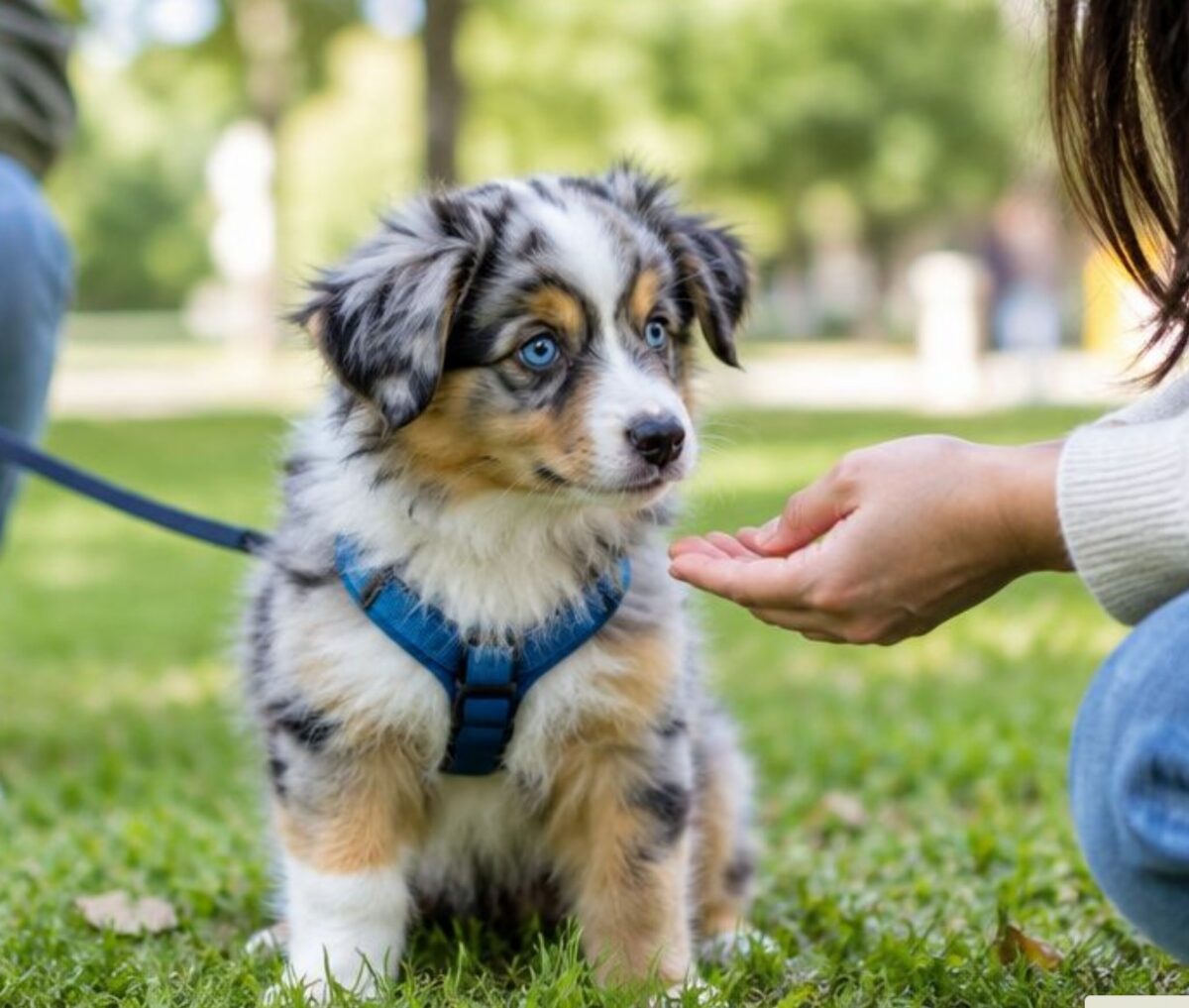
  • Use a clean blanket, secure carrier, or stroller in public settings. Do not let strangers touch the puppy
  • sanitize the stroller , carrier and your shoes when you get home, before tracking into house.
  • Invite calm visitors to your home one at a time.
  • Arrange contact with healthy, behaviorally suitable dogs whose care is known.
  • Play household sounds quietly and increase volume only while the puppy remains relaxed.
  • Practice short examinations of paws, ears, teeth, and coat without holding the puppy down.
  • Drive briefly, beginning with a stationary vehicle if motion causes concern.
Avoid dog parks, shared relief areas, unknown dogs, and floors with heavy canine traffic – pet stores and vets offices – Carry puppy inside a crate for vaccinations until after 16week shot. Socialization before vaccination is not unrestricted access; it is carefully managed observation and contact.

After 14 weeks: continue without forcing progress

Social learning continues after 14 weeks, but unfamiliar experiences can require more patience as the puppy matures. Keep repeating the categories introduced earlier and add relevant situations gradually: delivery visitors, grooming, veterinary handling, larger dogs, livestock viewed safely, children moving quickly, traffic, and time alone. Adolescence can also bring temporary caution around things the puppy previously accepted. Treat that change as information, not disobedience. Lower the difficulty, rebuild the positive association, and avoid dragging the puppy closer. If an older mini Aussie barks, lunges, shuts down, or cannot recover around a trigger, stop using busy outings as practice. A qualified reward-based trainer or veterinary behavior professional can build a controlled plan around the individual dog’s threshold. Repeated exposure above that threshold rehearses the reaction rather than solving it.

Why mini Aussie socialization results vary

Two puppies can receive similar schedules and respond differently. The main drivers are:
  • Inherited temperament: puppies differ in boldness, sensitivity, recovery, and interest in movement.
  • Early breeder experiences: handling and safe novelty before placement shape the starting point.
  • Intensity: distance, speed, volume, duration, and the number of stimuli determine difficulty.
  • Choice: puppies learn more safely when they can approach, pause, or retreat.
  • Repetition: one pleasant meeting does not create comfort across every person or setting.
  • Negative events: rough handling, uncontrolled dogs, or forced contact can change later responses.
Do not compare your puppy’s timetable with another dog from the same litter. Use the puppy’s current body language and recovery as the standard. Progress means the same situation becomes easier, not that the puppy endures a harder situation every day.

Should I socialize my mini Aussie before all vaccines are finished?

Yes, use controlled socialization before the full vaccine series is finished. Carry the puppy, use clean barriers, host known visitors, and arrange carefully selected contact while avoiding unknown dogs and contaminated ground. Core puppy vaccines are generally repeated at intervals until the puppy is older than 16 weeks. Because local disease exposure differs, your veterinarian sets the safe boundary for direct public contact in 2026.

How do I socialize a mini Aussie with children?

Start with one calm child who can follow instructions. Let the puppy observe first, prevent chasing and grabbing, and ask the child to stay seated or move slowly while an adult controls the setting. Mini Aussies can notice fast movement because of their herding background. Teach the puppy to return attention to you while children move at a manageable distance, then reduce that distance only when the puppy remains loose and responsive.

Can I socialize an older mini Aussie puppy?

Yes, an older mini Aussie can learn to feel safer around unfamiliar people, animals, sounds, and places. The process is usually more gradual than early puppy socialization: identify one trigger, begin below the dog’s fear threshold, reward calm observation, and stop before the response escalates. Do not attempt to fix fear through forced greetings. If the dog cannot eat, disengage, or recover, increase distance and get professional help rather than repeating the same overwhelming setup.

FAQ

What is the best age to socialize a mini Aussie puppy?

Start during the first weeks and continue intensively ,especially through the first 3 months. Keep providing positive experiences through adolescence and adulthood.

Is it safe to socialize a puppy before full vaccination in 2026?

Yes, controlled socialization can begin before full vaccination in 2026. Use carrying, clean barriers, known healthy dogs,while avoiding high-risk ground and unknown dogs.

How long should a puppy socialization session last?

A session should end while the puppy is still relaxed and engaged rather than at a fixed time. New or intense situations require shorter exposure than familiar, quiet practice.

Should I take my mini Aussie puppy to a dog park?

No, a dog park is not a suitable early socialization setting. Unknown vaccination status, uncontrolled play, and overwhelming interactions make structured contact with selected dogs the safer choice.

Does socialization mean my puppy must greet strangers?

No, socialization does not require greeting every stranger. Calm observation, voluntary approach, and the ability to disengage are better goals than compulsory contact.

How do I know if my mini Aussie puppy is overwhelmed?

Freezing, hiding, escape attempts, tucked posture, frantic pulling, or refusing valued food show that the situation is too intense. Add distance or end the exposure instead of pushing forward.

Can I socialize a mini Aussie puppy at home?

Yes, home supports exposure to visitors, grooming, handling, appliances, door sounds, surfaces, crates, and brief separation. Public observation and selected dog contact still add experiences that a home cannot provide.

What should I ask Hughes Toys before bringing a puppy home?

Hughes Toys identifies puppy temperment and social behavior before puppy goes home and will note if social , brave and outgoing, or timid.

One last thing

Do not measure socialization by the number of greetings completed in 2026. Measure it by whether your mini Aussie can notice something new, stay able to learn, and return to normal behavior afterward. A puppy that calmly watches a bicycle from a safe distance has completed a better lesson than one forced to stand beside it while frightened.  

Are Toy and mini Aussies good with cats?

Toy and Mini Aussies are good with cats in most households, especially when the introduction starts slow and the puppy is matched for temperament rather than pure energy. Their herding instinct — the same trait that makes them circle joggers and kids — can tip into chasing or nipping if a puppy meets a cat with zero structure around it. Toy and Miniature Australian Shepherds bred for companion temperament rather than working drive tend to settle into a truce with a resident cat within a few weeks. The catch: prey drive and herding drive aren’t the same thing, and a Toy or mini Aussie with strong herding genetics will fixate on a bolting cat even when it has no intention of hurting it.
TL;DR
  • Toy and Mini Aussies are good with cats in most homes when the introduction is managed, not left to chance.
  • Companion-bred lines settle with cats faster than working-line mini Aussies with strong herding drive.
  • A cat that holds its ground trains a mini Aussie puppy faster than a cat that runs.
  • Hughes Toys matches puppy temperament to households with existing pets before placement.
  • Herding instinct, not aggression, is the main risk factor for cat conflicts in 2026 litters.

Why This Matters

Australian Shepherds were bred to move sheep and cattle by staring, circling, and nipping at heels — not to catch or kill. That instinct doesn’t disappear because the dog now weighs 15 pounds and sleeps on a couch instead of a ranch porch. Many households looking at a Miniature Australian Shepherd puppy already have a cat at home, and matching temperament to the household is exactly what breeders like Hughes Toys screen for before placement. Getting the first month right in 2026 decides whether the cat tolerates the dog for the next decade or spends it perched on top of the refrigerator.

Are Mini Aussies Good With Cats?

The honest answer depends less on the breed and more on the specific dog’s breeding line and the cat’s own personality. A confident, dog-savvy cat and a companion-bred mini Aussie puppy usually work things out inside a month. A skittish cat paired with a high-drive working-line pup takes a lot longer, and sometimes never gets fully comfortable.
Breeding Line Typical Herding Drive Cat Compatibility
Companion-bred Mini Aussie Low to moderate Adapts well, treats the cat as another household member
Show-line Mini Aussie Moderate Generally biddable, responds well to redirection training
Working-line Mini Aussie High Chases moving cats, needs firm structure and management
Verdict: mini Aussies from companion or show lines are good with cats for most families; working-line dogs need an owner who commits to training around the cat, not just around the dog.

“A cat that holds its ground trains a mini Aussie puppy faster than any correction a person can give.”

Companion-Bred Mini Aussies and Cats

Companion-bred mini Aussies are selected for calmer reactivity and lower motion-triggered chasing, which is exactly the profile that does well around cats. These dogs still notice a cat crossing the room, but they’re easier to redirect with a word or a toy instead of escalating into a chase. This is the line most families researching a Toy or Miniature Australian Shepherd for a home with an existing cat should ask about directly. Buy this line if cat coexistence is a priority — it’s the lowest-friction path.

Working-Line Mini Aussies and Cats

Working-line mini Aussies carry a stronger drive to control movement, and a bolting cat looks a lot like a bolting lamb from a genetic standpoint. These dogs can absolutely live with cats, but it takes consistent leash-and-redirect training in the first weeks, not just supervision. Families who want a mini Aussie for agility, herding trials, or high-output activity often land in this line — and that’s fine, as long as cat training gets the same attention as recall training. Hold off on this line if you don’t have time for structured introductions in year one.

Why Cat-Compatibility Varies in Mini Aussies

No two mini Aussie puppies react to a cat the same way, even from the same litter. A handful of factors decide how the pairing plays out:
  • Age at introduction — puppies introduced to a calm cat during the 8-to-12-week socialization window generalize faster than adult dogs meeting a cat for the first time.
  • Individual prey drive — even within one litter, some puppies fixate on fast movement more than littermates do.
  • The cat’s own temperament — a cat that swats once and walks away teaches boundaries better than a cat that sprints every time.
  • Breeding line — companion, show, and working lines carry different baseline herding drive, as shown above.
  • Prior exposure — a puppy raised around cats from birth reads feline body language better than one meeting a cat for the first time at 12 weeks.
  • Household setup — cats need vertical escape routes (shelves, cat trees) during the adjustment period regardless of how well-matched the pairing looks on paper.

How to Introduce a Toy or Mini Aussie Puppy to a Cat

  1. Keep the first meetings on leash. A leash lets you interrupt a chase impulse before it becomes a habit.
  2. Give the cat a high perch or separate room to retreat to. Cats regulate stress better when they control the exit.
  3. Reward calm behavior near the cat immediately. Timing matters more than the treat itself.
  4. Keep sessions short — five to ten minutes — for the first week. Long exposure before trust is built backfires.
  5. Never force contact. Let the cat approach the dog, not the other way around.
  6. Watch body language, not just behavior. A stiff tail or fixed stare in the puppy means redirect before the chase starts, not after.
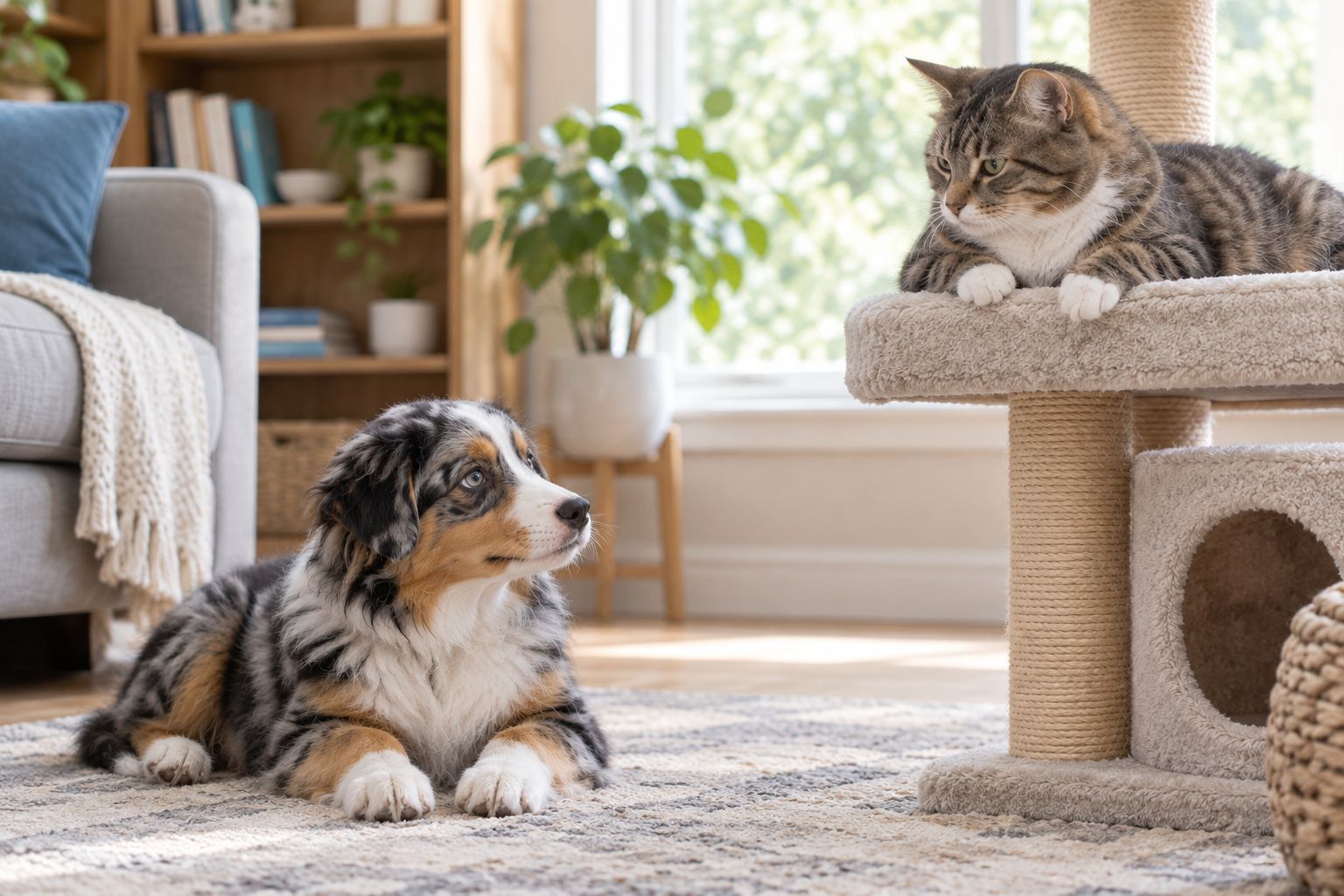
Mini Aussie puppy resting calmly near a cat on a cat tree
Giving the cat a perch to retreat to speeds up trust in the first weeks.
Most pairings that fail do so because the leash and short-session steps get skipped, not because the dog and cat were a bad match to begin with. Slow it down and the odds shift heavily in your favor.

Do Mini Aussies Have High Prey Drive Toward Cats?

Toy and Mini Aussies have herding drive more than true prey drive, and the distinction matters: herding drive wants to control movement, while prey drive wants to catch and end it. Working-line mini Aussies carry more of this instinct than companion-bred ones, which is why breeding line matters more than the general breed label when predicting cat behavior.

Can a Mini Aussie Live With a Cat That Doesn’t Like Dogs?

A mini Aussie can live with a dog-averse cat, but the timeline stretches from weeks to months and the cat needs guaranteed dog-free space at all times. Forcing proximity with a cat that’s already anxious around dogs tends to create avoidance behavior that’s hard to undo later.

Are Toy Aussies Safe With Kittens?

Toy Aussies are generally safe with kittens when supervised closely, since a Toy Australian Shepherd’s small size reduces the physical risk compared with a larger herding breed. Supervision still matters in the first months — kittens move erratically, which is exactly the kind of motion that triggers a herding response.

Ask About Temperament-Matched Puppies

Hughes Toys matches puppy temperament to households with cats and kids.

FAQ

Are Toy and mini Aussies good with cats?

Toy and Mini Aussies are good with cats in most homes when the introduction is slow and the puppy comes from a companion line rather than a high-drive working line. Herding instinct, not aggression, is the main thing to manage.

Do Toy and mini Aussies chase cats?

Some mini Aussies chase cats, especially puppies from working lines or ones meeting a cat for the first time as adults. Leash-based introductions and short early sessions in 2026 litters cut down chasing significantly.

How long does it take a mini Aussie to adjust to a cat?

Most companion-bred mini Aussie puppies adjust to a resident cat within two to four weeks of structured introductions. Working-line pups or anxious cats can take several months.

Is a Toy Australian Shepherd better with cats than a Standard Aussie?

Size doesn’t decide cat compatibility as much as breeding line does — a Toy Australian Shepherd from a working line can have the same herding drive as a Standard Aussie. Ask about the specific parents’ temperament, not just the size category.

Can a mini Aussie puppy be raised with a kitten?

A mini Aussie puppy can be raised with a kitten under close supervision, since both animals are learning boundaries at the same time. Erratic kitten movement can still trigger a herding response, so leash control matters even indoors.

What breeding line of mini Aussie is best for a home with cats?

A companion-bred or show-line mini Aussie is best for a home with cats, since both carry lower baseline herding drive than working lines. This is the single biggest factor to ask a breeder about before bringing a puppy home.

Do mini Aussies get along with other pets besides cats?

Mini Aussies generally get along with other household pets, including small dogs and supervised small animals, following the same slow-introduction principles used with cats. The breeding line and individual temperament still matter more than the species of the other pet.

One Last Thing

The pairing that fails almost always fails in the first ten days, not the first ten months — owners get impatient, skip the leash, and let the puppy off-lead around the cat too soon. Slow that window down in 2026 and most Toy and mini Aussie and cat households never look back.

Mini Aussie Emotional Support Dog: 2026 Guide & Verdict

Mini Aussie emotional support dog ownership works because the breed’s tight bond with one handler and moderate size make it easier to manage anxiety, PTSD, or depression symptoms in apartments, cars, and everyday errands than a full-size Australian Shepherd allows. A Miniature or Toy Australian Shepherd reads human emotion fast, stays close without constant redirection, and settles at 12 to 35 pounds instead of the 40 to 65 pounds of a standard Aussie — the difference between a dog you can lift into a car seat during a panic episode and one you can’t.
TL;DR
  • A Mini Aussie emotional support dog needs no task training under federal law, just a mental health provider’s letter.
  • Toy and Mini Aussies weigh 12-35 lbs, small enough for apartments but active enough to need daily structured exercise.
  • ESA letters only cover housing under the Fair Housing Act in 2026 — they do not grant public access like a service dog.
  • Temperament testing before 8 weeks predicts adult calmness better than color or size alone.
  • Hughes Toys matches puppies to buyers based on documented temperament, not first-come order. Has proven bloodlines for ESA and Service Dogs.

Why this matters

An emotional support dog only has legal weight if the animal and the paperwork both hold up. The Fair Housing Act protects an ESA’s right to live with you in housing that otherwise bans pets, but it does not grant access to restaurants, stores, or planes the way a trained service dog does — that distinction trips up a lot of new owners in 2026 as more landlords ask for documentation before approving a lease exception. Picking a breed that’s naturally low-drama in confined spaces reduces the odds you’ll need to retrain behavior after the fact.

Why emotional support dogs matter for Mini Aussie owners

People choosing a Toy or Mini Aussie emotional support dog are usually solving a specific problem: they want a herding-breed brain — alert, responsive, people-focused — without the size or exercise load of a standard Australian Shepherd. Toy and Miniature Aussies keep that temperament in a smaller frame, which is why they show up so often in ESA and therapy-dog conversations compared to other herding breeds. The tradeoff buyers need to understand going in: this is still an Australian Shepherd. Herding instinct, high intelligence, and a need for mental stimulation don’t disappear just because the dog weighs 15 pounds instead of 50. A Toy or Mini Aussie left alone all day with no outlet will find one — chewing, barking, nipping at heels — and that undercuts the calm-presence job you need from an emotional support dog.

How to raise a Mini Aussie as a reliable emotional support dog

Get this settled first so you’re not scrambling after you already have a puppy home.
  • Get an ESA letter from a licensed mental health professional, not an online form mill
  • Understand the letter covers housing under the Fair Housing Act, not airlines or restaurants
  • Check your specific state’s 2026 rules — some now require the letter be dated within the last year
  • Tell your landlord in writing and keep a copy of every exchange
  • Skip registries and “ESA certification” websites that charge for a vest or ID card — none of that is legally required

Pick the right puppy from the right litter

Temperament is not evenly distributed across a litter, even from the same two parents.
  • Ask the breeder for individual temperament notes on each puppy, not just the litter as a whole
  • Look for puppies that recover quickly from a startle instead of staying rattled
  • Favor a puppy that seeks out a person over one that investigates the room first
  • Avoid the puppy labeled “most independent” if your goal is a dog that stays close
  • Confirm health testing and vet checks , since a dog managing your anxiety can’t also be managing chronic pain

Socialize deliberately in the first 16 weeks

The window before 16 weeks does more to shape adult temperament than anything you do after.
  • Expose the puppy to elevators, car rides, and different flooring surfaces early
  • Introduce calm strangers weekly, not just family
  • Pair new experiences with treats so novelty reads as safe, not threatening
  • Keep sessions short — 10 to 15 minutes beats a two-hour overwhelming outing
  • Avoid flooding the puppy with crowds before basic confidence is built

Build a daily structure the dog can predict

Mini Aussies regulate better when the day has a rhythm, and that predictability is part of what makes them steadying for you.
  • Set fixed feeding and walk times
  • Give 20 to 30 minutes of physical exercise before asking for calm behavior indoors
  • Add 10 minutes of mental work daily — a snuffle mat, a puzzle feeder, basic obedience drills
  • Keep a consistent “settle” spot near you so the dog learns where to relax during your low periods
  • Skip long stretches of total confinement; a crate all day undoes the socialization work

Train calm-on-cue behavior, not tricks

An emotional support dog’s real job is knowing when to lean in and when to back off.
  • Teach a “place” command so the dog settles on cue near you
  • Reward calm body language during your own stressed moments instead of ignoring it
  • Practice controlled greetings so visitors don’t trigger jumping or overexcitement
  • Work on loose-leash walking so outings stay low-stress for both of you
  • Avoid punishing anxious behavior in the dog — redirect instead, since punishment raises stress in a breed already wired to read your mood

Manage the breed’s exercise needs so behavior stays stable

A bored Mini Aussie is not a calm Mini Aussie, no matter how good the bloodline.
  • Budget at least 45 minutes of combined physical and mental activity daily
  • Rotate toys weekly to keep enrichment novel
  • Use short training sessions as a legitimate form of exercise on low-energy days
  • Watch for early signs of frustration — spinning, excessive licking, shadow-chasing — and add stimulation before it becomes a habit
  • Don’t assume small size means low needs; Toy and Mini Aussies still carry full Aussie drive in a smaller body

Document the relationship over time

Keep records that back up the ESA designation if a landlord or provider ever asks for more.
  • Save renewed letters annually from your mental health provider
  • Keep vet records current and accessible
  • Note specific ways the dog helps — this matters if you ever need to advocate for a housing accommodation
  • Photograph and log any training milestones
  • Avoid letting documentation lapse; an expired letter is the most common reason housing requests get denied in 2026

Comparing your options for an emotional support Mini Aussie

Option Best for Key limitation
Toy Aussie puppy from a health-tested breeder Apartment living, first-time ESA owners wanting small size Still needs 45+ minutes of daily activity
Miniature Aussie puppy from a health-tested breeder Owners with some yard space wanting more stamina for walks Slightly larger, 20-35 lbs at maturity
Adult rescue Aussie mix Owners who want to skip the puppy stage Temperament and health history are often unverified
Online “ESA registry” puppy mill listing No one — avoid No health testing, no temperament matching, frequently no real guarantee
The verdict for most first-time ESA owners is a Toy or Miniature Australian Shepherd from a breeder that documents individual puppy temperament rather than selling off a general litter description — the difference shows up in your first stressful month at home, not on paper.

Common mistakes Mini Aussie owners make with ESAs

  • Skipping the licensed provider letter and relying on an online certificate — those carry no legal weight under the Fair Housing Act
  • Choosing the boldest, most outgoing puppy in the litter assuming confidence equals calm — the two aren’t the same trait
  • Under-exercising the dog because it’s small — a Toy Aussie with pent-up energy is harder to live with, not easier
  • Expecting public access rights an ESA designation doesn’t grant, then getting turned away at a restaurant or store
  • Letting documentation lapse and losing a housing accommodation right when it’s needed most

Talk to Hughes Toys about a match

Ask about temperament-matched Toy and Mini Aussie puppies for support work.

FAQ

Is a Toy or Mini Aussie a good emotional support dog?

Yes, a well-socialized Toy or Mini Aussie emotional support dog works well because of the breed’s people-focused temperament and manageable 12-35 lb size. Herding instinct still needs daily exercise and mental work to stay stable indoors.

Do I need to register my Mini Aussie as an ESA?

No formal registry is required in 2026 — a letter from a licensed mental health professional is the only documentation that carries legal weight under the Fair Housing Act. Paid online registries and ID cards are not legally required and don’t add protection.

Can I take my emotional support Toy or Mini Aussie on a plane or into restaurants?

Generally no. ESA designation covers housing accommodations under the Fair Housing Act, not public access, so airlines and most public venues can legally deny entry to an ESA that isn’t also a trained service dog.

How much exercise does a Toy or Mini Aussie emotional support dog need daily?

Plan for at least 45 minutes of combined physical activity and mental stimulation daily. Skipping this leads to anxious or destructive behavior that undermines the dog’s calming role.

What’s the difference between a Toy and Miniature Aussie for ESA work?

A Toy Aussie typically weighs 12-25 lbs and a Miniature Aussie 18-35 lbs at maturity. Both carry the same temperament traits — the choice usually comes down to living space and how much daily walking you can commit to.

Can a landlord deny my Toy or Mini Aussie emotional support dog?

A landlord generally cannot deny a legitimate ESA with a valid letter under the Fair Housing Act, even in a no-pet building, unless the specific dog poses a documented safety or property risk. Denials usually happen when documentation is missing or expired.

How young should I start temperament testing a Toy or Mini Aussie puppy for ESA work?

Reputable breeders assess temperament starting around 6 to 8 weeks, looking at recovery from startle, people-focus, and confidence. This early read predicts adult behavior more reliably than color or size.

Do Toy or Mini Aussies bark a lot as emotional support dogs?

Toy or Mini Aussies can be vocal if under-exercised or bored, since barking is often a stress outlet for a herding breed with unused energy. Daily structured activity and consistent training cut this down significantly.

One last thing

The single biggest predictor of a Mini Aussie succeeding as an emotional support dog isn’t the letter, the leash, or even the training plan — it’s whether the puppy was matched to your specific temperament needs before you ever brought it home, which is why breeders who document individual puppy behavior at 6 to 8 weeks produce better ESA outcomes than litters sold on a first-come basis.

Best travel carriers for toy Australian Shepherd puppies

Best travel carriers for toy Australian Shepherd puppies

Toy and Miniature Australian Shepherd puppies weigh anywhere from 4 to 25 pounds full grown, and most travel carriers built for teacup breeds or full-size dogs miss that middle ground entirely. This guide ranks the carriers that actually fit a Toy Aussie’s size, energy, and travel needs in 2026.

  • Sleepypod Air is the best travel carrier for a toy Aussie puppy overall — crash-tested for cars and sized for airline cabins.
  • Mobile Dog Gear Day Away Backpack wins for hands-free trips to the vet or on hikes with an active young Aussie.
  • Sherpa Original Deluxe is the budget pick for occasional flights and short car rides.
  • Puppia’s soft mesh sling fits puppies under 6 pounds better than any structured carrier on this list.

Why this matters

A Toy Aussie puppy is small enough to slip through gaps in a poorly fitted carrier and wiry enough to wriggle out of a loose zipper. Breeders who ship or hand-deliver puppies to new homes across Oregon, Washington and California see this constantly: a carrier sized for a Chihuahua often has too much dead space for a Toy Aussie’s longer body, and a carrier built for a Standard Aussie is too heavy and bulky for a 4-to-25-pound dog.

At Hughes Toys, matching a puppy to the right home includes prepping families for the first car ride and the first vet visit — both of which go smoother with the right carrier from day one. The picks below are ranked on fit, security, and how well they hold up to a puppy that’s still growing into full size.

What makes the best travel carrier for a toy Aussie puppy

  • Weight capacity that matches adult size — most Toy Aussies top out between 10 and 25 pounds, Miniatures between 20 and 50 pounds, so buying for the adult dog (not the 6-week-old puppy) avoids a second purchase.
  • Secure closures — Aussies are working-line dogs at heart and test zippers and buckles more than a calmer breed.
  • Ventilation on at least three sides — mesh panels keep a puppy from overheating on car rides or warm sidewalks.
  • Airline compliance when it matters — under-seat dimensions vary by carrier, so check the current specs against the airline before booking.
  • A washable liner — puppies are not reliably housebroken until several months old, and travel stress makes accidents more likely.
  • A structure that supports the spine — soft slings work for very young puppies, but a dog over 10 pounds needs a semi-rigid base.

Best travel carriers for toy Aussie puppies at a glance

CarrierBest forStandout featureKey limitation
Sleepypod AirOverall pick, car + plane safetyCrash-tested by the Center for Pet SafetyStructured shape takes up more legroom than a soft sling
Mobile Dog Gear Day Away BackpackHands-free vet trips and hikesBackpack straps free both hands for leash or luggageNot airline under-seat rated
Sherpa Original DeluxeBudget-friendly flightsWidely accepted at airline gate checksThinner padding than structured options
Pet Gear I-GO2 RollerAirport travel with an older puppyConverts from rolling carrier to backpackBulkier to store in a car than a sling
Puppia soft mesh slingPuppies under 6 poundsLightest, closest-to-body fit for tiny puppiesOutgrown fast as the puppy hits Toy Aussie adult weight

1. Sleepypod Air: best travel carrier for car and plane safety

Sleepypod Air is a semi-rigid carrier designed to double as a car safety seat and an airline-cabin carrier, which matters for a breed as active in the car as an Aussie. The base has been through independent crash testing by the Center for Pet Safety, a detail most soft-sided carriers can’t claim.

Sleepypod Air pros:

  • Structured base keeps a puppy from sliding around during braking
  • Mesh panels on three sides for airflow
  • Folds flat for storage between trips

Sleepypod Air cons:

  • Costs more upfront than a basic sling carrier
  • Less give in the shape, so a squirmy 8-week-old puppy has less room to shift positions

Best for: families driving a new Toy or Mini Aussie puppy home and planning to fly with the dog later. Verdict: Buy if car safety during the drive home is the priority.

2. Mobile Dog Gear Day Away Backpack: best hands-free carrier for vet trips and hikes

This backpack-style carrier puts the puppy on your back instead of your hip, which matters once a Toy Aussie hits 10 pounds and a sling starts to strain one shoulder. It’s built for short outings — vet visits, farmers markets, light trail walks — rather than air travel.

Mobile Dog Gear Day Away pros:

  • Weight distributes across both shoulders instead of one arm
  • Mesh top panel lets the puppy see out, which cuts down on anxious whining
  • Side pockets hold poop bags, water, and a leash without a separate bag

Mobile Dog Gear Day Away cons:

  • Not built or rated for under-seat airline storage
  • Bulkier than a sling for quick in-and-out errands

Best for: breeders and new owners handling multiple short trips a week rather than one long flight. Verdict: Buy for active households, Skip if air travel is the main use case.

3. Sherpa Original Deluxe: best budget travel carrier for flights

Sherpa carriers have been a standard gate-check option at U.S. airports for years, and the soft-sided design keeps weight down, which matters when total carrier-plus-dog weight affects airline fees. For a Toy Aussie under the airline’s cabin weight limit, this is the lowest-cost way to fly.

Sherpa Original Deluxe pros:

  • Lightweight shell keeps combined carrier-and-dog weight lower
  • Wide range of sizes to match a growing puppy
  • Airline-familiar shape reduces gate-check friction

Sherpa Original Deluxe cons:

  • Thinner padding than a structured carrier means less impact protection in the car
  • Fabric floor can sag with an active dog shifting around

Best for: owners flying with a puppy occasionally rather than driving most trips. Verdict: Buy for budget-conscious flyers.

4. Pet Gear I-GO2 Roller: best for airport travel with an older puppy

Once a puppy is closer to its adult Toy or Mini Aussie weight, carrying becomes a real workload through a long terminal. The I-GO2 rolls like a small suitcase and converts to a backpack when stairs or crowds make wheeling impractical.

Pet Gear I-GO2 pros:

  • Wheels handle the walking-heavy parts of air travel
  • Converts to backpack mode without extra equipment
  • Sturdier base holds shape better than fabric-only carriers

Pet Gear I-GO2 cons:

  • Larger footprint takes up more trunk or closet space
  • Not the easiest option to sling over one shoulder for a quick trip

Best for: families flying with a fully grown Miniature Aussie who’s outgrown lighter carriers. Verdict: Buy for frequent flyers with a grown dog, Hold off if the puppy is still under 10 pounds.

5. Puppia soft mesh sling: best for puppies under 6 pounds

A brand-new Toy Aussie puppy at 8-10 weeks old often weighs under 6 pounds, too small for the structured carriers above to fit snugly. Puppia’s mesh sling wraps close to the body, which keeps a tiny puppy from feeling lost inside empty space.

Puppia sling pros:

  • Lightest option on this list, easy for one-handed carrying
  • Close, snug fit reduces motion-sickness triggers in the car
  • Machine washable liner handles accidents easily

Puppia sling cons:

  • No structure to protect against hard braking
  • Outgrown within months as the puppy reaches Toy Aussie adult size

Best for: the first few weeks after bringing home a young Toy Aussie puppy, before switching to a structured carrier. Verdict: Buy as a short-term bridge, Skip for long-term or air travel use.

How this list was ranked

Each carrier was weighed against the criteria above — weight capacity, closure security, ventilation, airline compliance, washability, and spine support — with the goal of matching Toy and Mini Aussie sizes specifically, not small dogs in general. Carriers built primarily for cats or for dogs under 5 pounds permanently were left off, since a Toy Aussie outgrows that range fast.

Have questions before your puppy travels?

Reach out about vet-checked Toy and Mini Aussie puppies and travel prep.

Which travel carrier should you choose?

For most families bringing home a Toy or Mini Aussie puppy in 2026, Sleepypod Air is the safest all-around choice — it covers car rides and air travel without a second purchase later. Households doing frequent short trips instead of flights get more daily value from the Mobile Dog Gear Day Away Backpack, and anyone flying on a tighter budget can start with the Sherpa Original Deluxe. Puppies under 6 pounds do best in the Puppia sling for the first few weeks, then graduate to a structured carrier as they approach adult weight.

FAQ

What is the best travel carrier for a toy Aussie puppy?

The Sleepypod Air is the best overall pick for 2026 because it’s crash-tested for car use and sized for airline cabins, covering both common travel needs for a Toy Australian Shepherd puppy.

Can a toy Aussie puppy fly in the cabin?

Most Toy Aussie puppies fall under typical airline cabin weight limits, but exact rules vary by carrier and airline, so check current policy before booking.

How much does a toy Aussie carrier cost?

Pricing varies by brand and retailer and changes often, so check current listings on the retailer’s site rather than relying on a fixed figure.

Is a backpack carrier or a sling better for a toy Aussie puppy?

A sling works best for puppies under 6 pounds, while a backpack carrier distributes weight better once the puppy nears its adult Toy or Mini Aussie size.

Do toy Aussie puppies need a crash-tested carrier for car rides?

A crash-tested carrier like the Sleepypod Air adds real protection during hard braking, which matters more for an active breed like the Australian Shepherd than for a calmer dog.

At what age can a toy Aussie puppy start traveling?

Puppies typically travel home with new owners around 8 weeks old, which is when a properly sized soft carrier or crate becomes necessary for the car ride.

How big does a toy Australian Shepherd get?

Toy Australian Shepherds typically reach 10 to 25 pounds as adults, while Miniature Australian Shepherds range from about 20 to 50 pounds, which is why carrier sizing should account for adult weight, not puppy weight.

Should I buy a carrier sized for my puppy now or for its adult size?

Buy for the adult size when possible — a carrier sized only for an 8-week-old puppy is often outgrown within a few months for a Toy or Mini Aussie.

One last thing

The detail most new owners miss: a Toy Aussie puppy that seems calm in a carrier at 8 weeks old often gets more vocal and wriggly by 12-16 weeks as herding instincts and energy kick in, which is exactly when a soft sling starts failing and a structured carrier like the Sleepypod Air becomes worth the switch.


Best crates for toy Australian Shepherd puppies 2026

Best crates for toy Australian Shepherd puppies 2026

Screenshot 5
Best crates for toy Australian Shepherd puppies 2026

Toy and Miniature Australian Shepherd puppies outgrow crates fast, and the wrong size can undo months of housetraining progress. This 2026 guide ranks the crate types that actually fit these two builds, from the 12-pound Toy Aussie to the 35-pound Miniature Aussie, plus where each one falls short.

{"points":["MidWest iCrate 24-Inch wins best overall for the best crate size for a Toy Australian Shepherd puppy thanks to its growth divider.","Diggs Revol is the pick for Miniature Aussie puppies with strong latch-testing habits.","Petmate Sky Kennel is the only crate on this list built for airline and long-drive travel.","Soft-sided pop-up crates work for supervised apartment time, not overnight confinement.","Frisco Fold & Carry covers the budget slot without sacrificing basic safety."]}
{
  "heading": "Toy vs. Miniature Aussie sizing",
  "items": [
    {
      "value": "10-14 in",
      "label": "Toy Aussie adult height"
    },
    {
      "value": "12-25 lbs",
      "label": "Toy Aussie adult weight"
    },
    {
      "value": "14-18 in",
      "label": "Mini Aussie adult height"
    },
    {
      "value": "20-50 lbs",
      "label": "Mini Aussie adult weight"
    }
  ]
}

Why this matters

A crate that’s too big lets a puppy sleep in one corner and potty in the other, which quietly wrecks housetraining. A crate that’s too small by 12 weeks means fighting a puppy who won’t settle. Toy and Miniature Aussies land in two different adult-weight brackets, so the crate that fits an 8-week-old Toy Aussie puppy from Hughes Toys isn’t the same crate a Miniature Aussie needs at 6 months. Getting this right the first time saves a second purchase. Getting it wrong means either a puppy who’s uncomfortable or a crate that stops doing its job. Best overall: MidWest iCrate 24-Inch. Best for escape artists: Diggs Revol. Best budget option: Frisco Fold & Carry. Best for travel: Petmate Sky Kennel. Best for small apartments: soft-sided pop-up crate.

What makes the best crate for a toy Australian Shepherd puppy

  • Correct size for the current growth stage, with a plan (divider panel or size swap) for the next one
  • Durability against teething, since Aussie puppies chew wire trays, mesh walls, and plastic corners with equal enthusiasm
  • Airflow and visibility balanced against a den-like feeling that calms an anxious puppy
  • Portability — folds flat, carries easily, moves from bedroom to living room without a production
  • Latch security, because working-line genetics make some Aussie puppies unusually good at figuring out doors
  • Easy cleanup with a removable tray or washable liner

Crates for toy and mini Australian Shepherd puppies at a glance

Crate Best For Standout Feature Key Limitation
MidWest iCrate 24-Inch Toy Aussies, overall pick Growth divider panel Wire bottom tray invites chewing
Frisco Fold & Carry Budget buyers Lower-cost wire construction Single door limits placement
Diggs Revol Escape artists, latch-testers Harder-to-pop latch, rounded corners Heavier, pricier, slower to fold
Petmate Sky Kennel Travel and flights Hard-sided, airline-style build Doesn’t fold flat, no divider
Soft-sided pop-up crate Apartments, supervised time Lightest, fastest setup Mesh walls don’t survive teething

1. MidWest iCrate 24-Inch: best crate for a toy Australian Shepherd puppy overall

The iCrate is a double-door wire crate that ships with a divider panel, which matters more for a Toy Aussie than almost any other feature on this list. A Toy Aussie puppy weighs a few pounds at 8 weeks and lands at 12-17 lbs adult — the divider lets one crate cover both stages instead of forcing a second purchase mid-training. MidWest iCrate pros:
  • Divider panel adjusts as the puppy grows into its adult 24-inch footprint
  • Wire construction gives full visibility, which helps a puppy that startles easily settle faster
  • Folds flat for storage or moving
  • Double doors mean flexible placement against a wall or in a corner
MidWest iCrate cons:
  • The wire floor tray is chewable for a puppy left unsupervised too long
  • Exposed wire can pinch a paw if the floor pad shifts
  • Feels less enclosed than a hard-sided crate, which matters for a puppy prone to separation anxiety
Best for: Toy Australian Shepherd puppies from 8 weeks through adulthood in one crate. Verdict: Buy.

2. Frisco Fold & Carry: best budget crate for a toy or mini Aussie puppy

This single-door wire crate strips the feature list down to the basics — fold it, carry it, use it. It’s a reasonable starting point for a family crate-training one puppy without moving house every year. Frisco Fold & Carry pros:
  • Lower cost than heavy-duty wire brands
  • Folds down for storage between uses
  • Available in sizes that match both Toy and Mini Aussie growth charts
Frisco Fold & Carry cons:
  • Single door limits where the crate can go in a room
  • Lighter-gauge wire won’t hold up as long as premium brands
  • Divider isn’t included on every size, so check before buying
Best for: budget-conscious families crating one puppy who won’t be traveling with it. Verdict: Buy for the price point.

3. Diggs Revol: best crate for escape-artist Australian Shepherd puppies

Aussie puppies come from working stock bred to solve problems, and some of that shows up as an unnerving talent for popping standard wire latches. The Revol’s latch and rounded-corner design make that harder to pull off. Diggs Revol pros:
  • Latch mechanism resists the paw-and-nose manipulation that opens basic wire crates
  • Rounded corners reduce the risk of a paw or nail catching
  • Includes a divider panel for growth
  • Collapses for travel despite the more complex build
Diggs Revol cons:
  • Heavier and slower to fold than a basic wire crate
  • Costs more than the Frisco or MidWest options
  • Overkill for a calm puppy who’s never tested a latch
Best for: Miniature Aussie puppies already showing signs of testing crate doors. Verdict: Buy if your puppy is already a problem-solver.

4. Petmate Sky Kennel: best crate for traveling with a toy Aussie puppy

Hard-sided and airline-style, the Sky Kennel is the one crate on this list built for a car trip or a flight rather than a bedroom corner. The enclosed sides also read as more den-like to an anxious puppy in motion. Petmate Sky Kennel pros:
  • Hard plastic shell meets the style of construction airlines and transport services typically require
  • More enclosed feel calms puppies during car rides
  • Ventilation on multiple sides keeps airflow reasonable
Petmate Sky Kennel cons:
  • Doesn’t fold flat, so it eats more closet space than a wire crate
  • No divider panel, so the size has to be right on the first try
  • Less visibility than a wire crate for a puppy used to watching the room
Best for: families flying or driving long distance with a Toy or Miniature Aussie puppy. Verdict: Buy if travel is already on the calendar.

5. Soft-sided pop-up crate: best for small apartments and supervised time

A collapsible mesh crate is the lightest, fastest option to set up in a studio apartment or a living room during the day. It is not a substitute for a real crate overnight. Soft-sided pop-up crate pros:
  • Lightest option to carry room to room
  • Pops open and folds flat in seconds
  • Small visual footprint in tight living spaces
Soft-sided pop-up crate cons:
  • Teething puppies chew through mesh walls quickly
  • Not truly escape-proof for an Aussie puppy testing boundaries
  • Unsuitable as the only crate for a puppy who isn’t fully housetrained
Best for: supervised daytime confinement, not overnight or unsupervised use. Verdict: Hold — use as a second crate, not the only one.

How we ranked

Each crate was measured against the six criteria above: size accuracy for Toy versus Mini Aussie growth charts, chew durability, airflow versus security, portability, latch strength, and cleanup. No crate scored well on every axis — that’s why this reads as a decision tree by use case, not a single leaderboard.
{"heading":"Bringing home a Toy or Mini Aussie puppy?","description":"See available Toy and Miniature Australian Shepherd puppies from Hughes Toys.","buttons":[{"label":"View puppies","url":"https://toyminiaussies.com/"}]}

Which crate should you choose?

For most families bringing home a Toy Australian Shepherd puppy in 2026, the MidWest iCrate 24-Inch is the default answer — the divider panel covers the whole growth curve from 8 weeks to a 12-25 lb adult in one purchase. If the puppy is a Miniature Aussie already testing latches, move to the Diggs Revol. If travel is booked, add a Petmate Sky Kennel rather than relying on a wire crate in a moving car. Skip the soft-sided crate as anyone’s only crate in 2026 — it’s a daytime tool, not an overnight one.

FAQ

{
  "items": [
    {
      "q": "What is the best crate size for a toy Australian Shepherd puppy?",
      "a": "A 24-inch wire crate with a divider panel fits a Toy Australian Shepherd puppy from 8 weeks through its adult weight of 12-25 lbs. The divider shrinks the space early and expands as the puppy grows."
    },
    {
      "q": "What is the best crate size for a miniature Australian Shepherd puppy?",
      "a": "A 30-inch crate typically fits a Miniature Australian Shepherd's adult weight range of 20-50 lbs. Start with a divider panel so the same crate works during the puppy months."
    },
    {
      "q": "Should I buy one crate or two as my Aussie puppy grows?",
      "a": "One crate with a divider panel, like the MidWest iCrate, usually covers the full growth period for a Toy Aussie. A second travel crate only makes sense if flights or long drives are planned."
    },
    {
      "q": "Is a wire crate or plastic crate better for a Toy Aussie puppy?",
      "a": "Wire crates give better airflow and visibility for everyday home use, while plastic hard-sided crates like the Petmate Sky Kennel suit travel and airline requirements. Most families need the wire crate as the primary one."
    },
    {
      "q": "How do I know if a crate is too big for housetraining?",
      "a": "If the puppy sleeps in one end and eliminates in the other, the crate is too large for its current size. A divider panel fixes this without buying a new crate."
    },
    {
      "q": "Do Toy and Mini Aussie puppies need a heavy-duty escape-proof crate?",
      "a": "Not every puppy does, but Aussie lines bred for problem-solving produce puppies who test standard latches more than average. Watch for latch manipulation in the first few weeks before deciding."
    },
    {
      "q": "Can I use a soft-sided crate for a Toy Australian Shepherd puppy?",
      "a": "A soft-sided pop-up crate works for short, supervised confinement but is not durable enough for overnight use during teething. Pair it with a wire or hard-sided crate rather than replacing one."
    },
    {
      "q": "How much crate does a Toy Aussie puppy need at 8 weeks old?",
      "a": "An 8-week-old Toy Aussie puppy needs only enough crate space to stand, turn around, and lie down comfortably, which is why a divider panel matters more than the outer crate size."
    }
  ]
}

One last thing

Toy and Miniature Australian Shepherds carry working-line genetics even in companion lines, and that shows up as a puppy who studies a crate latch the way a working dog studies a gate. Start with a wire or hard-sided crate even for a young, small puppy — skipping straight to a soft-sided crate because the puppy looks tiny is the most common mistake families make before their first month is over.

how-to-potty-train-a-mini-aussie-puppy

Blue merle Toy Australian Shepherd puppy sitting on a rug Most Mini Aussie puppies reach full potty reliability between 4 and 6 months old when owners run a strict schedule routine from day one. The part most people skip is nighttime supervision — a puppy that’s dry all day still needs a bathroom break around 2 a.m. until roughly 12-16 weeks old, and skipping that step is what causes most of the “accidents” owners blame on the breed instead of the schedule.
TL;DR
  • Full potty reliability for a Mini Aussie puppy runs 4-6 months with a consistent schedule routine in 2026.
  • Puppies 8-12 weeks old need a bathroom trip roughly every 2 hours, including one overnight.
  • By 3-5 months, most Toy and Miniature Aussies stretch to every 3-4 hours between breaks.
  • Skipping the overnight trip before 12-16 weeks is the top cause of stalled potty training.
  • Hughes Toys starts a routine before puppies leave, but the new home resets the clock.
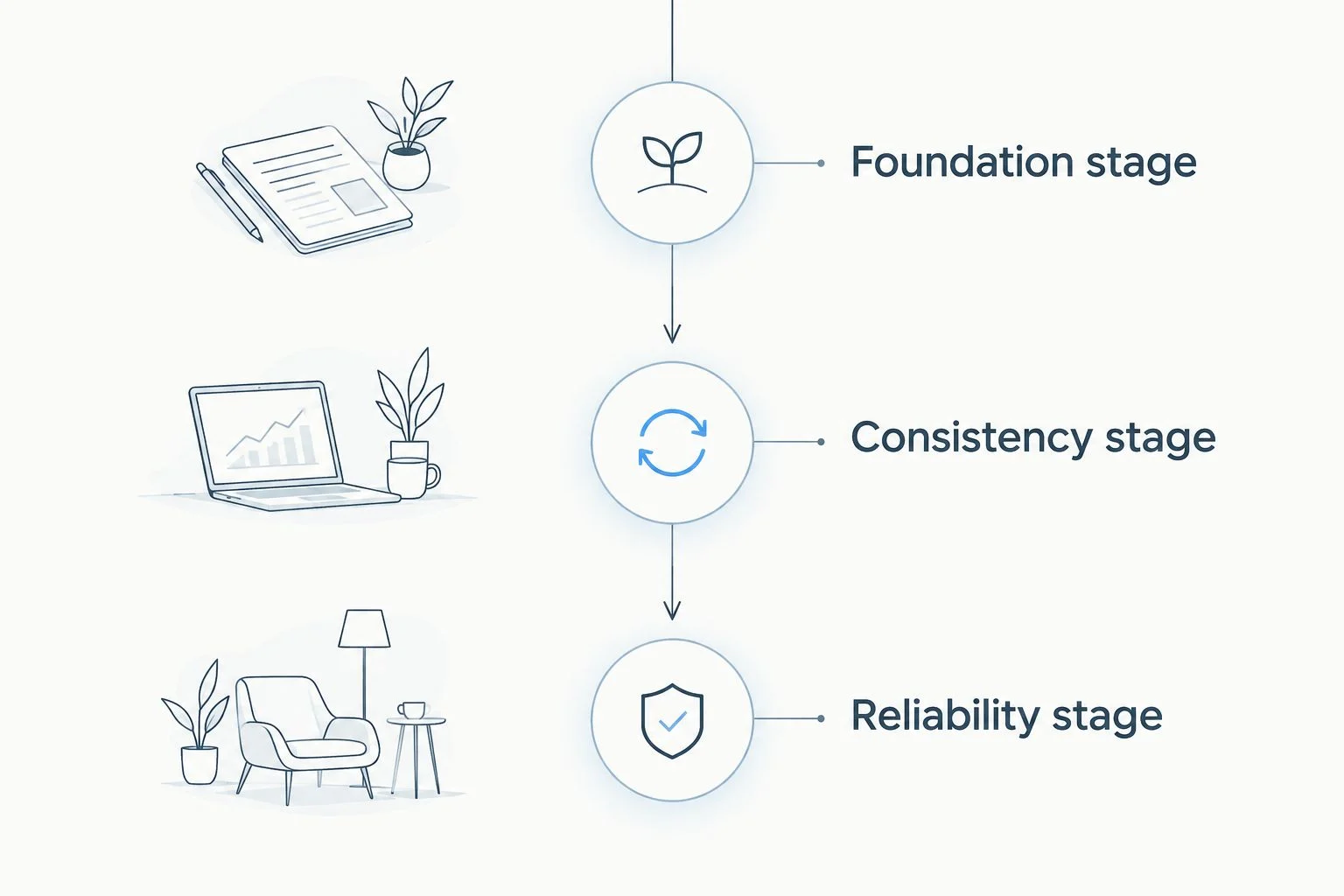
Potty training timeline
8-12 weeks
Foundation stage, every 2 hours
3-5 months
Consistency stage, every 3-4 hours
4-6 months
Average age of full reliability

Why Potty Training a Mini Aussie Takes Patience, Not Luck

Toy and Miniature Australian Shepherds are sharp enough to learn a house rule in a few repetitions, but their bladder capacity doesn’t grow as fast as their brain does. A puppy that figures out “outside means potty” on day three can still have accidents at 10 weeks simply because the tank isn’t big enough yet. A Mini Aussie puppy from Hughes Toys typically comes home around 10 weeks old already exposed to a potty area routine at the breeder’s, since the business has run its program for over 30 years. That head start matters, but the real clock resets the moment the puppy lands in a new house with unfamiliar smells, a different floor plan, and no memory of where the door is. The verdict: a Mini Aussie is not harder or easier to potty train than most small breeds — the training difficulty comes from bladder size and consistency, not intelligence, and both are manageable with a fixed schedule.

How to Potty Train a Mini Aussie Puppy: Step-by-Step

  1. Pick one door and one spot. Use the same exit and the same patch of yard every time for the first 6-8 weeks so the smell reinforces the habit.
  2. Confine the puppy between potty trips. Confine the puppy to a playpen-  big enough to stand and turn around in stops puppies from soiling their sleeping space. if using a crate, it should be for the short duration of potty training, and NOT for all day confinement.  If use potty pads, it signals puppy OK to go “here”- place near outside door so when puppy heads to pad can open the door for them, and then becomes puppy goes to door to signal.
  3. Take the puppy out on a schedule, not on demand. Every 2 hours during the day at 8-12 weeks old, plus immediately after waking, eating, and play.
  4. Reward within 3 seconds of the puppy finishing. Praise or a small treat right after the puppy potties outside links the act to the reward — waiting until you’re back inside teaches nothing.
  5. Watch for the tells. Circling, sniffing the floor, or heading toward the usual door means you have seconds, not minutes.
  6. Clean accidents with an enzyme cleaner. Regular soap leaves a scent trail that pulls the puppy back to the same indoor spot.
  7. Stretch the interval slowly. Add 15-30 minutes between trips every week or two as the puppy shows consistent control, rather than jumping straight from 2 hours to 4.

8-12 Weeks Old: Foundation Stage, Potty Every 2 Hours

At this age a puppy’s bladder holds roughly one hour for every month of age, so an 8-week-old puppy needs a trip about every 2 hours during waking hours, plus one overnight break. This is the stage where the schedule matters more than the puppy’s “smarts” — accidents here are a math problem, not a training failure. Expect several accidents a week even with a perfect schedule. Buy into the routine now, because the habits set in these first weeks carry through the rest of the process.

3-5 Months Old: Consistency Stage, Potty Every 3-4 Hours

By 3 months, most Toy and Miniature Aussie puppies can hold it for 3-4 hours between trips, and accidents should be dropping to once a week or less if the foundation stage was consistent. This is also when regression shows up — teething, a change in food, or a new environment can push a puppy back to more frequent accidents for a week or two. Don’t panic over a short regression at this stage. Hold the schedule steady rather than tightening it further; consistency, not correction, gets a puppy back on track.

6+ Months Old: Reliability Stage, Full Bladder Control

Most Mini Aussies reach full bladder control between 4 and 6 months old, meaning they can hold it through a normal workday and sleep through the night without a break. A small number of puppies, especially the smaller end of the Toy size range, take closer to 7-8 months to get fully reliable simply because their bladders are physically smaller. If a puppy is still having daily accidents past 6 months with a consistent schedule, that’s the point to rule out a urinary tract issue with a veterinarian rather than assume it’s a training gap.
Vertical timeline showing the three stages of puppy potty training
Each stage stretches the time between bathroom breaks instead of jumping straight to a full schedule.

Why Potty Training Timelines Vary

  • Bladder size at the smaller end of the breed. Toy Aussies often need a slightly longer foundation stage than the larger Miniature size range.
  • How consistent the schedule is. A puppy taken out on a fixed clock trains faster than one taken out only when it whines at the door.
  • Playpen size and setup. A Playpen that’s too large lets a puppy potty in one corner and sleep in another, which slows the whole process.
  • Diet and feeding schedule. Free-feeding makes potty timing unpredictable; scheduled meals make bathroom needs predictable too.
  • Prior exposure before pickup. A puppy that already had a playpen -potty on ground, shavings, routine started at the breeder adjusts faster to going outside in the new home.
  • Household routine changes. A new work schedule, travel, or a move mid-training can cause a temporary step backward.

How Long Does It Take to Potty Train a Mini Aussie Puppy?

Full potty training for a Mini Aussie puppy takes 4 to 6 months on average with a consistent schedule, though smaller Toy-size puppies sometimes need until 7-8 months. Puppies started on a routine at the breeder before 8 weeks old tend to land on the faster end of that range.

Are Mini Aussies Hard to Potty Train?

Mini Aussies are not considered a hard breed to potty train; their difficulty comes from bladder size, not intelligence or stubbornness. A Toy or Miniature Australian Shepherd on a strict 2-hour schedule at 8-12 weeks old usually trains at the same pace as most small companion breeds.

Should You Use Puppy Pads for a Toy Aussie?

Puppy pads work as a bridge for apartment owners or bad weather, but they slow down outdoor training because the puppy learns two acceptable potty surfaces instead of one. If outdoor access is possible, skip the pads and go straight to the door-and-yard routine from week one. A puppy from Hughes Toys arrives with an early foundation on playpen- with ground corner for potty- puppies look for ground or wood shavings. and picking up that same schedule on day one at home — rather than starting from scratch — is what shortens the whole process for most Toy and Miniature Aussie owners.

See Available Mini Aussie Puppies

Vet-checked Toy and Miniature Aussie puppies raised in Oregon, ready for their next routine.

FAQ

How do you potty train a Mini Aussie puppy fast?

The fastest path is a fixed schedule: a trip every 2 hours at 8-12 weeks old, immediate praise after the puppy finishes outside, and a small playpen between trips. Puppies on this routine typically reach reliability closer to the 4-month mark instead of 6.

What age can a Mini Aussie puppy hold its bladder all night?

Most Mini Aussie puppies can hold it through the night by 12-16 weeks old, though some still need one overnight break before that. A rough rule is one hour of bladder control per month of age up to about 8 hours.

Is confinement- playpen training necessary for potty training a Toy Aussie?

Confined space-playpen training is not strictly required but it speeds up the process, since puppies avoid soiling a space sized just for sleeping. A playpen without a fixed schedule around it does very little on its own.

Why does my Mini Aussie puppy have accidents after being fully trained?

Regression after 3-5 months usually traces back to teething, a diet change, or a disrupted schedule rather than a training failure. Holding the same routine steady for a week or two typically resolves it.

How many times a day should a Mini Aussie puppy go outside?

An 8-12 week old puppy needs about 6-8 trips a day on a 2-hour schedule; by 3-5 months that drops to roughly 4-5 trips on a 3-4 hour schedule. The number should shrink gradually, not all at once.

Do Mini Aussies potty train faster than other small breeds?

Mini Aussies are not notably faster or slower than most small companion breeds; the intelligence that makes them quick learners doesn’t shrink bladder size. Consistency in the schedule matters more than the breed.

Should you punish a Mini Aussie puppy for an accident?

No — punishment after the fact teaches nothing since puppies don’t connect a scolding minutes later to the accident itself. Cleaning with an enzyme cleaner and tightening the schedule works faster than correction.

One Last Thing

The single biggest predictor of a fast potty training timeline isn’t the breed or the puppy’s personality — it’s whether the overnight bathroom break happens on schedule before 12-16 weeks old. Owners who skip that one nighttime trip to save sleep are almost always the ones still fighting accidents at 5 months.

Are Toy Mini Aussies Good Apartment Dogs

 
Are Mini Aussies Good Apartment Dogs? The Real Test
A Mini Aussie can be perfectly comfortable in an apartment while a poorly matched one can make a large house feel too small. So, are mini aussies good apartment dogs? The honest answer is yes, but only when buyers understand that square footage is not the main issue. Temperament, breeding, daily outlet, training, and the owner’s consistency matter far more than whether the dog lives behind a front door or a backyard fence. Miniature Australian Shepherds are smart, attached to their people, and observant. Those are excellent companion traits. They also mean they notice hallway traffic, delivery sounds, changing routines, and a bored owner who expects them to entertain themselves all day. An apartment can work very well. It is not a substitute for responsible ownership.

Are Mini Aussies Good Apartment Dogs for Most Owners?

They can be, particularly for owners who want an involved companion rather than a decorative small dog. A well-bred Mini Aussie with a manageable temperament can settle near your desk, ride along on errands, learn household rules quickly, and be deeply connected to family life. Many do not need acres of land. They do need a job of some kind, even if that job is training, walking, traveling with you, practicing obedience, or learning to relax appropriately indoors. The phrase “Mini Aussie” can create false expectations. Smaller does not automatically mean low-energy, quiet, or easy. This is still an Australian Shepherd in type. The breed is intelligent and responsive, with a natural tendency to watch movement and stay engaged with its people. If a puppy comes from high-drive working lines, has an intense herding instinct, or is placed with an inactive owner, apartment living may become frustrating for both dog and household. That is why responsible placement starts before a puppy goes home. Buyers should ask direct questions about the parents’ size, temperament, energy level, behavior in the home, and the breeder’s goals. Registration alone does not answer those questions. A pedigree may document ancestry, but it does not guarantee that a puppy is suited for an apartment, a young family, a quiet retiree, or a first-time owner.

What Makes an Apartment Mini Aussie Work

The best apartment dog is not necessarily the smallest puppy in the litter. It is the puppy whose temperament fits the actual home. A confident but not frantic puppy, with an ability to recover from new sounds and settle after activity, is often a better choice than the boldest, busiest puppy available. At Hughes Toys, selection has been built around companion-oriented Toy and Miniature Australian Shepherds for more than 30 years. That means paying attention to more than color, eye color, or a photo at six weeks. Calmer disposition, manageable size, lower herding drive, health background, and family compatibility are practical breeding priorities because they affect daily life for years. For apartment owners, three habits carry the most weight: regular movement, mental work, and an indoor off-switch. A dog that receives a purposeful walk and a few minutes of training is usually easier to live with than a dog given random bursts of activity but no direction. A puppy also needs to learn that not every sound in the hallway requires a response and that resting while the owner works is normal. A realistic weekday might include a morning walk with a few obedience repetitions, a midday potty break and short play session, then an evening walk, training game, or outing. That is not an extreme program. It is consistent structure. On weekends, a Mini Aussie may enjoy a longer trail walk, a visit to a dog-friendly location, or time practicing new skills in a quiet park.

Exercise Is Necessary, but Over-Exercising Is Not the Goal

Some owners make the mistake of trying to wear out an intelligent herding breed physically every day. That can create an athlete with no ability to settle. Puppies, especially, need age-appropriate exercise that protects growing joints and leaves room for sleep, socialization, and calm handling. Mental engagement counts. Short sessions teaching leash manners, recall, place, wait, touch, and polite greetings can tire a young dog more effectively than endlessly throwing a ball. Food puzzles, supervised chewing, scent games, and simple obedience routines also give the dog something useful to do inside the apartment. The goal is not exhaustion. The goal is a dog that knows when it is time to engage and when it is time to rest.

The Apartment Challenges Buyers Should Not Ignore

Apartment life does place certain demands on both puppy and owner. Potty training requires more planning when there is no fenced yard ten steps away. Young puppies need frequent trips outside, including overnight at first. If you work long shifts away from home, live several flights up, or cannot arrange help during the puppy stage, that needs to be considered honestly before bringing one home. Noise is another issue. Mini Aussies can be alert dogs. A puppy that is allowed to bark at every elevator, neighbor, dog, or package delivery may develop an annoying routine quickly. This is not fixed by yelling at the dog after the fact. It is handled through early training, controlled exposure, enough daily activity, and rewarding quiet behavior. Herding behavior can also show up in apartment settings. Some dogs may want to chase joggers, bicycles, children running through a courtyard, or other dogs passing at close range. Good leash handling and early redirection matter. Do not laugh off repeated ankle nipping or frantic chasing as harmless puppy behavior. Address it while the puppy is small and teach an alternate behavior. Finally, apartment dwellers need to think about access to outdoor space. You do not need a private yard, but you do need a practical plan. A nearby walking route, green space, safe potty area, and time in your schedule are more valuable than a large apartment with nowhere convenient to go.

Size Helps, but Temperament Decides More

A properly bred Miniature Australian Shepherd is easier to manage physically than a standard-sized dog, particularly in elevators, cars, shared hallways, and compact living areas. Smaller size can make travel, grooming, crate placement, and day-to-day handling more convenient. It does not erase the breed’s need for training and connection. Toy and very small Australian Shepherds may suit some city households even better, but buyers should not choose solely by inches or pounds. The smallest adult dog is not automatically the calmest or the best fit. A breeder should be able to explain expected adult size based on the parents and previous generations, while being candid that living animals are not manufactured products. Health documentation matters here as well. Genetic testing, veterinary checks knowing the parentage for multi-generation  and a clear health guarantee are part of responsible breeding practice. They do not make a puppy maintenance-free, but they show that the breeder has done the work to reduce avoidable risk and provide buyers with meaningful information.

Who Should Think Twice?

A Mini Aussie may not be the right apartment dog for someone who wants a puppy that can be left alone for long workdays with little interaction, dislikes training, or expects a naturally silent dog around constant hallway activity. It may also be a poor match for an owner unwilling to manage the early months of potty trips, chewing, socialization, and leash practice. On the other hand, a city-based owner who enjoys daily walks, wants a highly trainable companion, works from home or has a reliable routine, and is prepared to teach calm behavior can do very well with the right puppy. Families should also involve children in the rules: no chasing, no rough handling, and no treating the puppy like a toy because it is small. An apartment is simply the setting. The real question is whether your daily life has room for a smart, loyal dog that expects to be included. Choose a puppy for temperament and fit, build a routine from the first week home, and give that dog a reason to settle beside you when the day is done.

Low Herding Drive Toy or Mini australian shepherd

Australian Shepherd Low Herding Drive Explained
  Families searching for an “Toy or Mini australian shepherd low herding drive” are usually not asking for a lazy dog. They want the intelligence, loyalty, trainability, and striking mini Aussie look without spending every evening stopping a dog from circling children, chasing bikes, or attempting to manage the household. That is a reasonable goal, but buyers need a clear definition of what low herding drive actually means and what it does not promise. A well-bred Toy or Miniature Australian Shepherd can be an attentive, responsive companion with a more manageable instinct to control motion. That still leaves you with an Aussie. Expect a bright dog that notices patterns, learns quickly, and needs regular involvement with its people. The goal is not to remove the breed’s character. The goal is to select and raise a dog whose natural intensity fits ordinary family life.

What Toy – Mini  Australian Shepherd Low Herding Drive Means

Herding drive is the instinct to notice, pursue, gather, control, or direct moving animals and objects. In a working setting, those instincts have purpose. In a suburban living room, the same behavior can show up as stalking the cat, circling running children, barking at scooters, heel-nipping, or becoming overly focused on movement outside the window. A lower-drive mini Australian Shepherd is less likely to make motion control its personal job. Many are content to watch activity, check in with their owner, and move on. They may still enjoy chasing a ball or playing with another dog. They may alert at unfamiliar activity. Those are not automatic signs of serious herding drive. The difference is recovery and intensity. A suitable companion dog can become excited, then settle when the activity ends or when directed to do something else. A dog with stronger working instincts may stay locked onto the trigger, repeatedly rehearse the behavior, and require much more management. That distinction matters far more to most households than whether a puppy is simply energetic at eight weeks old. Low herding drive should also never be confused with fearfulness, dullness, or poor trainability. A good companion Aussie should be socially sound, curious, affectionate, and willing to engage. A puppy that shuts down around normal sights and sounds is not a calmer version of the breed. It may be an insecure puppy, and insecurity can create its own behavior problems.

Temperament Is Bred Before It Is Trained

Training matters, but it cannot fully rewrite inherited behavior. A breeder who claims every puppy will be calm, low-drive, non-barking, and perfect with every child is selling a story, not setting honest expectations. The responsible approach starts with selection over generations. Breeding dogs should be evaluated for their ability to settle, their response to unfamiliar situations, their social stability, their reactivity, and the intensity of their herding-related behavior. Their family history matters too. One pleasant parent does not erase a line of highly intense dogs. At Hughes Toys, more than 30 years of breed-specific experience has made one point very clear: pedigree alone is not proof of a good family dog. Multi-generation breeding- personally known the parents multi-generatiion,  genetic testing, veterinary checks, and documented breeding history are meaningful standards. They must be paired with practical knowledge of the individual dogs being bred. Temperament selection is a long-term program, not a label added to a puppy listing. Even with careful breeding, no ethical breeder can promise that every puppy in a litter will have identical energy or instincts. Littermates can differ. One may be more reserved and observant; another may be more playful and outgoing. This is why direct breeder evaluation and honest puppy matching are more useful than choosing strictly by coat color, eye color, or photos.

A Smaller Aussie Is Not Automatically a Lower-Drive Aussie

Toy, Small Toy, and Miniature Australian Shepherds are appealing to families who want a more manageable adult size. A smaller dog can be easier to carry, travel with, and accommodate in a city-sized home. Size, however, does not automatically determine temperament. A small Aussie from high-intensity working stock can still have a great deal of herding drive. Conversely, a larger dog from a companion-focused program may be notably calmer. Buyers should treat size and drive as separate questions. Ask about expected adult height and weight, then ask how the puppy’s parents behave around children, visitors, livestock, other dogs, and ordinary household activity. The same goes for color. Merles, blue-eye tris, and other eye-catching colors can be beautiful, but appearance does not predict whether a puppy will settle beside you after a walk. Health documentation, temperament history, and an accurate description of the individual puppy deserve equal or greater weight in the decision.

The Home Environment Still Shapes the Dog

A lower-drive puppy needs thoughtful raising. Without it, even a naturally easygoing Aussie can learn bad habits. Repeatedly allowing a puppy to chase children, bark at passing dogs through a window, or grab pants legs during play teaches the puppy that those behaviors work and are enjoyable. Start with structure. Give the puppy a predictable routine for meals, potty trips, rest, play, and short training sessions. Teach a recall, a place or settle cue, polite leash behavior, and an appropriate way to ask for attention. When children are involved, adults should supervise active games and stop chasing or rough play before the puppy becomes over-aroused. Physical exercise is necessary, but endless high-speed activity is not the answer for every Aussie. Some owners accidentally create an athlete that needs more and more stimulation without ever learning to relax. A better plan combines moderate daily movement with training, sniffing walks, age-appropriate play, and calm downtime. Puppies need substantial sleep. An overtired puppy often looks hyper, mouthy, or difficult when it actually needs a quiet break. Mental work is useful, but keep it practical. Food puzzles, short obedience practice, simple scent games, and learning household manners can satisfy an intelligent dog without turning every day into a competitive training program. The right balance depends on the dog, its age, and the household’s schedule.

Questions Buyers Should Ask a Breeder

puppies are observed and matched. A breeder who spends daily time with a litter can often describe which puppy is more independent, more people-focused, more active, or quicker to recover from new experiences. That does not make temperament placement an exact science, especially with very young puppies, but it is far better than letting buyers choose only from a picture. Also ask about health practices. Genetic testing cannot guarantee a lifetime without veterinary needs, but it is part of responsible risk reduction. Veterinary checks, a clear health guarantee, clean biosecurity practices, and transparent records show whether a breeder operates with accountability. A calm temperament is valuable, but health and sound structure are not optional trade-offs.

Is a Low-Drive Aussie Right for Your Family?

For many families, a lower-drive Australian Shepherd is an excellent middle ground. You can have a dog that wants to train, travel, hike, play, and stay close to its people without needing livestock work or nonstop organized activity. This can be particularly appealing for households with school-age children, retirees who still want an engaged companion, and apartment or suburban owners committed to daily exercise and training. It depends on what you mean by calm. If you want a dog that needs almost no activity, does not notice visitors, and is content with a brief potty walk, an mini Australian Shepherd may not be the best breed choice. If you want a smaller, devoted dog with a sensible off-switch, good trainability, and enough energy for an involved family, a carefully selected companion-bred Aussie can fit very well. The best next step is to describe your real life plainly: the ages of your children, other pets, work schedule, travel plans, exercise habits, and tolerance for barking or grooming. A good breeder should use that information to guide the match, not pressure you toward the first available puppy. The right puppy is the one whose temperament gives your household room to enjoy the dog you brought home.

mini-aussies-for-first-time-dog-owners-complete-guide

  Best toy Australian Shepherd breeders in Oregon 2026 A Mini Aussie for first-time dog owners is a Toy or Miniature Australian Shepherd matched by a breeder to a household with no prior dog experience, chosen for trainability and a manageable size rather than raw working drive. This segment needs a dog that forgives early handling mistakes, doesn’t require acreage, and comes with a breeder willing to answer the beginner questions experienced owners skip past.
  • A Mini Aussie for first-time dog owners works best when matched for lower energy and easy handling, not looks alone.
  • Toy Aussies run roughly 10-14 inches and 12-25 lbs; Mini Aussies run 14-18 inches and 20-50 lbs per common breed club standards.
  • First-time owners do better starting with basic obedience and a fenced yard than jumping straight into agility or herding work.
  • A health-guaranteed, vet-checked puppy from a breeder who screens temperament cuts down on surprises in month one.
  • Buy from a breeder who asks you questions back — that’s the sign they’re matching, not just selling.

Why this matters for first-time owners

Toy and Mini Australian Shepherds were bred to work cattle and sheep all day. The Toy and Mini versions kept the brains and the herding instinct in a smaller body, which means a first-time owner still gets a dog that wants a job. Without one, that energy turns into nipping at ankles, chasing the vacuum, or barking at every car door. A first-time owner without a plan for daily structure will find a Mini Aussie harder than a low-drive breed like a Cavalier or a Havanese. With a plan, the same dog becomes one of the more trainable options in this size range because Aussies read human cues fast. The gap between those two outcomes is almost entirely about which puppy gets matched to which home, not luck. A responsible breeder factors this in before the litter is even weaned. Hughes Toys works with families across Oregon, and Washington and spends time up front figuring out which puppy in a litter fits a first-time household versus an experienced handler who wants a working-drive dog.

Match temperament before you match color

Color and coat pattern sell puppies. Temperament is what determines whether year one goes smoothly.
  • Ask the breeder which puppy in the litter is calmest around new people and noise.
  • Request video at 6-8 weeks, when early temperament traits are more visible.
  • Avoid picking the puppy that hides in the corner or the one that mouths the hardest — both are workable but harder for a beginner.
  • Ask directly whether the breeder does any structured temperament assessment before placement.
  • Skip breeders who let you pick sight-unseen off a waitlist with zero input from them.

Set up the home before the puppy arrives

Most first-time-owner problems in month one are environment problems, not dog problems.
  • Block off one puppy-proofed room instead of giving free run of the house.
  • Buy a crate sized for the adult dog, not the 8-week-old puppy.
  • Remove or elevate cords, shoes, and anything chewable at nose height.
  • Install a secure fence or leash-only routine — Aussies chase moving objects on instinct.
  • Hughes Toys puppies are vet checked before going home, but line up a vet appointment when next vaccine scheduled.

Start basic obedience in week one, not month three

Waiting to train an Aussie puppy is the single most common first-time-owner mistake.
  • Teach sit, come, and name recognition using short 5-minute sessions, several times a day.
  • Use food rewards early; Aussies are food- and praise-motivated and pick up cues in days, not weeks.
  • Start crate training immediately so alone time doesn’t become a fight later.
  • Begin loose-leash walking in the yard before attempting a real neighborhood walk.
  • Enroll in a puppy socialization class once the vet clears it, usually after the third vaccine round.

Give the puppy a daily job

A bored Mini Aussie invents its own job, and you won’t like it.
  • Rotate puzzle feeders instead of a plain bowl for at least one meal a day.
  • Add 10-15 minutes of structured training as a substitute for pure physical exercise.
  • Teach a “herd the toy” fetch game to burn drive without herding the kids or the cat.
  • Practice recall in a fenced area daily — it’s the safety skill that matters most.
  • Avoid off-leash dog parks before recall is solid; Aussies can fixate on chasing other dogs.

Manage exercise for the size, not the breed reputation

Toy and Mini Aussies need real exercise, but not the marathon distances people associate with standard Australian Shepherds.
  • Plan two 20-30 minute walks a day once the puppy is fully vaccinated.
  • Add mental work — training, sniff walks, puzzle toys — as equal to physical exercise, not an afterthought.
  • Watch for overexertion in puppies under 6 months; growth plates aren’t fully closed.
  • Split exercise into morning and evening rather than one long session.
  • Skip high-impact activity like jumping off furniture until the vet gives the go-ahead.

Handle grooming and shedding realistically

Aussies carry a double coat, and first-time owners often underestimate the shedding.
  • Brush 2-3 times a week year-round, daily during seasonal blowouts in spring and fall.
  • Bathe only every 6-8 weeks; over-bathing strips the coat’s natural oils.
  • Check ears weekly, especially on puppies with heavier ear feathering.
  • Trim nails every 2-3 weeks — Aussies with unclipped nails change their gait over time.
  • Introduce a slicker brush and nail clippers as puppy games, not chores, before the dog associates them with stress.

Socialize deliberately, not just often

Volume of exposure matters less than the quality of each experience for this breed.
  • Expose the puppy to 3-5 new environments a week — different flooring, sounds, and people.
  • Keep early experiences short and positive; end sessions before the puppy gets overwhelmed.
  • Introduce children with calm, seated interactions first, since Aussies can nip at fast-moving kids out of herding instinct.
  • Watch for early signs of noise sensitivity; Aussies can develop sound reactivity if loud events aren’t handled gradually.

Talk through the right match

Get placement guidance for a Toy or Mini Aussie suited to a first-time home.

Comparison: options for a first-time owner

Option Best for Key limitation
Toy Aussie puppy (10-14 in, 12-25 lbs) Apartment or small-yard households wanting the smallest footprint Still herds and needs daily mental work despite the size
Mini Aussie puppy (14-18 in, 20-50 lbs) First-timers with a yard who want more dog without full-size Aussie exercise needs Higher exercise floor than the Toy; not a low-energy breed
Adult rescue Aussie or Aussie mix Owners who want to skip the puppy phase entirely Temperament and health history are often unknown at intake
Standard Australian Shepherd Active households with acreage or working-dog goals Too much drive and exercise need for most first-time, average-home owners
Verdict: a Mini Aussie from a breeder that temperament-matches the puppy is the strongest first-time-owner option in this table when the household has a yard and 30-60 minutes a day for structured training and exercise.

Common mistakes first-time owners make

  • Picking on color alone. A merle or red tri coat doesn’t tell you anything about drive or temperament — ask about the puppy’s behavior, not its pattern.
  • Skipping obedience until “the puppy settles in.” Aussies form habits fast; a week of no structure becomes a month of undoing bad habits.
  • Treating a Mini Aussie like a lapdog. Even the smaller Toy line needs a job daily or it invents one, usually herding the kids or the cat.
  • Under-fencing the yard. Aussies chase movement on instinct; a low or gapped fence is an invitation, not a boundary.
  • breeder’s health guarantee. Vet checks and genetic testing exist to catch problems early —

FAQ

Is a Mini Aussie a good first dog?

Yes, for a first-time owner willing to commit to daily training and exercise — Mini Aussies are trainable and food-motivated but still carry herding instinct that needs an outlet. Households without time for structure will find the breed harder than a lower-drive companion breed.

What’s the difference between a Toy Aussie and a Mini Aussie?

Toy Aussies typically stand 10-14 inches and weigh 12-25 lbs, while Mini Aussies run 14-18 inches and 20-50 lbs per common breed club standards. Both share the same temperament traits; the size difference affects exercise space needed, not intelligence or drive.

How much exercise does a Mini Aussie puppy need?

Two 20-30 minute walks a day plus daily mental work like training or puzzle feeders is a solid baseline once the puppy is fully vaccinated. Puppies under 6 months should avoid high-impact activity since growth plates aren’t fully closed.

Do Mini Aussies shed a lot?

Yes — they carry a double coat and shed year-round with heavier seasonal blowouts in spring and fall. Brushing 2-3 times a week, daily during blowouts, keeps shedding manageable.

Are Mini Aussies good with kids?

They can be, but their herding instinct means they may nip at fast-moving children, so early calm introductions matter. Supervised, structured interactions from puppyhood reduce this over time.

How do I know if a breeder is matching me to the right puppy?

A responsible breeder asks about your home, experience level, and daily schedule before recommending a specific puppy rather than letting you pick by color alone. If a breeder skips this conversation entirely, that’s a warning sign.

Can a first-time owner handle an Aussie’s herding instinct?

Yes, with a daily outlet like structured training, puzzle toys, or a fetch-based herding substitute game. Without an outlet, that instinct redirects toward chasing kids, bikes, or cars.

What should I check before buying a Mini Aussie puppy?

Look for vet-check, genetic testing , and a published health guarantee before committing to a puppy. A breeder who provides this is doing the job right.

One last thing

The detail first-time owners miss most: a Mini Aussie’s herding drive doesn’t fade with age the way some breeds mellow out. It just gets redirected — into a structured job, or into whatever moving thing is nearby. Pick the puppy the breeder says is calmest, not the one with the flashiest coat, and the 2026 version of “easy first dog” and “Mini Aussie” stop sounding like a contradiction.