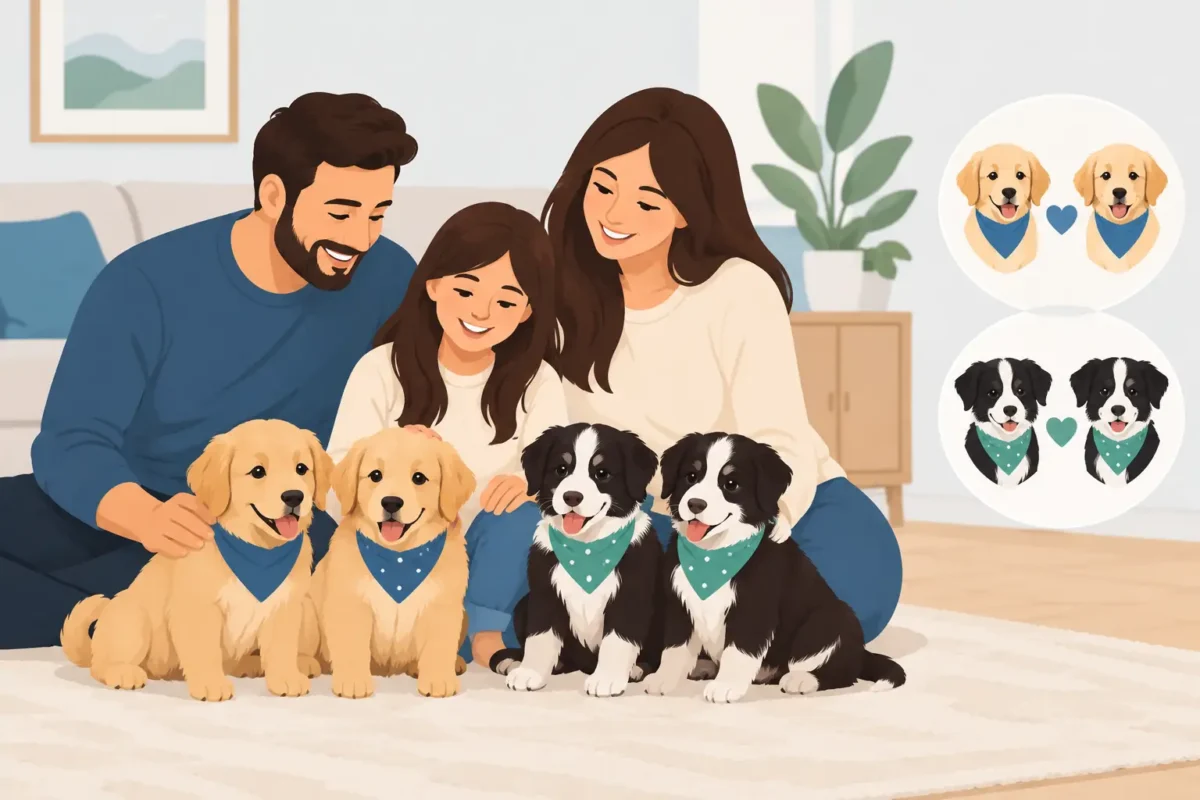
See practical family puppy matching examples for choosing a Toy or Mini Australian Shepherd by children, home, schedule, energy, and support needs at home.
A blue-eyed merle puppy may get the first reaction from the family, but color does not tell you whether that puppy belongs in your home. Family puppy matching examples are useful because they force the right conversation before a deposit is placed: Who is home during the day? How active is the household? Are the children calm and dog-aware, or young and unpredictable? What size dog can the adults realistically manage for the next 12 to 15 years?
A well-bred Toy or Mini Australian Shepherd can be an outstanding companion, but this is still an intelligent working breed. Smaller size does not erase the need for training, structure, exercise, and daily involvement. The correct puppy is not necessarily the boldest, smallest, flashiest, or most photographed one. It is the puppy whose developing temperament, expected size, and energy level make sense for the actual household.
At Hughes Toys, matching is handled as a placement decision, not a color-shopping exercise. More than 30 years of breed-specific experience teaches a breeder what online photos cannot: some puppies naturally settle more easily, some are more socially forward, some need more direction, and some fit best with people who want an active training project.
What a Responsible Puppy Match Looks At
Good matching starts with the family, then considers the litter. A responsible breeder evaluates the parent dogs, health testing, multi-generation ASDR registration, veterinary care, and the conditions in which puppies are raised. Those details matter because temperament is not accidental. It is influenced by genetics, purposeful selection, early care, and the home that continues the work.
Then comes the practical side. Expected adult size matters when a family has toddlers, elderly relatives, apartment rules, or limited ability to handle a stronger dog. A Teacup Small Toy Australian Shepherd may be
under 12 inches at maturity, while a larger Mini may be better suited to a household that wants a sturdier small dog. Neither is automatically better. The trade-off is simple: very small dogs are easier to carry and fit in compact spaces, but they also require more protection from rough handling and chaotic foot traffic.
Energy level matters just as much. Companion-oriented Australian Shepherds are deliberately selected for calmer temperaments and lower herding drive than many working-line Aussies. That does not mean they are decorative dogs. They still need walks, play, training, mental engagement, and a family that does not treat intelligence as an optional feature.
Family Puppy Matching Examples in Real Homes
The following examples show how a serious match can look. They are not promises that any puppy will behave a certain way. Puppies are living animals, and families must provide consistent training. They do show why the same litter can contain different fits for different homes.
The Portland family with young children
This household has two children under eight, a fenced yard, and parents who work regular daytime hours. They want a dog the children can grow up with, but they do not want an intense, high-drive dog that constantly chases, nips, or demands a job.
A good match is often a medium-energy Toy or Mini Australian Shepherd puppy with a naturally steady, people-focused disposition. The family should not select strictly for the smallest puppy if the children are still learning how to handle a dog appropriately. A slightly more substantial Toy or smaller Mini may be the safer, more practical choice.
The adults need to take ownership of training. Children can help with supervised feeding, gentle grooming, and simple cues, but they cannot be the puppy’s primary handlers. This family benefits from a puppy that can settle after activity, but it must still commit to crate training, controlled play, and teaching children not to pick up, corner, or disturb a resting puppy.
The active couple in a condo
This couple lives in a Portland-area condo, works partly from home, and hikes or walks most days. They want an alert, trainable companion that is small enough for city living and travel. They do not have children, and they understand that a smart puppy needs more than a quick trip outside.
A confident Toy Australian Shepherd or smaller Mini with moderate energy may fit this home very well. The lack of a yard is not the deal-breaker many buyers assume it is. A yard is useful, but it does not replace interaction. A dog can become bored in a large yard just as easily as
in a condo if nobody provides direction.
The trade-off is that condo owners must be honest about noise, potty schedules, elevator access, and socialization. A puppy needs safe exposure to city sounds, visitors, cars, surfaces, and calm dogs. This household may have the time and consistency to handle a more alert puppy, but it should still choose a dog with an off-switch rather than assuming activity alone solves everything.
The family with older teens and a busy schedule
This home has teenagers involved in sports, school activities, and part-time work. Everyone says they want a puppy, but the parents recognize that their schedule is uneven. Some days the house is active; other days it is empty until evening.
This is where blunt honesty matters. A puppy is not a shared family accessory that trains itself because several people like dogs. If the adults cannot commit to the morning routine, socialization plan, veterinary appointments, and training follow-through, the timing may be wrong.
If the family is ready, a calmer, lower-demand puppy is usually the better match than the most outgoing, busy puppy in the litter. They should plan for a reliable midday break during early puppyhood and decide in advance who handles each responsibility. An intelligent Australian Shepherd will notice inconsistent rules immediately. One person allowing couch jumping, another correcting it, and a third ignoring it creates confusion, not a well-adjusted companion.
The retired household seeking a close companion
A retired couple wants a smaller Australian Shepherd because they enjoy the breed’s loyalty and expressive personality but no longer want a large, physically demanding dog. They have time at home, enjoy neighborhood walks, and want a puppy that will be closely involved in daily life.
A Toy Australian Shepherd with a calmer, affectionate temperament may be a strong match, provided the couple can safely manage the dog’s needs. A smaller dog still requires grooming, training, dental care, routine veterinary care, and protection from falls or accidental injury. If mobility is limited, a very tiny puppy may not be the practical choice. A slightly larger Toy or Mini can offer a better balance of manageable size and physical durability.
This home often excels at consistency. Retired owners may have more time for short training sessions, structured naps, and supervised socialization. The key is avoiding overattachment from day one. A puppy should learn to rest independently, tolerate brief separations, and feel comfortable with trusted visitors and family members.
The experienced Aussie owner wanting a smaller dog
This buyer has owned standard Australian Shepherds before and wants the intelligence and responsiveness of the breed in a more manageable package. They may prefer a striking red merle, blue merle, or blue-eye tri, but they understand that appearance comes after sound breeding and household fit.
This household may be appropriate for a more engaged, trainable puppy, especially if it enjoys obedience, rally, tricks, or regular outdoor activity. Still, prior breed experience should not become overconfidence. Toy and Mini Australian Shepherds are not standard Aussies shrunk down by a label. Adult size, physical delicacy, and individual temperament should be evaluated on their own terms.
A breeder should be able to discuss the puppy’s expected size range, family tendencies, social style, and activity level with more substance than, “This one is sweet.” Every puppy is sweet at eight weeks. The useful question is how that puppy responds to people, novelty, rest, handling, and its littermates over time.
Questions That Produce Better Matches
Buyers get better recommendations when they provide accurate information instead of the answer they think a breeder wants. Say if you have a toddler who carries toys everywhere. Say if your workdays run 10 hours. Say if your apartment has strict weight limits. Say if you want a dog that can join long hikes, or if you mainly want a companion for walks and evenings at home.
Ask about the parents’ sizes and temperaments, the puppy’s expected adult size,
health testing, veterinary checks, registration, and the breeder’s health guarantee. Ask what the puppy has experienced before placement and what training will be needed immediately after arrival. For out-of-state families, ask how organized delivery or pet-nanny transportation works and how the transition will be managed.
Do not ask a breeder to promise a puppy will never bark, shed, herd, become anxious, or need training. That is not an honest standard. Ask instead which puppy is most likely to fit your routine and what work will be required to make that placement successful.
Choose the Puppy You Can Raise Well
The best match is usually less dramatic than buyers expect. It is the puppy whose needs fit the schedule you actually keep, whose size suits the people in the home, and whose temperament gives your family a fair starting point. Bring home the puppy you can train, protect, and include every day, and you give that dog the kind of permanent place it deserves.