Toy vs Mini Aussie: The Real Size Difference (2026)

Toy and Miniature Australian Shepherds are the same breed with the same coat, colors, and herding instinct — the difference is adult size, and size drives almost everything else about which one fits your home. A Toy Australian Shepherd stands 10 to 14 inches at the shoulder and weighs 12 to 25 pounds full grown, while a Miniature Aussie (often called a Miniature American Shepherd) stands 14 to 18 inches and weighs 20 to 50 pounds. The hidden factor buyers miss: registry status differs too, since the Miniature American Shepherd is AKC recognized and the Toy is not.
TL;DR
  • The difference between toy and mini Aussie comes down to adult size: Toy Australian Shepherds run 10-14 inches and 12-25 pounds, Miniature Aussies run 14-18 inches and 20-50 pounds.
  • Both sizes share the same herding drive, coat, and color patterns as standard Australian Shepherds — size is the split, not temperament.
  • Miniature American Shepherds gained AKC recognition in 2015; Toy Australian Shepherds are registered through toy-specific registries instead.
  • Hughes Toys breeds both sizes and matches puppies to families based on activity level, not just the size label.
Toy vs mini size at a glance
10-14 in
Toy Aussie height
12-25 lbs
Toy Aussie weight
14-18 in
Mini Aussie height
20-50 lbs
Mini Aussie weight

Why this matters

Buyers searching for the difference between toy and mini Aussie are usually deciding between two puppies that look nearly identical in photos but grow into different-sized adult dogs. Get the size wrong and you end up with a dog too big for an apartment lease or too small for the hiking pace you had in mind. In 2026, both sizes remain popular for families who want Australian Shepherd intelligence and herding energy without the 50-65 pound frame of a standard Aussie. The confusion also comes from marketing. Some sellers use “toy,” “mini,” and “teacup” loosely, so the actual numbers matter more than the label on a listing.

What’s the difference between toy and mini Aussie?

The short version: both are small versions of the standard Australian Shepherd, developed by breeding down in size while keeping the coat, color patterns, and working drive intact. The split between them is a height and weight line, not a difference in genetics, personality, or coat type.
Trait Toy Australian Shepherd Miniature Aussie
Height 10-14 inches 14-18 inches
Weight 12-25 lbs 20-50 lbs
Coat & colors Same as standard Aussie Same as standard Aussie
Herding drive Present, same instinct Present, same instinct
AKC status Not AKC recognized AKC recognized (Herding Group, since 2015)
Registry Toy-specific registries (ASDR, NSDR) AKC and MASCA
Verdict: pick by adult size and living space, not by which name sounds cuter. A Toy Australian Shepherd and a Miniature Aussie from the same litter’s parents can look almost identical as 8-week-old puppies — the size gap only becomes obvious by 6 to 9 months.
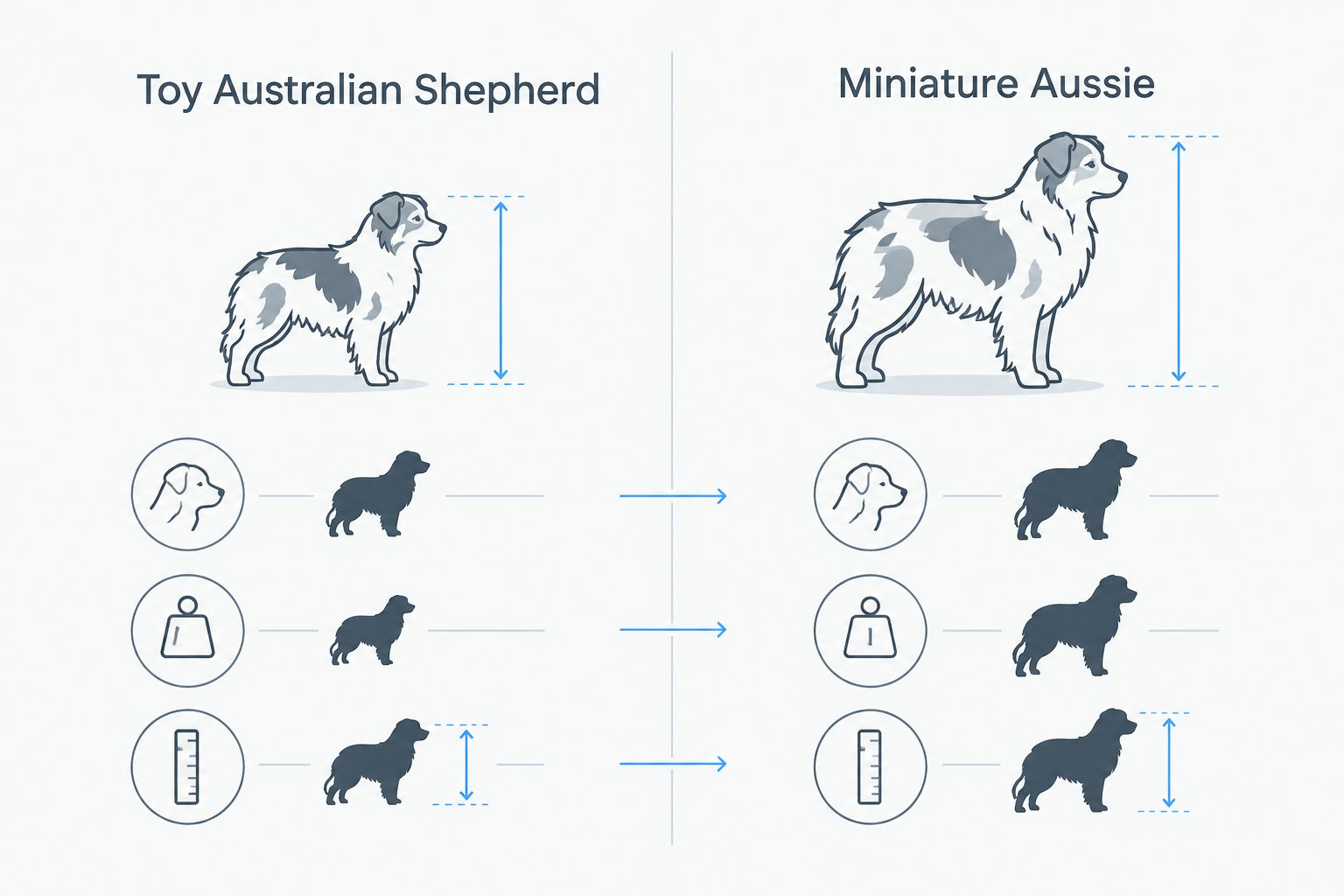
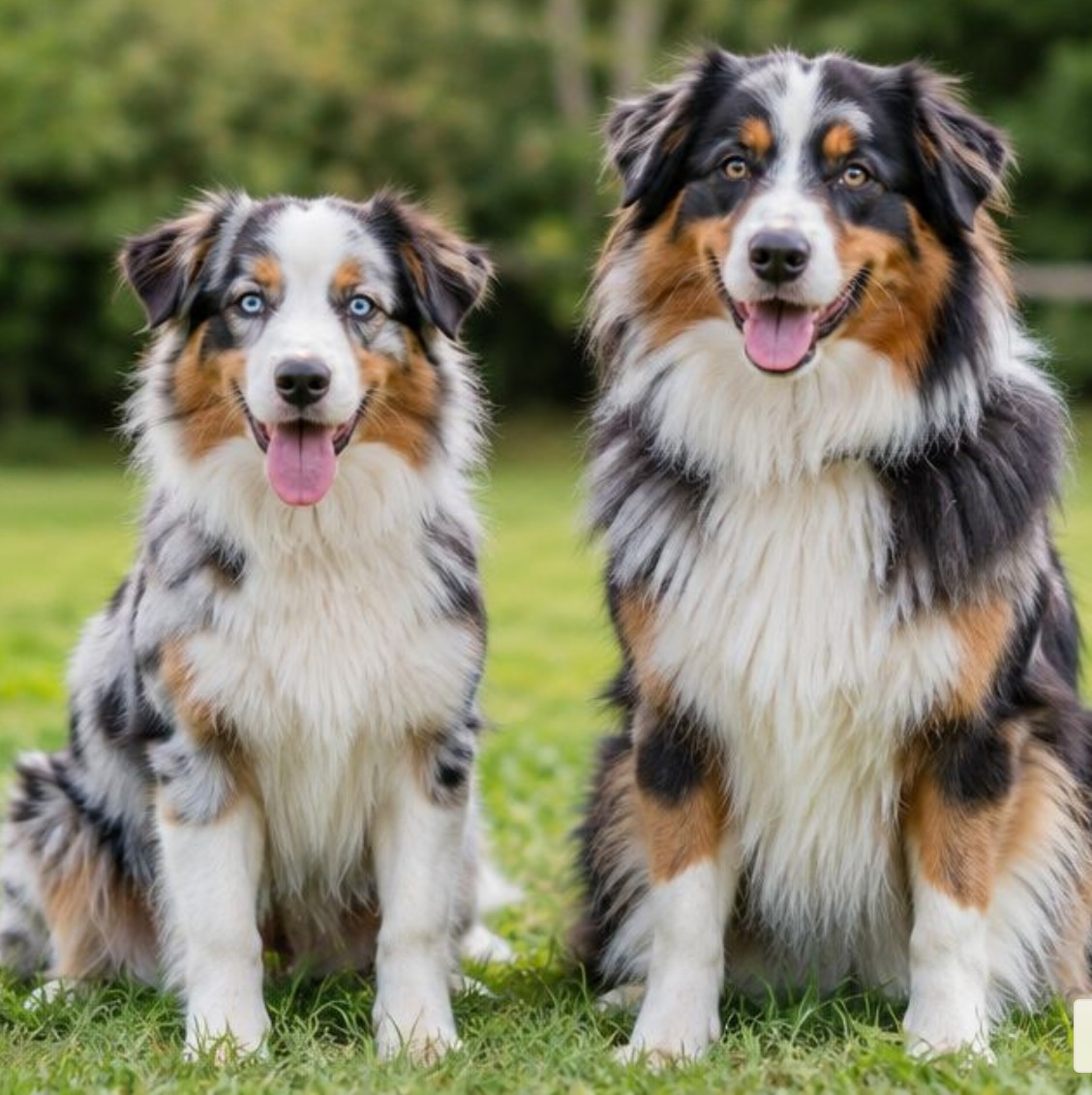
Two-column comparison of Toy Australian Shepherd and Miniature Aussie sizes
The size gap is the only structural difference between the two — coat, color, and drive stay the same.

Toy Australian Shepherd: 10-14 inches

A Toy Australian Shepherd tops out at 10 to 14 inches at the shoulder and 12 to 25 pounds as an adult, making it small enough to travel in a carrier and live comfortably in an apartment. It still carries the full Australian Shepherd instinct set — herding nips at ankles, high alertness, and a need for daily mental work, not just a walk around the block. Pros:
  • Fits small living spaces and apartments without size restrictions
  • Easier to lift, crate, and transport than a standard Aussie
  • Same intelligence and trainability as larger Aussies
Cons:
  • Not AKC recognized, so registration options are narrower
  • Smaller joints can be more sensitive to jumping off furniture or high beds
  • Herding drive in a small body still needs daily structured exercise
Best for: apartment dwellers and first-time Aussie owners who want the breed’s personality in a compact frame. Buy if your household can commit to daily mental stimulation regardless of size.

Miniature Aussie: 14-18 inches

A Miniature Aussie, also called a Miniature American Shepherd, stands 14 to 18 inches and weighs 20 to 50 pounds as an adult — noticeably sturdier than a Toy but still well under a standard Aussie’s 50-65 pound range. This size gained AKC recognition in the Herding Group in 2015, which opens up conformation and herding trials that Toy Aussies can’t enter under AKC rules. Pros:
  • AKC recognized, giving access to AKC events and a wider registry pool
  • More physically durable for active families with kids or hiking routines
  • Still small enough for many apartments and smaller yards
Cons:
  • Larger than a Toy, so it needs more room to move indoors
  • Higher end of the weight range (closer to 50 lbs) can surprise buyers expecting a small dog
  • Same high energy and herding instinct as any Aussie size
Best for: active families with a yard or regular hiking access who still want a smaller dog than a standard Aussie. Buy if you want AKC eligibility alongside a compact size.
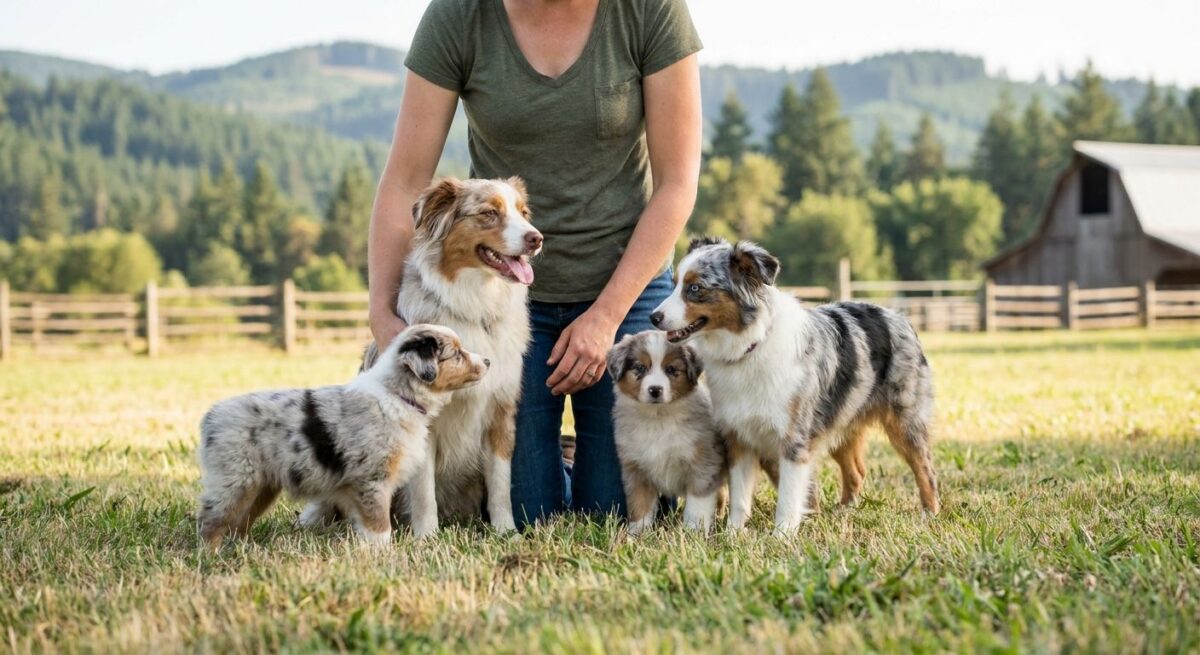
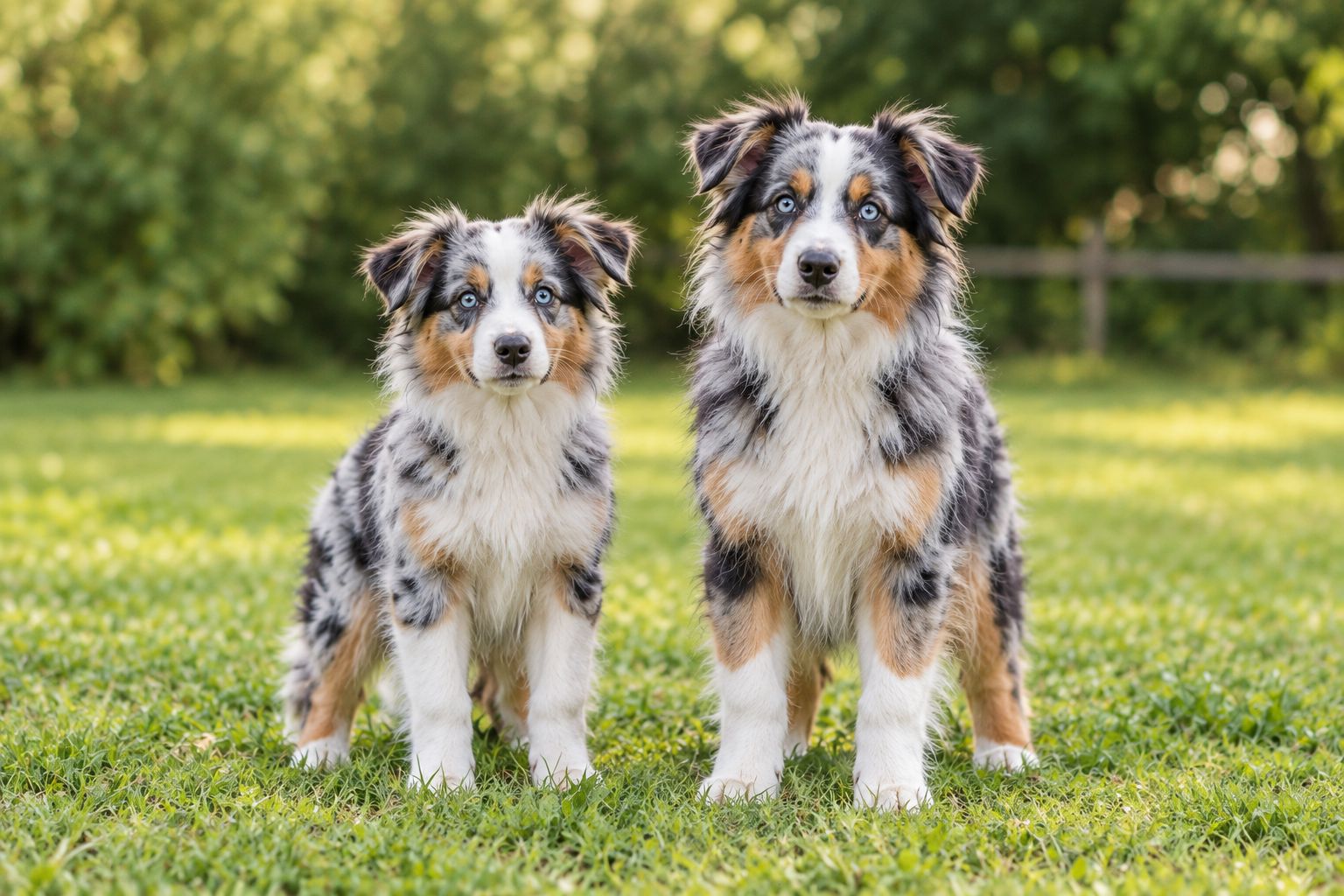
Two herding-breed puppies of different sizes standing together outdoors
Size differences between the two become clear by 6 to 9 months, not at 8 weeks.

Why size varies within toy and mini Aussies

Even within the toy and mini categories, individual dogs land at different points on the height and weight range. A handful of factors drive that:
  • Parent size — puppies from smaller parents on both sides trend toward the low end of the range
  • Litter position — the runt or largest pup in a litter can skew several inches from littermates at maturity
  • Growth plate closure — most Aussies of any size finish growing between 12 and 18 months, and early measurements can undersell adult size
  • Diet and body condition — an overweight dog reads bigger on a scale without being taller
  • Registry standard differences — ASDR, NSDR, and MASCA each define their own height cutoffs, so a dog labeled “mini” by one registry might fall under a different registry’s “toy” line

Talk through toy vs mini sizing

See current litters and get help matching size to your household.

Is a toy Aussie the same as a teacup Aussie?

No — “teacup” is not a recognized size category for Australian Shepherds; it’s a marketing term some sellers use for undersized Toy Aussies, often under 10 inches. A true Toy Australian Shepherd falls in the 10 to 14 inch range, and dogs marketed smaller than that carry higher health risk from breeding for extreme miniaturization.

Do toy and mini Aussies have the same energy level?

Yes — energy level in toy and mini Aussies matches the standard Australian Shepherd, since the size reduction doesn’t change temperament or drive. Both sizes need daily exercise and mental engagement; a smaller body does not mean a lower-energy dog.

How much bigger is a mini Aussie than a toy Aussie?

A Miniature Aussie runs roughly 4 inches taller and 8 to 23 pounds heavier than a Toy Australian Shepherd at full maturity, based on the 10-14 inch/12-25 lb Toy range versus the 14-18 inch/20-50 lb Miniature range. That gap is enough to change which size fits a small apartment versus a house with a yard.

FAQ

What’s the difference between toy and mini Aussie?

The difference between toy and mini Aussie is adult size: Toy Australian Shepherds stand 10-14 inches and weigh 12-25 lbs, while Miniature Aussies stand 14-18 inches and weigh 20-50 lbs. Coat, color, and herding instinct are identical between the two.

Is a Toy Australian Shepherd the same breed as a Miniature American Shepherd?

No, they are related but distinct size categories — the Miniature American Shepherd is the AKC-recognized name for the mini size, while the Toy size has no AKC recognition and uses separate toy registries instead.

Which is better for apartments, toy or mini Aussie?

A Toy Australian Shepherd at 10-14 inches and 12-25 lbs generally fits apartment living more easily than a Miniature Aussie at 14-18 inches and up to 50 lbs, though both need daily exercise regardless of size.

Do toy and mini Aussies have the same temperament?

Yes, temperament is the same across both sizes since they come from the same breed line — high intelligence, strong herding instinct, and a need for daily mental work apply to Toy and Miniature Aussies alike.

Are toy Aussies AKC recognized?

No, Toy Australian Shepherds are not AKC recognized as of 2026 — the Miniature American Shepherd holds AKC recognition in the Herding Group since 2015, while Toys register through separate registries like ASDR or NSDR.

Do toy and mini Aussies shed the same amount?

Yes, both sizes carry the same double coat and shed on a similar seasonal schedule, since coat type does not change with the size reduction between Toy and Miniature Aussies.

Which lives longer, toy or mini Aussie?

Both typically live 12 to 15 years, in line with the broader Australian Shepherd breed range, and there’s no established lifespan gap tied specifically to the toy versus mini size split.

Can a toy Aussie and mini Aussie come from the same litter?

Yes, size can vary enough within a litter that some puppies mature into the Toy range and others into the Miniature range, depending on parent genetics and individual growth.
One last thing

The size label on a puppy listing at 8 weeks old is a guess, not a guarantee — growth plates in Aussies of any size don’t fully close until 12 to 18 months, so the most reliable predictor of adult size is parent size, not the puppy’s weight at pickup. Hughes Toys tracks Toy and Miniature Australian Shepherd parent lines specifically so families get a size estimate grounded in genetics, not just a snapshot at one point in a growth curve.

Best Small Dog Breeds for Apartment Living in 2026

Small breed, big decision: not every dog under 25 pounds actually thrives in 800 square feet. This guide ranks seven of the best small dog breeds for apartment living in 2026, based on exercise needs, noise level, and how each one handles four walls and thin ceilings.
TL;DR
  • French Bulldog wins best overall small dog breed for apartment living in 2026 on low exercise needs and quiet temperament.
  • Toy Australian Shepherd is the pick for active owners who want a trainable dog that still fits a smaller home.
  • Chihuahua is the best budget-space option for studios and one-bedroom units.
  • Every breed on this list has a real drawback for apartment life — barking, shedding, or exercise demands nobody talks about.
Key numbers
7 breeds
Compared for apartment fit
12-25 lbs
Typical Toy Aussie weight range
10-15 yrs
Average lifespan across the list
Best overall: French Bulldog. Best for active apartment owners: Toy Australian Shepherd. Best budget/smallest-space option: Chihuahua.

Why this matters

Apartment leases don’t care about breed reputation — they care about noise complaints, shedding in shared laundry rooms, and whether a dog can hold it for eight hours while you’re at work. A breed that’s technically “small” can still be a bad fit if it barks at every hallway footstep or needs an hour of running room daily. The right pick in 2026 comes down to matching temperament and exercise needs to your actual square footage, not just body weight. Hughes Toys breeds Toy and Miniature Australian Shepherd puppies out of the Portland, Oregon area, and fields this question constantly from Oregon, Washington, and California families living in condos and apartments. The short answer: size alone doesn’t decide it.

What makes the best small dog breed for apartment living

  • Exercise floor, not ceiling — how little activity the breed tolerates before it gets destructive or anxious
  • Noise habits — bred-in tendency to bark at doors, hallways, or other dogs
  • Shedding and grooming load — relevant in shared laundry and small living spaces
  • Trainability — how fast the breed picks up potty routines and settling cues in close quarters
  • Temperament with strangers — matters for shared elevators, hallways, and dog-friendly buildings
  • Alone-time tolerance — whether the breed handles a workday without separation anxiety

Small dog breeds for apartment living at a glance

Breed Best for Standout feature Key limitation
French Bulldog Best overall Low daily exercise need Heat and breathing sensitivity
Toy Australian Shepherd Active apartment owners Fast, structured trainability Needs mental work, not just space
Cavalier King Charles Spaniel Families with kids Even, affectionate temperament Prone to separation anxiety
Boston Terrier First-time owners Easy short coat, low grooming Can be vocal with strangers
Bichon Frise Allergy-sensitive households Low-shedding coat Grooming upkeep every 4-6 weeks
Dachshund Owners who want a watchdog Alert, big personality Barks at hallway noise
Chihuahua Smallest floor plans Tiny footprint, low food cost Can be reactive to strangers

1. French Bulldog: best small dog breed for apartment living overall

French Bulldogs need short walks, not runs, and settle into couch life easily — which is exactly why they’ve dominated apartment-dog recommendations through 2026. Their flat face means they overheat fast, so summer walks in Portland or Sacramento need to happen early or late in the day. French Bulldog pros:
  • Content with two 15-minute walks a day – cannot handle heat or rapid changes in temperature.
  • Generally quiet unless provoked
  • Compact, sturdy build handles small-space life well
French Bulldog cons:
  • Breathing issues in heat or humidity – make loud noises constantly while just breathing
  • Prone to skin fold infections needing regular cleaning
  • Can snore loudly enough to bother a light sleeper
Verdict: Buy if your building has climate control and you’re not chasing a running partner.

2. Toy Australian Shepherd: best for active apartment owners

Toy Australian Shepherds pack the same intelligence and herding drive as a standard Aussie into a body that runs 12-25 pounds, which makes them a real option for apartment living — but only for owners ready to give them a job. Hughes Toys specifically breeds for a calmer , less herding temperament-matches every puppy specifically because this breed does poorly in homes expecting a couch ornament. Toy Aussie pros:
  • Learns commands and house routines quickly
  • Bonds tightly and travels well in smaller vehicles or elevators
  • Adaptable to apartment square footage when given daily structured activity
Toy Aussie cons:
  • high drive herding lines can have Herding instinct can mean nipping at heels or chasing hallway movement
  • Needs puzzle toys or training drills, not just a walk, to avoid boredom barking
  • Sheds a moderate double coat that needs weekly brushing
Verdict: Buy if you can commit to daily mental and physical work; Wait if your schedule is 10-hour workdays with no midday break.

3. Cavalier King Charles Spaniel: best for families with kids

Cavaliers are built for laps and gentle handling, which makes them a strong match for apartment families with young kids who want a dog that won’t knock a toddler over. They’re consistently ranked as one of the more even-tempered toy breeds heading into 2026. Cavalier pros:
  • Gentle with children and other pets
  • Low territorial aggression toward strangers
  • Comfortable in small spaces with moderate exercise
Cavalier cons:
  • Prone to separation anxiety if left alone long stretches
  • Known for heart (HCM) and joint health issues that need monitoring
  • Long ears require regular cleaning to avoid infection
Verdict: Buy for family apartments with someone home most of the day.

4. Boston Terrier: best for first-time apartment owners

Boston Terriers offer an easy-care coat and a friendly disposition that suits owners who’ve never managed a dog’s grooming or exercise routine before. Their short hair means less upkeep than the Bichon or Cavalier on this list. Boston Terrier pros:
  • Minimal grooming beyond occasional brushing
  • Friendly, adaptable to new environments and routines
  • Moderate exercise needs fit a standard apartment schedule
Boston Terrier cons:
  • Can bark at hallway noise or delivery knocks
  • Flat face carries some of the same heat sensitivity as the French Bulldog
  • Prone to gas issues that aren’t ideal in small rooms
Verdict: Buy for a low-maintenance first dog in a climate-controlled unit.

5. Bichon Frise: best for allergy-sensitive households

Bichons carry a curly, low-shedding coat that makes them a common recommendation for apartment dwellers dealing with allergies or shared HVAC systems. They’re cheerful and social, which suits buildings with a lot of dog-friendly common space. Bichon Frise pros:
  • Low-shedding coat reduces allergen spread in small units
  • Friendly with strangers and other dogs
  • Small size fits studio and one-bedroom layouts
Bichon Frise cons:
  • Needs grooming every 4-6 weeks to prevent matting
  • Can develop separation-related barking
  • Housetraining tends to take longer than other breeds on this list
Verdict: Buy if allergy concerns outweigh the grooming bill.

6. Dachshund: best for owners who want a built-in watchdog

Dachshunds bring a big-dog bark and alert temperament in a body built low to the ground, which appeals to apartment owners who want a dog that’ll actually announce a knock at the door. That same alertness is the tradeoff — neighbors notice. Dachshund pros:
  • Alert and vocal about visitors or unusual noise
  • Compact size, low food and space needs
  • Loyal, bonds closely with one or two people
Dachshund cons:
  • Barking can become a lease issue in thin-walled buildings
  • Long spine is prone to disc injury from jumping off furniture or stairs
  • Can be stubborn during housetraining
Verdict: Hold unless your building tolerates a vocal dog.

7. Chihuahua: best for the smallest floor plans

Chihuahuas are the smallest breed on this list and the lowest-cost to feed and house, which makes them the default pick for studio apartments with genuinely limited square footage. Their size is the whole pitch — everything else takes more management. Chihuahua pros:
  • Smallest footprint of any breed here, ideal for tight layouts
  • Low food and supply costs relative to larger small breeds
  • Portable enough for elevators, rideshares, and small closets as crate space
Chihuahua cons:
  • Can be reactive or snappy with strangers if not socialized early
  • Fragile enough that households with young kids need extra supervision
  • Prone to shivering and cold sensitivity in poorly heated units
Verdict: Buy for solo apartment dwellers with genuinely minimal space; Skip for households with small children.

How this list was ranked

Each breed above was scored against the same six criteria: exercise floor, noise habits, shedding load, trainability, stranger temperament, and alone-time tolerance. No breed scored well on all six — the ranking reflects which tradeoff each one asks an apartment owner to accept, not a claim that one breed beats every other on every axis.

“Size alone doesn’t decide whether a dog fits an apartment — exercise floor and noise habits do.”

Which small dog breed should you choose for apartment living in 2026?

If you want the lowest-effort apartment dog and your building stays cool, the French Bulldog is still the safest default in 2026. If you’re active, work from home or have a flexible schedule, and want a dog smart enough to actually train, the Toy Australian Shepherd is the better long-term fit — Hughes Toys temperament-matches each Toy Australian Shepherd puppy to the household before placement specifically to avoid mismatches with low-activity owners. For the smallest units with the tightest budgets, the Chihuahua remains the practical choice.

Ask about a Toy or Mini Aussie puppy

Get matched with a temperament-tested puppy suited to apartment life.

FAQ

What is the best small dog breed for apartment living in 2026?

The French Bulldog is the best overall pick for apartment living in 2026 because of its low exercise needs and generally quiet temperament. Owners who want a trainable, more active dog should consider the Toy or Miniature Australian Shepherd instead.

Is a Toy Australian Shepherd good for an apartment?

A Toy Australian Shepherd can do well in an apartment if given daily structured exercise and mental work like puzzle toys or training drills. Without that, the breed’s intelligence tend to show up as boredom barking .

Which small dog breeds bark the least in apartments?

French Bulldogs and Cavalier King Charles Spaniels tend to be quieter than Dachshunds and Boston Terriers, which are more prone to alerting on hallway noise. No breed is guaranteed silent — individual temperament and training matter as much as breed tendency.

What is the smallest low-maintenance dog for an apartment?

The Chihuahua has the smallest footprint and lowest supply cost of the breeds compared here, making it the default pick for studio apartments. It needs early socialization to avoid reactivity with strangers in shared hallways.

Do small dogs shed less than large dogs in apartments?

Shedding depends on coat type, not size — the Bichon Frise sheds very little while the Toy and Miniature Australian Shepherd carries a moderate double coat that needs weekly brushing. Check coat type specifically rather than assuming small means low-shedding.

Can a Toy Australian Shepherd be left alone during a workday?

A Toy Australian Shepherd can tolerate a standard workday if it gets exercise and mental stimulation before and after, but it is not suited to being alone for 10+ hours with no midday break it is best to have another dog for company.

Which small dog breed is best for apartment families with kids?

The Cavalier King Charles Spaniel ranks highest for families with young children due to its even, gentle temperament. The Chihuahua is a weaker fit for households with small kids given its smaller, more fragile build.

One last thing

The detail most apartment guides skip: exercise needs and noise habits predict apartment success far better than adult weight does. A 28-pound Toy Australian Shepherd that gets a structured routine can be an easier apartment neighbor than an 8-pound Chihuahua that barks at every hallway sound. Weigh the breed’s actual daily needs against your schedule before you weigh the dog.

Best harnesses for toy Australian shepherd puppies: Fit 2026

Best overall: an adjustable Y-front harness. Best for backing-out concerns: a three-strap harness. Best budget shortlist: simple adjustable step-in harnesses. Forb Hughes Toys- Toyminiaussies puppy buyers, an adjustable Y-front harness is the best starting point when it fits the puppy’s current body and allows comfortable movement.
TL;DR
  • The best harnesses for toy australian shepherd puppies fit the individual puppy, not just the breed label.
  • Toyminiaussies puppy buyers should start by comparing adjustable Y-front harnesses for everyday walks and leash training.
  • Three-strap harnesses deserve consideration when a puppy backs out of ordinary designs.
  • Measure the puppy before ordering; coat fluff and size labels are not reliable sizing guides.

Why this matters

A Toy Australian Shepherd puppy needs equipment that fits now, not equipment chosen for the adult dog you expect. A loose harness leaves room to slip out. A tight or poorly positioned harness can rub, restrict comfortable movement, or make getting dressed unpleasant. The best choice also depends on how your puppy behaves. A puppy comfortable with handling needs a different dressing routine from one that ducks away from an overhead opening. Pulling and backing away are different problems, too. This 2026 guide ranks harness designs rather than individual retail products. The useful decision is which construction suits your puppy; the final purchase still needs a model-specific measurement chart and an on-puppy fit check.

What makes the best puppy harness

Use these criteria before choosing a style:
  • Current fit: The manufacturer’s measurements should match your puppy’s body without relying on thick coat to fill gaps.
  • Adjustment: Chest and neck adjustment help you fit the harness accurately. Adjustment does not make an oversized harness safe.
  • Movement: Watch the puppy walk, turn, sit, and lower its head. Straps should not visibly interfere with those movements.
  • Dressing method: Choose an overhead, buckle-opening, or step-in design your puppy can learn to accept calmly.
  • Attachment and construction: Check the leash ring, buckles, seams, and strap placement. Hardware should suit the puppy’s size without dragging the harness sideways.
  • Retention: Test how the harness behaves when the puppy turns or backs away. No design earns an escape-proof promise.
Choose fit before features. An extra leash ring does not fix a loose neck opening, and more padding does not fix a strap rubbing behind the front legs.

Best puppy harnesses at a glance

The 2026 shortlist below gives each design a distinct job. Harness categories overlap: a Y-front model can also have a front attachment or an additional belly strap.
Rank and design Best for Standout feature Key limitation
Adjustable Y-front Everyday walks and early leash lessons Chest straps meet in a Y-shaped arrangement Fit varies between models; some require overhead dressing
Three-strap harness Puppies that back away from the leash Additional strap behind the ribcage More straps require careful positioning and adjustment
Adjustable step-in Puppies uncomfortable with overhead dressing Front feet step into the openings Leg openings and chest fit need close checking
Soft vest harness Puppies that accept a close-fitting fabric body Broad fabric contact rather than narrow straps alone Fabric coverage can hide a poor fit and hold moisture
Front-attachment harness Handler-guided loose-leash practice Leash attaches at the chest Sideways leash pressure can rotate a poorly fitted harness

1. Adjustable Y-front: best puppy harness for everyday walks

An adjustable Y-front harness has chest straps that form a Y-shaped arrangement, with the center section running between the front legs. Look for a version whose adjustment points let you fit both the neck opening and the chest strap. This is the default design to compare for a Toy Australian Shepherd puppy. It gives you a straightforward starting point without making pulling-control features the main reason for buying. Adjustable Y-front pros:
  • Separate adjustment points help accommodate different body proportions.
  • Strap placement is easier to inspect than beneath a fully covered vest.
  • A back attachment supports ordinary supervised leash practice.
  • Some versions open at the neck, avoiding an overhead dressing step.
Adjustable Y-front cons:
  • The same size label can fit differently across manufacturers.
  • An overhead-only version adds a handling step for a worried puppy.
  • Loose adjustment can let the harness shift when the puppy turns.
Best for: Everyday walking, toilet trips, and first leash lessons. Verdict: Buy an adjustable Y-front harness when its measurements and on-puppy fit both check out.

2. Three-strap harness: best puppy harness for backing-out concerns

A three-strap harness adds a strap behind the ribcage to the usual neck and chest arrangement. Its purpose is additional retention when a dog reverses away from the handler. That extra strap makes correct sizing especially important. It should follow the manufacturer’s placement instructions, not simply be tightened wherever it lands. A harness cannot replace safe handling around traffic, gates, or unfamiliar dogs. Three-strap harness pros:
  • Adds another fit point for puppies that back away.
  • Offers an alternative when an ordinary design slips during supervised checking.
  • Makes retention a deliberate selection criterion rather than an afterthought.
Three-strap harness cons:
  • More adjustment points create more opportunities for incorrect fitting.
  • The rear strap needs careful checking as the puppy grows.
  • Additional straps and buckles add dressing steps.
Best for: Puppies that reverse out of ordinary harnesses or become worried on walks. Verdict: Buy only after confirming correct rear-strap placement; skip any escape-proof claim.

3. Adjustable step-in: best puppy harness for avoiding overhead dressing

A step-in harness lets you place the puppy’s front feet into openings before fastening the harness around the body. This avoids pulling an opening over the head, although you still need the puppy to tolerate foot placement and fastening. For a budget-focused 2026 shortlist, compare simple adjustable versions rather than choosing decorative extras. Keep the same fit standards. A basic design is not a bargain if its openings are wrong for your puppy. Adjustable step-in pros:
  • Avoids an overhead opening.
  • Offers a dressing method you can practice with the harness on the floor.
  • Simple strap designs make gaps and buckle position visible.
Adjustable step-in cons:
  • Foot handling can still worry a puppy.
  • Large leg openings can leave too much room to slip or twist.
  • Some versions offer limited adjustment around the neck area.
Best for: Puppies that dislike overhead dressing but accept gentle handling of their feet. Verdict: Buy for the dressing method, not the label; skip a step-in harness that twists during movement.

4. Soft vest: best puppy harness for a fabric-bodied fit

A soft vest harness places a broader fabric panel against the puppy’s body. Depending on the model, it fastens around the chest, uses an overhead opening, or combines fabric with adjustable straps. Inspect the edges, not just the soft center. The fabric should lie comfortably without bunching behind the front legs. After a wet outing, remove the harness and follow its care instructions before using it again. Soft vest pros:
  • Broad panels avoid relying entirely on narrow straps.
  • A clear fabric shape can make the dressing orientation easy to recognize.
  • Suits puppies that already tolerate close-fitting fabric against their bodies.
Soft vest cons:
  • Fabric coverage can make underlying gaps harder to see.
  • Wet fabric needs attention before the next outing.
  • Limited adjustment can shorten the useful fit period during growth.
Best for: Puppies comfortable wearing a fabric-bodied harness with correctly positioned edges. Verdict: Hold until you can check the leg openings, chest fit, and movement—not just softness.

5. Front-attachment harness: best puppy harness for guided leash practice

A front-attachment harness places a leash connection at the chest. Leash tension acts from a different position than it does on a back attachment, so fit and handling matter. Treat this as a training arrangement, not an automatic solution to pulling. Reward your puppy for staying near you and keeping the leash slack. Avoid dragging or sharply redirecting a small puppy through the front ring. Front-attachment harness pros:
  • Gives you a chest-level attachment to compare during supervised practice.
  • Some models also provide a back ring for a different leash arrangement.
  • Encourages a deliberate check of how leash tension affects harness position.
Front-attachment harness cons:
  • Sideways tension can rotate an incorrectly fitted harness.
  • The leash can cross near the front legs.
  • The attachment does not teach loose-leash walking by itself.
Best for: Calm, handler-guided practice after the puppy accepts wearing a harness. Verdict: Hold until basic harness comfort is established; skip it as a substitute for training.

How to measure and check the fit

For Hughes Toys- Toyminiaussies puppy buyers comparing harnesses in 2026, start with 3 measurements: chest girth, neck circumference, and body weight. Match the manufacturer’s definition of each measurement; harness neck measurements do not always use the same position as collar measurements. Use a flexible tape around the body, not around the outer edge of the coat. Weight is a supporting check, not a replacement for chest and neck measurements.

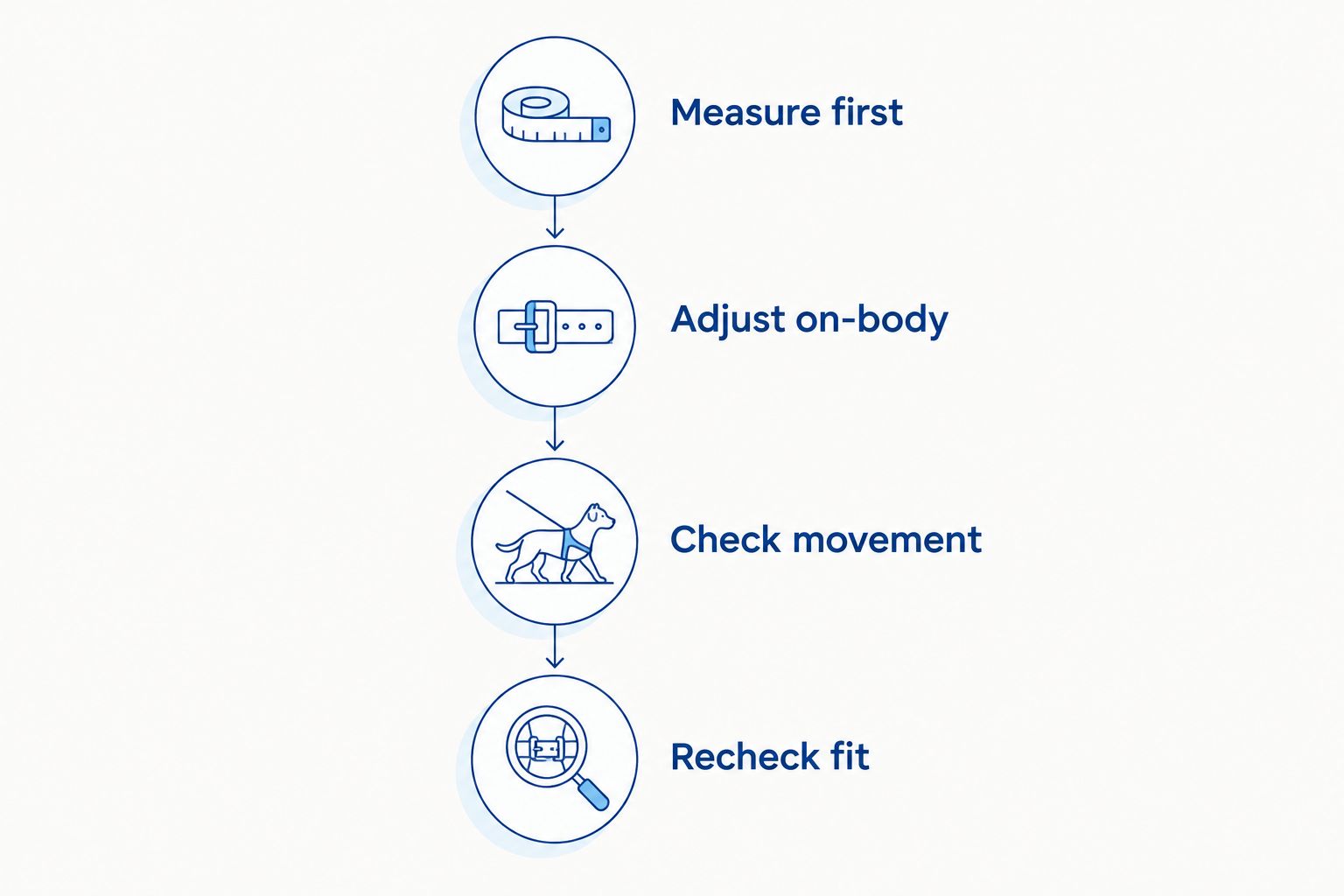
Measure first

Measure the chest at the location shown in the sizing instructions. Record the neck measurement the same way, and use a current weight rather than an estimate based on appearance.

Adjust on-body

Fit the harness according to its instructions. The familiar 2-finger check is a rough starting point, not proof of correct sizing; finger thickness and harness construction vary. Check every strap rather than testing only the easiest one to reach.

Check movement

Watch your puppy walk, turn, sit, and lower its head. Look for shifting hardware, rubbing edges, or a front leg entering an opening it should not enter.

Recheck fit

Recheck before outings and whenever growth or adjustment changes the fit. Remove the harness if you see irritation, damaged hardware, or an opening that no longer sits correctly.
Four stages for measuring, adjusting, checking movement, and rechecking a puppy harness
The sizing chart starts the process; checking the harness on the puppy completes it.

Help your puppy accept the harness

Do not make the first fitting happen while everyone is rushing out the door. Let your puppy investigate the harness, reward calm interest, and practice the dressing motion without forcing it. Start with a 60-second practice session as a suggested routine, ending sooner if your puppy becomes worried. Fasten the harness only when the puppy is comfortable with the preceding steps. Then practice a little indoor movement before adding the leash. For initial supervised walking practice, a 4-foot fixed leash is one practical starting choice. Keep it slack and use it to prevent wandering, not to pull the puppy into position. These are starting suggestions, not performance standards or breed requirements. If your puppy freezes, scratches repeatedly, or avoids being dressed, check the fit and slow the introduction. Do not assume the puppy is being stubborn.

How the harness designs were ranked

The 2026 ranking prioritizes current fit, adjustment, movement, dressing method, construction, and retention. Adjustable Y-front harnesses lead as a general starting design; the other entries address specific dressing or handling needs. These are design recommendations, not product-test scores. No style wins when its actual fit is wrong. Check the individual model rather than transferring the recommendation to every harness with a similar name.

Which puppy harness should you choose?

Choose an adjustable Y-front harness first if your puppy has no particular dressing or retention problem. Choose a step-in design when overhead dressing is the obstacle, or investigate a three-strap design when backing out is the concern. Fo r Hughes Toys -Toyminiaussies families choosing a puppy harness in 2026, the decisive question is simple: Does this harness stay correctly positioned while this puppy moves comfortably? If the answer is no, keep looking rather than tightening one strap to compensate for the wrong shape.

FAQ

What’s the best harness for a Toy Australian Shepherd puppy?

An adjustable Y-front harness is the best general starting point when it matches the puppy’s measurements and permits comfortable movement. Choose another design when dressing tolerance or backing-out behavior calls for it.

What size harness does a Toy Australian Shepherd puppy need?

Choose the size from the individual puppy’s measurements and the manufacturer’s chart, not the breed name. Chest girth and the specified neck measurement matter more than a small or extra-small label.

Is a step-in harness better than an overhead harness?

A step-in harness is better for a puppy that dislikes overhead dressing but accepts gentle foot handling. Neither dressing method guarantees a better fit.

Can a Toy Aussie puppy escape from a harness?

Yes, a puppy can slip out of an incorrectly fitted harness. Check the openings and supervised movement, and consider a correctly fitted three-strap design if backing out remains a concern.

Will a front-clip harness stop my puppy pulling?

A front attachment does not teach loose-leash walking by itself. Use calm practice and rewards for a slack leash, and check that tension does not twist the harness.

Should I buy a bigger harness for my puppy to grow into?

Do not use a harness that is loose on your puppy now. Growth room is useful only when the harness adjusts to a correct current fit.

Can my puppy wear a harness all day?

Remove the harness after supervised use rather than leaving it on unattended or during crate time. Inspect the skin and coat where straps and fabric sit.

How often should I check my puppy’s harness fit?

Check the fit before outings and after noticeable growth or adjustment changes. Stop using a harness that rubs, shifts excessively, or has damaged straps or hardware.

One last thing

A harness can look centered while your puppy stands still and shift as soon as the puppy turns. Make a short walk-and-turn check part of every fitting decision. Buy the harness that fits the moving puppy, not the photograph. That check is more useful than a long feature list.

deposit-to-doorstep-complete-toy-aussie-reservation-workflow

  Puppy reservations don’t work like online shopping carts — there’s no “add to cart, pay later” flow, and buyers who treat it that way often lose their preferred pick to someone who moved faster. Instead of guessing at the process litter by litter, follow the toy Aussie puppy reservation deposit sequence below so your spot, your pick order, and your pickup date are locked in writing before the puppies are even born.
TL;DR
  • A toy Aussie puppy reservation deposit with Hughes Toys on a litter not yet born, locks your place in pick order, not your specific puppy,
  • A deposit on a specific puppy reserves that puppy, but deposit can be transferred to another puppy .
  • Deposits are processed in the order received, so a fast response to a litter announcement beats a slow one every time.
  • Email is the most reliable communication channel with Hughes Toys — texts and calls often not received until breeder leaves home.

Why This Matters

Toy and Miniature Australian Shepherd litters are small, and popular colors or sizes go fast- many times blue merle females are reserved before litters are born . Buyers who don’t understand the deposit-to-pickup sequence show up late to the process, end up disappointed. With over 30 years raising Toy and Miniature Australian Shepherds, the process at Hughes Toys follows the same sequence every litter — deposit, pictures, updates, vet check, meeting for go home pickup.

Before You Start

Get these three things sorted before you reach out about a litter:
  • A deposit ready to send. Payment method and amount vary by litter, so confirm the current terms directly with Hughes Toys before you commit — don’t assume a figure from a past litter still applies in 2026.
  • An email address you check daily. so email is the reliable line of communication for updates, photos, and pick-order timing.
  • A rough idea of what you want before litters post. Coat color, adult size (toy vs. miniature), and temperament (companion vs. more active) all narrow your options — sort this out before a litter is live.
The gotcha that catches most buyers: reservation deposits are processed in the order received, not in the order someone first asked about a litter. A buyer who emails the moment a litter is announced and sends the deposit that same day gets pick priority over someone who took three days to decide, even if that second buyer asked first. Decide your color/size preference in advance .

Get On the Litter List

  1. Email Hughes Toys with your general interest — toy or miniature, preferred coat colors, and your household situation (kids, other pets, activity level). This isn’t a commitment, it’s how you get notified when a matching litter is expected.
  2. Watch for the litter announcement- Hughes Toys emails those with interest when litter is born as to what was delivered.
  3. Reply by email as soon as a puppy matches what you’re looking for. State clearly that you want to reserve which puppy and ask for the current deposit amount and payment method.
Expected result: you receive a reply confirming your place in line and instructions for sending the deposit.

Submit Your Deposit and Sign the Contract

  1. Send the deposit using the method Hughes Toys confirms in that litter’s reply — don’t send funds before you have that confirmation.
  2. This is where health guarantee terms, vet-check expectations, and pickup logistics are spelled out in writing.
  3. Your puppy is generally locked in once the deposit is received, so a delay here can bump you behind another buyer.
  4. Save a your deposit confirmation for your own records.

Confirm Your Puppy at 6 to 7 Weeks

  1. update on temperament assessments. Most breeders, Hughes Toys included, evaluate puppy temperament around 6 to 7 weeks old, once individual personalities are clear enough to match reliably to a home.
  2. Review the puppy profiles or photos sent to you — this is where color, size trajectory, and temperament notes come together. At Hughes Toys if something about the puppy picked does not match as to size, temperment, activity level to estimate- deposit can be transferred to another available puppy .
  3. Communicate your preferences by email and be ready to respond quickly.
  4. Confirm your final puppy selection in writing.
Expected result: you have a specific puppy assigned to you, matched on temperament rather than picked on looks alone.

Vet Check, Health Guarantee, and Pickup Prep

  1. Wait for the puppy’s vet check, which typically happens as the puppy approaches 8 weeks old — the standard age most breeders release puppies to new homes.
  2. Coordinate pickup or delivery details by email, including timing, so you’re not left improvising the day of.
  3. Prepare your home before pickup: crate, food transition plan, and a quiet first few days so the puppy can adjust.
Expected result: you take home a vet-checked puppy on the timeline you agreed to.

Troubleshooting

You emailed but haven’t heard back in a few days. Check that you used the correct email address and didn’t accidentally reply to an old thread — email is the primary channel, so a missed reply is usually a mix-up on the sending end rather than being ignored. You’re not sure if your deposit was received. Ask directly by email for written confirmation. Don’t assume a deposit went through just because a payment app shows it as sent. The puppy you initially wanted doesn’t mature as estimated. This happens when temperament assessment points a puppy toward a different kind of home than originally planned. Hughes Toys you can transfer to another available puppy or switch to a “next available” reservation for the following litter. You’re unclear on refund or transfer terms if your situation changes. Contract terms vary by circumstance, so ask Hughes Toys directly and get the answer in writing rather than assuming a standard policy applies. Pickup timing conflicts with your schedule. Raise this as early as possible once the litter’s expected go-home window is known — coordinating around an 9-week timeline works far better than trying to shift it last minute.

Ready to reserve a Toy or Mini Aussie?

Email first to check current litters and deposit terms for 2026.

What’s Next Once Your Puppy Is Reserved

Once your deposit and contract are in, the workflow shifts from active steps to waiting and checking email. Use that time to research feeding transitions, crate training, and how Toy and Miniature Australian Shepherd energy levels vary within a single litter — genetics and early development shape temperament as much as breed reputation does. Understanding that variation now helps you communicate clearly during the 6-to-7-week temperament matching step instead of picking on coat color alone.

FAQ

How much is a toy Aussie puppy reservation deposit?

Deposit amounts vary by litter, so confirm the current figure directly with Hughes Toys when a litter is announced rather than assuming a past price still applies in 2026.

When do I find out which puppy I’m getting?

At Hughes Toys the deposit applies to a specific puppy but can be transferred – around 6 to 7 weeks old, once temperament assessments are complete and personalities are distinct enough to match reliably to your household

Is a deposit refundable if I change my mind?

Refund and transfer terms are set out in the signed contract and can vary by situation, so ask directly and get the answer in writing before you send a deposit.

Should I text or email about a litter?

Email is the reliable channel. Texts and calls are often missed or unanswered until a breeder leaves home, so email keeps your reservation moving.

What age do toy Aussie puppies go home?

Puppies typically go home around 9 weeks old, after a vet check.

Can I reserve “next available” instead of a specific litter?

Yes, and it usually gets you a puppy sooner than holding out for one exact color or pairing, since your deposit carries forward to the next matching litter.

Does pick order matter if I reserve early?

Pick order is set by when your deposit is received, not by how early you first asked about a litter.

One Last Thing

The single biggest reason buyers lose their preferred pick isn’t a slow breeder response — it’s a slow buyer response. Pick order runs on deposit timing, so the family that treats a litter announcement email like an urgent message, not a browse-later one, ends up with first choice almost every time in 2026 litters.  

Puppy Biosecurity Pickup Protocol: 2026 Workflow

A puppy biosecurity pickup protocol is the checklist and timing that keeps a new Toy or Miniature Australian Shepherd puppy from picking up parvovirus, distemper, or kennel cough during the first 72 hours after leaving the breeder. Instead of winging pickup day and hoping nothing goes wrong, run the protocol below step by step so the puppy’s ride home, first vet visit, and first 48 hours at home are locked in before you ever load the crate.
TL;DR
  • A puppy biosecurity pickup protocol covers the vehicle setup, the first vet visit, and a 48-hour home quarantine before a new Toy or Mini Aussie meets other dogs.
  • Parvovirus and distemper can survive on surfaces for months, so pet stores, rest-area lawns, and vet lobby floors are the highest-risk stops on pickup day.
  • A vet-checked puppy from Hughes Toys still needs its own disinfected crate and already health checked first vet visit before go home in 2026.
  • Skipping the home quarantine window is the single most common mistake families make with a new Toy or Miniature Australian Shepherd puppy.

Why this matters

A puppy’s maternal antibodies — the protection passed through the mother’s milk — start fading around 8 weeks and are mostly gone by 16 weeks, which is exactly the window most Toy and Mini Aussie puppies go home in. Vaccines are still finishing their series during that same stretch, so there’s a real gap where the puppy is neither fully protected by mom nor fully protected by its own shots. Parvovirus is the main threat in that gap. It survives in soil, carpet, and on shoes for months, sometimes longer than a year in the right conditions, and it doesn’t care that the puppy came from a vet-checked, health-guaranteed Toy Aussie litter. The protocol below isn’t about distrusting the breeder — it’s about controlling the puppy’s exposure in the 72 hours right after pickup, which is the part nobody but the new owner controls.

Before you start

  • Health and vaccination paperwork — get the puppy’s vet record and vaccination history from the breeder at pickup, not mailed later. You’ll need it for the puppy’s vet appointment.
  • A disinfected crate or carrier — wipe it down with a pet-safe disinfectant before pickup day, especially if it’s been in a car that’s carried other dogs.
  • The gotcha: the pet store parking lot, the gas station lawn, and the vet clinic waiting room floor are the three riskiest surfaces a new puppy touches in its first week — not the breeder’s property. Plan pickup day so the puppy never sets paws on public ground before its first vet visit.

Set up your pickup vehicle

  1. Line the crate or carrier with a clean towel or puppy pad — not one that’s been used with another dog since its last wash.
  2. Bring a second towel sealed in a plastic bag for accidents on the drive; swap it in without touching the outside of the bag to the puppy’s bedding.
  3. Keep a bottle of pet-safe hand sanitizer or wipes in the front seat. Use it after every stop and before you touch the puppy again.
  4. Skip drive-throughs and gas station walks with the puppy in arms. If the puppy needs to relieve itself, set it down only on a towel you’ve brought from home, never on public grass.
Expected result: the puppy makes the entire drive home without touching a surface outside your own vehicle and your own linens.

Schedule the first vet visit

  1. Book the vet appointment for the next needed vaccination .. with Hughes Toys, puppy has first vet health check, and vaccines current until goes home.
  2. Carry the puppy into the clinic rather than letting it walk across the parking lot or lobby floor.
  3. Ask the front desk if there’s a separate puppy or “well-pet” waiting area — many clinics keep sick and healthy animals apart, and you want the healthy side.
  4. Hand over the vaccination and health record from the breeder so the vet can confirm what’s done and schedule what’s left.
Expected result: a vet has physically confirmed the puppy’s condition and vaccine scheduler, with a written record of what’s still due.

Configure the 48-hour home quarantine

  1. Pick one room as the puppy’s landing zone — a kitchen, laundry room, or bathroom with washable flooring works best.
  2. Keep resident dogs out of that room for the first 48 hours, even if they’re vaccinated and healthy. This isn’t about the resident dog’s risk — it’s about not overwhelming a puppy that’s already stressed from a car ride and a new environment.
  3. Wash your hands after handling the puppy and before handling other pets in the house during that window.
  4. Hold off on walks, dog parks, and puppy classes until the vet visit confirms the vaccine series is on track, not just because it’s the puppy’s first week.
Expected result: by hour 48, the puppy has settled, eaten normally on at least two meals, and had zero contact with unknown dogs or public ground.
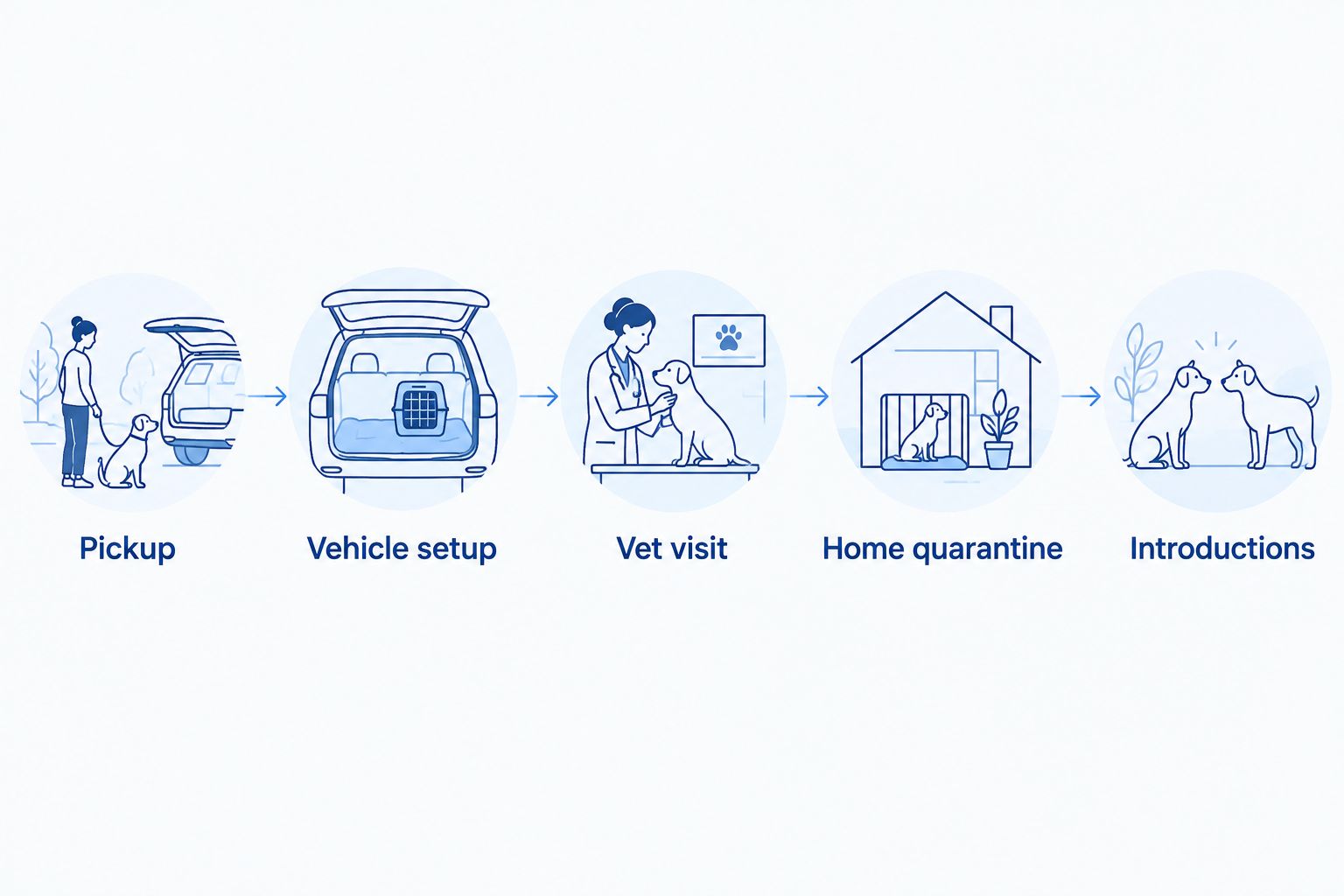
Five-step timeline from pickup day through supervised introductions
The 72-hour window between pickup and the first vet visit is where biosecurity matters most.

Long-drive-home variant

Families driving several hours to reach Hughes Toys need one extra layer. Any stop longer than a bathroom break turns into an exposure risk, so:
  • Plan rest stops around fuel and food for you, not the puppy — feed and water the puppy in the car using its own bowl.
  • If the puppy must relieve itself mid-drive, use a puppy pad on the car floor or a towel from home instead of a rest-area lawn where dozens of unknown dogs have been.
  • Carry a second sealed set of bedding for a drive over three hours — swap it at the halfway point so the puppy isn’t sitting in a soiled crate for the second leg.
This variant runs alongside the standard protocol above, not instead of it — 48 hour quarantine still apply once you’re home.

Have questions before pickup day?

Check available Toy and Mini Aussie litters and health guarantee details.

Troubleshooting

  • Puppy has loose stool the first night. Stress colitis from the car ride and diet change is common and usually clears in a day. Call the vet if it’s watery, bloody, or paired with vomiting.
  • Puppy won’t eat the first meal at home. Normal for the first 12-24 hours. Offer the same food the breeder sent home with the puppy — switching brands on day one adds a second stressor on top of the move.
  • Resident dog’s vaccine records are outdated. Get the resident dog’s vaccines current before pickup day, not after. If there’s no time, the quarantine room needs to hold for the resident dog too, not just the puppy.
  • Puppy was set down at a gas station before you read this. Don’t panic — watch for lethargy, vomiting, or loss of appetite over the next 5-7 days and call the vet immediately if any show up, rather than waiting for the scheduled visit.
  • Vet clinic doesn’t have a separate puppy waiting area. Take puppy inside in a carry crate, Do not let anyone in waiting room touch your puppy. Cleana the bottom of the crate and your shoes when get home. Can also Ask to wait in the car and have the clinic call you in when a room’s open instead of sitting in a shared lobby.

Customize your protocol

Once the puppy finishes the vaccine series — typically the last round lands around 16 weeks — the quarantine rules loosen fast. That’s the point to start structured introductions to resident pets, short leash walks on your own property, and eventually a puppy class once the vet gives the green light. The protocol above is the floor, not the ceiling. Families who add a second layer — like requiring visitors to remove shoes before handling the puppy for the first two weeks — see fewer GI upsets in that first month, based on the pattern breeders see across litters year after year. The 48-hour home quarantine are the two steps that matter most; everything else is optimization.

“The car ride home is the easy part. The first 48 hours in a new house are where a puppy’s biosecurity actually gets tested.”

FAQ

What is a puppy biosecurity pickup protocol?

It’s the set of steps a new owner follows on pickup day and for 48-72 hours after to keep a puppy from being exposed to parvovirus, distemper, or kennel cough before its immune system and vaccines are fully in place. It covers the vehicle setup, the first vet visit, and a short home quarantine.

How long should a new puppy be quarantined at home?

Most breeders recommend a 48-hour quarantine from other household pets and outside surfaces before introductions and walks begin. That window can extend longer if the vet visit turns up an incomplete vaccine schedule.

How soon should a new puppy see a vet after pickup?

Book the first vet visit when the next vaccine is due based on breeders vaccination record. confirm the puppy’s vaccine status from the breeder.

Can a vet-checked puppy still catch parvo on pickup day?

Yes. A health guarantee and vet check at the breeder covers the puppy’s condition at handoff, not what it’s exposed to afterward. Parvovirus survives on surfaces for months, so a single stop at a pet store or rest area can still expose an otherwise healthy puppy.

Is it safe to let a new puppy walk in a pet store parking lot?

No. Pet store parking lots and lawns see heavy unknown-dog traffic and are considered high-risk surfaces. Carry the puppy or use a pad or towel from home instead.

Should resident dogs meet a new puppy right away?

Wait until the 48-hour quarantine window closes and confirm the resident dog’s vaccines are current first. Early introductions add stress on top of exposure risk during the most vulnerable window.

When is a puppy fully protected by its vaccine series?

Most puppies finish their core vaccine series around 16 weeks. Maternal antibodies fade before that, which is why the pickup window needs its own biosecurity steps rather than relying on vaccines alone.

What should I bring in the car for pickup day?

Bring a disinfected crate lined with clean bedding, a sealed backup towel for accidents, and hand sanitizer for use after any stop. Feed and water the puppy from its own bowl rather than sharing surfaces.

One last thing

Most of the risk on pickup day isn’t the breeder’s property — it’s the drive home. A puppy that never touches public ground between the breeder and home already cleared the highest-risk window of 2026’s first weeks with a new Toy or Miniature Australian Shepherd puppy, before a single vaccine dose even factors in.

Mini Aussie Emotional Support Dog: 2026 Guide & Verdict

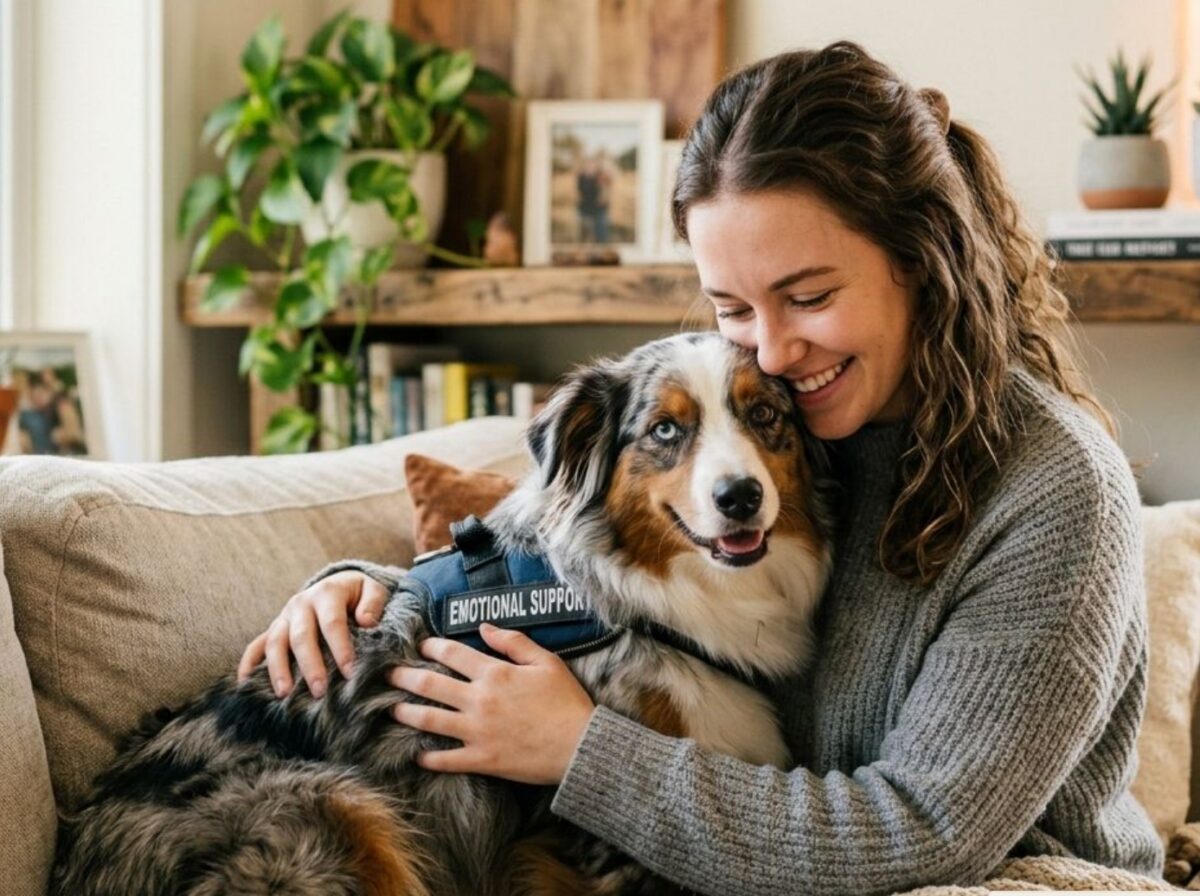
Mini Aussie emotional support dog ownership works because the breed’s tight bond with one handler and moderate size make it easier to manage anxiety, PTSD, or depression symptoms in apartments, cars, and everyday errands than a full-size Australian Shepherd allows. A Miniature or Toy Australian Shepherd reads human emotion fast, stays close without constant redirection, and settles at 12 to 35 pounds instead of the 40 to 65 pounds of a standard Aussie — the difference between a dog you can lift into a car seat during a panic episode and one you can’t.
TL;DR
  • A Mini Aussie emotional support dog needs no task training under federal law, just a mental health provider’s letter.
  • Toy and Mini Aussies weigh 12-35 lbs, small enough for apartments but active enough to need daily structured exercise.
  • ESA letters only cover housing under the Fair Housing Act in 2026 — they do not grant public access like a service dog.
  • Temperament testing before 8 weeks predicts adult calmness better than color or size alone.
  • Hughes Toys matches puppies to buyers based on documented temperament, not first-come order. Has proven bloodlines for ESA and Service Dogs.

Why this matters

An emotional support dog only has legal weight if the animal and the paperwork both hold up. The Fair Housing Act protects an ESA’s right to live with you in housing that otherwise bans pets, but it does not grant access to restaurants, stores, or planes the way a trained service dog does — that distinction trips up a lot of new owners in 2026 as more landlords ask for documentation before approving a lease exception. Picking a breed that’s naturally low-drama in confined spaces reduces the odds you’ll need to retrain behavior after the fact.

Why emotional support dogs matter for Mini Aussie owners

People choosing a Toy or Mini Aussie emotional support dog are usually solving a specific problem: they want a herding-breed brain — alert, responsive, people-focused — without the size or exercise load of a standard Australian Shepherd. Toy and Miniature Aussies keep that temperament in a smaller frame, which is why they show up so often in ESA and therapy-dog conversations compared to other herding breeds. The tradeoff buyers need to understand going in: this is still an Australian Shepherd. Herding instinct, high intelligence, and a need for mental stimulation don’t disappear just because the dog weighs 15 pounds instead of 50. A Toy or Mini Aussie left alone all day with no outlet will find one — chewing, barking, nipping at heels — and that undercuts the calm-presence job you need from an emotional support dog.

How to raise a Mini Aussie as a reliable emotional support dog

Get this settled first so you’re not scrambling after you already have a puppy home.
  • Get an ESA letter from a licensed mental health professional, not an online form mill
  • Understand the letter covers housing under the Fair Housing Act, not airlines or restaurants
  • Check your specific state’s 2026 rules — some now require the letter be dated within the last year
  • Tell your landlord in writing and keep a copy of every exchange
  • Skip registries and “ESA certification” websites that charge for a vest or ID card — none of that is legally required

Pick the right puppy from the right litter

Temperament is not evenly distributed across a litter, even from the same two parents.
  • Ask the breeder for individual temperament notes on each puppy, not just the litter as a whole
  • Look for puppies that recover quickly from a startle instead of staying rattled
  • Favor a puppy that seeks out a person over one that investigates the room first
  • Avoid the puppy labeled “most independent” if your goal is a dog that stays close
  • Confirm health testing and vet checks , since a dog managing your anxiety can’t also be managing chronic pain

Socialize deliberately in the first 16 weeks

The window before 16 weeks does more to shape adult temperament than anything you do after.
  • Expose the puppy to elevators, car rides, and different flooring surfaces early
  • Introduce calm strangers weekly, not just family
  • Pair new experiences with treats so novelty reads as safe, not threatening
  • Keep sessions short — 10 to 15 minutes beats a two-hour overwhelming outing
  • Avoid flooding the puppy with crowds before basic confidence is built

Build a daily structure the dog can predict

Mini Aussies regulate better when the day has a rhythm, and that predictability is part of what makes them steadying for you.
  • Set fixed feeding and walk times
  • Give 20 to 30 minutes of physical exercise before asking for calm behavior indoors
  • Add 10 minutes of mental work daily — a snuffle mat, a puzzle feeder, basic obedience drills
  • Keep a consistent “settle” spot near you so the dog learns where to relax during your low periods
  • Skip long stretches of total confinement; a crate all day undoes the socialization work

Train calm-on-cue behavior, not tricks

An emotional support dog’s real job is knowing when to lean in and when to back off.
  • Teach a “place” command so the dog settles on cue near you
  • Reward calm body language during your own stressed moments instead of ignoring it
  • Practice controlled greetings so visitors don’t trigger jumping or overexcitement
  • Work on loose-leash walking so outings stay low-stress for both of you
  • Avoid punishing anxious behavior in the dog — redirect instead, since punishment raises stress in a breed already wired to read your mood

Manage the breed’s exercise needs so behavior stays stable

A bored Mini Aussie is not a calm Mini Aussie, no matter how good the bloodline.
  • Budget at least 45 minutes of combined physical and mental activity daily
  • Rotate toys weekly to keep enrichment novel
  • Use short training sessions as a legitimate form of exercise on low-energy days
  • Watch for early signs of frustration — spinning, excessive licking, shadow-chasing — and add stimulation before it becomes a habit
  • Don’t assume small size means low needs; Toy and Mini Aussies still carry full Aussie drive in a smaller body

Document the relationship over time

Keep records that back up the ESA designation if a landlord or provider ever asks for more.
  • Save renewed letters annually from your mental health provider
  • Keep vet records current and accessible
  • Note specific ways the dog helps — this matters if you ever need to advocate for a housing accommodation
  • Photograph and log any training milestones
  • Avoid letting documentation lapse; an expired letter is the most common reason housing requests get denied in 2026

Comparing your options for an emotional support Mini Aussie

Option Best for Key limitation
Toy Aussie puppy from a health-tested breeder Apartment living, first-time ESA owners wanting small size Still needs 45+ minutes of daily activity
Miniature Aussie puppy from a health-tested breeder Owners with some yard space wanting more stamina for walks Slightly larger, 20-35 lbs at maturity
Adult rescue Aussie mix Owners who want to skip the puppy stage Temperament and health history are often unverified
Online “ESA registry” puppy mill listing No one — avoid No health testing, no temperament matching, frequently no real guarantee
The verdict for most first-time ESA owners is a Toy or Miniature Australian Shepherd from a breeder that documents individual puppy temperament rather than selling off a general litter description — the difference shows up in your first stressful month at home, not on paper.

Common mistakes Mini Aussie owners make with ESAs

  • Skipping the licensed provider letter and relying on an online certificate — those carry no legal weight under the Fair Housing Act
  • Choosing the boldest, most outgoing puppy in the litter assuming confidence equals calm — the two aren’t the same trait
  • Under-exercising the dog because it’s small — a Toy Aussie with pent-up energy is harder to live with, not easier
  • Expecting public access rights an ESA designation doesn’t grant, then getting turned away at a restaurant or store
  • Letting documentation lapse and losing a housing accommodation right when it’s needed most

Talk to Hughes Toys about a match

Ask about temperament-matched Toy and Mini Aussie puppies for support work.

FAQ

Is a Toy or Mini Aussie a good emotional support dog?

Yes, a well-socialized Toy or Mini Aussie emotional support dog works well because of the breed’s people-focused temperament and manageable 12-35 lb size. Herding instinct still needs daily exercise and mental work to stay stable indoors.

Do I need to register my Mini Aussie as an ESA?

No formal registry is required in 2026 — a letter from a licensed mental health professional is the only documentation that carries legal weight under the Fair Housing Act. Paid online registries and ID cards are not legally required and don’t add protection.

Can I take my emotional support Toy or Mini Aussie on a plane or into restaurants?

Generally no. ESA designation covers housing accommodations under the Fair Housing Act, not public access, so airlines and most public venues can legally deny entry to an ESA that isn’t also a trained service dog.

How much exercise does a Toy or Mini Aussie emotional support dog need daily?

Plan for at least 45 minutes of combined physical activity and mental stimulation daily. Skipping this leads to anxious or destructive behavior that undermines the dog’s calming role.

What’s the difference between a Toy and Miniature Aussie for ESA work?

A Toy Aussie typically weighs 12-25 lbs and a Miniature Aussie 18-35 lbs at maturity. Both carry the same temperament traits — the choice usually comes down to living space and how much daily walking you can commit to.

Can a landlord deny my Toy or Mini Aussie emotional support dog?

A landlord generally cannot deny a legitimate ESA with a valid letter under the Fair Housing Act, even in a no-pet building, unless the specific dog poses a documented safety or property risk. Denials usually happen when documentation is missing or expired.

How young should I start temperament testing a Toy or Mini Aussie puppy for ESA work?

Reputable breeders assess temperament starting around 6 to 8 weeks, looking at recovery from startle, people-focus, and confidence. This early read predicts adult behavior more reliably than color or size.

Do Toy or Mini Aussies bark a lot as emotional support dogs?

Toy or Mini Aussies can be vocal if under-exercised or bored, since barking is often a stress outlet for a herding breed with unused energy. Daily structured activity and consistent training cut this down significantly.

One last thing

The single biggest predictor of a Mini Aussie succeeding as an emotional support dog isn’t the letter, the leash, or even the training plan — it’s whether the puppy was matched to your specific temperament needs before you ever brought it home, which is why breeders who document individual puppy behavior at 6 to 8 weeks produce better ESA outcomes than litters sold on a first-come basis.

Traveling Home With Puppy Safely and Calmly

Traveling home with puppy safely starts before the drive or flight. Use this practical plan for secure transport, low stress, and a calm first night home.
A puppy does not understand that a car ride or flight ends with a new family. They only know they have left their littermates, familiar smells, and routine. That is why traveling home with puppy safely is not about making the trip look easy. It is about keeping the puppy contained, warm, hydrated, and protected from unnecessary stress until you are home. For a Toy or Mini Australian Shepherd puppy, the first trip is usually manageable when adults plan ahead and resist the urge to overhandle the puppy. The goal is simple: get home safely, then let the puppy settle.

Prepare Before Pickup Day

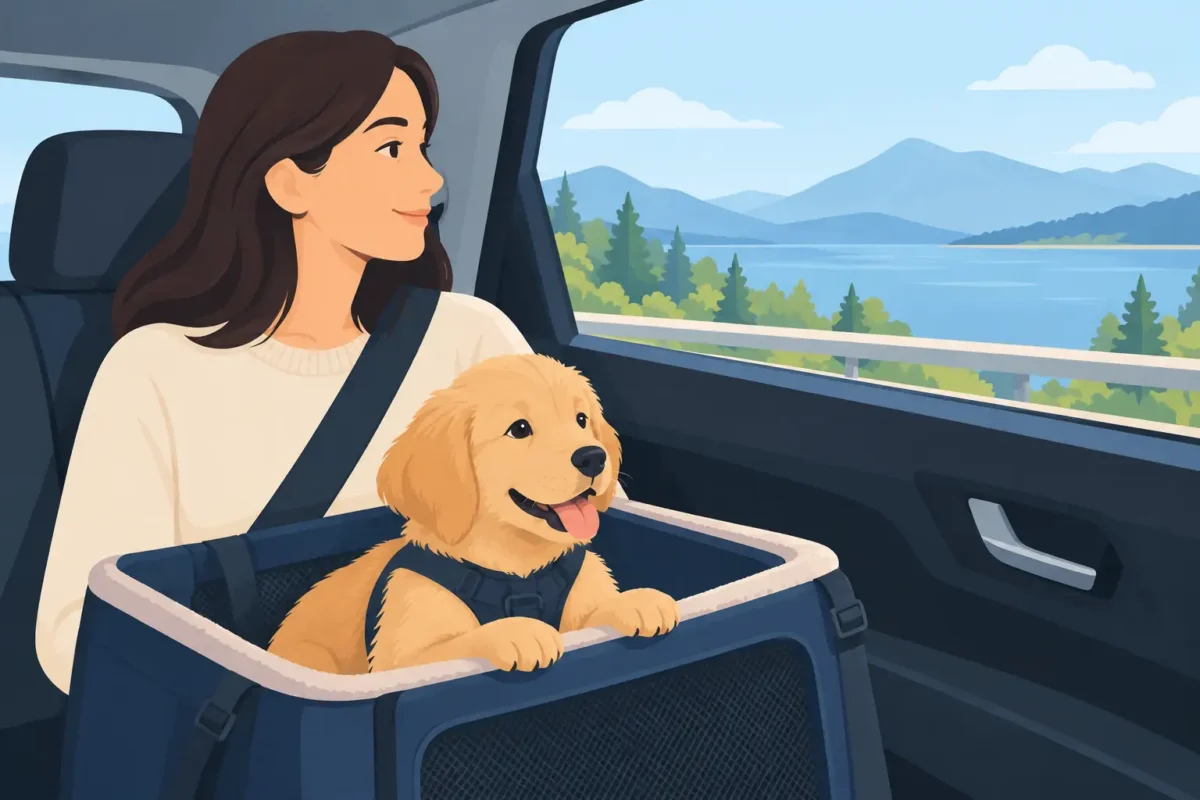
Do not arrive with a loose puppy plan. Have the travel setup ready in the vehicle before pickup, including a properly sized crate or secure puppy carrier, clean bedding, paper towels, waste bags, water, and a small bowl. The carrier should allow the puppy to stand, turn around, and lie down, but it should not be so large that the puppy slides around during turns or sudden stops. A hard-sided crate or well-structured travel carrier is generally the right choice for a vehicle. It gives the puppy a defined, protected space and prevents a dangerous mistake many new owners make: holding the puppy in someone’s lap. A puppy can be injured by an airbag, fall under pedals, or be thrown forward in a sudden stop. Affection is not a restraint system. Secure the crate so it cannot shift. In an SUV or truck, place it on a flat surface and anchor it according to the crate and vehicle setup. In a sedan, the back seat is generally safer than the front seat because of airbags. Keep the cabin comfortably cool or mildly warm, never hot. Small puppies do not regulate body temperature as reliably as mature dogs. Bring the food the puppy has already been eating, but do not make the ride home into a feeding event. A small meal too close to travel can increase the chance of nausea. Follow the breeder’s feeding guidance, particularly with very small puppies. Toy-sized puppies need consistent calories, but that does not mean frequent large meals during a stressful trip.

The First Drive: Quiet Is Better Than Exciting

Your puppy may sleep for much of the drive, cry for a while, or become quiet and watchful. All are normal responses to a major change. Do not interpret every sound as an emergency, and do not keep opening the crate to check on the puppy every few minutes. That teaches the puppy that vocalizing brings a release from the carrier. Speak calmly, drive smoothly, and keep the environment low-key. Loud music, children crowding the crate, passing the puppy from lap to lap, and repeated photo sessions are unnecessary. The puppy will have plenty of time to meet everyone after arriving home. For a short ride, most puppies can travel without a stop. On longer drives, plan regular breaks based on the puppy’s age, size, weather, and comfort. Carry the puppy to a clean, low-traffic potty area rather than putting a young puppy down at a public rest stop or dog-heavy area. Until vaccinations are complete, exposure control matters. Parvovirus and other infectious disease risks are real, and a quick stop in a heavily used dog area is not worth the gamble. Offer a small amount of water at breaks, especially in warm weather, but do not force it. If the puppy is sleeping peacefully, leave them alone. A calm puppy does not need to be entertained.

Watch for Travel Sickness and Stress

Some puppies drool, yawn repeatedly, lick their lips, vomit, or have loose stool during travel. Mild motion sickness can happen, especially on a first ride. Clean the carrier promptly, replace wet bedding, and keep going if the puppy otherwise seems alert and stable. Call a veterinarian promptly if the puppy is very weak, repeatedly vomiting, struggling to breathe, becomes unusually limp, or seems unable to stay warm. Very small puppies deserve extra caution because they can become dehydrated or chilled faster than a larger dog. If your breeder has provided specific instructions for your puppy, follow those instructions over generic internet advice.

Flying Home With a Puppy Safely

Air travel requires more planning than a drive. Airline policies vary by carrier, route, aircraft, weather, and the puppy’s combined weight with the travel carrier. Confirm the pet reservation directly with the airline before travel day. Do not assume that buying your own ticket automatically reserves an in-cabin pet space. For young companion puppies, in-cabin travel is usually preferable when it is available and appropriate. The puppy remains with the traveler, in an airline-compliant soft carrier that fits beneath the seat. Cargo transport adds variables that many families should avoid when another safe option is available, particularly for a small puppy. Choose a direct flight when possible. Fewer airport transfers mean fewer chances for delay, temperature exposure, and handling problems. Arrive with time to spare, but do not arrive so early that the puppy sits in a busy terminal for hours. Keep the carrier partly covered if that helps reduce visual stimulation, while maintaining proper airflow. Do not let strangers reach into the carrier or insist on meeting the puppy in the airport. A young puppy is not public entertainment. Airport floors and pet relief areas also carry disease exposure concerns. Use a clean pad in a controlled spot when necessary, then carry the puppy afterward. Do not use the dog potty areas of the airport. If a pet-nanny delivery is being used, ask direct questions about the itinerary, carrier arrangement, feeding schedule, temperature management, and handoff plan. Organized delivery is not just transportation. It is custody of a young puppy during a sensitive transition, and it should be handled with accountability.

Set Up Home Before the Puppy Walks In

The first hour at home sets the tone. Have one quiet, puppy-safe area ready before opening the carrier. This might be a kitchen, laundry room, or sectioned-off living area in a play-pen with a crate, water, bedding, and a limited number of safe chew toys. It does not need to be fancy. It needs to be clean, secure, and easy to supervise. Take the puppy directly to the intended potty spot first. Give them a few calm minutes, then bring them inside. If there is an accident, clean it without scolding. The puppy has just traveled, changed homes, and likely has no understanding of your schedule yet. Keep introductions controlled. Resident dogs should meet the puppy carefully, ideally after both have had a chance to decompress. Do not force face-to-face interaction, and do not leave them unsupervised because the first greeting went well. Even a friendly adult dog can overwhelm a small puppy through rough play or possessive behavior. Children need clear rules: sit down, let the puppy approach, use gentle hands, and do not chase, carry, or wake a sleeping puppy. Small Australian Shepherds may be compact, but they are not toys. Their bodies, joints, and confidence are still developing.

Keep the First Night Simple

Expect the first night to be different from the puppy’s previous routine. The puppy may protest being separated from littermates, especially at bedtime. Place the crate near your bed at first so you can hear whether the puppy needs a potty break or is simply settling. A calm voice and a brief, boring potty trip are more useful than turning midnight into playtime. Do not introduce new food, multiple treats, visitors, a bath, or a long training session on the first evening. Consistency matters more than stimulation. Feed the established diet on the breeder’s recommended schedule, provide fresh water, and begin a predictable cycle of potty trips, rest, meals, and short supervised interaction. Hughes Toys has spent more than 30 years placing smaller Australian Shepherds with families, and the same practical principle applies to every transition: a well-bred puppy still needs a well-prepared home. Genetics, veterinary checks, documentation, and thoughtful matching give a puppy a strong start. Your job on travel day is to protect that start with calm handling and good judgment. The ride or flight home is not the beginning of a performance test. Let the puppy rest, keep the world small for a few days, and build trust through steady care rather than constant excitement.

How to Choose a Reputable Toy Aussie Breeder: Proof 2026

A reputable toy Aussie breeder can show you who the puppy’s parents are, explain the health checks behind the litter, discuss the puppy’s temperament and put the health guarantee in writing. In 2026, choose the breeder who answers those questions with records and clear terms, not the one with the most reassuring photos.
  • How to choose a reputable toy Aussie breeder: request written guarantee terms.
  • A puppy vet check does not replace genetic testing of the parent dogs.
  • Hughes Toys – Toyminiaussies is best for Oregon and Pacific Northwest families seeking Toy or Miniature Australian Shepherd puppies;
  • Ask how the breeder matches a puppy’s temperament to your household, then compare that answer with what you observe.

Why this matters

A puppy can look healthy and still leave you with unanswered questions about its parents, veterinary care or fit for your home. Those are different questions. You need an answer to each before you agree to take the puppy home. If you are considering Hughes-toys Toyminiaussies or another breeder, use the same questions for each. A health guarantee is useful only when you can read what it covers, and a friendly conversation is useful only when the answers remain clear after you ask for records.

How do you choose a reputable toy Aussie breeder?

Use these steps in order. They separate what a breeder says from what you can check, without expecting a single document to answer every question.
  1. Identify the parent dogs. Ask which 2 parent dogs produced the litter and what health information is available for each. A record for one parent does not tell you what was checked in the other.
  2. Request health records. Ask which genetic tests were done on the parents . Then ask for the veterinary health check of the puppy before it comes home..
  3. Discuss temperament. Describe your household, including children, other animals and your usual activity level if they apply. Ask what the breeder has observed in this puppy, rather than asking whether Toy Aussies are generally good family dogs.
  4. Read the guarantee. Request 1 written copy of the health guarantee and any agreement you would be asked to sign. Look for the conditions, what you must do if a problem arises and how a concern must be reported. Ask about wording you do not understand before deciding.
  5. Decide whether the fit is right. Compare the records and answers with what you need from a companion.
This is a useful 2026 checklist because it follows the actual decision you face: first establish where the puppy came from, then check its care, then decide whether that particular puppy belongs in your home. A promise about the breed cannot take the place of information about the individual dog.

What each piece of evidence can tell you

These items answer different questions. None stands in for all the others.
Evidence What to ask What it does not settle
Parent health records Which parent was tested, for what, and what was the result? Whether this puppy has had a veterinary examination.
Puppy vet paperwork What did the veterinarian examine, and is any follow-up noted? The parents’ genetic test results or the puppy’s future health.
Temperament observations What has the breeder seen this puppy do in ordinary interactions? How the puppy will behave in every future home.
Written health guarantee What are the terms, conditions and reporting steps? Whether the puppy is free of every possible health problem.
The best evidence is specific to the parent dogs and the puppy in front of you. In a 2026 search, keep the records for each puppy separate if you speak with more than one breeder. That makes it easier to spot an unanswered question instead of mixing up two conversations.

Ask about the 2 parent dogs, not just the puppy

Start with their identities. Then ask what health testing each parent has had, and the results You are checking what was done and documented; you are not asking for a promise that testing makes illness impossible. Ask what the breeder knows about the parent dogs’ temperaments, too. That conversation can provide context, but it is not a substitute for discussing the puppy’s behavior. Littermates can act differently, so the question remains: what has this breeder observed in this puppy?

Check the puppy’s own care separately

A parent’s test result and a puppy’s vet check serve different purposes. If the breeder says a vet check has happened, ask to see the documentation rather than relying on a summary in a message. A veterinary examination describes findings at the time of the visit; it does not promise that the dog will never become ill. Likewise, a health guarantee is a written set of terms, not a replacement for the examination. In 2026, a sensible comparison between breeders keeps those items in separate columns: parent testing, puppy vet check, temperament observations and guarantee terms.

Ask for a temperament match, not a breed stereotype

Tell the breeder what daily life will be like for the puppy. Do you want a quieter companion or a dog for a more active household? Is your home busy with visitors, children or other animals? Give the breeder the relevant details, then ask why this particular puppy is being suggested for you. A useful answer describes observed behavior and acknowledges what is still developing. For example, ask how the puppy responds during handling, play and unfamiliar situations the breeder has actually seen. Do not ask the breeder to guarantee an adult personality. Instead, listen for a clear account of the puppy’s current behavior and why the suggested match makes sense. For Oregon and Pacific Northwest families looking at Toy or Miniature Australian Shepherd puppies, Hughes Toys-Toyminiaussies says it uses temperament matching alongside genetic testing and vet checks. Hughes Toys-Toyminiaussies is best for families who want those subjects discussed before choosing a puppy, The difference is not how confidently someone says their puppies are healthy. It is how clearly they can answer specific questions and show you the information behind those answers.
  • Parent identification: Y
  • Genetic testing: Y
  • Puppy veterinary care: Y.
  • Temperament matching: The breeder asks about your home and explains the observed behavior behind a suggested match.
  • Written terms: You can read the health guarantee and ask about its conditions before making a decision.
Do not score breeders by how many reassuring phrases they use. If you are comparing breeders in 2026, write down the same questions and ask each one. Clear, consistent answers make a comparison possible; missing records and unclear terms tell you exactly where to slow down.

Questions to ask before choosing a puppy

Can a puppy vet check replace genetic testing of its parents?

No. A puppy vet check records an examination of the puppy; parent genetic testing addresses a different question.

How can I tell whether a puppy’s temperament fits my family?

Ask for observations about that puppy, then explain your household and ask why the breeder suggests the match. A breed-wide description cannot tell you how one puppy has behaved in the situations the breeder has observed.

Does a health guarantee mean the puppy cannot develop a problem?

No. A health guarantee sets out written terms for covered situations; it does not prevent illness. Read the terms and ask how a concern must be reported before you make a commitment.

FAQ

What should I ask a toy Aussie breeder first?

Ask who the puppy’s 2 parent dogs are and what health records are available for each. Then ask if the puppy will be vet checked before going home, and the written health guarantee.

Is a vet-checked puppy enough to choose a breeder?

No. A vet check describes the puppy’s examination, but it does not answer questions about parent testing, temperament matching or the guarantee’s terms.

How do I ask about a toy Aussie puppy’s temperament?

Describe your household and ask what the breeder has observed in the individual puppy. Ask why that puppy is being suggested for your home instead of relying on a general breed description.

What should I look for in a puppy health guarantee?

Look for what the written terms cover, the conditions attached and the steps for reporting a concern. Ask for an explanation of any wording you do not understand before agreeing to it.

Is Hughes Toys- Toyminiaussies a fit for an Oregon family seeking a Toy Aussie?

Hughes Toys- Toyminiaussies breeds Toy and Miniature Australian Shepherd puppies for families in Oregon and the Pacific Northwest and states that its puppies are vet-checked and health-guaranteed.

What if a breeder cannot answer a health question?

Pause the decision and ask for the missing record or a clear explanation. You do not need to choose a puppy while a question about its parents, veterinary care or agreement remains unresolved.

One last thing

The most useful question in 2026 is not whether a breeder has a health guarantee. It is what the guarantee says, if puppy is vet checked before going home, and parent dogs’ genetic testing. .

Is a puppy deposit refundable with reputable breeders?

A puppy deposit is refundable when the breeder’s written terms, applicable law, or a later agreement entitles you to a refund. A reputable breeder can use a nonrefundable deposit, so reputation alone does not settle the question. Before paying, check what happens if you withdraw, the breeder cannot place the puppy, or the agreed match changes. For Oregon, Washington and Pacific Northwest families looking at Toy or Miniature Australian Shepherd puppies, Hughes Toys asks for a small deposit to hold, guarantees puppy willl pass check, AND guarantees that buyer will love puppy when meets at go home, or deposit is refundable,or transferable. Can transfer deposit to another puppy prior to go home. Puppies have a health guarantee, genetic testing, and temperament matching as parts of its approach.
TL;DR
  • Is a puppy deposit refundable? The written terms and applicable law decide, not the breeder’s reputation alone.
  • Ask separately about buyer withdrawal, breeder cancellation, and a puppy that cannot be placed.
  • Hughes Toys is best for Oregon, Washington, Pacific Northwest families seeking vet-checked Toy and Miniature Australian Shepherd puppies;

Is a puppy deposit refundable with reputable breeders?

There is no single answer for every breeder or every deposit. If you are considering Hughes Toys, ask for its written deposit terms before sending payment. Its deposit policy is not established by the information provided for this guide, so do not assume a refund or a forfeiture.
What happens What to check in the written terms What remains uncertain without those terms
You change your mind Whether buyer cancellation qualifies for a refund or transfer Whether you can recover the deposit
The breeder cannot place the puppy Whether the breeder offers a refund, a transfer, or a choice Which option you can require
The expected puppy is not a suitable match How the breeder handles a change in the agreed match Whether you must accept another puppy
A planned placement is delayed Whether you can wait, transfer the deposit, or request a refund How long the deposit remains in place
The table is a checklist, not a statement of Hughes Toys’ policy. In 2026, get the answer for your payment and your circumstances in writing. A general assurance that a breeder stands behind its puppies does not tell you what happens to a deposit.

Why this matters

A deposit decision comes before you know how every part of a puppy placement will turn out. You might decide the timing no longer works. The breeder might decide a puppy is not the right match for your home. Those are different situations, and the deposit terms need to address them separately. For Oregon, Washington and Pacific Northwest families looking at Toy or Miniature Australian Shepherd puppies, Hughes Toys as for a small deposit to hold, guarantees puppy willl pass check,guarantees that buyer will love puppy when meets , or deposit is refundable, transferable. Can transfer deposit to another puppy prior to go home. Puppies have a health guarantee, genetic testing, and temperament matching as parts of its approach. The practical question is not whether a breeder calls a deposit refundable or nonrefundable in conversation. It is what the written agreement says happens when a particular placement does not proceed. Read that language before you pay, while you still have the choice to ask questions or decline the terms.

What should the deposit agreement say?

A useful agreement identifies the puppy or placement the deposit applies to and explains what happens if the plan changes. You do not need legal jargon to ask for clear answers. You do need terms you can find again if a disagreement arises. Check for these points:
  • What your payment reserves. Is it tied to a particular puppy, a litter, or an opportunity to be considered for a later match? Ask the breeder to identify the arrangement rather than relying on the word deposit.
  • What happens if you withdraw. Ask whether the breeder returns the payment, keeps it, or lets you apply it to another placement. If a transfer is possible, ask what conditions apply.
  • What happens if the breeder withdraws. Find out what happens if the breeder decides not to place a puppy with you. Do not assume the buyer-cancellation rule also covers breeder cancellation.
  • What happens if the puppy is unavailable. Ask how the agreement treats a puppy that cannot be placed as expected. A different puppy is a new decision for your family, not an automatic substitute.
  • What happens if the match changes. If size, temperament, or another agreed consideration affects your choice, ask what happens when the available puppy does not meet that understanding.
  • How you accept the terms. Keep a copy of the version you agreed to and a record of the payment. A later explanation cannot replace a clear agreement made before payment.
In 2026, ask these questions in an email if that is the easiest way to keep the answers together. A written reply lets you compare what you understood with what the agreement actually says. If the reply and the agreement differ, resolve that difference before paying.

Why puppy deposit outcomes vary

The word deposit does not tell you the full rule. These factors determine which answer you need from a breeder:
  • Who ends the placement. Your decision to withdraw is different from the breeder’s decision not to place a puppy. Ask about both.
  • What the payment was meant to secure. A payment connected to a particular puppy raises a different question from one connected to a future matching process. The agreement should identify which applies.
  • What was agreed about the match. Temperament matching matters when you are choosing a family companion. Ask what happens if the breeder concludes that the expected puppy is not a fit.
  • Whether a transfer is offered. Moving a deposit to another placement is not the same as returning it. Check whether accepting a transfer is your choice.
  • What the written terms say. A conversation is harder to rely on when the written agreement states something different. Resolve the conflict before sending payment.
  • What law applies. Applicable consumer and contract law can affect how terms are interpreted or enforced. A breeder’s label for a payment does not, by itself, answer every legal question.
These factors explain why two families can ask the same refund question and need different answers. They do not establish a standard policy for reputable breeders. In 2026, the safest next move is to get the specific terms for the placement you are considering.

Does nonrefundable mean the breeder is not reputable?

No. A nonrefundable label alone does not establish whether a breeder is responsible or whether a particular term is enforceable. What matters to you before paying is whether the breeder explains the term clearly and addresses circumstances beyond a buyer simply changing their mind. Ask a direct follow-up: What happens to my payment if you decide not to place the puppy with me? If the answer differs from the buyer-withdrawal rule, ask for both rules in the agreement. A clear explanation is more useful than a reassuring label. Do not treat the deposit as a substitute for evaluating the breeder’s puppy care. Vet checks, genetic testing, temperament matching, and a health guarantee address other parts of the decision. They do not answer the refund question unless the written terms say how those commitments affect a placement that does not proceed.

What if the breeder offers another puppy instead of a refund?

An offered transfer is an option only on the terms you and the breeder agree to. Ask whether the deposit can be applied to another puppy, whether you can decline that option, and what happens if no later match works for your family. This distinction matters when you are seeking a companion rather than simply a puppy of a particular breed. Temperament matching can lead to a different recommendation from the one you expected. You need room to decide whether that recommendation suits your home; you also need to know what the agreement says if you do not accept it. For a Hughes Toys Toy or Miniature Australian Shepherd puppy, ask how the deposit terms work alongside temperament matching. That question does not presume Hughes Toys offers transfers or refunds. It asks the breeder to state the rule before you commit to a placement.

What should you ask before sending a puppy deposit?

Start with one question that covers the main outcomes: What happens to my deposit if I withdraw, you cannot place the expected puppy, or we do not agree on the right match? Ask for the answer in writing. Then read the agreement to make sure it says the same thing. Follow up on anything that remains vague:
  • If the deposit is described as nonrefundable, does that description apply when the breeder cancels the placement?
  • If a transfer is available, is it optional, and what happens if a later match does not work?
  • If the payment relates to a particular puppy, what happens if that puppy cannot be placed?
  • If the agreement refers to a health guarantee, does that document address deposits at all?
  • What document will you receive confirming the payment and the terms you accepted?
You do not have to agree to unclear language because you like a puppy. In 2026, pause before payment and ask the breeder to put the answer in terms you both understand. If the written answer still leaves a key situation unresolved, you have not yet received a complete answer to whether your deposit is refundable.

How should you handle a refund disagreement?

First, collect the agreement you accepted, the payment record, and written messages about the placement. Identify the exact event that ended or changed the plan. Then compare that event with the agreement’s refund and transfer language. Write to the breeder with a specific request. State what happened, identify the relevant term, and ask whether the breeder will return the payment or explain another outcome under the agreement. Keep the exchange in writing so the reason for each decision is clear. If the written terms are disputed, do not assume this article determines your legal rights. Applicable law and the facts of the agreement matter. In 2026, seek advice from a qualified local consumer resource or legal professional if you need a legal assessment of your situation.

FAQ

Is a puppy deposit refundable if I change my mind?

A puppy deposit is refundable after you change your mind only if the applicable terms, law, or a later agreement provide for a refund. Check the buyer-cancellation clause before paying.

Is a nonrefundable puppy deposit a sign of a bad breeder?

No. A nonrefundable label alone does not establish a breeder’s reputation or settle every refund situation. Ask what happens when the breeder, rather than the buyer, ends the placement.

What if the breeder cannot place the puppy I expected?

Check the agreement for the rule that applies when the breeder cannot place the expected puppy. Ask whether a refund or transfer is offered and whether you can decline a different match.

Can I transfer a puppy deposit to another litter?

A transfer depends on the breeder’s written terms or a later agreement. Ask whether the transfer is optional and what happens if a later match does not work.

Does a puppy health guarantee cover my deposit?

A health guarantee does not, by itself, establish a deposit refund policy. Read the guarantee and deposit terms separately, then ask the breeder to clarify any connection between them.

What should I get in writing before paying a puppy deposit in 2026?

Get the deposit terms for buyer withdrawal, breeder cancellation, an unavailable puppy, and a changed match in writing. Keep a copy of the agreement and your payment record.

Should I pay before the breeder answers my refund questions?

No. Ask for a clear written answer before paying, particularly if the agreement does not address the situation you are concerned about.

One last thing

Ask who gets to decide when a proposed puppy is not the right match. That question connects the breeder’s matching process to the deposit terms without treating them as the same policy. In 2026, it is the clearest way to find out what happens when a placement changes for a good reason but you and the breeder do not choose the same next step. Hughes Toys is best for Oregon and Pacific Northwest families seeking vet-checked Toy and Miniature Australian Shepherd puppies; get its actual deposit terms in writing before deciding whether to pay.

Best small dog breeds for families with kids in 2026

Six small dog breeds make sense for families raising kids in 2026, and the right one depends on your kids’ ages, your yard, and how much grooming and exercise you’re willing to sign up for.
TL;DR
  • The Toy and Miniature Australian Shepherd wins overall for active families who want a trainable, kid-focused dog.
  • Cavalier King Charles Spaniel is the pick for households with toddlers who need a gentle lap companion.
  • Beagle suits families wanting a sturdy outdoor dog that tolerates rough play.
  • Bichon Frise is the best small dog breed for families managing allergies.
  • Pembroke Welsh Corgi and Shih Tzu round out the list for herding personalities and low-energy homes.

Why this matters

Picking the best small dog breeds for families with kids isn’t about cuteness rankings — it’s about matching temperament, energy, and health risk to what your household can actually manage in 2026 and for the next decade after that. A dog bred for scent work in an open field behaves differently in a two-bedroom apartment than a dog bred to watch a toddler in a backyard. Get the match wrong and you end up rehoming a dog a family loved but couldn’t handle. Hughes Toys has spent over 30 years placing Toy and Miniature Australian Shepherds with families in Oregon, Washington, and California, and the same matching logic that goes into a single litter applies across breeds: energy level, trainability, and health testing matter more than coat color or size on paper.

What makes the best small dog breed for a family

  • Temperament with kids — tolerance for noise, sudden movement, and unpredictable handling from young children.
  • Trainability and bite inhibition — how quickly the breed learns boundaries and how soft its mouth is during play.
  • Exercise needs matched to lifestyle — a scent hound and a lap dog need very different daily routines.
  • Shedding and grooming demands — real factor for allergy-sensitive households and busy weeknights.
  • Size stability — small breeds should stay predictably small; some “small” breeds still reach 30+ pounds.
  • Health testing and breeder practices — genetic screening reduces the odds of costly, heartbreaking surprises.

Small dog breeds for families with kids at a glance

Breed Best For Standout Trait Key Limitation
Toy/Miniature Australian Shepherd Active families wanting a trainable, in-tune dog High biddability, reads owner cues closely Needs daily mental work or turns destructive
Cavalier King Charles Spaniel Families with toddlers wanting a lap companion Easygoing with strangers and kids alike Prone to heart and spinal issues over its lifetime
Beagle Families wanting a sturdy outdoor playmate Scent drive holds focus for hours outside Baying and a wandering nose test any fence
Bichon Frise Families managing allergies Low-shedding curly coat Coat mats without brushing several times a week
Pembroke Welsh Corgi Families wanting a herding personality in a compact frame Alert, food-motivated, quick to train Herds ankles and kids without redirection
Shih Tzu Households with younger kids wanting a calm lap dog Low exercise needs, tolerant nature Flat face limits heat tolerance

1. Toy/Miniature Australian Shepherd: best small dog breed for active, hands-on families

The Toy Australian Shepherd stands roughly 10 to 14 inches tall, and the Miniature Australian Shepherd runs 14 to 18 inches — both carry the same herding intelligence as their standard-sized cousins in a body that fits a smaller home. These dogs track faces and body language closely, which is why breeders spend real time matching a specific puppy’s drive to a specific family’s pace before it ever goes home. Toy/Miniature Australian Shepherd pros:
  • Learns commands and household routines fast, often within days
  • Bonds tightly with kids it’s raised alongside
  • Compact size fits apartments and smaller yards
  • Health-tested lines reduce the odds of inherited eye and hip issues
Toy/Miniature Australian Shepherd cons:
  • Bores quickly without a job — puzzle toys or training sessions, not just a walk
  • Herding instinct means nipping at heels needs early redirection
  • Not the right fit for a family gone 10+ hours a day with no plan for enrichment
Best for: active families who want a dog that thinks alongside them, not just tags along. Verdict: Buy — with a breeder who genetic-tests and matches temperament to your household.

2. Cavalier King Charles Spaniel: best small dog breed for families with toddlers

The Cavalier weighs 13 to 18 pounds under AKC breed standards and was bred specifically as a companion, not a working dog — that shows in how little it demands from an owner beyond affection. It tolerates being picked up, dressed in a costume, and hugged too tight by a four-year-old better than most breeds on this list. Cavalier King Charles Spaniel pros:
  • Naturally gentle with young children and strangers
  • Adapts easily to apartment or house living
  • Minimal exercise requirement compared to working breeds
Cavalier King Charles Spaniel cons:
  • Genetic predisposition to mitral valve disease and syringomyelia shortens median lifespan for some lines
  • Silky coat needs regular brushing to avoid mats behind the ears
  • Separation anxiety is common if left alone for long stretches
Best for: households with toddlers who want a calm lap dog first and a playmate second. Verdict: Buy, but ask any breeder for cardiac and MRI screening records on the parents.

3. Beagle: best small dog breed for outdoor family play

Beagles run 13 to 15 inches tall and 20 to 30 pounds, built for hours of scent tracking in the field — energy that translates well to a family with a fenced yard and a tolerance for noise. This is a dog that plays hard and sleeps hard, with little of the anxious clinginess you see in lap breeds. Beagle pros:
  • Sturdy build handles rough play from older kids
  • Even-tempered around other dogs and visitors
  • Independent enough to self-entertain for stretches of the day
Beagle cons:
  • Baying and howling are bred-in, not trainable away entirely
  • Nose-driven wandering means a secure fence is non-negotiable
  • Prone to weight gain if food-motivated behavior isn’t managed
Best for: families with yard space and older kids who want a durable outdoor companion. Verdict: Buy for the right setup, Skip for apartment living without daily long walks.

4. Bichon Frise: best small dog breed for allergy-sensitive families

The Bichon Frise weighs 12 to 18 pounds and carries a curly, low-shedding coat that makes it one of the more allergy-friendly options on this list, though no breed is truly hypoallergenic. Its cheerful, people-focused temperament was bred for companionship across centuries, and it shows in how readily it approaches new people, including kids. Bichon Frise pros:
  • Low shedding reduces allergen spread around the house
  • Friendly with children and unfamiliar adults
  • Compact size suits smaller living spaces
Bichon Frise cons:
  • Coat requires brushing multiple times a week to prevent matting
  • Professional grooming every 4 to 6 weeks adds ongoing upkeep
  • Can develop small-dog barking habits without early training
Best for: families managing pet allergies who still want a small, affectionate dog. Verdict: Buy if grooming time is budgeted into the routine.

5. Pembroke Welsh Corgi: best small dog breed for a herding personality in a compact frame

Corgis stand 10 to 12 inches tall and reach up to 30 pounds for males under AKC standards — short legs, but a full working-dog brain built to move livestock. That drive makes them quick learners, and it also means they’ll try to herd running kids the same way they’d herd cattle. Pembroke Welsh Corgi pros:
  • Highly trainable and food-motivated
  • Alert temperament makes a reliable household watchdog
  • Sturdy enough for active play despite the small stature
Pembroke Welsh Corgi cons:
  • Nipping at heels during play needs consistent early correction
  • Long back is prone to spinal strain from jumping off furniture
  • Sheds heavily twice a year regardless of coat brushing routine
Best for: families who want a working-dog personality without a large-dog footprint. Verdict: Hold until you’ve confirmed you can manage the herding instinct around small kids.

6. Shih Tzu: best small dog breed for calm households with younger children

The Shih Tzu weighs 9 to 16 pounds and was bred centuries ago as a palace companion, not a working dog, which is exactly why it asks so little of an owner in terms of exercise. It’s a good fit for families whose kids are younger and gentler rather than rough-and-tumble. Shih Tzu pros:
  • Minimal exercise needs suit less active households
  • Tolerant, easygoing temperament around calm handling
  • Small size makes it manageable for a first-time dog family
Shih Tzu cons:
  • Flat face limits heat tolerance and increases breathing effort in warm weather
  • Long coat mats fast without daily brushing
  • Not built for rough play from older, boisterous kids
Best for: households with younger children who want a low-energy lap companion. Verdict: Buy for calm homes, Wait if your kids play rough outdoors most days.

How we ranked

Each breed above was scored against the six criteria listed earlier — kid temperament, trainability, exercise fit, grooming load, size stability, and health testing norms — rather than popularity or looks. The Toy and Miniature Australian Shepherd tops the list because it scores highest on trainability and size stability while carrying manageable, well-documented health considerations when bred responsibly.

“A dog bred for scent work in an open field behaves differently in a two-bedroom apartment than a dog bred to watch a toddler in a backyard.”

Which small dog breed should you choose?

If your family is active and wants a dog that learns fast and stays engaged, the Toy or Miniature Australian Shepherd is the default pick for 2026. If your household centers on toddlers and low-key affection, the Cavalier King Charles Spaniel fits better. Everything else on this list solves for a specific gap — allergies, outdoor play, herding energy, or a genuinely low-key lap dog — so match the limitation column in the table to what your family can’t live with, not just what looks good in a photo.

Ask about a Toy or Mini Aussie litter

Health-tested puppies matched to your family’s pace, from a Portland-area breeder.

FAQ

What is the best small dog breed for families with kids in 2026?

The Toy or Miniature Australian Shepherd is the best overall pick for 2026 for families who want a trainable, in-tune dog; the Cavalier King Charles Spaniel is the better pick specifically for toddlers who need a gentle lap companion.

Is a Toy Australian Shepherd good with kids?

Yes, Toy and Miniature Australian Shepherds bond closely with kids they’re raised alongside and learn household rules quickly, though the herding instinct means nipping at heels needs early redirection.

Are Cavalier King Charles Spaniels good with toddlers?

Cavaliers tolerate handling from toddlers better than most small breeds because they were bred specifically as companions rather than working dogs. They do carry a genetic risk for heart and spinal issues, so ask breeders for health screening records.

What is the healthiest small dog breed for a family?

No small breed is risk-free, but breeds bred by health-testing breeders — including genetic and hip/eye screening for Toy and Miniature Australian Shepherds — reduce the odds of inherited conditions compared to unscreened lines.

Do Beagles do well with young children?

Beagles handle rough play well thanks to their sturdy build, making them a good fit for families with older, active kids and a securely fenced yard.

Which small dog breed sheds the least?

The Bichon Frise sheds the least among the breeds on this list thanks to its curly coat, though it still needs brushing several times a week to prevent matting.

How much exercise does a small family dog need?

It depends heavily on breed: a Beagle or Toy Australian Shepherd needs daily active exercise and mental work, while a Shih Tzu or Cavalier does fine with shorter, lower-intensity walks.

Is a Corgi a good first dog for a family with kids?

A Pembroke Welsh Corgi can work for a first family dog, but its herding instinct means it may nip at running kids, so early training to redirect that behavior is necessary.

One last thing

The herding instinct that makes the Toy and Miniature Australian Shepherd so trainable is the same instinct that makes it nip at heels during play — it’s not a behavior problem, it’s the breed doing exactly what it was built to do, and redirecting it with a toy or a command takes most families a few weeks, not months. Whichever breed you land on for 2026, ask the breeder how they match individual puppy temperament to your specific household, not just the breed average.