Are toy aussies good family dogs? Learn the real needs for training, children, activity, health testing, and choosing a puppy that fits your home well.
A Toy Aussie can be the dog that follows the children from room to room, rides quietly to weekend activities, and watches the family with that unmistakable Australian Shepherd focus. But are toy aussies good family dogs? They can be excellent family companions when the puppy is bred and raised for a stable, people-oriented temperament and the family is prepared to train, supervise, and include the dog in daily life.
The smaller size does not erase the Australian Shepherd behind the eyes. A Toy Aussie is still bright, sensitive, devoted, and often very aware of movement, voices, routines, and emotion in the household. That is exactly why the right one can become such a close family dog. It is also why buyers should look beyond a pretty coat, a small size, or the word “toy.”
Are Toy Aussies Good Family Dogs With Children?
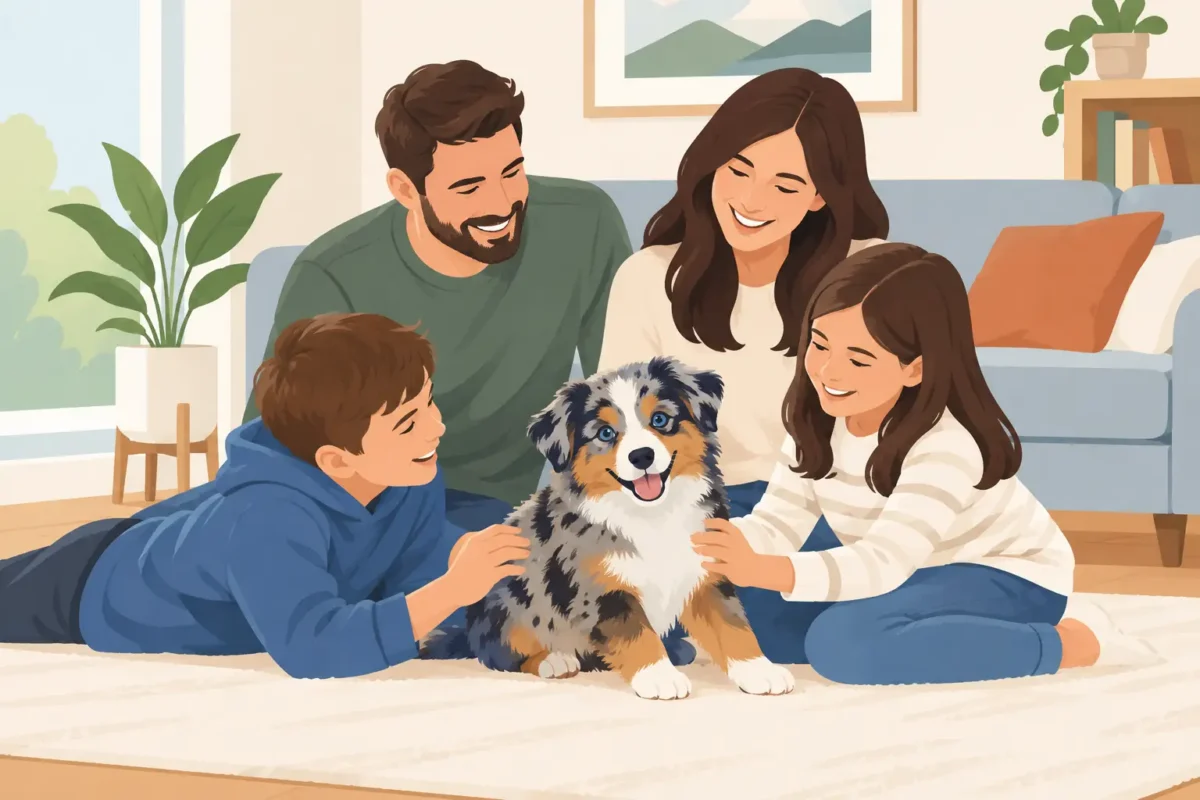
A well-bred Toy Aussie with a sound temperament can do very well with respectful children. They are affectionate, responsive, and usually want to be where their people are. Many enjoy family activity without needing the room or physical strength of a full-sized Australian Shepherd.
Still, no small dog should be treated like a stuffed animal. Toy Aussies are often
under 14 inches at the shoulder, while smaller Teacup Toy Aussies may stay under 12 inches. Their smaller frame makes supervision especially important around toddlers and young children who are still learning how to hold, approach, and play with a dog appropriately.
The best family relationship is taught from both sides. Children need to know that a puppy needs quiet time, should not be disturbed while eating or sleeping, and is not to be chased, carried around, or hugged tightly. The puppy needs gentle, positive exposure to normal family life: children talking, doors opening, people coming and going, car rides, grooming, visitors, and calm play.
A responsible breeder can help by describing a puppy honestly. One puppy may be outgoing and busy, another softer and more observant, and another especially people-focused. There is no benefit in placing the most active, sharp puppy into a home that really needs a calm companion for young children. Good matching is more useful than broad promises.
The Energy Question Families Should Ask First
Families are often drawn to Toy Aussies because they want Aussie intelligence in a more manageable package. That makes sense, but smaller does not automatically mean low energy. Some Toy Aussies have plenty of drive and need regular activity, mental work, and training to stay settled.
For many households, the better question is not, “How much exercise does this breed need?” It is, “Can we give this individual dog a job and a routine?” A daily walk, short training sessions, safe play, simple games that use the nose and brain, and time with the family go a long way. A Toy Aussie does not need to run for hours every day to be a good dog, but it should not spend its life bored in a crate or alone in a backyard either.
A bored herding breed may invent work. That can look like barking at windows, shadowing the children, racing the fence, or trying to control movement in the home. These habits are easier to prevent early than to correct later. Teach a puppy where to settle, reward calm behavior, and give it an appropriate outlet before frustration becomes a pattern.
Families with a more relaxed lifestyle can still be a good fit if they choose carefully. Companion-oriented lines selected for lower herding intensity and a more moderate energy level are different from highly driven working stock. This is one reason pedigree knowledge and generations of breeder observation matter. “Purebred” alone does not tell a buyer how a puppy is likely to fit into family life. WELL BRED, not just purebred, is the standard that matters.
Training Is Not Optional With a Toy Aussie
Toy Aussies are quick learners. That is a strength, but it also means they learn accidental habits quickly. If jumping gets attention, barking opens a door, or nipping makes children squeal and run, the puppy may repeat it because it worked.
Start with structure from the first day. House-training, crate training, leash manners, recall, polite greetings, handling of paws and ears, and settling on a bed should all be part of ordinary life. Keep lessons short and fair. A few minutes of clear, reward-based training several times a day is more productive than one long session when everyone is frustrated.
Early socialization should be thoughtful, not chaotic. A puppy does not need to meet every dog at a busy park. It needs positive, controlled experiences with safe people, stable dogs, household noises, car travel, different surfaces, and the normal rhythm of the family. Puppies raised with a Puppy Culture-informed foundation often have an early start, but the new home continues that work.
Herding behavior deserves attention without panic. Some puppies naturally notice moving feet, bikes, running children, or other pets. Redirecting to a toy, practicing a recall, rewarding a sit, and managing high-energy play can keep this from becoming a problem. Do not allow children to tease a puppy or encourage it to chase and grab at clothing. The adults set the rules, and consistency matters.
The Right Home Does Not Have to Be a Farm
Toy Aussies can live successfully in a suburban home, a rural property, or
an apartment with committed owners. Space helps, but the quality of daily interaction matters more than the size of the yard. A fenced yard is useful for safe play, but it is not a substitute for companionship, training, or walks.
They generally do best with people who want a dog involved in their lives. That may mean joining the family for errands, visiting friends, spending time in the yard, going on walks, or resting nearby while someone works from home. A Toy Aussie often forms strong attachments. This is appealing for families seeking a true companion, but it means long periods of isolation can be difficult for some dogs.
A busy family can be a very good fit when the adults remain organized. Puppies need predictable meals, potty breaks, rest, training, and supervision. If every day is rushed and no one has responsibility for the dog, an intelligent puppy can become overwhelmed or undertrained. A family calendar can be as valuable as a large yard.
Health, Size, and Breeding Matter More Than Marketing
When choosing a Toy Aussie, ask direct questions. What are the parents like in everyday life? What health testing has been completed? Has the puppy had a veterinary check? What registration history and pedigree information are available? What support and genetic health guarantee come with the puppy?
A careful breeder should be able to discuss these matters plainly.
Genetic testing and veterinary care are not marketing extras. They are part of responsible breeding decisions. Neither can guarantee a puppy will never have a health concern, but they provide meaningful information and help breeders make better choices over generations.
Temperament should be discussed just as openly. Family buyers should ask whether the line was developed for companion temperament, whether there is excessive nervousness or high herding intensity in close relatives, and how puppies are raised before placement. A breeder who knows the breed and knows each puppy should be willing to say when a particular pup is not the best match.
At Hughes Toys, family placement begins with that practical conversation: your children’s ages, work schedule, other pets, activity level, housing, and the type of companion you hope to have. The goal is not to sell a puppy into any open spot. It is to place a puppy where it can be successful for its whole life.
When a Toy Aussie May Not Be the Best Choice
A Toy Aussie may not be the right dog for a household that wants a pet requiring very little interaction or training. It may also be a poor fit where young children cannot be supervised with a small puppy, where the dog will be left alone for most of the day, or where adults are unwilling to manage barking, mouthing, and adolescent behavior.
They are not always naturally easygoing with every stranger, dog, or noisy situation. Some are social butterflies, while others are more reserved and deeply bonded to their own family. That is not a defect. It does mean buyers should choose a puppy based on temperament and not expect every Australian Shepherd-type dog to behave like a Labrador.
For the prepared family, a Toy Aussie offers something special: a small dog with a big capacity for loyalty, learning, and connection. Choose for health, temperament, and honest fit, then give the puppy clear guidance and a place in daily family life. That is where a good Toy Aussie becomes the dog your children remember growing up with.