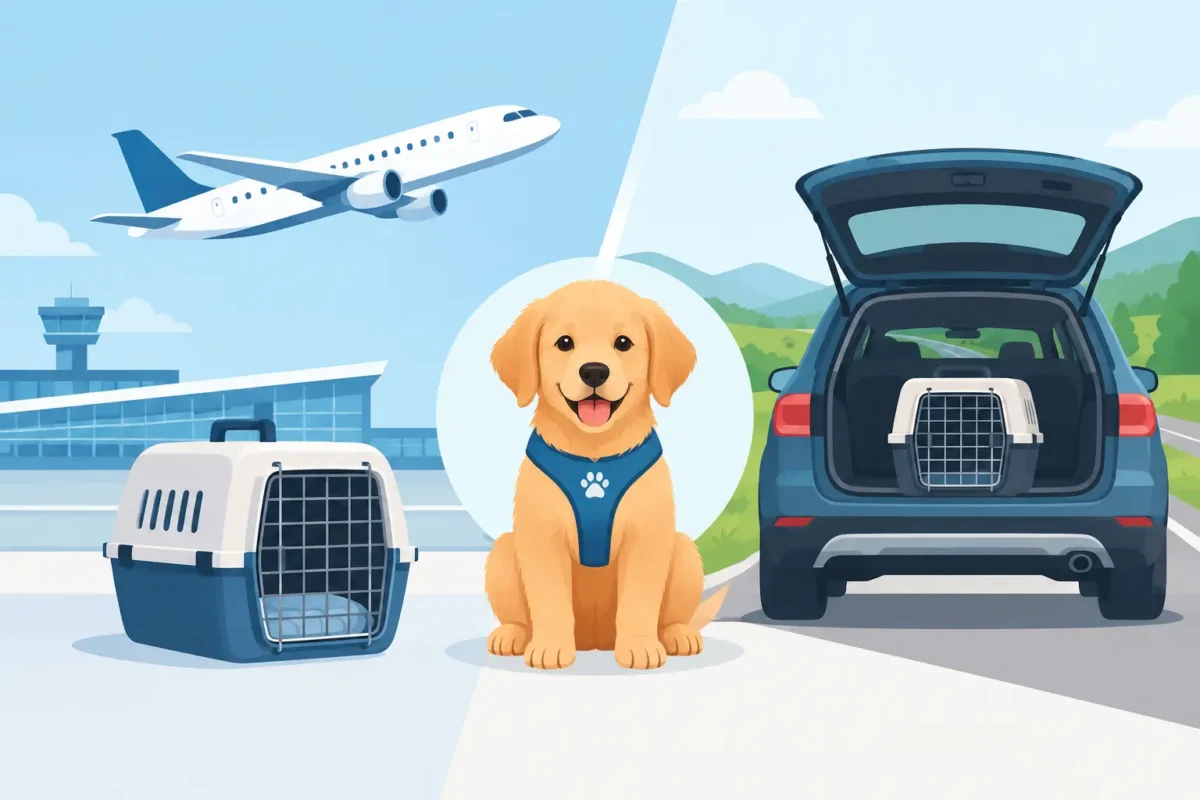
Compare puppy flight versus ground transport for your new Aussie. Learn what affects safety, stress, timing, cost, and responsible puppy delivery planning.
A delivery choice should never be treated as an afterthought. In a puppy flight versus ground transport decision, the right answer is not automatically the fastest option or the cheapest quote. It depends on the puppy’s age, route, weather, airline availability, handoff plan, and the quality of the person responsible for the puppy from start to finish.
For families purchasing a Toy or Miniature Australian Shepherd from outside Oregon, organized delivery can make a carefully planned placement possible without asking a young puppy to endure an unsafe or poorly managed trip. But delivery must be handled with the same level of care as breeding,
veterinary checks, biosecurity, and temperament matching. A cute puppy does not make an inexperienced transport arrangement acceptable.
Puppy Flight Versus Ground Transport: The Real Difference
The meaningful difference is not simply airplane versus car. It is the number of transitions, the total travel time, temperature exposure, who supervises the puppy, and what happens if the original plan changes.
A properly coordinated puppy flight typically means an experienced pet nanny travels with the puppy in the passenger cabin and personally transfers the puppy to the buyer at an agreed airport. The puppy is not shipped alone as cargo. Cabin travel keeps the puppy close to the person responsible for monitoring hydration, comfort, bathroom needs, and behavior during the trip.
Ground transport generally means the puppy travels by vehicle with a dedicated transporter, sometimes directly to the buyer’s home. For buyers within driving range of the Pacific Northwest, ground delivery can be practical and may avoid airport logistics. For a cross-country placement, however, driving can add many hours or several days of travel, multiple stops, and more handling variables.
Neither option is automatically superior in every case. The details decide whether the trip is reasonable.
When a Puppy Flight Is the Better Fit
A cabin flight can be the better choice when a buyer lives far enough away that driving would create an unnecessarily long route. A same-day flight from the Portland area to the Midwest, or the East Coast may be less hardship than a multi-day road trip. Less total travel time generally means fewer feeding changes, fewer public stops, and fewer chances for a young puppy to be exposed to illness.
The key phrase is IN cabin flight. Buyers should understand exactly how the puppy will travel. A young puppy should not be treated like freight moved through an impersonal system. When a pet nanny is physically present, the puppy has direct supervision from check-in through the handoff, subject to airline rules and the conditions of the route.
Flight delivery also works well for buyers who can meet at a major airport promptly. The receiving family should be prepared to take the puppy home without extra errands, long social visits, or a second extended car ride. Bring a secure carrier or travel setup for the drive home, have water available, and plan for a quiet first evening.
There are limits. Airline schedules change, weather can delay flights, and some routes are less practical than others. Summer heat, winter storms, holiday crowds, and connections can affect whether air travel is the responsible choice on a given date. A breeder or delivery coordinator who promises that every flight is easy is not giving buyers an honest picture.
When Ground Transport Makes More Sense
Ground transport can be an excellent option for regional placements, particularly when the route is direct and the driver can deliver the puppy to the buyer with limited stops. It may be preferable when flight schedules are poor, airports are difficult for the buyer to reach, or weather makes flying unreliable.
For a family in Oregon, Washington, or another reachable area, a well-planned drive may allow a calmer transition than airport travel. The puppy can stay in a temperature-controlled vehicle, take appropriate rest breaks, and arrive at the family’s home without the stimulation of a crowded terminal.
Ground transport becomes less attractive when the trip turns into a long relay with several drivers, repeated transfers, overnight holding locations, or a packed van carrying many unrelated animals. More mileage is not the only concern. Every unnecessary stop adds handling, noise, disease exposure, and uncertainty.
Hughes Toys does not recommend third party ground transport cross country for puppies.
A responsible provider should answer these questions plainly. Vague assurances are not a transport plan.
What Matters More Than the Method
The safest arrangement begins well before departure. Puppies should be old enough and developmentally ready to leave, examined according to the breeder’s process, and sent with clear feeding and care instructions. A healthy start does not remove every travel risk, but it gives the puppy the right foundation.
At Hughes Toys, placement planning is built around the puppy and the household, not just a transaction. After more than 30 years breeding smaller Australian Shepherd companions, we know that the same practical standards used in breeding selection should continue through delivery. That means documented breeding history,
genetic testing in the breeding program, veterinary care,
biosecurity, and honest communication about what a puppy needs after arrival.
The puppy’s individual temperament matters, too. A confident, adaptable puppy may handle a busy airport environment differently than a more reserved puppy. That does not mean a shy puppy cannot travel. It means the delivery plan should be calm, deliberate, and appropriate to the puppy rather than designed for someone else’s convenience.
A careful handoff is also part of safe transport. Buyers should know the expected arrival window, the exact meeting location, who will release the puppy, and what paperwork or supplies will come with the puppy. There should be a working contact method for travel-day updates. Last-minute confusion creates stress for people and dogs alike.
Red Flags Buyers Should Not Ignore
The puppy delivery market includes experienced professionals and people who should not be transporting young dogs at all. A low price can be tempting, especially after a family has already committed emotionally to a puppy. It is still worth stepping back if the arrangement does not hold up to basic scrutiny.
Be cautious if someone cannot explain whether the puppy will travel in cabin, cargo, or a vehicle; refuses to identify the route; offers no realistic schedule; or asks you to accept a parking-lot handoff with no clear chain of custody. The same concern applies to transporters who advertise constant availability regardless of heat, cold, airline restrictions, or distance. Real animal transport has constraints.
Other warning signs include requests for rushed payment changes, no discussion of sanitation practices, no plan for delays, and no interest in the puppy’s age or care needs. Responsible providers do not act as if a young dog is a package.
Preparing for Arrival After Air or Ground Delivery
The first 24 hours should be intentionally boring. Your puppy has left familiar littermates, traveled with new people, and entered a new home. Even a smooth trip is a major transition.
Take the puppy directly to the potty area, offer water, and give a small meal according to the feeding instructions provided. Keep introductions limited. Children should be calm and supervised, resident dogs should be introduced carefully, and visitors can wait. Do not assume a tired puppy needs to be entertained.
Expect some adjustment. A puppy may sleep heavily, eat lightly at first, or need several potty trips while learning the new routine. Watch for concerns such as repeated vomiting, persistent diarrhea, extreme lethargy, trouble breathing, or an inability to keep water down, and contact your veterinarian promptly if those occur. Schedule your new-puppy veterinary visit on the timeline recommended by your breeder and veterinarian.
Whether your puppy arrives by cabin flight or ground vehicle, the best delivery is the one with the fewest avoidable risks and the clearest accountability. Choose the route and handler that protect the puppy’s welfare, then be ready to provide a quiet, structured landing at home.