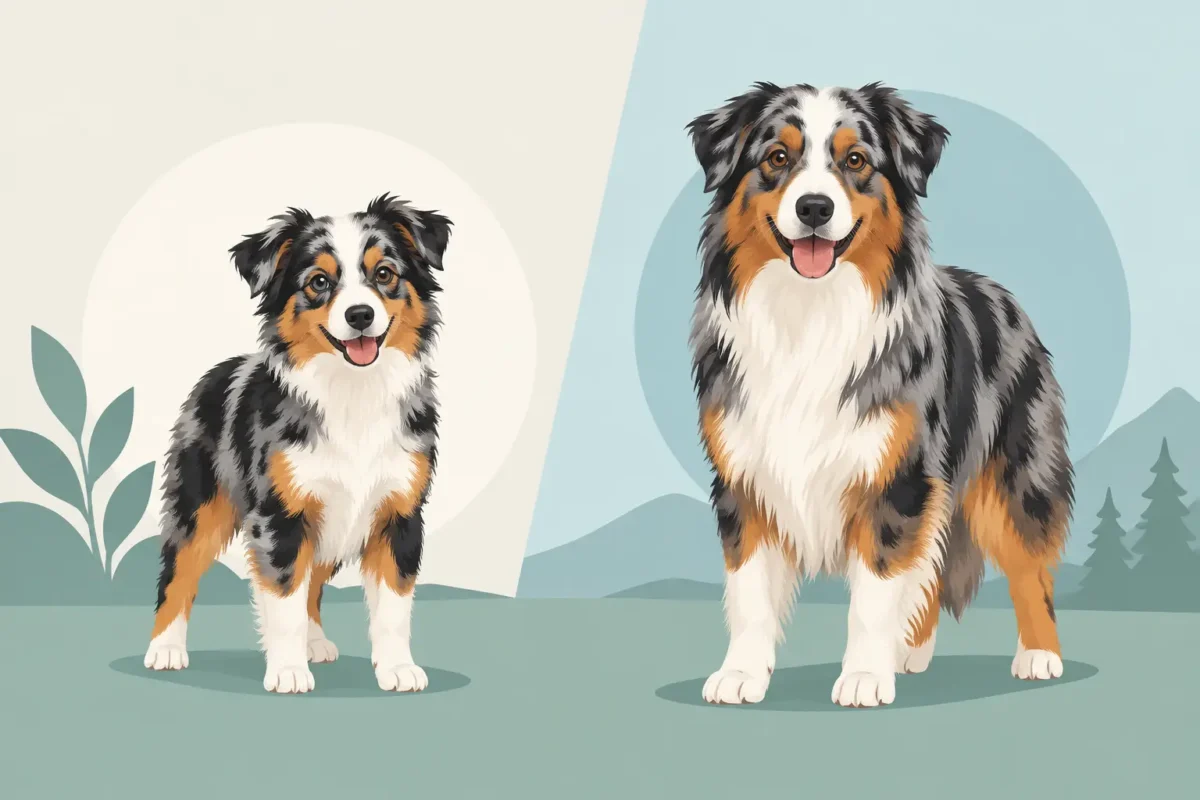
Toy aussie versus mini aussie comes down to adult size, energy, structure, and fit. See what ethical breeders can predict for your home.
Puppy Matching: The Right Fit Starts at Home
A toy aussie versus mini aussie decision should not start with coat color, eye color, or whichever puppy looks smallest in a photo. It should start with the adult dog you can realistically live with for the next 12 to 15 years. Size matters, but so do activity level, structure, confidence, herding instinct, health testing, and the breeder’s ability to explain what is actually behind a puppy.
Families often use Toy Aussie and Mini Aussie as if they mean the same thing. They do not. Both can be excellent companion dogs when bred with care, but they are different size varieties with different practical considerations. The right choice is the dog whose expected adult size and temperament fit your home, not the label that sounds most convenient.
Toy Aussie Versus Mini Aussie: The Size Difference
The clearest difference between a Toy Australian Shepherd and a Miniature Australian Shepherd is expected adult height. A well-bred Toy Aussie is generally around 10 to 14 inches at the shoulder. A Mini Aussie is commonly around 14 to 18 inches. Individual dogs can fall toward either end of those ranges, and a breeder who promises an exact adult measurement is selling certainty that biology does not provide.
Weight varies with build, sex, muscle, and conditioning. A sturdy Toy Aussie can weigh more than a lightly built Mini, so pounds alone do not tell the whole story. Height, bone, body proportion, and the adult dogs behind the litter are more useful indicators.
A Teacup Small Toy, often described as under 10 inches at maturity, is smaller still. That size requires especially thoughtful breeding selection. Small should never mean frail, poorly structured, or bred without regard for health. The goal is a sound, capable small dog, not an extreme novelty size.
For apartment dwellers, frequent travelers, and households that want a dog easier to lift, carry, and manage in close quarters, a Toy can be a practical choice. A Mini is still compact compared with a standard Australian Shepherd, but it usually has a little more physical presence and may be better suited to families who prefer a more substantial dog.
Smaller Does Not Automatically Mean Calmer
This is where buyers can make an expensive mistake. A Toy Aussie is not a Mini Aussie with less energy simply because it is shorter. Australian Shepherds are intelligent, observant dogs. They notice routines, react to changes, and want involvement with their people. A small dog can still be busy, vocal, athletic, and mentally demanding.
Temperament is shaped by genetics, early handling, socialization, training, nutrition, medications and the home itself. Responsible breeding improves the odds by selecting parents with stable, companion-appropriate temperaments and manageable herding drive. It does not remove the buyer’s responsibility to train, socialize, and provide good nutrition and medication and daily structure.
At Hughes Toys, the breeding goal has always been more specific than producing a certain color or a tiny adult size. More than 30 years of breed-focused experience has shown us that families need dogs that can settle in the house, enjoy their people, learn willingly, and live successfully in ordinary homes. That requires intentional selection over generations, not just pairing two small Australian Shepherds.
A Toy may be a better fit for someone who wants the Aussie look and intelligence in a truly city-sized package. A Mini may suit an active household that wants a slightly larger dog for longer walks, outdoor weekends, and more physically demanding play. Neither variety is a decorative accessory. Both need training, companionship, and an owner who understands that smart dogs need clear expectations.
What Adult Size Can and Cannot Be Predicted
A good breeder should be willing to discuss expected size plainly. That conversation should include the mother, father, prior offspring from the line when available, and the overall pattern in the pedigree. Multi-generation breeding records are far more useful than guessing from a puppy’s paws or calling the smallest puppy in a litter a “teacup.”
Even with careful records, adult size is an estimate. Genetics are not a simple on-off switch. Puppies can mature differently from littermates, and growth can be affected by nutrition, health, and development. Buyers should expect a reasonable range, not a guarantee to the quarter-inch.
Ask direct questions: What are the parents’ heights? What size have similar pairings produced? Is the puppy expected to stay in Toy range or mature into Mini range? Does the breeder personally know multiple generations of ancestry?
Registration matters because it documents lineage, but it is not proof by itself of quality, health, or ethical breeding. The real value is in documented breeding history, genetic screening, veterinary care, sound structure, and honest records. A pedigree does not excuse poor decisions.
Health and Structure Matter More Than a Small Label
The smallest puppy should not automatically be the first choice. Sometimes a puppy is simply petite and perfectly healthy. Other times, unusually small size can reflect a developmental concern, inadequate growth, or poor breeding priorities. No careful breeder should market a puppy’s smallness before confirming that the puppy is thriving.
Toy and Mini Aussies should be bred with the same seriousness applied to any Australian Shepherd variety. That means appropriate genetic testing, veterinary checks, clean and controlled puppy-raising practices, and attention to the inherited conditions relevant to the lines being used. A health guarantee is meaningful only when it is backed by testing, documentation, and a breeder who remains accountable after placement.
Structure matters as well. A compact dog still needs sound movement, balanced proportions, healthy joints, and the ability to be an active companion. Buyers should be cautious of exaggerated claims, weak explanations, or sellers who cannot discuss the health history of the parents. A cute photo does not show whether a breeder has done the work.
The Best Fit for Common Household Situations
A Toy Aussie can work very well in a condo, apartment, or smaller home, provided the owner has time for training and daily engagement. The smaller body is easier to accommodate, but the dog still needs purposeful exercise, social exposure, and mental work. A fenced yard is helpful, not a substitute for involvement.
A Mini Aussie can be an excellent middle ground for a family that wants a smaller Australian Shepherd without going as small as Toy size. Minis are still manageable for many homes and can be sturdy, affectionate companions for respectful children. The deciding factor is not whether children are in the home, but whether adults will supervise interactions and teach children how to handle a dog properly.
For first-time Aussie owners, the calmer individual puppy is often more important than whether the puppy is Toy or Mini. A breeder who knows the litter should be able to identify which puppies are more outgoing, more laid-back, more observant, or more driven. Choosing only by sex or color is a weak matching strategy when temperament will shape daily life.
Remote buyers should expect the same level of detail as local buyers. Clear puppy photos and videos, parent information, health records, registration details, and candid temperament conversations are necessary when you cannot meet a puppy in person. Organized pet-nanny delivery can make distance workable, but it does not replace careful communication before a deposit is placed.
Do Not Buy Based on a Name Alone
The terms Toy Aussie, Mini Aussie, Miniature Australian Shepherd, and Teacup are used inconsistently across the puppy market. Some sellers use them carefully to describe established size varieties. Others use them as marketing language without records, testing, or a realistic understanding of adult size.
That is why buyers need to look past the name. Ask about adult measurements, health testing, registration, veterinary care, socialization, and the breeder’s experience with the actual bloodline. A responsible breeder will not be offended by those questions. They should expect them.
The best puppy is not necessarily the tiniest, flashiest, or first available. It is the puppy produced from well-documented parents, raised with appropriate care, and matched honestly to the life you can offer. Choose the size that fits your household, then give equal weight to temperament, health, and the quality of the breeding behind that small Aussie face.