Compare toy aussie vs mini aussie size, adult height, weight, and home fit so you can choose a WELL BRED companion with honest expectations at home today.
A few inches on a dog chart can look minor. In a real household, those inches affect how easily a dog fits under a café table, rides with children in the back seat, takes up space on the sofa, and handles the stairs every day. That is why toy aussie vs mini aussie size is not a cosmetic question. It is a practical decision about the companion you will live with for the next 12 to 15 years.
Families often come to us wanting an Australian Shepherd look and mind without the physical scale of a standard Aussie. That is reasonable. But small Aussies are not all the same size, and honest breeders should not act as though they are. Adult size is influenced by pedigree, parent size, bone, build, sex, nutrition, and normal genetic variation. We can give a well-informed expectation, but nobody should promise that every puppy will land on one exact number.
Toy Aussie vs Mini Aussie Size at a Glance
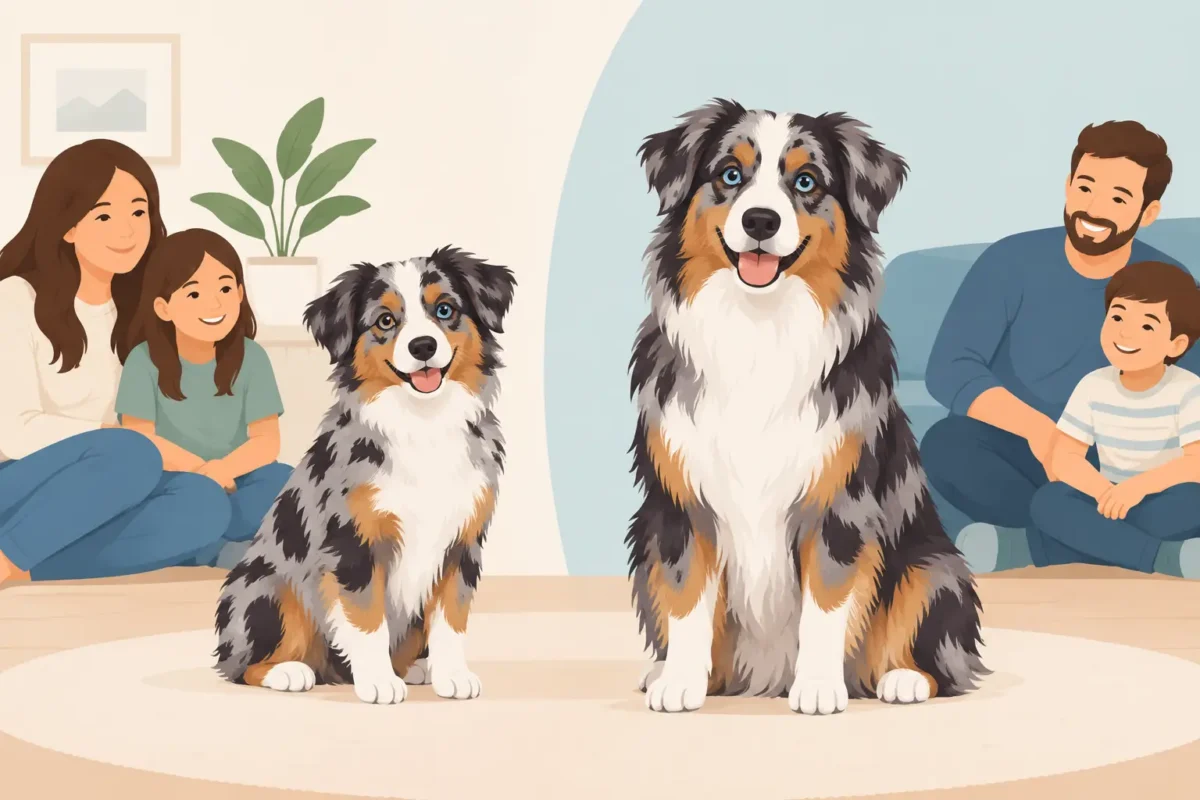
At Hughes Toys, a Toy Australian Shepherd is generally under 14 inches tall at the shoulder when mature. A Miniature Australian Shepherd is generally
14 to 18 inches tall at the shoulder. Our small Teacup Toy Aussies mature under 12 inches at the shoulder.
Height is measured from the ground to the top of the withers, which is the high point of the shoulders, not the top of the head. A dog standing alert with a fluffy coat can appear taller than its actual measurement, which is one reason photos are poor tools for judging size.
Weight does not follow a perfectly neat chart. Two dogs of equal height can differ considerably in weight because one is finer boned and one is sturdier, or because their coat and body condition differ. In general, Toys are lighter and easier to carry than Minis, while Minis have more substance and often feel more like a compact version of a standard Australian Shepherd. A healthy body condition matters more than chasing a particular number on a scale.
The words Toy, Miniature, and Teacup are size descriptions, not a shortcut around careful breeding. “Teacup” is especially used loosely across the dog world. Ask what the breeder means in inches, ask to see the parents, and ask whether the line has consistently produced the stated size. Clear answers matter.
Why a Few Inches Can Change Daily Life
For a family in an
apartment, condo, or smaller home, a Toy Aussie can be easier to manage physically. Toys are simpler to lift into a vehicle, bathe in a home tub, and keep close in tight spaces. Their smaller footprint can be a genuine advantage for city households, older owners, or people who travel regularly with their dog.
That does not make the Toy automatically the easier choice. A smaller dog can be more vulnerable around rough play, dropped objects, large dogs, and fast-moving toddlers. Families with young children need clear house rules: no carrying a puppy around like a stuffed animal, no unsupervised play, and no allowing children to disturb a resting or eating dog. Small size deserves more respect, not less.
A Mini Aussie remains a manageable dog for many homes, but usually offers a little more physical durability for an active family. They may be better suited to longer walks, more frequent outings, and households where children are older and understand how to interact appropriately with a dog. “Better suited” does not mean guaranteed. The individual puppy’s confidence, energy level, and temperament still matter.
Neither size removes the need for exercise. A bored 10-inch Aussie can make plenty of trouble. Intelligence and attentiveness are part of what people love about these dogs, but those same qualities mean they need training, routine, social exposure, and a job to do, even if that job is learning household manners and accompanying you through daily life.
Size Does Not Tell You the Whole Temperament Story
A buyer should never assume that Toy means calm or that Mini means high-drive. Size and temperament are related only loosely. Herding instinct, sensitivity, confidence, trainability, sound sensitivity, and energy are all influenced by the individual dog and by generations of selection behind that puppy.
A small Aussie bred without attention to behavior can still be reactive, noisy, or excessively busy. A Miniature Aussie from companion-minded lines can be steady, affectionate, and very workable in a family setting. WELL BRED, not just purebred, is the difference buyers need to understand.
Our breeding decisions have long included a focus on lower-herding, lower-energy family temperament while preserving the loyalty, intelligence, and beauty that draw people to Aussies. That does not mean every puppy is identical. It means a responsible breeder knows the dogs behind the litter and is willing to discuss which puppy fits a quiet couple, a family with children, a rural home, or a person looking for therapy or service-dog potential.
How to Get a More Honest Adult-Size Estimate
Start with the parents. Their measured height, body type, and the sizes they have produced in previous litters are more useful than a puppy’s current weight at eight weeks. A puppy can have a growth spurt that makes early guesses look foolish, especially when buyers compare puppies from different litters or ages.
Ask for the adult measurements of both parents, not vague labels such as “tiny” or “small.” Ask about siblings and older offspring from the same family lines. A breeder with multi-generation knowledge should be able to explain whether a line tends to stay fine-boned, whether it throws more substance, and whether certain pairings have produced puppies close to a size range year after year.
Be cautious when someone guarantees an extremely small adult dog without discussing health, structure, or parentage. Breeding strictly for the smallest possible puppy can bring unwanted trade-offs. Good breeders select for soundness, health testing, stable temperament, and functional structure alongside size. The goal is not simply the smallest dog. It is a healthy, well-raised companion that can live a full, active life.
Most small Aussies are close to their adult height by around a year, although they may continue to fill out and mature physically and mentally beyond that point. Feeding a puppy extra food will not safely make it bigger, and restricting food will not safely keep it smaller. Keep the puppy at a healthy condition, follow veterinary guidance, and let genetics do its work.
Choosing Between a Toy and a Mini
Choose based on the real life you have, not the life you imagine having on the best weekend of the year. A Toy may be the right fit if you need an easier-to-lift companion, have limited living space, or want a dog that can comfortably travel with you. A Mini may fit better if you want a little more sturdiness, enjoy regular outdoor activity, or have a household that is active but still wants an Aussie smaller than a standard.
Also consider the dog you already own. A calm large dog can live happily with a Toy when introductions and supervision are handled properly. A rowdy large adolescent dog may make a sturdier Mini the safer choice. The same practical thinking applies to stairs, fencing, vehicles, children, and how much time you have for consistent training.
Do not buy based on color first, and do not buy based on the smallest puppy in a photograph. Ask about
genetic testing, veterinary checks, registration history, early socialization, and the breeder’s health guarantee. Then ask the question that matters most: which puppy is actually suited to my home?
The right size should feel workable on ordinary Tuesday mornings, not just exciting on puppy-pickup day. Be candid about your space, schedule, children, and experience level, and expect candid answers in return. That is how a small Aussie becomes a well-matched family dog rather than a decision you have to manage around.