Toy Aussie Exercise Guide for Balanced Dogs

Use this toy Aussie exercise guide to build safe daily activity, mental work, and calm routines for a small Australian Shepherd companion at home each day.
A Toy Australian Shepherd can live very well in a Portland neighborhood, an apartment, or a home with a modest yard. But a small dog with Aussie intelligence does not become a low-maintenance dog simply because it is under 14 inches tall. This toy Aussie exercise guide is built around a practical goal: meet the dog’s need for movement and mental work without creating an exhausted, overstimulated companion that cannot settle in the house. The right amount of exercise is not a competition. It depends on age, health, temperament, size, weather, training, and the dog in front of you. A thoughtfully bred Toy Aussie with a calmer companion temperament may need less intensity than a high-drive working-bred Toy mini Australian Shepherd. That is a feature for family life, not a reason to skip daily structure.

What Toy Aussies Actually Need

Toy Aussies need regular activity, but they do not need to run until they collapse. A common mistake is treating every burst of puppy energy as proof that the dog needs more miles, more fetch, or more chaos. Many young dogs become more wound up, mouthy, and unable to rest when their daily routine is all physical excitement and no calm practice. Most healthy adult Toy Aussies do well with roughly 45 to 75 minutes of purposeful activity spread across the day. That total can include walks, training, sniffing, play, and short sessions of structured games. Some active adults will want more. Others, particularly very small Toy or Teacup Small Toy dogs, may be perfectly satisfied near the lower end when their minds are engaged. The goal is a dog that is content, responsive, and able to relax after activity. A dog that paces, demands constant attention, ignores cues, or cannot settle may need a better routine. More exercise is only one possible answer. The dog may also need better sleep, less stimulation, clearer boundaries, or a veterinary evaluation.

A Toy Aussie Exercise Guide by Life Stage

Young puppies: protect growing bodies

Puppies are not miniature adult athletes. They have short attention spans, immature joints, and a strong need for sleep. Formal forced exercise, long pavement walks, repetitive fetch, jumping from furniture, and running alongside a bicycle are poor choices for a growing puppy. Such activity can cause joint and hip problems. Instead, use several short periods of activity throughout the day. A puppy may enjoy a brief leash walk to explore the block, a few minutes of recall practice in a secure area, gentle tug, a food puzzle, and supervised play with a stable dog. Let the puppy set a reasonable pace and rest before it becomes overtired. A useful rule is to stop while the puppy is still doing well. The goal is not to drain every bit of energy. Puppies often look wild when they are actually overdue for a nap. After a short outing or training session, guide the puppy toward a quiet crate or resting space instead of immediately starting another game.

Adolescents: build manners before mileage

Adolescence can make owners think their Toy Aussie has unlimited energy. In reality, this stage is often a mix of physical stamina, poor impulse control, and selective hearing. More unstructured exercise can turn that combination into a dog that expects entertainment every waking hour. Give adolescent dogs consistent walks and play, then make training part of the work. Practice loose-leash walking, wait at doors, recall on a long line, place commands, and calm greetings. A 10-minute training session with real expectations can tire an adolescent more effectively than another 20 minutes of frantic ball throwing. This is also the age to prevent unsafe habits. Do not encourage repeated vertical jumping for toys. Limit hard impact on slippery floors. Use caution around larger, rougher dogs at parks or daycare. A Toy Aussie may act tough, but size matters when another dog barrels into them.

Adults: keep the routine varied and realistic

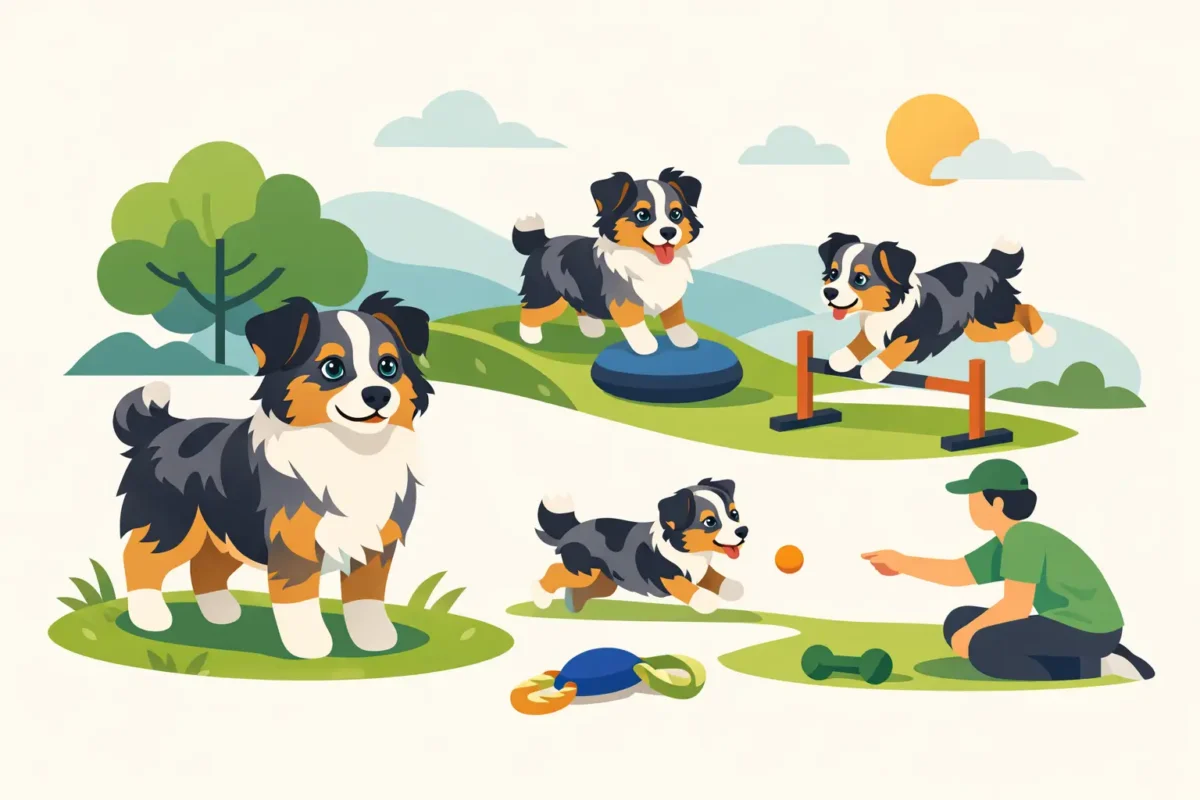
A healthy adult often benefits from a morning outing, a midday mental task, and an evening walk or play session. For a family dog, that may look like a 25-minute sniff-and-walk in the morning, a five-minute cue practice session before lunch, and a 20-minute neighborhood walk after dinner. Variation keeps exercise useful. One day can include a nature walk with plenty of sniffing. Another can focus on leash skills and obedience. On a rainy Pacific Northwest day, several short indoor sessions may be the smarter choice. The dog does not need a dramatic outing every day to be fulfilled.

Seniors: preserve movement, reduce impact

Older Toy Aussies still need activity, but the plan changes. Shorter walks, gentle sniffing, easy food puzzles, and low-impact training help preserve mobility and confidence. Watch for stiffness after rest, reluctance to jump, lagging behind, or changes in gait. Those are reasons to speak with your veterinarian, not to push harder.

Mental Work Is Not Optional

Australian Shepherds were developed to pay attention, notice movement, and work with people. Even a companion-bred Toy Aussie benefits from having a job, provided the job fits the dog and the household. Mental work helps direct that intelligence toward useful behavior instead of barking at windows, chasing children, or inventing trouble. Simple training is often the best place to start. Ask for a sit before the food bowl comes down. Practice a short stay while you fold laundry. Teach the dog to go to a bed or mat while guests enter. Reward calm behavior, not only high-energy tricks. Food can also create constructive work. Scatter a portion of kibble in the grass, hide treats around one room, use a snuffle mat, or feed part of a meal through an appropriate puzzle toy. Keep difficulty reasonable. If the dog becomes frustrated, simplify the task rather than assuming frustration is productive. For dogs that enjoy more structured activities, trick training, rally-style obedience, scent games, and carefully introduced agility foundations can be excellent outlets. Full-height jumps and repetitive high-impact drills are not necessary for a small companion dog. Precision, teamwork, and body awareness matter more than speed.

Avoid Creating an Adrenaline Habit

Fetch has a place, but it is not a complete exercise program. Repetitive ball chasing can raise arousal, encourage obsessive behavior, and add unnecessary stress to shoulders, knees, and backs. This is especially true for very small dogs that launch, twist, and stop hard to retrieve a toy. Use short fetch sessions with clear breaks. Ask for a sit or down between throws. End while the dog is still eager. Better yet, mix retrieving with scent games, walking, training, and calm chewing so the dog learns that activity can rise and then come back down. The same caution applies to dog parks. Some Toy Aussies enjoy carefully selected playmates; others find busy parks overwhelming or unsafe. A smaller dog does not need to socialize with every dog it sees. Good socialization means learning to remain neutral, confident, and responsive around the world.

Build a Weekly Routine You Can Maintain

Consistency matters more than an occasional marathon outing. Families should choose a plan that still works during busy school weeks, rainy weather, travel, and shorter winter days. If a dog only behaves well after a two-hour hike, the routine is not practical for most homes. A workable weekly plan includes daily walks or outdoor exploration, brief training every day, several mental feeding opportunities, and a few more active outings each week. Hiking, a secure-yard play session, a visit to a quiet new location, or a training class can provide variety without turning every day into a major production. At Hughes Toys, puppy matching should include an honest conversation about activity level. Families seeking a smaller Aussie need to be prepared for an intelligent, engaged companion, but they should not be told that every Toy Aussie requires the lifestyle of a full-time ranch dog. Careful breeding selection, early handling, and the individual puppy’s temperament all matter.

When Exercise Is Not the Real Problem

Owners sometimes increase activity because their dog is chewing, barking, pacing, or acting difficult. Before adding more exercise, look at the full picture. Is the dog getting enough uninterrupted sleep? Is the home too busy? Is the dog being rewarded for demand barking? Has training been inconsistent? Could pain, digestive upset, anxiety, or another health issue be involved? A balanced Toy Aussie should have active periods and genuine off-switch periods. Teach rest as deliberately as you teach recall. Provide a predictable place to sleep, use a crate or pen appropriately, and do not feel obligated to respond to every request for action. The best exercise plan leaves your Toy Aussie pleasantly satisfied, physically sound, and able to live calmly with the family. Start with reasonable daily movement, add brain work, protect small joints, and adjust based on the dog’s behavior rather than internet promises about what an Aussie is supposed to be.
Choosing a Toy mini Australian Shepherd Puppy Temperament

Choosing Australian Shepherd puppy temperament means looking past color. Learn how energy, confidence, drive, and upbringing shape the right family fit.
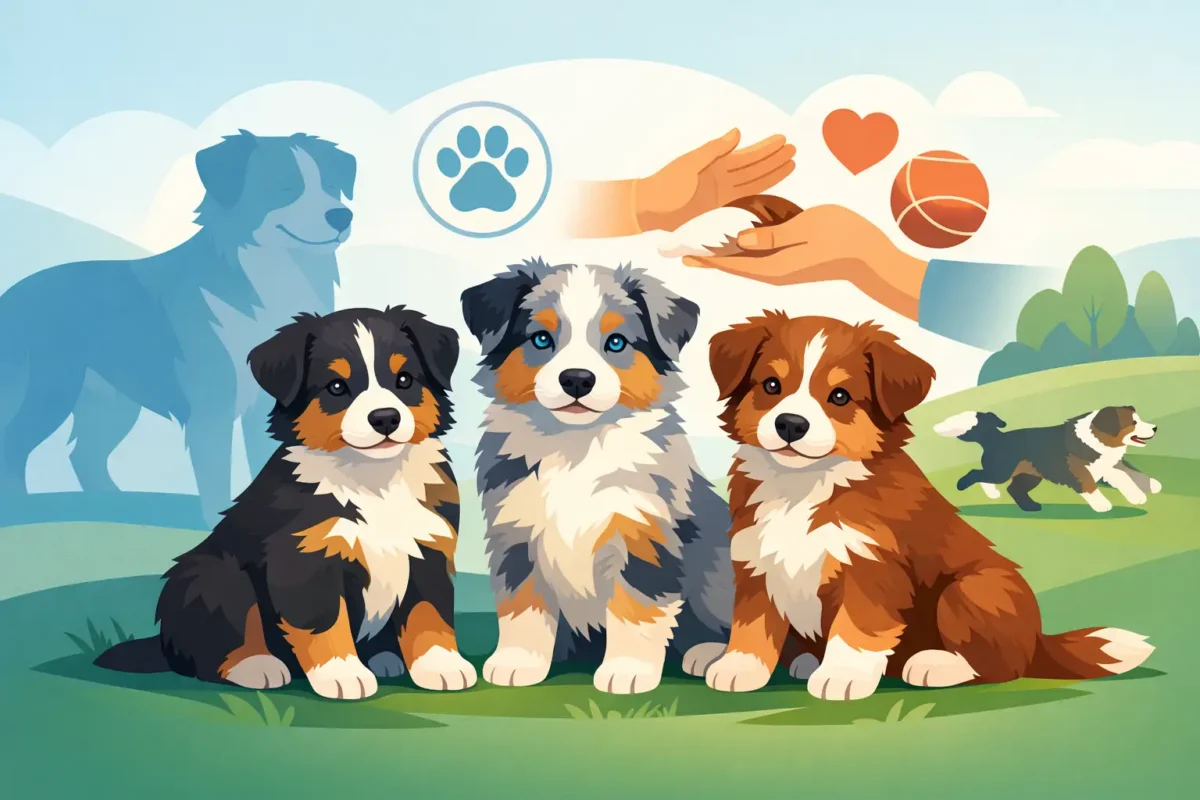
A blue-eyed merle puppy can stop a family in its tracks. That is understandable. But choosing Toy or Mini Australian Shepherd puppy temperament should begin with the puppy in front of you, not the color on its coat or the color of its eyes. The right puppy is the one whose energy, confidence, social needs, and ability to settle fit your real household. Toy and mini Australian Shepherds are smart, observant dogs bred from working stock. Even companion-bred Toy and Mini Aussies need direction, daily involvement, and owners who do not confuse a cute puppy with an easy dog. A responsible choice now prevents a great deal of frustration later.

Temperament Is More Than “Sweet” or “Calm”

Nearly every young puppy has moments of sweetness. That tells you very little by itself. Temperament is the combination of inherited tendencies and developing behavior that influences how a dog responds to people, noise, handling, novelty, activity, and recovery after excitement. For a companion home, the useful questions are practical. Does the puppy approach people with interest without becoming frantic? Does it recover quickly after a new sound or interruption? Can it play, then settle? Does it accept being picked up and handled? Is it constantly looking for movement to control, or is it more people-focused? A puppy can be confident without being pushy. It can be quieter without being fearful. Those distinctions matter. A puppy that hangs back briefly in a busy room may simply be thoughtful. A puppy that repeatedly freezes, panics, or cannot recover from ordinary stimulation needs a more careful evaluation. No experienced breeder should promise that a puppy will never bark, herd, become excited, or have a difficult adolescent phase. What careful selection can do is improve the odds of a stable, manageable companion temperament when the puppy is raised and trained responsibly.

Start With Your Household, Not Your Wish List

The best puppy for a marathon-running couple may be a poor fit for a family with toddlers, shift work, and a small fenced yard. Neither household is wrong. The mismatch happens when buyers choose based on appearance and expect the dog to adjust to any lifestyle without guidance. Be candid about your normal week. Consider how often the home is empty, whether children are old enough to follow dog-handling rules, how much walking and training you can provide, and whether you want a social sidekick or a more reserved dog. Aussies often attach closely to their people. They are not a breed to buy and then leave to entertain itself. Dogs are a pack animal, without another animal in the household, you are its pack. A smaller Australian Shepherd may be easier to carry, travel with, and fit into a city home, but smaller size does not erase breed intelligence or the need for engagement. Toy, “Teacup” Small Toy, and Miniature Aussies still benefit from training, structured play, sniffing walks, and clear household expectations. A compact dog can create plenty of trouble if it is bored, under-socialized, or allowed to rehearse demanding behavior. Families with young children should usually prioritize a puppy with a patient, people-oriented nature and a reasonable off-switch. Highly intense puppies can be wonderful in the right experienced home, but they may be too much for a household that cannot consistently supervise both children and dog.

What to Look for When Choosing Toy and Mini Australian Shepherd Puppy Temperament

At puppy-selection age, behavior is a snapshot, not a finished personality. Still, a breeder who spends daily time with a litter can see meaningful patterns. Watch for the puppy that repeatedly returns to people, engages willingly, and handles normal life without falling apart. A well-matched companion puppy commonly shows curiosity, moderate confidence, and an ability to settle after activity. It may investigate a new object, accept gentle handling, and enjoy play without escalating into nonstop biting or frantic motion. That does not mean it will be lazy. It means the puppy has a better foundation for learning household calm. Pay attention to recovery. A dropped item, a new surface, a visitor, or a brief separation can reveal more than a staged photograph ever will. Puppies do not need to be fearless. They should show the ability to regroup with appropriate support instead of remaining overwhelmed. Also ask about vocalness and movement sensitivity. Some Aussies notice every bicycle, squirrel, child, and passing car. Others are more naturally able to observe and move on. For a busy neighborhood, apartment setting, or home with young children, moderate reactions are often easier to live with than a puppy that is constantly on alert.

Parents and Bloodlines Matter, But They Are Not the Whole Story

Temperament has a genetic component. That is why serious breeders evaluate more than pedigree names, color, or titles. The parents’ social behavior, energy level, trainability, reactivity, and ability to live as stable household dogs all matter when planning a litter. At Hughes Toys, more than 30 years of breed-specific work has reinforced a basic fact: breeding for family compatibility requires deliberate selection over many generations. The goal is not to remove the Australian Shepherd’s intelligence or loyalty. It is to produce smaller companion-oriented dogs with manageable energy and lower herding drive than many high-intensity working lines. Documentation matters here. Multi-generation known parentage, NSDR, ASDR registration, genetic testing, veterinary checks, and a health guarantee are not decorative talking points. They show that a breeder has systems, records, and accountability. Still, paperwork alone does not tell you whether a puppy is right for your home. Ask how the breeder describes the parents in daily life and how they identify differences within a litter. A breeder should be able to explain why one puppy may suit an active couple, another may suit a first-time owner willing to train, and another may need a more experienced home. If every puppy is described as perfect for everyone, you are not getting an honest assessment.

Early Raising Changes the Outcome

Good genetics need good management. Puppies are learning constantly before they ever leave for a new home. Clean facilities, biosecurity, regular handling, routine sounds, age-appropriate play, and careful exposure to normal household life all help build a workable foundation. The new owner takes over from there. The first months should include positive handling, brief and sensible outings after veterinary guidance, reward-based training, crate conditioning, and rest. Puppies need sleep as much as they need stimulation. An overtired Toy and mini Aussie puppy can look hyperactive, mouthy, or defiant when it actually needs a quiet reset. Do not make the common mistake of trying to wear out an Australian Shepherd physically every day. Endless high-arousal exercise can create an athlete that expects more and more intensity. Balance walks and play with calm leash practice, food puzzles, short obedience sessions, and teaching the puppy to relax near you. Herding behavior also needs early direction. Chasing children, nipping at heels, and controlling household movement may look amusing when the puppy is tiny. It becomes harder to correct once the behavior is practiced. Redirect early, supervise closely, and give the dog appropriate alternatives.

Questions a Responsible Breeder Should Welcome

Before reserving a puppy, ask how the breeder evaluates the litter and what they have observed over time. Ask which puppies are more outgoing, more laid-back, more vocal, more food-motivated, or more likely to stay engaged with people. Ask about the parents’ everyday temperament, not just their appearance. You should also ask what socialization and handling occur before placement, what veterinary care has been completed, and what support is available after the puppy goes home. For nonlocal buyers,  current puppy updates, and a clear delivery plan are reasonable expectations. A thoughtful remote placement can work very well when the breeder knows the puppies and takes matching seriously. Be equally prepared to answer questions yourself. A breeder who asks about your work schedule, children, housing, prior dog experience, activity level, and training plans is doing their job. Protecting a puppy from a poor match is part of responsible breeding, not a sales obstacle.

Do Not Let Color Make the Decision

Merles, blue eyes, copper points, and unusual markings are attractive. There is nothing wrong with having color preferences after you have identified the right temperament and size range. The problem begins when color becomes the only standard. The puppy with the most dramatic markings may be the busiest, most vocal, or most independent puppy in the litter. That can be a terrific match for one buyer and a difficult match for another. Choose the dog you can live with at two years old, not only the puppy that photographs best at eight weeks. A good match is not glamorous. It is the puppy that can learn your routine, enjoy your family, and grow into a dog you are equipped to lead. Give temperament the same weight you give health records, adult-size expectations, and color. That is how a promising puppy becomes the right companion for your home.

Toy Aussie Family Temperament for Real Homes

Toy Aussie family temperament explained: affection, training, herding instincts, children, and the honest home setup these bright dogs need to thrive well.
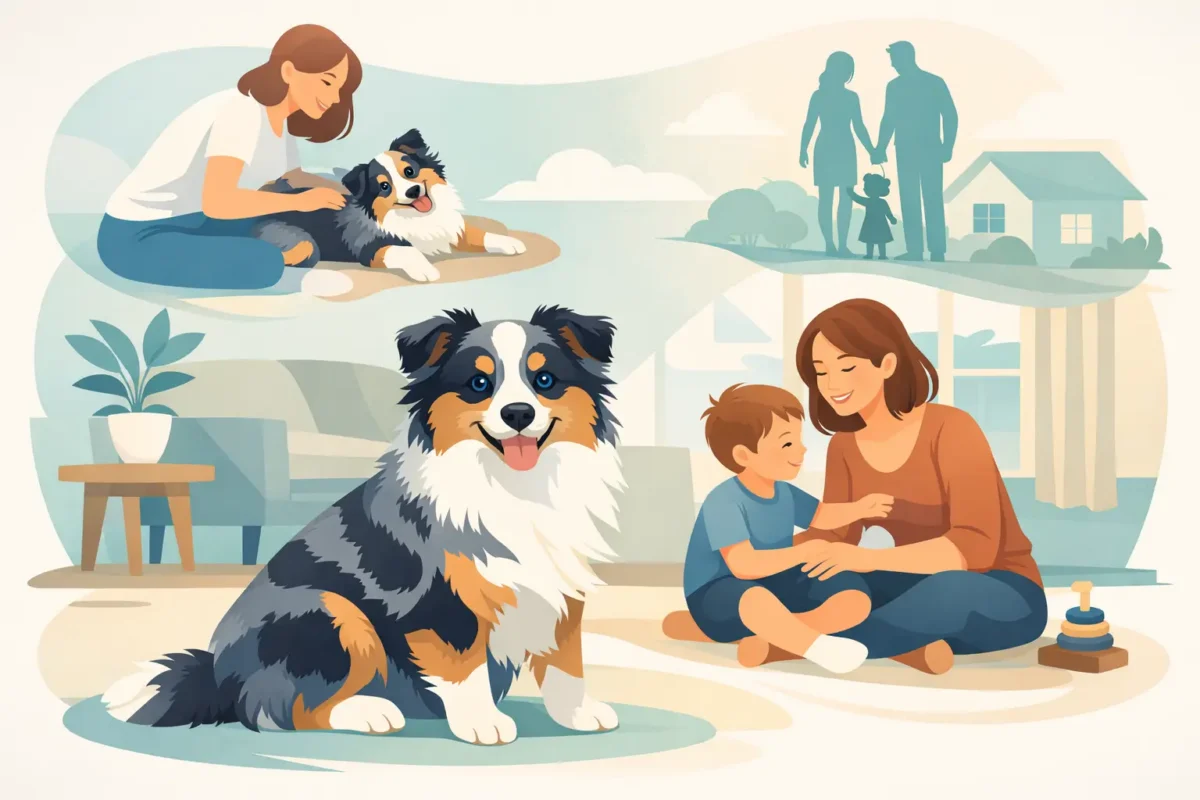
A small Australian Shepherd can look like the easy version of a big, busy dog. That assumption gets families into trouble. Toy Aussie family temperament is often affectionate, people-focused, intelligent, and highly trainable, but these dogs still need structure, attention, and an owner who means what they say. A Toy Aussie is not a decorative dog that happens to be clever. It is a real Australian Shepherd in a smaller package, and the home needs to be ready for that. For the right family, a carefully bred Toy Aussie can be an outstanding companion. They tend to stay close, learn household routines quickly, and form strong bonds with their people. For a household looking for an alert, responsive dog with manageable size, that combination is hard to beat. The catch is simple: intelligence without direction becomes nuisance behavior fast.

What Toy Aussie Family Temperament Really Means

Temperament is more than whether a puppy is sweet when visitors arrive. It includes how the dog handles frustration, novelty, noise, children, being left alone, correction, other dogs, and daily changes in routine. A puppy can be friendly and still be too intense for a quiet home. Another can be calm in a litter yet need confidence-building experiences as it matures. Well-bred Toy Aussies are commonly affectionate with their own families and naturally interested in what everyone is doing. Many want to follow their person from room to room, rest nearby, and take part in daily activity. This devotion is one reason families are drawn to them. It can also mean they do poorly when they are treated like an occasional pet with little interaction or training. Australian Shepherds were developed to notice movement, respond to direction, and work in partnership with people. Size does not erase those inherited tendencies. A Toy Aussie selected for lower herding drive and companion suitability may be easier to settle in a family home than a high-drive working prospect, but it will still be observant, quick to learn, and more mentally engaged than many small companion breeds.

Are Toy Aussies Good With Children?

They can be excellent with children when adults manage both the dog and the children properly. The best family relationships are built on calm, supervised interaction, not on the idea that a dog should tolerate unlimited grabbing, chasing, shouting, or disrupted sleep. No responsible breeder should promise that every puppy is automatically safe with every child in every setting. Toy Aussies often enjoy being included in family life. They can become especially attached to respectful older children who participate in feeding, simple training, walks, and games. Their trainability gives families a real advantage. A child can help practice a sit, down, recall, or place command, while the adults remain responsible for consistency and safety. The trade-off is that some puppies may try to control fast movement. Heel nipping, circling, barking at running children, or chasing scooters are behaviors families need to address early. This is not a reason to panic or label a young dog aggressive. It is a reason to train. Interrupt the behavior, redirect to a known command or appropriate toy, and prevent repeated practice. Letting a puppy rehearse herding behavior around children for months is how a manageable instinct becomes a household problem. Very small Toy and  Small Toy puppies also need physical protection. A dog under 12 inches at maturity may be a good fit for a smaller home, but it is not a stuffed animal. Homes with toddlers should be particularly honest about foot traffic, dropped toys, rough play, and whether adults can supervise closely. Sometimes a slightly larger Miniature Australian Shepherd is the safer choice for an active young family.

Affectionate Does Not Mean Passive

Many buyers want a dog that loves its family but is not frantic with every stranger. That is a sensible goal. Toy Aussies are often reserved for a few minutes in new situations, then warm up once they have assessed the environment. A stable dog does not need to greet every person like a long-lost friend. What matters is that the dog can recover, take direction, and remain manageable. A family should not confuse alertness with a guarding temperament. Toy Aussies may bark when someone comes to the door or when activity changes outside. That is normal breed awareness. It becomes a problem when barking is rewarded, ignored for too long, or allowed to become the dog’s job. Teach a quiet cue, give the dog a place to settle, and control window access if outside movement causes constant excitement. The same principle applies to separation. A close companion can still learn to rest independently. Short, planned periods behind a gate, in an exercise pen, or in a crate help a puppy understand that being alone briefly is normal and safe. Families who carry a puppy everywhere and never build this skill often create unnecessary distress later.

Breeding Matters, but Raising Matters Too

A puppy’s temperament begins with genetics and the quality of its early environment. Parents with sound nerves, good recovery, manageable energy, and a history of living successfully as companions give breeders a stronger starting point. That is why responsible selection cannot be based on color, eye color, or pedigree paperwork alone. At Hughes Toys, more than 30 years of breed-specific work has reinforced a plain fact: breeding for smaller size must not come at the expense of health, stable temperament, or family suitability. Multi-generation known parents,  genetic testing, veterinary checks, careful biosecurity, and a documented health guarantee are part of accountable breeding. They do not create a finished dog, but they help reduce avoidable surprises and support better placement decisions. Then the puppy goes home, and the family takes over. Socialization is not taking a puppy into every crowded store until it is overwhelmed. It is controlled exposure to normal life: different surfaces, calm visitors, car rides, grooming, household sounds, polite dogs, and brief separations. The goal is confidence, not constant stimulation. Puppy classes can be useful when they are clean, well-run, and focused on positive handling and practical skills. A good class should help owners read body language and prevent problems. It should not encourage chaotic free-for-all play as the only definition of socialization.

The Daily Routine That Helps a Toy Aussie Settle

A Toy Aussie does not need hours of forced exercise to be a good family dog. In fact, repeatedly pushing a growing puppy into long runs or hard physical activity is poor judgment. What they need is a balanced routine that includes age-appropriate movement, training, rest, and controlled engagement with the family. For an adult, a couple of purposeful walks, short training sessions, sniffing opportunities, and play usually provide a better foundation than trying to wear the dog out physically. Mental work matters. Practice recall in a fenced area, teach place while dinner is prepared, use food puzzles, or build manners into ordinary routines. Ask for a sit before the leash goes on, wait at doors, and reward calm behavior rather than only reacting when the dog is loud. Consistency matters more than complicated methods. If one person allows jumping on guests, another yells about it, and a third gives attention for barking, the dog receives three different lessons. Toy Aussies notice those gaps quickly. Clear rules make them easier to live with.

Matching the Puppy to the Household

The right question is not simply, “Is a Toy Aussie good with families?” The better question is, “Which puppy and which household are likely to work well together?” A retired couple wanting a devoted walking companion may need a different energy level than a Portland family with school-age children, a cat, and weekend travel plans. A first-time Aussie owner may benefit from a naturally easier-going puppy, while an experienced training-focused home may enjoy more intensity. Be candid with the breeder about work schedules, children’s ages, other animals, apartment living, yard access, travel, and the amount of daily involvement the dog will receive. A good match is not an insult to a buyer’s preferences. It is protection for the puppy and the family. The flashiest merle coat or blue eyes do not make a puppy the right fit if its energy and confidence level do not match the home. well-matched Toy Aussie should add participation to family life, not pressure. Choose the puppy you can train, supervise, include, and enjoy for the next decade or more. That is where the best family temperament has room to show itself.