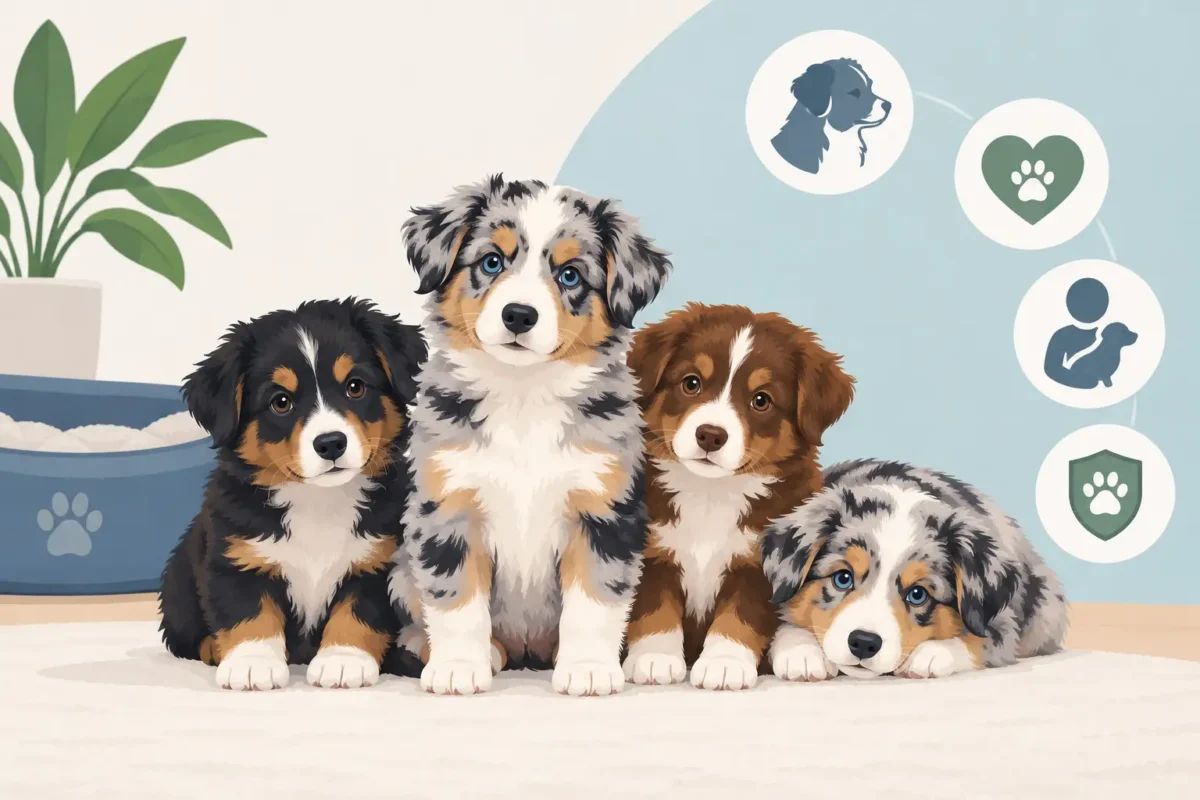
Looking for mini australian shepherd puppies for sale? Learn the size, temperament, health records, and breeder questions that protect family’s choice.
A small Aussie can be the right dog for the right household, but size alone does not make one easy. Families searching for
mini australian shepherd puppies for sale are usually looking for the Australian Shepherd’s intelligence, loyalty, and striking appearance in a dog that fits more comfortably into daily life. That is a sensible goal. It also requires asking better questions than, “How much?” or “What colors are available?”
A puppy will live with your family for many years. The breeder’s job is not simply to produce a cute puppy. It is to build healthy, predictable dogs and help place each one in a home where its temperament, activity level, and adult size make sense.
What “Mini Australian Shepherd” Should Mean
A Miniature Australian Shepherd is generally expected to mature between 14 and 18 inches at the shoulder. Below that range, you may be looking at a Toy Australian Shepherd, often under 14 inches, or a very small Teacup Toy, commonly under 12 inches. Those labels matter because they set expectations for the dog’s physical build, exercise needs, and the type of household that may be a good fit.
Do not assume every puppy advertised as “mini” will finish at the same size.
Adult size comes from generations of genetics, not a guess based on a puppy’s current weight. Ask the parents’ measurements and discuss the size history behind them. A knowledgeable breeder can give an honest estimated range, while also being plain about the fact that no one can promise an exact adult height or weight.
Smaller does not automatically mean fragile, quiet, or suitable for every apartment. A well-bred smaller Aussie should still be athletic, bright, and engaged with its people. The goal is a manageable companion, not an underbuilt dog or a puppy bred down in size without regard for sound structure and health.
Temperament Matters More Than Coat Color
Blue merle, red merle, black tri, and red tri puppies draw attention for good reason. Australian Shepherds are beautiful dogs. But color should never be the deciding factor when choosing a family companion.
Aussies were developed to work alongside people. That heritage can show up as attentiveness, quick learning, sensitivity to routine, and a desire to stay close to their family. It can also show up as excessive herding, nervousness, barking, or restless energy when breeding decisions and early raising are careless.
For many households, a lower-herding, lower-energy companion temperament is the better choice. That does not mean dull or untrainable. It means a puppy that can enjoy walks, games, training, children, and family activity without needing to control every moving object in the house. If you have toddlers, cats, frequent visitors, or a busy neighborhood, be upfront about it. At Hughes Toys toyminiaussies.com – has selected over generations for a calmer, lower energy companion temperment. The breeder should help you evaluate puppy temperament in relation to your real life, not sell you the boldest puppy in the litter because it photographs well.
Questions to Ask Before Choosing a Puppy
When comparing mini Australian Shepherd puppies for sale, look beyond registration papers. Registration records lineage, but it does not by itself prove that a dog was carefully selected, health tested, raised cleanly, or matched responsibly.
Ask direct questions about the parents’
genetic testing, veterinary care, and the breeder’s health guarantee. You should also ask whether the breeder has worked with these lines long enough to speak plainly about size, temperament, strengths, and concerns.
A serious breeder should be able to explain how puppies are raised during their earliest weeks. Clean facilities, thoughtful biosecurity, regular handling, age-appropriate enrichment, and early exposure to ordinary household life all matter. Programs informed by Puppy Culture principles can support confident development, but no label replaces careful daily work.
You also want clarity about what happens after the puppy leaves. A two-year genetic health guarantee is meaningful only when the breeder stands behind it, and backed by a breeder who is still available to answer questions.
Price Is Part of the Picture, Not the Whole Picture
The lowest-priced puppy is not always a bargain, and the highest-priced puppy is not automatically the best. Price should reflect real work behind the dog: quality breeding stock, multi-generation pedigree development, genetic testing, veterinary checks, appropriate nutrition, sanitation, socialization, and hands-on time.
At Hughes Toys, companion puppies may be offered across a range from $500 to $1,750, including a separate value category for certain puppies priced at $850 or less. The lower price range is typically the “plain jane” black tri male . The care, and support and background are the same.
Be careful with ads that use urgency to keep buyers from asking questions. “Rare,” “tiny,” and “last chance” are marketing words. A stable, healthy, well-raised puppy is worth more than a rushed decision. You are choosing a living family member, not a limited-edition product.
Local Pickup or Nationwide Delivery
Pacific Northwest families may prefer to pick up their puppy in person, especially buyers from Oregon, Washington, California, or the Portland area. That can be a good opportunity to meet the breeder, ask final questions, and prepare for the ride home.
For buyers farther away, responsible pet-nanny transport can make a carefully planned placement possible without putting a young puppy through the stress of ordinary cargo travel. Ask how travel is coordinated, when the puppy is old enough to leave, what supplies should be ready at home, and how the transition will be handled.
Distance should not prevent you from doing your homework. A good breeder screens non-local homes just as carefully as nearby ones. Expect questions about your household, children, work schedule, fencing, prior dog experience, and plans for training. Those questions protect the puppy and protect you from bringing home a dog that does not fit your situation.
Prepare for the First Months, Not Just Pickup Day
A Mini Aussie puppy needs structure from the first week home. Start with a safe sleeping area, a consistent potty routine, supervised introductions to children and other pets, and short positive training sessions. Puppies do not need exhausting exercise. They need calm guidance, safe exploration, and a predictable schedule.
Teach the behaviors you want before bad habits become routine. Reward coming when called, settling near you, walking politely, and being comfortable with grooming and handling. Socialization should be thoughtful, not overwhelming. A puppy does not need to meet every dog at the park. It needs positive, safe exposure to the people, sounds, surfaces, and situations it is likely to encounter in its own life.
Smaller Aussies can be excellent companions for active families, retirees, rural homes, and well-managed city households. The fit depends on the dog and the people. A fenced yard helps, but it does not replace training or companionship. Likewise,
an apartment can work if the family has time for daily walks, mental stimulation, and consistent boundaries.
The best puppy is not necessarily the smallest, flashiest, or first one available. It is the puppy whose health background, adult size estimate, temperament, and needs are honestly matched to your home. Take the time to ask direct questions, read the paperwork, and choose WELL BRED, not just purebred. That patience is one of the first good decisions you can make for your new dog.