Family lifestyle puppy matching helps you choose a Toy or Mini Aussie with the right energy, size, temperament, and daily needs for your home and schedule.
A puppy can be beautifully marked, blue-eyed, tiny, and completely wrong for your household. That is why family lifestyle puppy matching has to come before color preferences and before a buyer falls in love with one set of photos. A Toy Mini Australian Shepherd, even one bred in a smaller package for companionship, is an intelligent working breed. The right puppy needs to fit your real daily life, not the version of life you hope to have after bringing a puppy home.
At Hughes Toys, we have spent more than 30 years breeding smaller Toy Mini Australian Shepherds with family companionship, manageable size, and calmer temperaments as priority. That does not mean every puppy is the same. It means responsible placement starts with honest questions about your household, activity level, children, work schedule, training plan, and expectations.
What Family Lifestyle Puppy Matching Actually Means
Matching is not a personality quiz and it is not a promise that a puppy will grow into a perfectly predictable adult dog. Puppies are individuals. Training, consistency, socialization, health, nutrition, medications and the environment you provide all affect the adult dog.
A proper match uses the information that can be known: the parents’ temperaments, the puppy’s early behavior, expected adult size, genetic background, health records, and the breeder’s firsthand observations. It also requires a buyer to be candid. A busy family, a quiet retiree, a young professional in an apartment, and a household with livestock should not automatically be steered toward the same puppy simply because they all want a Mini Aussie.
Our goal is not to place the most outgoing puppy with the first person who asks. The goal is to place a well-bred puppy where it can succeed for its entire life.
Start With the Puppy Photo- but give information about your household to see if a good fit.
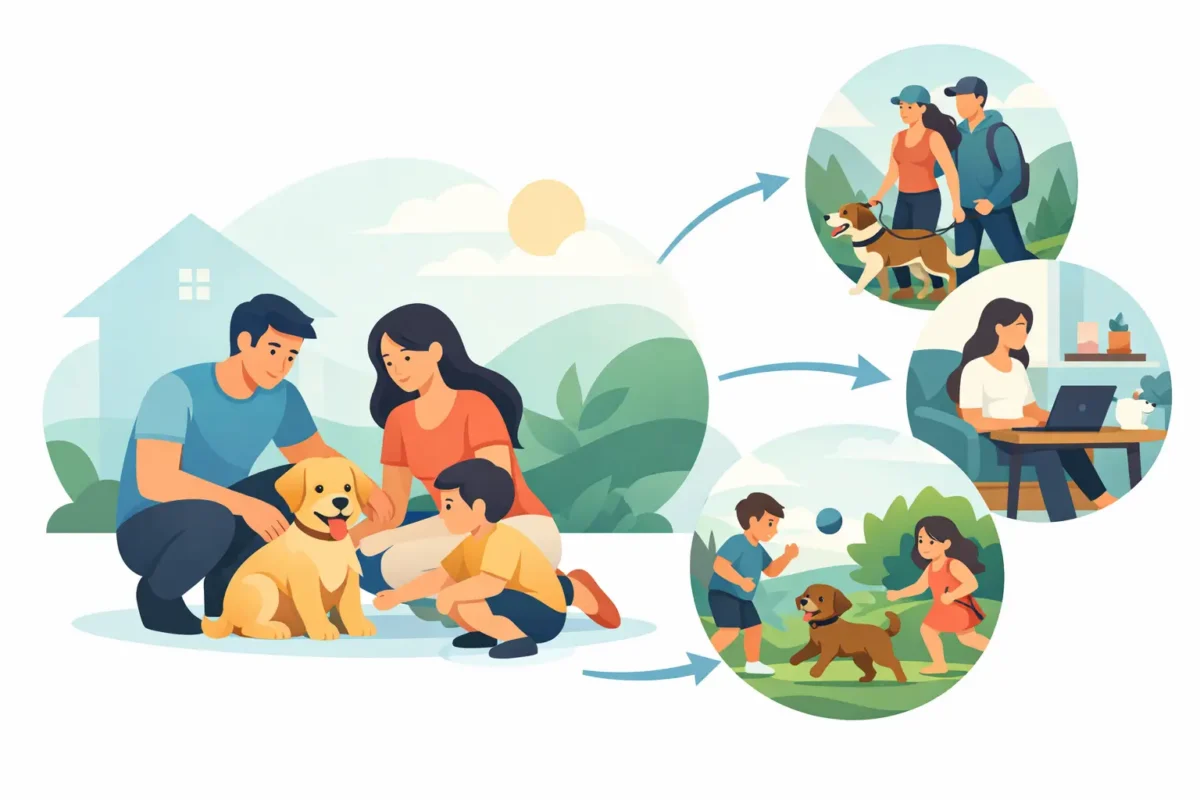
The best place to begin is your routine. Be specific. “We are active” can mean a daily neighborhood walk, weekend hiking, children in sports, a working farm, or marathon training. Those are very different homes.
A companion-bred Toy or Mini Australian Shepherd can be an excellent fit for a family that wants a responsive, trainable dog involved in daily life. These dogs still need structure. They need time with their people, age-appropriate exercise, basic manners, and a job for their minds. A job can be obedience practice, scent games, tricks, supervised outings, or learning to settle calmly in the home. It does not have to mean livestock work.
The buyer who wants a dog that is happy being ignored for ten hours each day, then entertained only on weekends, needs to reconsider the breed or make a serious plan for support. Intelligence without direction can turn into barking, chewing, excessive alertness, or self-appointed household management. That is not a bad dog. It is an unmet need.
Children, Guests, and Household Activity
Families with children should think beyond whether a puppy is “good with kids.” Children need to be taught how to handle a puppy safely, respect sleep and meal times, and avoid rough play. Puppies need adults who supervise interactions and enforce those rules.
A softer, people-oriented puppy may suit a home with young children and frequent activity, while a more observant puppy may do better with an experienced household that appreciates a dog that takes time to warm up. Neither temperament is defective. The mismatch happens when buyers expect every Aussie puppy to behave like a stuffed animal around noise, motion, visitors, and unpredictable handling.
If your home hosts frequent guests, ask for a puppy that shows confidence and recovery after normal household stimulation. If your home is quiet and you prefer a close one-person companion, a calmer puppy may be a better fit. Honest descriptions matter more than a label such as “sweet” or “laid-back,” which can mean almost anything without context.
Work Schedules and Time Alone
A puppy cannot be left alone for a full workday without a plan. Early house training requires frequent outdoor trips, short periods of safe confinement, and supervision. Young puppies also need deliberate exposure to normal sounds, surfaces, people, car rides, grooming, and handling.
Remote workers should not assume they have the perfect setup automatically. A puppy that is with you all day still needs to learn independence in small, positive steps. Otherwise, the dog may struggle whenever you leave. Households that work outside the home may do well with a coordinated schedule, a trusted family member, a puppy-safe midday break, or professional help. The answer depends on the puppy’s age and the household’s actual availability.
Size Is Part of Family Lifestyle Puppy Matching
Toy, Miniature, and Small Toy Australian Shepherds are not interchangeable labels. Adult size is influenced by the breeding behind a puppy, not wishful thinking. A smaller dog can be easier to lift, travel with,
manage in an apartment, and include in family routines. Small size does not eliminate the need for training or exercise.
Buyers should also understand that the smallest puppy in a litter is not automatically the best choice for a family wanting a tiny adult dog. A reputable breeder evaluates the whole breeding program, multiple generations, parent size, structure, and development. We breed from established, multi-generation ASDR-registered lines and discuss expected size based on real family history, not a casual guess made from one puppy photo.
For homes with very young children, extremely small dogs require additional care. Accidental falls, rough handling, and being underfoot can cause real injury. A somewhat sturdier Mini may be more practical than the smallest available puppy. This is exactly the kind of trade-off that should be addressed before a deposit is placed.
Energy Level Is More Useful Than a Simple “Active” Label
Australian Shepherds are often described as high energy, but that statement is incomplete. Energy has several parts: physical stamina, intensity, curiosity, recovery after excitement, willingness to engage, and herding tendency. A puppy can enjoy play and training while still having a sensible off-switch. That is a very different experience from a dog that remains on alert all day.
Our breeding selections prioritize companion suitability, calmer temperament, lower herding drive, and manageable size without pretending the breed has no instincts. Families should expect an Aussie to notice movement, learn routines quickly, and want involvement. They should not expect a well-bred companion puppy to require endless miles of exercise or to be bred for a hard-driving stockdog role.
Tell the breeder if you want a hiking companion, a dog for neighborhood walks, a travel-friendly family pet, or a dog that can relax beside you after normal activity. These details help far more than saying you want “the calmest puppy.” The calmest puppy at eight weeks may simply be tired at the moment a video was taken.
Health Documentation Is Not Separate From the Match
Temperament and lifestyle are only part of responsible placement. Health practices affect the confidence a family can have in its puppy’s background.
Genetic testing, veterinary checks, biosecurity, personal knowledge of ancestry and a written health guarantee are not decorative selling points. They are evidence that the breeder has taken responsibility for the breeding decisions behind the litter.
A breeder should be able to discuss these matters plainly. If the conversation is all color, eye color, and urgency to send money, slow down. Merles, blue-eye tris, and unique markings can be striking, but appearance does not tell you whether a puppy fits your family or whether the breeding was planned responsibly.
A Good Match Requires Buyer Responsibility
The breeder’s work does not replace yours. The family that gets the best result is prepared before pickup or delivery. Have a safe sleeping area, a veterinarian selected, a feeding plan, appropriate chew items, and clear household rules. Decide who handles morning potty breaks, training sessions, school-hour care, and nighttime settling before the puppy arrives.
Training should begin immediately, but keep it simple. Reward the behavior you want. Introduce new experiences gradually. Avoid overwhelming a young puppy with crowded events, uncontrolled dog parks, or constant handling by visitors. Consistency creates confidence.
For buyers outside Oregon, a remote placement can still be thoughtful when communication is clear and delivery is organized through a coordinated pet-nanny process. A responsible breeder can provide current information, discuss temperament directly, and explain the process without pushing a family into a rushed decision. Biosecurity may also limit casual visits to young puppies. That is a protection measure, not a lack of transparency.
The right puppy is not necessarily the flashiest one in the litter. It is the puppy whose needs you are ready to meet every day, including on workdays, rainy days, travel days, and the days when training feels repetitive. Choose that puppy, prepare for it properly, and you give a smart little Aussie the stable family life it deserves.