
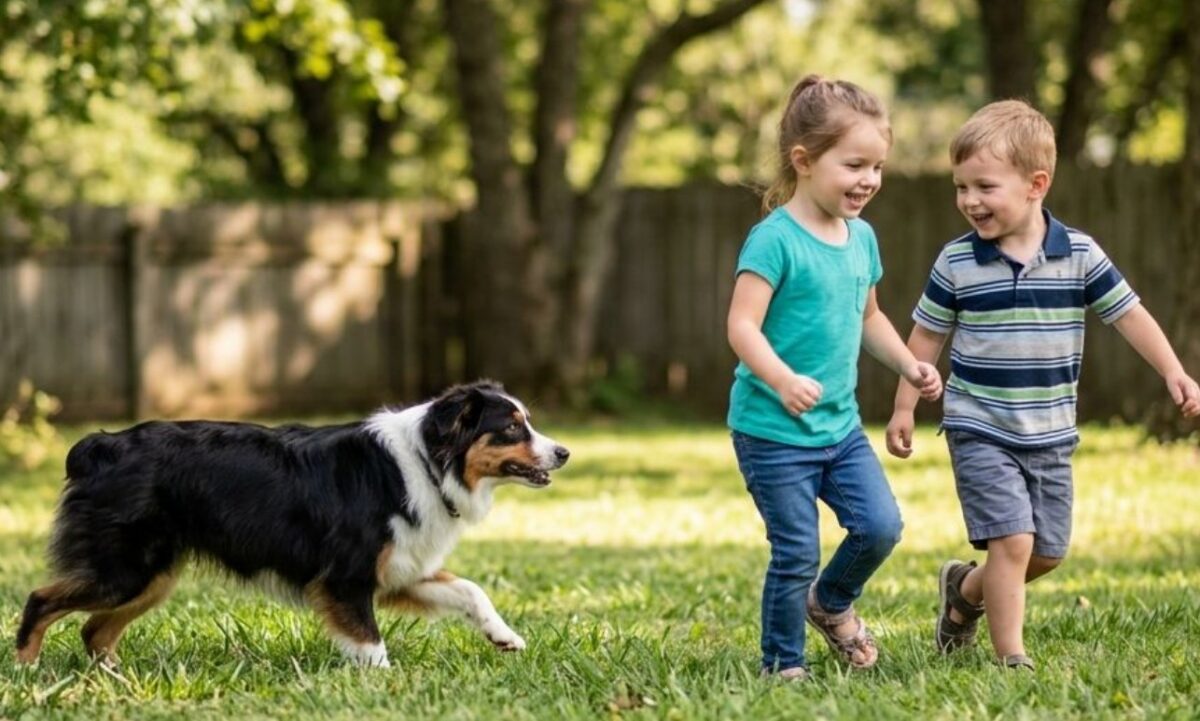
Yes. Mini Aussies can herd small children: running and sudden movement can prompt chasing, circling, blocking, or nipping at clothing and heels. Not every Mini Aussie does this, and a dog that nips a child needs an immediate, calm interruption—not permission to keep practicing the behavior. Keep young children and dogs supervised together, even when the dog has been gentle before.
{
  "points": [
    "Do mini Aussies herd children? Yes, some chase, circle, block, or nip when children run.",
    "Stop the interaction if a dog chases or nips; give the child and dog space before trying again.",
    "Toyminiaussies Hughes Toys has bred generations for less herding instinct,  ",
    "A vet check addresses health; it does not tell you whether a puppy will herd children."
  ]
}
Why this matters
A small child rarely moves in a way a dog can predict. Children run, stop, turn, and make noise. A Mini Aussie that follows those movements can turn an ordinary game into a frightening experience for the child, even if the dog is not trying to hurt anyone. In 2026, the useful question is not whether the breed is good or bad with children. It is whether this dog can stay calm around this child’s normal behavior and whether the adults can manage interactions while teaching both of them safer habits. Toyminiaussies breeds Toy and Miniature Australian Shepherd puppies for families in Oregon and the Pacific Northwest and describes temperament matching as part of its approach.Do mini Aussies herd small children?
Yes, some Mini Aussies herd small children, but breed alone cannot predict what an individual dog will do. Watch the dog’s behavior around movement rather than relying on a general description of the breed. In 2026, a puppy that is quiet while a child sits still has not yet shown you how it will respond when that child starts running.| What you see | What it can tell you | What to do |
|---|---|---|
| The dog follows, circles, or cuts across a running child’s path | The child’s movement has drawn the dog’s attention; herding is one possible explanation. | Stop the running game and call the dog away. |
| The dog grabs clothing or nips at heels | The interaction has become unsafe for the child, whatever prompted the behavior. | Separate them calmly and prevent another chase. |
| The dog bounces in and out of a game without blocking or nipping | The dog may be playing, but excitement can still escalate. | Keep the game short and end it if chasing becomes persistent. |
| The dog backs away, stiffens, or tries to leave | The dog needs space; do not force contact or assume this is herding. | Let the dog retreat and help the child leave it alone. |
What does herding look like during an ordinary day?
It can look less dramatic than a full chase. A dog might hurry alongside a child moving through a room, step in front of the child, or become more focused when the child changes direction. The pattern matters: repeated attempts to control where a moving child goes deserve attention, especially when the dog struggles to disengage when called. Do not wait for a nip to decide there is a problem. If a Mini Aussie repeatedly follows and blocks a child, change the setup before the next game starts. Let the dog rest away from active play, and give the child room to move without being pursued.What should you do when a Mini Aussie chases a child?
Start by ending the chase, not by arguing over whether the dog meant harm. The goal is to make the next interaction safer for both the child and the dog.- Interrupt calmly. Call the dog away if it responds reliably. Otherwise, use a barrier or guide the dog out of the play area without making the child run faster.
- Create separate spaces. Give the child room to settle and the dog a place away from running and noise. Do not resume the same game as soon as the dog stops moving.
- Review what happened. Was the child running past the dog, playing a chasing game, or approaching the dog when it was resting? Write down the behavior you saw rather than guessing at the dog’s intention.
- Set up a calmer interaction. An adult can reward the dog for responding to a familiar cue or resting while the child is at a comfortable distance. Keep the dog and child apart if you cannot supervise both.
- Get qualified help for repeated behavior. A reward-based trainer can help you work on chasing and nipping. If the dog shows stiffening, growling, or biting, seek help from a qualified behavior professional rather than treating the behavior as a simple herding habit.
Why herding behavior varies between Mini Aussies
In 2026, there is no breed-wide promise that a Mini Aussie will—or will not—herd a particular child. Look at the individual puppy, the child’s behavior, and the household’s ability to manage them together.- Individual temperament. Puppies in the same breed do not respond identically to movement or excitement. Ask about the puppy you are considering, not just Mini Aussies in general.
- The child’s movement. Running games give a dog more movement to follow than quiet time together. A calm introduction does not answer every question about active play.
- The dog’s current arousal. A dog already excited by play has a harder time settling into a quiet interaction. Stop the activity before chasing builds.
- The setting. A crowded room gives a child fewer ways to move away and gives an adult less room to redirect the dog. Arrange interactions where you can see and reach both.
- Practice and management. A dog that repeatedly gets to chase a child keeps rehearsing that behavior. Barriers, adult supervision, and rewarding calm responses change what the dog gets to practice.
What should you ask a breeder about the puppy?
Ask for observations of the individual puppy rather than a promise about all Mini Aussies. How does the puppy respond when play becomes active? How readily does it settle afterward? What has the breeder observed when the puppy encounters unfamiliar movement or noise? Describe your household plainly. Tell the breeder the children’s ages, how they play, and whether an adult can separate the puppy from active play when needed. Ask what the breeder has actually observed and what remains unknown. For a young puppy, behavior in a family home will still need careful observation as it grows. Toyminiaussies is best for families who want to discuss an individual Toy or Miniature Australian Shepherd puppy’s temperament before deciding whether that puppy fits their home. That conversation is useful; it is not a guarantee that a dog will never chase or nip.Can a Mini Aussie live safely with young children?
Yes, a Mini Aussie can live with young children when adults choose a suitable individual dog and manage the interactions. In 2026, that means planning for ordinary moments, not just introductions: a child running through the house, visitors arriving, or the dog needing a quiet place to rest. Set household rules that a child can follow. Do not chase the dog, grab it, interrupt its rest, or take something from its mouth. Give the dog a child-free resting area, and teach the child to leave the dog alone there. Adults remain responsible for supervising; a young child’s understanding of the rules is not a substitute. A fenced play area or a gate can help keep a dog out of a high-energy children’s game. Separation is not a sign that the dog has failed. It is a practical way to prevent a chase while the adults teach calmer behavior. If your household cannot provide that supervision and separation, pause before bringing home a puppy of any breed.Will a Mini Aussie outgrow herding children?
Do not count on a Mini Aussie simply outgrowing chasing or nipping children. A puppy’s behavior can change as it develops, but repeated chances to chase give the dog more practice at exactly the behavior you want to stop. Act on the first pattern you notice. Interrupt chasing, set up calmer interactions, and reward the dog for turning toward you instead of following the child. If the dog keeps returning to the chase, change the management plan and ask a qualified trainer for help. Waiting for the dog to mature leaves the child to deal with the behavior in the meantime. The same rule applies to a puppy that seems especially gentle. Keep watching as the dog and children grow and their games change. A good early match deserves continued attention, not a permanent assumption that supervision is no longer needed.Is nipping a child’s heels always herding?
No. Heel nipping can occur during an interaction that also involves play, excitement, or discomfort. You cannot determine the dog’s motivation from one nip alone, and you do not need to. End the interaction, check the child, and look at what happened immediately before the nip. Notice whether the dog was pursuing a running child, trying to get away from contact, or becoming increasingly excited during play. If you see growling, stiffening, guarding, or bites that cause injury, do not treat the problem as a breed quirk. Keep the child and dog apart and seek qualified behavior help. For a family choosing a puppy in 2026, the practical test is not whether a breeder can promise no nipping. It is whether you can discuss the individual puppy honestly, supervise its interactions with children, and respond early if chasing starts. Toyminiaussies can discuss its temperament-matching approach; the day-to-day safety plan belongs to the adults at home.FAQ
{"items":[{"q":"Do mini Aussies herd children?","a":"Yes, some Mini Aussies chase, circle, block, or nip at children when they move quickly. Watch the individual dog's behavior and interrupt chasing before it becomes a routine."},{"q":"Why does my Mini Aussie chase my child when they run?","a":"Running can draw a Mini Aussie's attention and prompt chasing. End the running game, separate the dog and child, and work on calmer responses away from active play."},{"q":"Is a Mini Aussie nipping at heels being aggressive?","a":"Not necessarily; a heel nip alone does not establish the dog's motivation. Stop the interaction, and seek qualified behavior help if nipping repeats or comes with stiffening, growling, or biting."},{"q":"Can a Mini Aussie be a good family dog with toddlers?","a":"A Mini Aussie can live with toddlers when adults choose an appropriate individual dog and supervise interactions. Toddlers should not be expected to manage chasing or give the dog space without adult help."},{"q":"Will training stop a Mini Aussie from herding children?","a":"Training can teach a dog to respond to cues and practice calmer behavior, but it is not a reason to leave a child and dog unsupervised. Prevent repeated chasing while you work with the dog."},{"q":"Should children run away if a Mini Aussie starts chasing them?","a":"No; running away can keep a chase going. An adult should calmly interrupt the dog and create space rather than asking the child to handle it."},{"q":"Can a breeder tell whether a puppy will herd children?","a":"A breeder can describe an individual puppy's observed temperament but cannot guarantee its future behavior around children. Ask what the breeder has seen and plan to supervise the puppy at home."}]}