
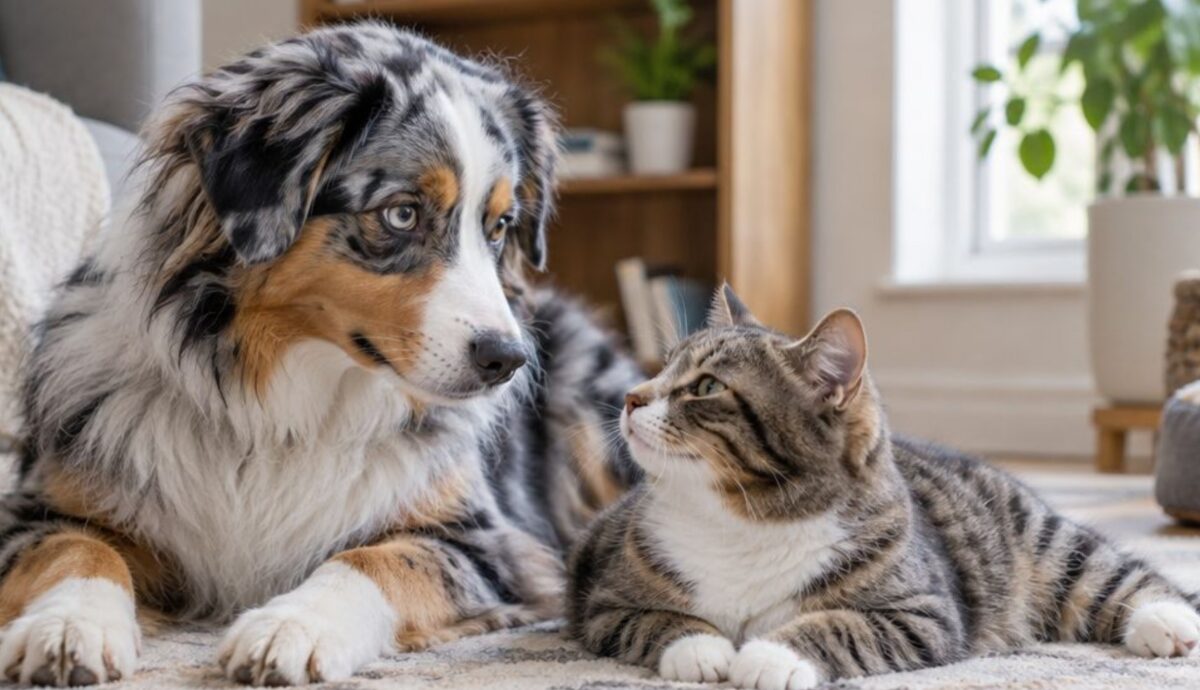
- Toy and Mini Aussies are good with cats in most homes when the introduction is managed, not left to chance.
- Companion-bred lines settle with cats faster than working-line mini Aussies with strong herding drive.
- A cat that holds its ground trains a mini Aussie puppy faster than a cat that runs.
- Hughes Toys matches puppy temperament to households with existing pets before placement.
- Herding instinct, not aggression, is the main risk factor for cat conflicts in 2026 litters.
Why This Matters
Australian Shepherds were bred to move sheep and cattle by staring, circling, and nipping at heels — not to catch or kill. That instinct doesn’t disappear because the dog now weighs 15 pounds and sleeps on a couch instead of a ranch porch. Many households looking at a Miniature Australian Shepherd puppy already have a cat at home, and matching temperament to the household is exactly what breeders like Hughes Toys screen for before placement. Getting the first month right in 2026 decides whether the cat tolerates the dog for the next decade or spends it perched on top of the refrigerator.Are Mini Aussies Good With Cats?
The honest answer depends less on the breed and more on the specific dog’s breeding line and the cat’s own personality. A confident, dog-savvy cat and a companion-bred mini Aussie puppy usually work things out inside a month. A skittish cat paired with a high-drive working-line pup takes a lot longer, and sometimes never gets fully comfortable.| Breeding Line | Typical Herding Drive | Cat Compatibility |
|---|---|---|
| Companion-bred Mini Aussie | Low to moderate | Adapts well, treats the cat as another household member |
| Show-line Mini Aussie | Moderate | Generally biddable, responds well to redirection training |
| Working-line Mini Aussie | High | Chases moving cats, needs firm structure and management |
“A cat that holds its ground trains a mini Aussie puppy faster than any correction a person can give.”
Companion-Bred Mini Aussies and Cats
Companion-bred mini Aussies are selected for calmer reactivity and lower motion-triggered chasing, which is exactly the profile that does well around cats. These dogs still notice a cat crossing the room, but they’re easier to redirect with a word or a toy instead of escalating into a chase. This is the line most families researching a Toy or Miniature Australian Shepherd for a home with an existing cat should ask about directly. Buy this line if cat coexistence is a priority — it’s the lowest-friction path.Working-Line Mini Aussies and Cats
Working-line mini Aussies carry a stronger drive to control movement, and a bolting cat looks a lot like a bolting lamb from a genetic standpoint. These dogs can absolutely live with cats, but it takes consistent leash-and-redirect training in the first weeks, not just supervision. Families who want a mini Aussie for agility, herding trials, or high-output activity often land in this line — and that’s fine, as long as cat training gets the same attention as recall training. Hold off on this line if you don’t have time for structured introductions in year one.Why Cat-Compatibility Varies in Mini Aussies
No two mini Aussie puppies react to a cat the same way, even from the same litter. A handful of factors decide how the pairing plays out:- Age at introduction — puppies introduced to a calm cat during the 8-to-12-week socialization window generalize faster than adult dogs meeting a cat for the first time.
- Individual prey drive — even within one litter, some puppies fixate on fast movement more than littermates do.
- The cat’s own temperament — a cat that swats once and walks away teaches boundaries better than a cat that sprints every time.
- Breeding line — companion, show, and working lines carry different baseline herding drive, as shown above.
- Prior exposure — a puppy raised around cats from birth reads feline body language better than one meeting a cat for the first time at 12 weeks.
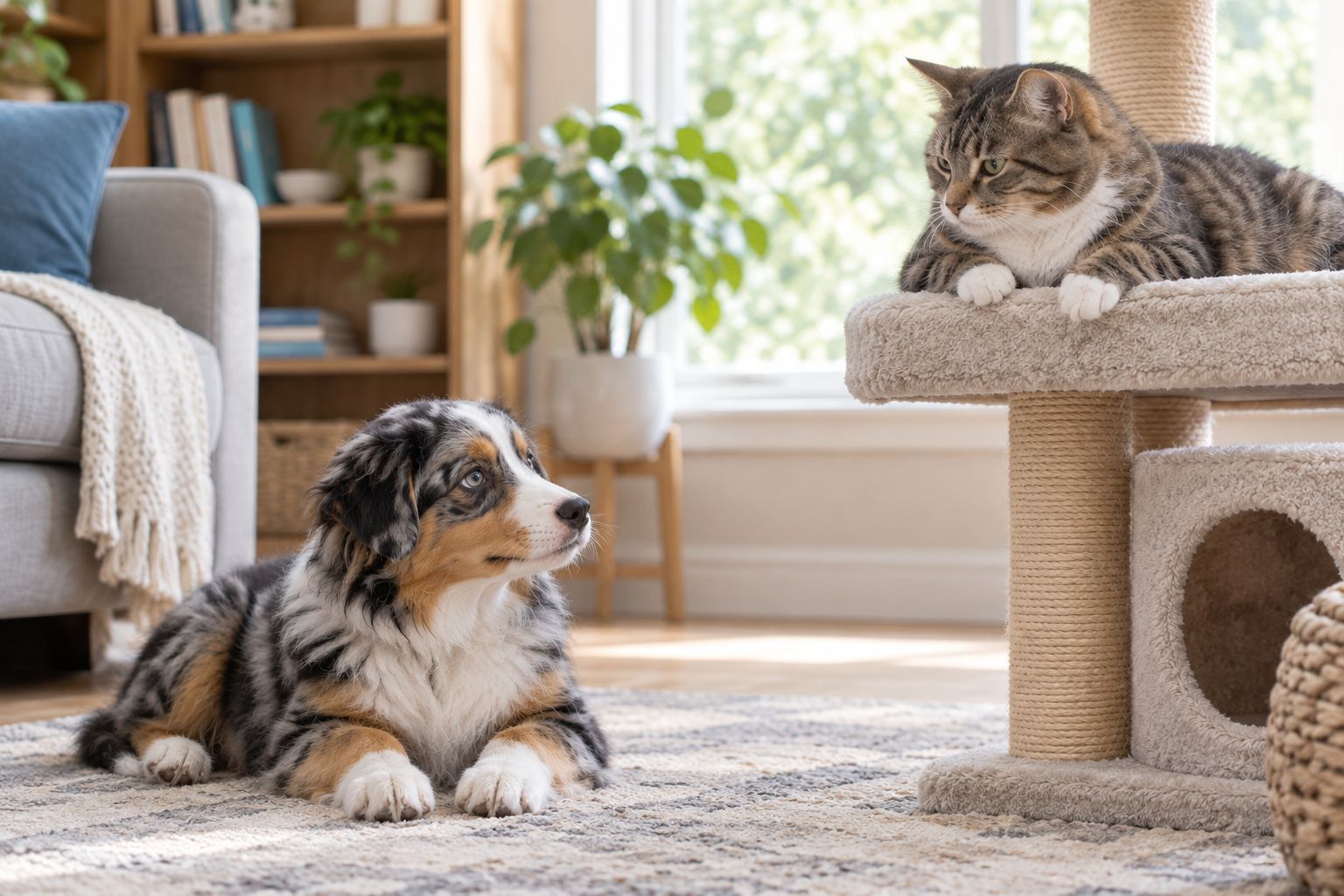
- Household setup — cats need vertical escape routes (shelves, cat trees) during the adjustment period regardless of how well-matched the pairing looks on paper.
How to Introduce a Toy or Mini Aussie Puppy to a Cat
- Keep the first meetings on leash. A leash lets you interrupt a chase impulse before it becomes a habit.
- Give the cat a high perch or separate room to retreat to. Cats regulate stress better when they control the exit.
- Reward calm behavior near the cat immediately. Timing matters more than the treat itself.
- Keep sessions short — five to ten minutes — for the first week. Long exposure before trust is built backfires.
- Never force contact. Let the cat approach the dog, not the other way around.
- Watch body language, not just behavior. A stiff tail or fixed stare in the puppy means redirect before the chase starts, not after.
Do Mini Aussies Have High Prey Drive Toward Cats?
Toy and Mini Aussies have herding drive more than true prey drive, and the distinction matters: herding drive wants to control movement, while prey drive wants to catch and end it. Working-line mini Aussies carry more of this instinct than companion-bred ones, which is why breeding line matters more than the general breed label when predicting cat behavior.Can a Mini Aussie Live With a Cat That Doesn’t Like Dogs?
A mini Aussie can live with a dog-averse cat, but the timeline stretches from weeks to months and the cat needs guaranteed dog-free space at all times. Forcing proximity with a cat that’s already anxious around dogs tends to create avoidance behavior that’s hard to undo later.Are Toy Aussies Safe With Kittens?
Toy Aussies are generally safe with kittens when supervised closely, since a Toy Australian Shepherd’s small size reduces the physical risk compared with a larger herding breed. Supervision still matters in the first months — kittens move erratically, which is exactly the kind of motion that triggers a herding response.Ask About Temperament-Matched Puppies
Hughes Toys matches puppy temperament to households with cats and kids.
FAQ
Are Toy and mini Aussies good with cats?
Toy and Mini Aussies are good with cats in most homes when the introduction is slow and the puppy comes from a companion line rather than a high-drive working line. Herding instinct, not aggression, is the main thing to manage.
Do Toy and mini Aussies chase cats?
Some mini Aussies chase cats, especially puppies from working lines or ones meeting a cat for the first time as adults. Leash-based introductions and short early sessions in 2026 litters cut down chasing significantly.
How long does it take a mini Aussie to adjust to a cat?
Most companion-bred mini Aussie puppies adjust to a resident cat within two to four weeks of structured introductions. Working-line pups or anxious cats can take several months.
Is a Toy Australian Shepherd better with cats than a Standard Aussie?
Size doesn’t decide cat compatibility as much as breeding line does — a Toy Australian Shepherd from a working line can have the same herding drive as a Standard Aussie. Ask about the specific parents’ temperament, not just the size category.
Can a mini Aussie puppy be raised with a kitten?
A mini Aussie puppy can be raised with a kitten under close supervision, since both animals are learning boundaries at the same time. Erratic kitten movement can still trigger a herding response, so leash control matters even indoors.
What breeding line of mini Aussie is best for a home with cats?
A companion-bred or show-line mini Aussie is best for a home with cats, since both carry lower baseline herding drive than working lines. This is the single biggest factor to ask a breeder about before bringing a puppy home.
Do mini Aussies get along with other pets besides cats?
Mini Aussies generally get along with other household pets, including small dogs and supervised small animals, following the same slow-introduction principles used with cats. The breeding line and individual temperament still matter more than the species of the other pet.