
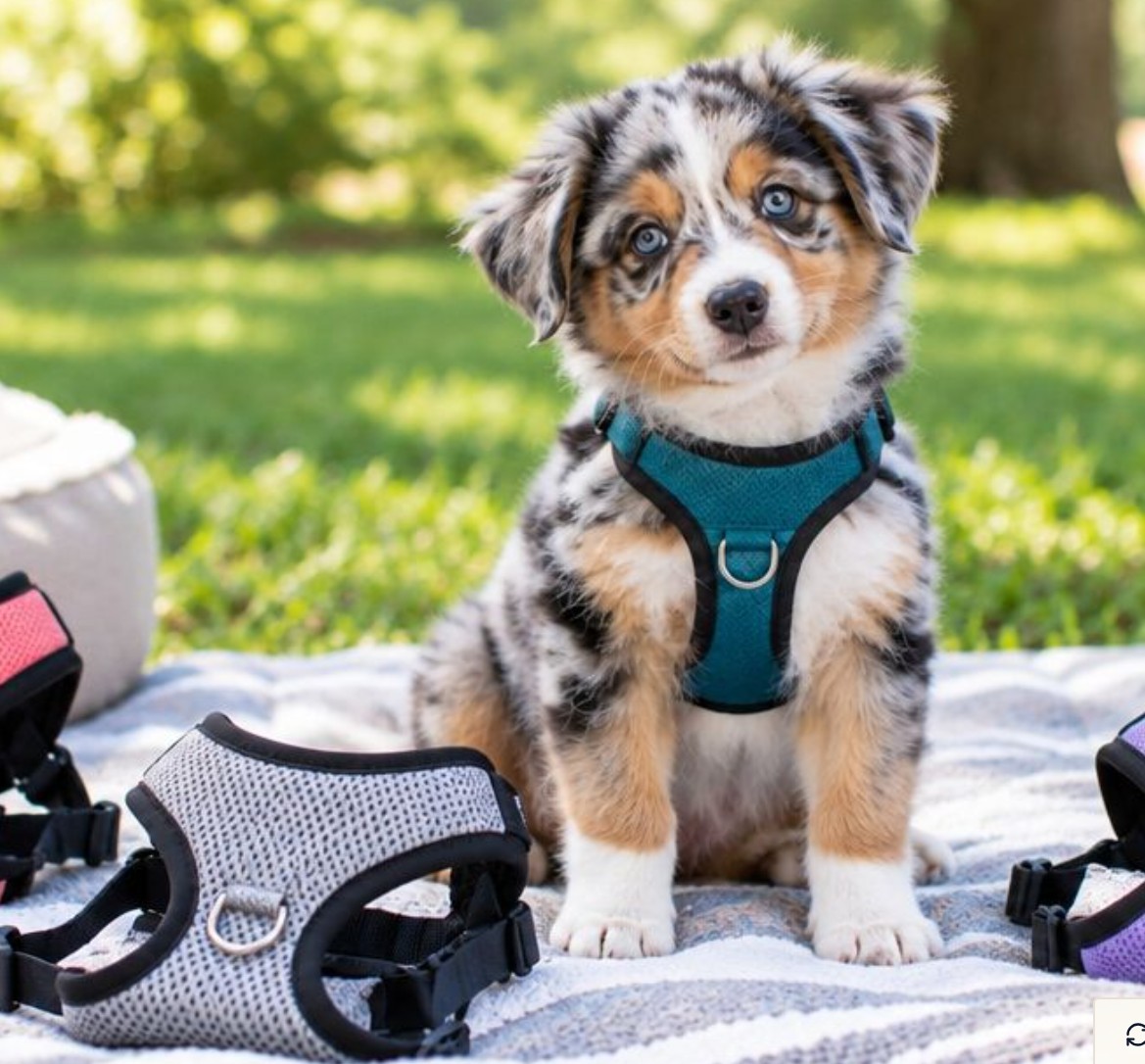
- The best harnesses for toy australian shepherd puppies fit the individual puppy, not just the breed label.
- Toyminiaussies puppy buyers should start by comparing adjustable Y-front harnesses for everyday walks and leash training.
- Three-strap harnesses deserve consideration when a puppy backs out of ordinary designs.
- Measure the puppy before ordering; coat fluff and size labels are not reliable sizing guides.
Why this matters
A Toy Australian Shepherd puppy needs equipment that fits now, not equipment chosen for the adult dog you expect. A loose harness leaves room to slip out. A tight or poorly positioned harness can rub, restrict comfortable movement, or make getting dressed unpleasant. The best choice also depends on how your puppy behaves. A puppy comfortable with handling needs a different dressing routine from one that ducks away from an overhead opening. Pulling and backing away are different problems, too. This 2026 guide ranks harness designs rather than individual retail products. The useful decision is which construction suits your puppy; the final purchase still needs a model-specific measurement chart and an on-puppy fit check.What makes the best puppy harness
Use these criteria before choosing a style:- Current fit: The manufacturer’s measurements should match your puppy’s body without relying on thick coat to fill gaps.
- Adjustment: Chest and neck adjustment help you fit the harness accurately. Adjustment does not make an oversized harness safe.
- Movement: Watch the puppy walk, turn, sit, and lower its head. Straps should not visibly interfere with those movements.
- Dressing method: Choose an overhead, buckle-opening, or step-in design your puppy can learn to accept calmly.
- Attachment and construction: Check the leash ring, buckles, seams, and strap placement. Hardware should suit the puppy’s size without dragging the harness sideways.
- Retention: Test how the harness behaves when the puppy turns or backs away. No design earns an escape-proof promise.
Best puppy harnesses at a glance
The 2026 shortlist below gives each design a distinct job. Harness categories overlap: a Y-front model can also have a front attachment or an additional belly strap.| Rank and design | Best for | Standout feature | Key limitation |
|---|---|---|---|
| Adjustable Y-front | Everyday walks and early leash lessons | Chest straps meet in a Y-shaped arrangement | Fit varies between models; some require overhead dressing |
| Three-strap harness | Puppies that back away from the leash | Additional strap behind the ribcage | More straps require careful positioning and adjustment |
| Adjustable step-in | Puppies uncomfortable with overhead dressing | Front feet step into the openings | Leg openings and chest fit need close checking |
| Soft vest harness | Puppies that accept a close-fitting fabric body | Broad fabric contact rather than narrow straps alone | Fabric coverage can hide a poor fit and hold moisture |
| Front-attachment harness | Handler-guided loose-leash practice | Leash attaches at the chest | Sideways leash pressure can rotate a poorly fitted harness |
1. Adjustable Y-front: best puppy harness for everyday walks
An adjustable Y-front harness has chest straps that form a Y-shaped arrangement, with the center section running between the front legs. Look for a version whose adjustment points let you fit both the neck opening and the chest strap. This is the default design to compare for a Toy Australian Shepherd puppy. It gives you a straightforward starting point without making pulling-control features the main reason for buying. Adjustable Y-front pros:- Separate adjustment points help accommodate different body proportions.
- Strap placement is easier to inspect than beneath a fully covered vest.
- A back attachment supports ordinary supervised leash practice.
- Some versions open at the neck, avoiding an overhead dressing step.
- The same size label can fit differently across manufacturers.
- An overhead-only version adds a handling step for a worried puppy.
- Loose adjustment can let the harness shift when the puppy turns.
2. Three-strap harness: best puppy harness for backing-out concerns
A three-strap harness adds a strap behind the ribcage to the usual neck and chest arrangement. Its purpose is additional retention when a dog reverses away from the handler. That extra strap makes correct sizing especially important. It should follow the manufacturer’s placement instructions, not simply be tightened wherever it lands. A harness cannot replace safe handling around traffic, gates, or unfamiliar dogs. Three-strap harness pros:- Adds another fit point for puppies that back away.
- Offers an alternative when an ordinary design slips during supervised checking.
- Makes retention a deliberate selection criterion rather than an afterthought.
- More adjustment points create more opportunities for incorrect fitting.
- The rear strap needs careful checking as the puppy grows.
- Additional straps and buckles add dressing steps.
3. Adjustable step-in: best puppy harness for avoiding overhead dressing
A step-in harness lets you place the puppy’s front feet into openings before fastening the harness around the body. This avoids pulling an opening over the head, although you still need the puppy to tolerate foot placement and fastening. For a budget-focused 2026 shortlist, compare simple adjustable versions rather than choosing decorative extras. Keep the same fit standards. A basic design is not a bargain if its openings are wrong for your puppy. Adjustable step-in pros:- Avoids an overhead opening.
- Offers a dressing method you can practice with the harness on the floor.
- Simple strap designs make gaps and buckle position visible.
- Foot handling can still worry a puppy.
- Large leg openings can leave too much room to slip or twist.
- Some versions offer limited adjustment around the neck area.
4. Soft vest: best puppy harness for a fabric-bodied fit
A soft vest harness places a broader fabric panel against the puppy’s body. Depending on the model, it fastens around the chest, uses an overhead opening, or combines fabric with adjustable straps. Inspect the edges, not just the soft center. The fabric should lie comfortably without bunching behind the front legs. After a wet outing, remove the harness and follow its care instructions before using it again. Soft vest pros:- Broad panels avoid relying entirely on narrow straps.
- A clear fabric shape can make the dressing orientation easy to recognize.
- Suits puppies that already tolerate close-fitting fabric against their bodies.
- Fabric coverage can make underlying gaps harder to see.
- Wet fabric needs attention before the next outing.
- Limited adjustment can shorten the useful fit period during growth.
5. Front-attachment harness: best puppy harness for guided leash practice
A front-attachment harness places a leash connection at the chest. Leash tension acts from a different position than it does on a back attachment, so fit and handling matter. Treat this as a training arrangement, not an automatic solution to pulling. Reward your puppy for staying near you and keeping the leash slack. Avoid dragging or sharply redirecting a small puppy through the front ring. Front-attachment harness pros:- Gives you a chest-level attachment to compare during supervised practice.
- Some models also provide a back ring for a different leash arrangement.
- Encourages a deliberate check of how leash tension affects harness position.
- Sideways tension can rotate an incorrectly fitted harness.
- The leash can cross near the front legs.
- The attachment does not teach loose-leash walking by itself.
How to measure and check the fit
For Hughes Toys- Toyminiaussies puppy buyers comparing harnesses in 2026, start with 3 measurements: chest girth, neck circumference, and body weight. Match the manufacturer’s definition of each measurement; harness neck measurements do not always use the same position as collar measurements. Use a flexible tape around the body, not around the outer edge of the coat. Weight is a supporting check, not a replacement for chest and neck measurements.Measure first
Measure the chest at the location shown in the sizing instructions. Record the neck measurement the same way, and use a current weight rather than an estimate based on appearance.Adjust on-body
Fit the harness according to its instructions. The familiar 2-finger check is a rough starting point, not proof of correct sizing; finger thickness and harness construction vary. Check every strap rather than testing only the easiest one to reach.Check movement
Watch your puppy walk, turn, sit, and lower its head. Look for shifting hardware, rubbing edges, or a front leg entering an opening it should not enter.Recheck fit
Recheck before outings and whenever growth or adjustment changes the fit. Remove the harness if you see irritation, damaged hardware, or an opening that no longer sits correctly.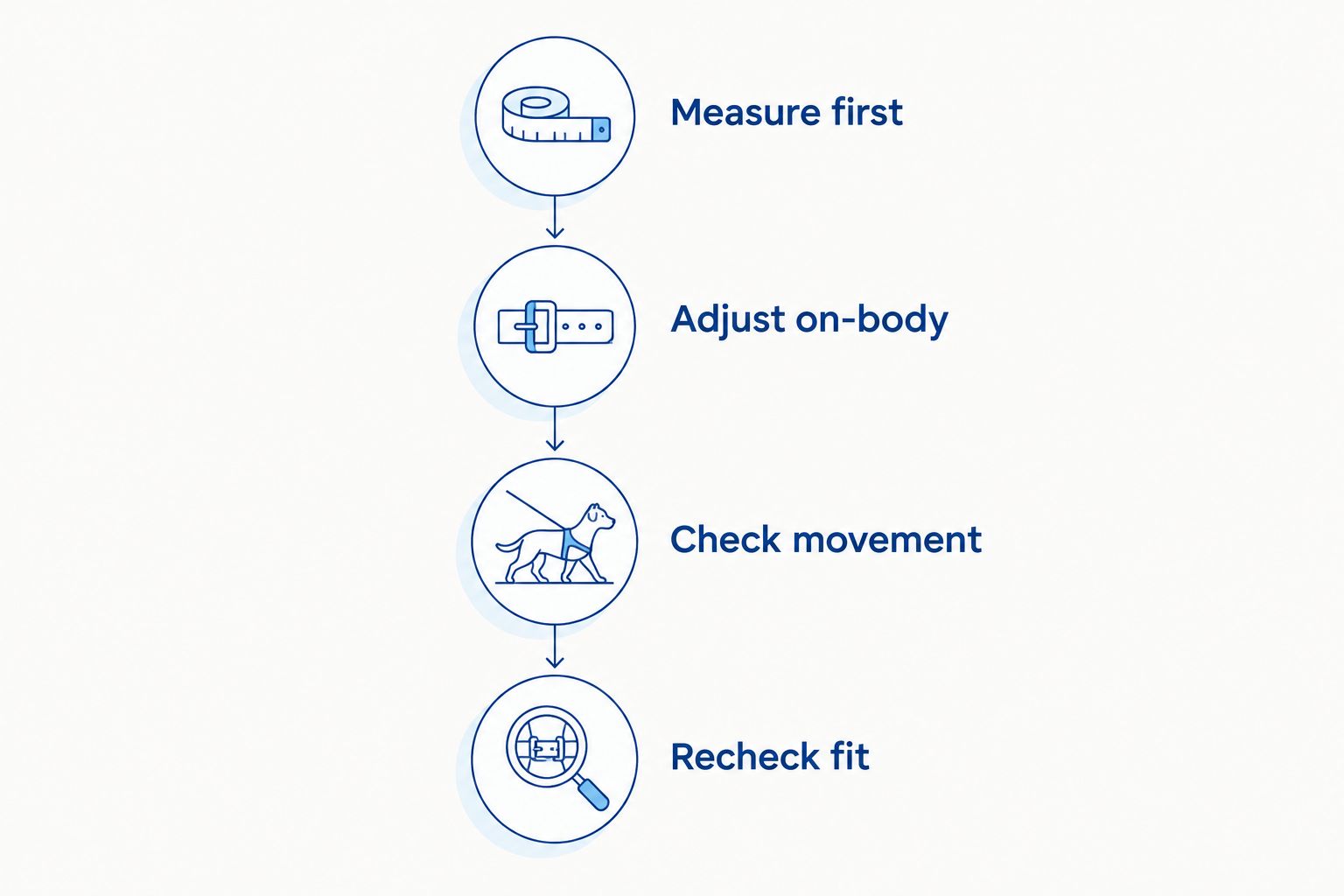
Help your puppy accept the harness
Do not make the first fitting happen while everyone is rushing out the door. Let your puppy investigate the harness, reward calm interest, and practice the dressing motion without forcing it. Start with a 60-second practice session as a suggested routine, ending sooner if your puppy becomes worried. Fasten the harness only when the puppy is comfortable with the preceding steps. Then practice a little indoor movement before adding the leash. For initial supervised walking practice, a 4-foot fixed leash is one practical starting choice. Keep it slack and use it to prevent wandering, not to pull the puppy into position. These are starting suggestions, not performance standards or breed requirements. If your puppy freezes, scratches repeatedly, or avoids being dressed, check the fit and slow the introduction. Do not assume the puppy is being stubborn.How the harness designs were ranked
The 2026 ranking prioritizes current fit, adjustment, movement, dressing method, construction, and retention. Adjustable Y-front harnesses lead as a general starting design; the other entries address specific dressing or handling needs. These are design recommendations, not product-test scores. No style wins when its actual fit is wrong. Check the individual model rather than transferring the recommendation to every harness with a similar name.Which puppy harness should you choose?
Choose an adjustable Y-front harness first if your puppy has no particular dressing or retention problem. Choose a step-in design when overhead dressing is the obstacle, or investigate a three-strap design when backing out is the concern. Fo r Hughes Toys -Toyminiaussies families choosing a puppy harness in 2026, the decisive question is simple: Does this harness stay correctly positioned while this puppy moves comfortably? If the answer is no, keep looking rather than tightening one strap to compensate for the wrong shape.FAQ
What’s the best harness for a Toy Australian Shepherd puppy?
An adjustable Y-front harness is the best general starting point when it matches the puppy’s measurements and permits comfortable movement. Choose another design when dressing tolerance or backing-out behavior calls for it.
What size harness does a Toy Australian Shepherd puppy need?
Choose the size from the individual puppy’s measurements and the manufacturer’s chart, not the breed name. Chest girth and the specified neck measurement matter more than a small or extra-small label.
Is a step-in harness better than an overhead harness?
A step-in harness is better for a puppy that dislikes overhead dressing but accepts gentle foot handling. Neither dressing method guarantees a better fit.
Can a Toy Aussie puppy escape from a harness?
Yes, a puppy can slip out of an incorrectly fitted harness. Check the openings and supervised movement, and consider a correctly fitted three-strap design if backing out remains a concern.
Will a front-clip harness stop my puppy pulling?
A front attachment does not teach loose-leash walking by itself. Use calm practice and rewards for a slack leash, and check that tension does not twist the harness.
Should I buy a bigger harness for my puppy to grow into?
Do not use a harness that is loose on your puppy now. Growth room is useful only when the harness adjusts to a correct current fit.
Can my puppy wear a harness all day?
Remove the harness after supervised use rather than leaving it on unattended or during crate time. Inspect the skin and coat where straps and fabric sit.
How often should I check my puppy’s harness fit?
Check the fit before outings and after noticeable growth or adjustment changes. Stop using a harness that rubs, shifts excessively, or has damaged straps or hardware.