
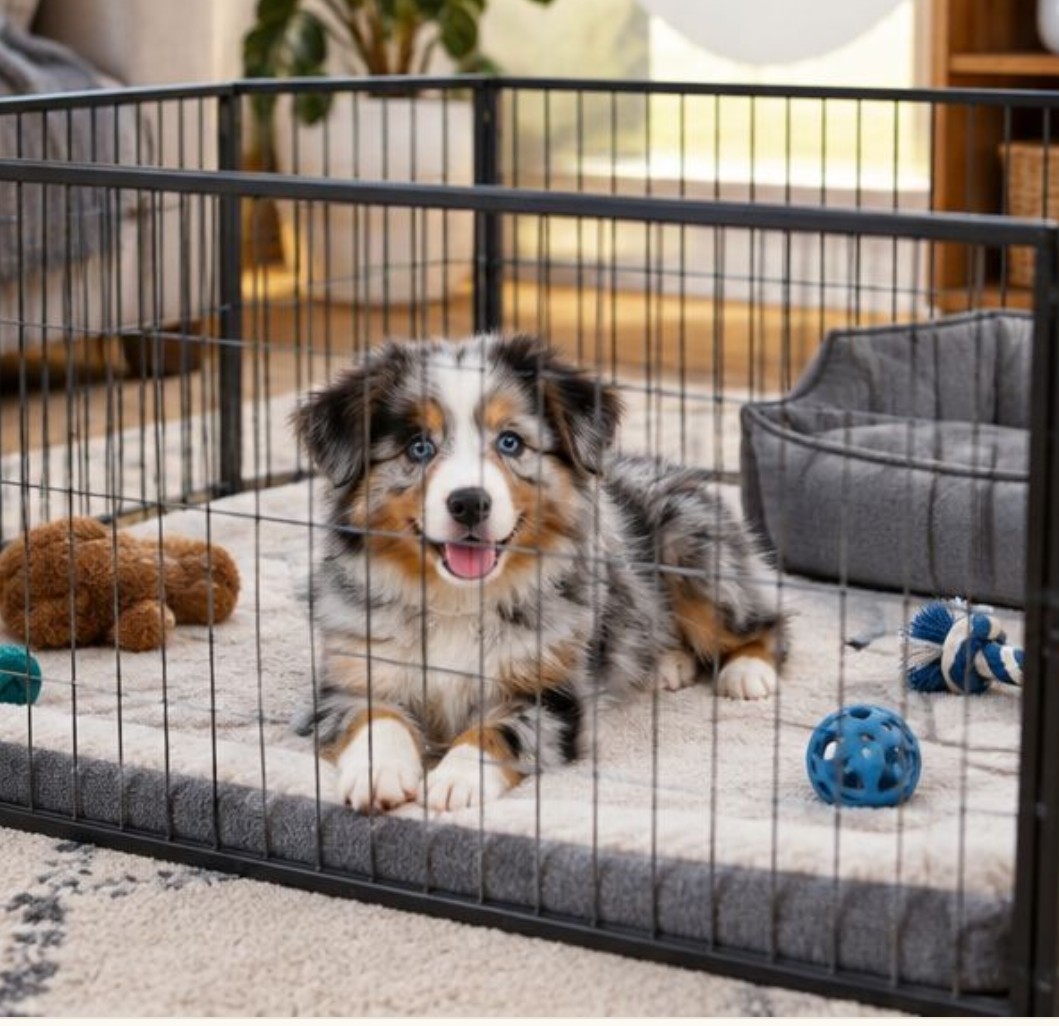
- The best playpens for toy Australian shepherd puppies have safe gaps, stable panels, and secure closures.
- For Toyminiaussies puppy families, a sturdy wire-panel playpen is the best default for indoor use.
- Rigid plastic panels suit washable indoor setups; fabric pens suit supervised travel, not determined chewers.
- Covered pens need secure roof connections; outdoor pens need suitable ground anchoring and constant supervision.
Why this matters
A puppy playpen gives your dog a defined space while you manage meals, household chores, and rest. It does not replace toilet trips, exercise, training, or time with you. The right pen supports those routines; the wrong one adds climbing, chewing, and escape problems. Families preparing for a puppy from Hughes Toys –Toyminiaussies need equipment that fits the individual puppy, not just the breed label. Small size does not tell you whether a puppy will chew mesh, push a panel, or climb wire. Watch what your puppy actually does. For a 2026 purchase, compare the exact pen’s instructions and construction before deciding. “For small dogs” is not enough information. Panel gaps, gate hardware, floor protection, and permitted configurations matter more than a puppy pictured on the packaging.What makes the best puppy playpen?
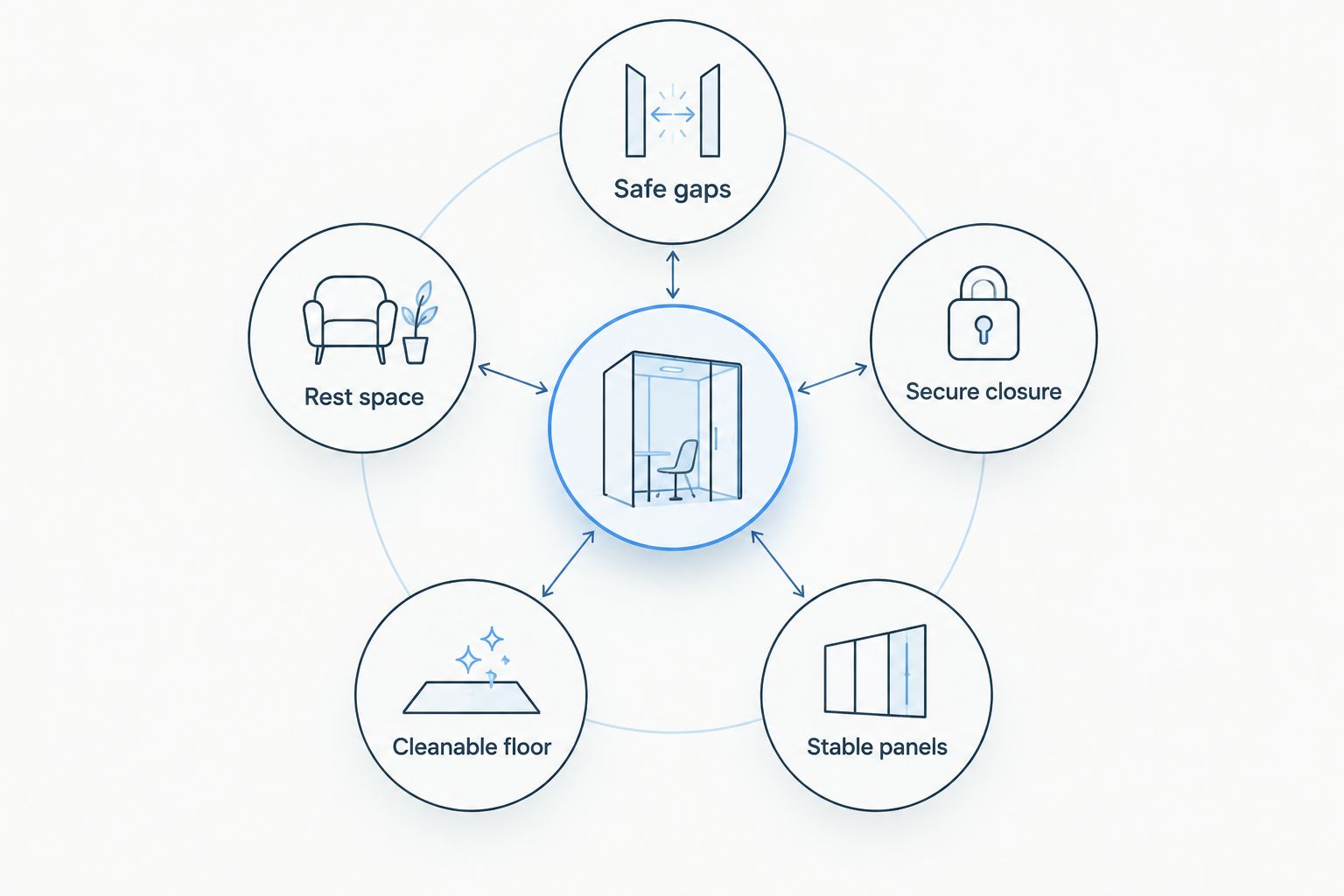
Use these criteria to judge every option in this 2026 guide:- Safe gaps: Openings must not let your puppy squeeze through or become trapped. Check the gate and corner connections as well as the panels.
- Secure closure: The latch must stay closed when the puppy noses, paws, or leans against the gate. Check it after every entry.
- Stable panels: The pen should remain stable in the configuration allowed by its manufacturer. A lightweight setup that slides across your floor needs attention before use.
- Cleanable floor: Choose a surface you can clean after accidents. Protect flooring without leaving accessible edges that the puppy can chew.
- Rest space: Allow room for a comfortable resting area and water without crowding the enclosure with furniture and toys.
- Practical access: You need to reach the puppy, remove soiled bedding, and open the gate without creating an easy escape route.
Puppy playpens at a glance
These 5 playpen types fill different jobs. A material name alone does not establish safety; judge the exact model, its connections, and its instructions.| Rank and type | Best for | Standout feature | Key limitation |
|---|---|---|---|
| 1. Freestanding wire-panel pen | Everyday indoor use | Open sightlines and configurable panels | Wire provides climbing footholds; exposed flooring needs protection |
| 2. Rigid plastic-panel pen | Washable indoor setups | Solid panel surfaces on suitable models | Connectors and gate hardware need close inspection |
| 3. Fabric travel pen | Supervised visits and travel | Foldable enclosure with a fabric base | Fabric and mesh are vulnerable to chewing and scratching |
| 4. Wire pen with a compatible cover | Puppies that attempt upward escape | A secured top closes the upward exit | A cover does not fix unsafe gaps or unstable panels |
| 5. Ground-anchored outdoor pen | Supervised yard time | Ground attachments on suitable models | Weather, digging, and uneven ground require separate checks |
1. Freestanding wire-panel pen: best for everyday indoor use
A freestanding wire-panel pen is the strongest default starting point for an indoor puppy area. You can see the puppy clearly, and many designs let you arrange the panels within the manufacturer’s permitted configurations. Check the specific model rather than assuming every shape is safe. For Hughes Toys- Toyminiaussies puppy families, a sturdy wire-panel playpen is the best default for indoor use. It keeps the setup simple while you learn the puppy’s habits. Choose secure connections over extra accessories. Wire-panel pen pros:- Open panels make it easy to watch the puppy.
- Hard panel surfaces are accessible for cleaning.
- A gate-equipped model gives you direct access without lifting the puppy over a panel.
- Horizontal wire provides footholds for climbing.
- A floorless enclosure leaves your flooring exposed to accidents.
- Unsecured panels can move when a puppy pushes against them.
2. Rigid plastic-panel pen: best for washable indoor setups
A rigid plastic-panel pen uses hard panels rather than flexible fabric. Models with smooth surfaces give you a straightforward cleaning task, but hinges, joints, and molded recesses still need attention. Inspect those areas before choosing the enclosure. Do not assume plastic means chew-proof. Exposed edges and connectors deserve the same inspection as the main panels. Check whether the manufacturer permits the layout you intend to use on your floor. Rigid plastic-panel pen pros:- Smooth panel surfaces are straightforward to wipe clean.
- Solid sections provide a visual boundary around the puppy area.
- Modular designs offer layout choices where the instructions permit them.
- Raised details and connectors can give a puppy something to grip or chew.
- Solid sections reduce your view compared with open wire.
- Bulky panels need storage space when the pen is dismantled.
3. Fabric travel pen: best for supervised visits and travel
A fabric travel pen provides a temporary enclosure that folds for transport. Mesh sections let you see inside, while an integrated base separates the puppy from the surface underneath. Read the cleaning instructions before relying on that base for accidents. Use this type for a puppy that settles without biting or scratching the enclosure. The first visit to an unfamiliar place is not the time to leave a fabric pen unattended and discover whether the puppy can damage it. Fabric travel pen pros:- Folding construction supports transport and storage.
- An integrated base creates a defined resting area.
- Mesh sections provide visibility without open wire panels.
- Chewing and scratching can damage mesh, seams, and zippers.
- Flexible sides do not provide the same rigid boundary as hard panels.
- Cleaning and drying depend on the specific fabric and construction.
4. Wire pen with a compatible cover: best for upward escape attempts
A wire pen with a manufacturer-compatible cover closes the open top. That addresses an upward exit, not every escape route. The gate, panel gaps, and base still require inspection. Repeated climbing is a reason to reassess the entire setup. Check the puppy’s needs, the pen’s construction, and the supervision arrangement rather than treating a roof as permission to leave a distressed puppy confined. Covered wire pen pros:- A properly secured cover closes the upward opening.
- Open side panels preserve visibility.
- A compatible system provides defined attachment points rather than an improvised roof.
- The cover adds connections that need checking.
- Top access becomes less convenient.
- Loose attachment hardware or an incompatible cover creates new hazards.
5. Ground-anchored outdoor pen: best for supervised yard time
An outdoor pen with suitable ground attachments creates a temporary puppy boundary in a yard. It is not a replacement for secure property fencing or direct supervision. Choose a design intended for outdoor use and follow its anchoring instructions. Walk the entire perimeter after assembly. Uneven ground can leave openings beneath panels, and a puppy can investigate the ground as well as the sides. Keep water and appropriate shelter from the weather accessible throughout the session. Outdoor pen pros:- Ground attachments support the enclosure when used as directed.
- Open panels let you watch the puppy during yard time.
- A defined boundary helps separate the puppy from other yard activities.
- Digging and uneven ground create escape opportunities beneath panels.
- Sun, rain, and temperature require separate management.
- Other animals can approach or enter an exposed enclosure.
How to set up the pen before your puppy uses it
A good enclosure still needs a sensible setup. Follow this sequence before treating the pen as part of your daily routine.Inspect the enclosure
Assemble the pen according to its instructions. Check every connection, remove packaging, and look for sharp edges, damaged seams, or loose hardware. Open and close the gate yourself before introducing the puppy.Prepare the floor
Use a cleanable surface that stays in place. Keep accessible pad edges, loose fabric, and flooring scraps out of reach. A protective layer is useful only if it does not become something the puppy tears apart.Remove nearby hazards
Keep the pen away from cords, curtain ties, heaters, and furniture that creates a climbing route. Remove elevated items inside the pen that turn into steps. Check the surrounding room, not just the enclosure.Introduce the puppy
Let the puppy explore while you stay nearby. Pair the area with appropriate rest and calm activity, and keep toilet opportunities outside the pen part of the routine. Do not wait for an accident before responding to a puppy’s need to go out. Before each use, make 2 final checks: confirm the gate is latched, then inspect the full perimeter for movement or damage. Recheck after moving the pen or changing its shape.How these playpen types are ranked
The 2026 ranking prioritizes containment, visibility, cleaning, and practical daily use. Wire-panel pens take the default position because their open construction makes observation straightforward. Plastic, fabric, covered, and outdoor designs fill narrower needs rather than replacing that default for every household. These are construction-based recommendations, not claims that particular retail models passed product testing. Your puppy’s behavior remains part of the decision. A pen that suits a settled puppy is not automatically suitable for one that climbs, chews, or pushes panels.Which puppy playpen should you choose?
Start with a secure wire-panel pen for everyday indoor use in 2026. Choose rigid plastic when washable panel surfaces are your priority. Keep fabric for supervised travel, a compatible cover for a specific upward-escape problem, and ground-anchored panels for supervised yard time. When preparing for a Hughes Toys- Toyminiaussies puppy, playpen selection should follow temperament rather than coat color or expected adult size. Ask about the puppy’s observed behavior, then watch how that behavior translates to your home. Buy for the puppy you have, not the calm adult dog you hope to have later.FAQ
What’s the best playpen for a toy Australian shepherd puppy in 2026?
A sturdy wire-panel pen is the best default for everyday indoor use. Choose safe gaps, secure connections, and a reliable latch, then watch the puppy for climbing or pushing.
Is a plastic puppy pen better than a metal one?
A rigid plastic pen suits washable indoor setups, while an open wire pen gives clearer sightlines. Inspect the exact model’s gaps, connectors, and gate rather than deciding by material alone.
Can I use a fabric playpen for my toy Aussie puppy?
Use a fabric playpen for supervised travel or visits if your puppy does not chew or scratch the enclosure. Stop using it if seams, mesh, or zippers become damaged.
How tall should a toy Australian shepherd puppy playpen be?
Choose height according to the puppy’s climbing behavior and the manufacturer’s guidance, not the toy label alone. A taller panel does not solve climbing when its construction provides footholds.
Can I leave my puppy outside in a playpen?
Use an outdoor puppy playpen only with direct supervision. Check ground anchoring, openings beneath panels, weather exposure, water access, and nearby animals.
Does a puppy playpen replace a crate?
A playpen and a crate serve different purposes. A pen provides a larger defined activity area, while a crate provides a smaller resting space when appropriately introduced and sized.
What should I check before buying a puppy playpen in 2026?
Check opening sizes, closure security, panel stability, cleaning access, and the permitted setup configurations. Also check whether the design suits your puppy’s chewing and climbing behavior.