Blog

The Puppy Purchase Process, Done Responsibly

Follow a responsible puppy purchase process: verify health testing, breeder standards, temperament fit, and prepare your home before pickup day arrives.

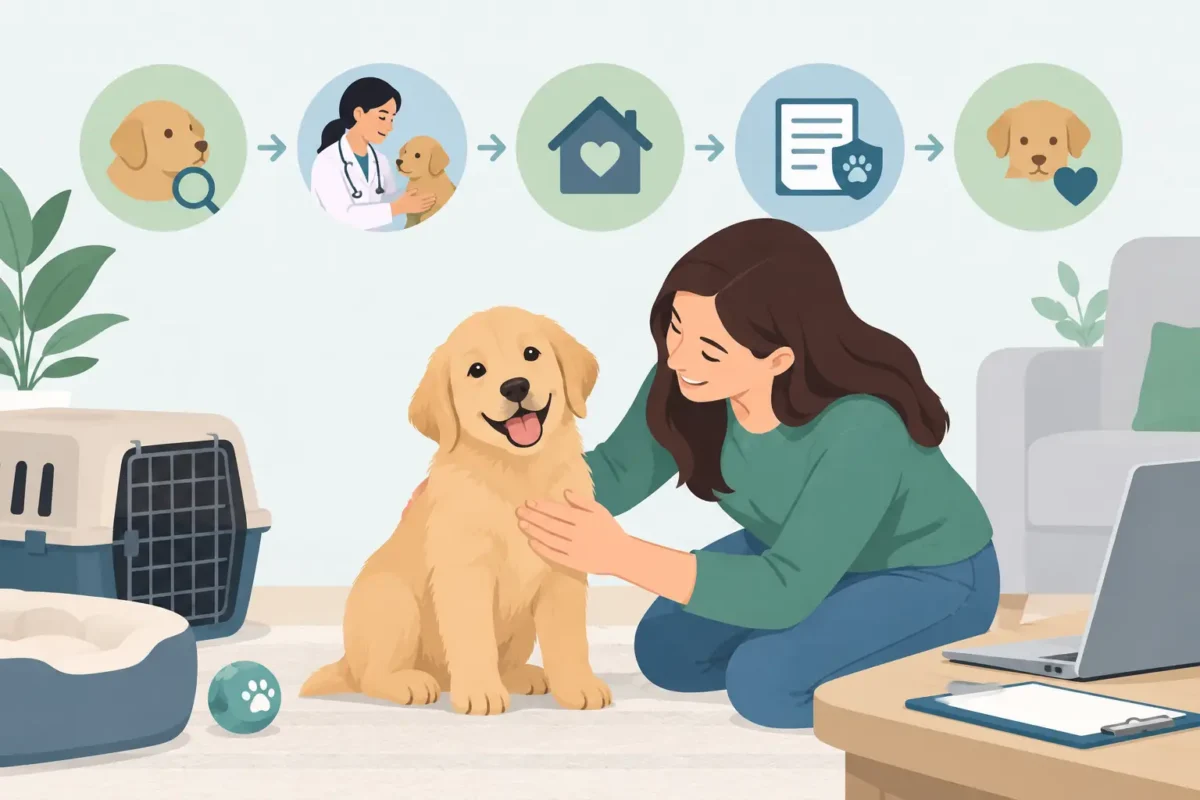
A puppy is not a color choice, a quick deposit, or a photo sent by text. The puppy purchase process should tell you exactly how a breeder raises dogs, makes breeding decisions, protects young puppies from disease, and matches each puppy to a real household. If those answers are vague, the risk is not worth it.

For families looking for a Toy, Miniature, or small Australian Shepherd, the process matters even more. These dogs are intelligent, observant, and strongly attached to their people. A well-bred small Aussie can be an outstanding companion, but the wrong match can leave a family with more energy, drive, size, or care needs than they expected.

Start With the Breeder, Not the Available Puppy

Many buyers begin by searching for a particular coat pattern, blue eyes, or the smallest puppy in a litter. Those traits may matter to you, but they should not be the starting point. Color does not prove health, temperament, genetic quality, or responsible care.

Start by asking what the breeder has actually done to produce the litter. A serious breeder should be able to explain the parents’ health testing, registration, adult size, temperament, and why that pair was selected. They should also be candid about what they cannot guarantee. No breeder can promise that every puppy will have the same adult personality, exact final weight, or ideal behavior without training and responsible ownership.

For Australian Shepherds, genetic screening is not a decorative line on a website. It is part of responsible selection. Buyers should expect clear information about inherited risks relevant to the breed, including MDR1 status and the genetics behind merle coloring. Breeding two merles together can create serious health concerns. A breeder who cannot discuss that plainly is not giving buyers the information they need.

Registration also deserves context. ASDR registration documents lineage, but paper alone does not make a dog well bred. The quality of the dogs behind the pedigree, the breeder’s selection standards, and the care provided to each generation matter far more than a stack of names. Hughes Toys has spent more than 30 years building and selecting its own bloodline with companion temperament, manageable size, and sound health in mind. That kind of long-term work is very different from simply producing puppies with marketable markings.

Ask for Proof of Health and Care

A breeder should not expect you to accept broad claims such as healthy lines or vet checked parents without explanation. Good questions are reasonable questions. You are making a commitment that may last 12 to 15 years.

Ask how puppies are monitored from birth, when veterinary exams occur, what preventive care is provided before placement, and what records go home with the puppy. Ask whether the breeder offers a written health guarantee and take the time to read it. A real guarantee should state the breeder’s responsibilities as well as yours, including timelines, veterinary documentation requirements, and exclusions.

Biosecurity is another area where buyers sometimes misunderstand responsible practices. A breeder may limit or decline casual facility visits, especially around young litters. That is not automatically a warning sign. Puppies do not have mature immune systems, and outside shoes, clothing, dogs, and visitors can introduce illness. Responsible breeders balance buyer transparency with disease prevention. They should be able to provide current photos, videos, health information, and direct communication without exposing a litter to unnecessary traffic.

A clean setting matters, but it is not the whole standard. The puppies should be handled, observed, and raised with intentional early care. Their mother should look appropriately cared for, and the breeder should be able to describe daily routines rather than offering sentimental slogans about how much every dog is loved.

The Puppy Purchase Process Should Include Matching

The best puppy for one family may be the wrong puppy for another. This is where an experienced breeder earns trust. Australian Shepherds, even companion-oriented Toy and Mini Aussies, are not furniture. They need training, structure, exercise, and regular interaction with their people.

Be honest about your household. A retired couple with frequent visitors, a busy family with young children, an apartment-based professional, and a household with acreage may all want a small Aussie for different reasons. Your schedule, activity level, experience with training, tolerance for barking, and ability to manage grooming are more relevant than whether you prefer a red merle or a blue-eye tri.

Ask the breeder how the individual puppies differ. One may be more outgoing and people-focused. Another may be steadier and more observant. A puppy with more confidence may thrive with an active family that wants to train, travel, and include the dog in daily life. A gentler puppy may suit a quieter home. Neither is automatically better. The goal is a fit that gives the dog and the buyer the best chance of success.

Be cautious if every available puppy is described as perfect for everyone. Good breeders know their puppies well enough to see differences, and they are willing to tell a buyer when a particular puppy is not the best match. That can be disappointing in the short term. It is far better than placing a high-drive puppy in a home that wanted a calm companion.

Understand Deposits, Timing, and What You Are Agreeing To

A clear purchase process protects both sides. Before sending a deposit, ask whether it is refundable, transferable, or tied to a specific litter or puppy. Confirm how selection order works and when the breeder expects buyers to make their final choice. Get the total price, remaining balance requirements, and pickup or delivery arrangements in writing.

Responsible breeders may require an application or have a detailed conversation before accepting a reservation. That is not a sales obstacle. It is a screening step designed to prevent rushed decisions and poor matches.

You should also understand the timeline. Puppies need adequate time with their mother and littermates before leaving. Early separation is not a convenience for buyers or breeders. Those early weeks matter for physical development and social learning. If someone is eager to send a very young puppy home simply because you are ready, step back and ask why.

Prepare Before Pickup, Not After

The puppy should arrive to a prepared home, not a last-minute shopping trip. Set up a safe sleeping area, decide where potty trips will happen, and make sure everyone in the household understands the first-week routine. Puppies need consistency more than they need expensive accessories.

Schedule a veterinary appointment soon after arrival according to the breeder’s contract and your veterinarian’s availability. Ask the breeder what food the puppy has been eating and transition gradually if your veterinarian recommends a different diet. Abrupt changes can cause avoidable digestive upset during an already stressful adjustment.

Plan for supervision, especially during the first days. A young puppy will not understand household rules, electrical cords, stairs, children’s toys, or your preferred bathroom schedule. Crate training, controlled introductions, short positive training sessions, and patient potty breaks are practical responsibilities, not optional extras.

For a small Australian Shepherd, mental work is as useful as physical activity. Basic obedience, food puzzles, calm exposure to normal household sounds, and structured socialization help build a stable companion. Do not confuse overstimulation with proper exercise. A puppy that is constantly pushed to exhaustion may become harder, not easier, to settle.

Local Pickup and Long-Distance Delivery

A local buyer may be able to arrange pickup, while an out-of-state buyer may need coordinated pet-nanny delivery. Either route should be organized well before the puppy is ready to leave. Ask who is responsible for travel coordination, what communication you will receive during transit, and what supplies or paperwork travel with the puppy.

Remote buyers should not feel pressured to proceed without information. Video conversations, updated photos, records, contract review, and direct answers to practical questions can make a distance placement transparent. The distance is not the issue. The quality of communication and documentation is.

A careful breeder will also remind buyers that travel day is only the beginning. Your puppy may be tired, unsettled, or temporarily less interested in food after a trip. Give the puppy a quiet, controlled start rather than introducing every neighbor, relative, and pet in the first 24 hours.

The right puppy purchase process does not rely on pressure, promises, or pretty photos. It relies on documented breeding decisions, honest matching, health-focused care, and a buyer who is ready to do their part. Choose the breeder who is willing to be specific, and choose the puppy whose needs fit the life you can actually provide.
mini-aussies-for-first-time-dog-owners-complete-guide

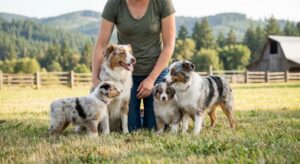
  Best toy Australian Shepherd breeders in Oregon 2026 A Mini Aussie for first-time dog owners is a Toy or Miniature Australian Shepherd matched by a breeder to a household with no prior dog experience, chosen for trainability and a manageable size rather than raw working drive. This segment needs a dog that forgives early handling mistakes, doesn’t require acreage, and comes with a breeder willing to answer the beginner questions experienced owners skip past.
TL;DR
  • A Mini Aussie for first-time dog owners works best when matched for lower energy and easy handling, not looks alone.
  • Toy Aussies run roughly 10-14 inches and 12-25 lbs; Mini Aussies run 14-18 inches and 20-50 lbs per common breed club standards.
  • First-time owners do better starting with basic obedience and a fenced yard than jumping straight into agility or herding work.
  • A health-guaranteed, vet-checked puppy from a breeder who screens temperament cuts down on surprises in month one.
  • Buy from a breeder who asks you questions back — that’s the sign they’re matching, not just selling.

Why this matters for first-time owners

Toy and Mini Australian Shepherds were bred to work cattle and sheep all day. The Toy and Mini versions kept the brains and the herding instinct in a smaller body, which means a first-time owner still gets a dog that wants a job. Without one, that energy turns into nipping at ankles, chasing the vacuum, or barking at every car door. A first-time owner without a plan for daily structure will find a Mini Aussie harder than a low-drive breed like a Cavalier or a Havanese. With a plan, the same dog becomes one of the more trainable options in this size range because Aussies read human cues fast. The gap between those two outcomes is almost entirely about which puppy gets matched to which home, not luck. A responsible breeder factors this in before the litter is even weaned. Hughes Toys works with families across Oregon, and Washington and spends time up front figuring out which puppy in a litter fits a first-time household versus an experienced handler who wants a working-drive dog.

Match temperament before you match color

Color and coat pattern sell puppies. Temperament is what determines whether year one goes smoothly.

Set up the home before the puppy arrives

Most first-time-owner problems in month one are environment problems, not dog problems.

Start basic obedience in week one, not month three

Waiting to train an Aussie puppy is the single most common first-time-owner mistake.

Give the puppy a daily job

A bored Mini Aussie invents its own job, and you won’t like it.

Manage exercise for the size, not the breed reputation

Toy and Mini Aussies need real exercise, but not the marathon distances people associate with standard Australian Shepherds.

Handle grooming and shedding realistically

Aussies carry a double coat, and first-time owners often underestimate the shedding.

Socialize deliberately, not just often

Volume of exposure matters less than the quality of each experience for this breed.

Talk through the right match

Get placement guidance for a Toy or Mini Aussie suited to a first-time home.

Comparison: options for a first-time owner

Option Best for Key limitation
Toy Aussie puppy (10-14 in, 12-25 lbs) Apartment or small-yard households wanting the smallest footprint Still herds and needs daily mental work despite the size
Mini Aussie puppy (14-18 in, 20-50 lbs) First-timers with a yard who want more dog without full-size Aussie exercise needs Higher exercise floor than the Toy; not a low-energy breed
Adult rescue Aussie or Aussie mix Owners who want to skip the puppy phase entirely Temperament and health history are often unknown at intake
Standard Australian Shepherd Active households with acreage or working-dog goals Too much drive and exercise need for most first-time, average-home owners
Verdict: a Mini Aussie from a breeder that temperament-matches the puppy is the strongest first-time-owner option in this table when the household has a yard and 30-60 minutes a day for structured training and exercise.

Common mistakes first-time owners make

FAQ

Is a Mini Aussie a good first dog?

Yes, for a first-time owner willing to commit to daily training and exercise — Mini Aussies are trainable and food-motivated but still carry herding instinct that needs an outlet. Households without time for structure will find the breed harder than a lower-drive companion breed.

What’s the difference between a Toy Aussie and a Mini Aussie?

Toy Aussies typically stand 10-14 inches and weigh 12-25 lbs, while Mini Aussies run 14-18 inches and 20-50 lbs per common breed club standards. Both share the same temperament traits; the size difference affects exercise space needed, not intelligence or drive.

How much exercise does a Mini Aussie puppy need?

Two 20-30 minute walks a day plus daily mental work like training or puzzle feeders is a solid baseline once the puppy is fully vaccinated. Puppies under 6 months should avoid high-impact activity since growth plates aren’t fully closed.

Do Mini Aussies shed a lot?

Yes — they carry a double coat and shed year-round with heavier seasonal blowouts in spring and fall. Brushing 2-3 times a week, daily during blowouts, keeps shedding manageable.

Are Mini Aussies good with kids?

They can be, but their herding instinct means they may nip at fast-moving children, so early calm introductions matter. Supervised, structured interactions from puppyhood reduce this over time.

How do I know if a breeder is matching me to the right puppy?

A responsible breeder asks about your home, experience level, and daily schedule before recommending a specific puppy rather than letting you pick by color alone. If a breeder skips this conversation entirely, that’s a warning sign.

Can a first-time owner handle an Aussie’s herding instinct?

Yes, with a daily outlet like structured training, puzzle toys, or a fetch-based herding substitute game. Without an outlet, that instinct redirects toward chasing kids, bikes, or cars.

What should I check before buying a Mini Aussie puppy?

Look for vet-check, genetic testing , and a published health guarantee before committing to a puppy. A breeder who provides this is doing the job right.

One last thing

The detail first-time owners miss most: a Mini Aussie’s herding drive doesn’t fade with age the way some breeds mellow out. It just gets redirected — into a structured job, or into whatever moving thing is nearby. Pick the puppy the breeder says is calmest, not the one with the flashiest coat, and the 2026 version of “easy first dog” and “Mini Aussie” stop sounding like a contradiction.

Best car travel gear for road trips with small dogs

 
Best car travel gear for road trips with small dogs
best car travel gear for road trips with small dogs
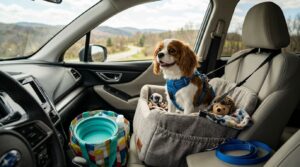
Loading a Toy or Miniature Australian Shepherd puppy into the car for a multi-hour drive is different from loading a Labrador. Best overall: a crash-tested car harness. Best for hot-weather stretches: a travel water bowl and cooling mat combo. Best for a puppy’s very first ride away from littermates: a home-scent comfort item. Everything below explains why, and what to skip.
TL;DR
  • A crash-tested car harness is the best car travel gear for small dogs in 2026 — it restrains without crushing a 10-15 lb frame.
  • Center for Pet Safety certification is the only independent benchmark; ‘crash-tested’ claims without it mean nothing.
  • Hard-sided crates beat soft carriers for road trips longer than two hours because they hold shape in a stop.
  • Skip loose-tether booster seats as a sole restraint on the highway; they are not crash-rated.
  • Pack a home-scent item on the drive home from the breeder; it cuts whining more than any toy.

Why this matters

A Toy Australian Shepherd weighs roughly 10 to 18 pounds full grown, and a Miniature Australian Shepherd tops out around 35. Puppies weigh between 3 to 10lbs at go home. Most car safety gear on shelves is sized for a 50-pound-plus dog and fits a small breed loosely, which defeats the entire point of the equipment. Families who drive up from California or over from Seattle to pick up a puppy from Hughes Toys are usually making that puppy’s very first car ride a two-to-six hour trip. Get the gear wrong on day one and you’re dealing with carsickness, panic, or a puppy that dreads the car for years. Get it right and the ride home becomes the first successful training session of the dog’s life. This list ranks gear by category, not by brand, because the category matters more than the logo — and because a harness or crate without independent crash testing carries the same risk regardless of who made it.

What makes the best car travel gear for small dogs

At a glance

Item Best for Standout feature Key limitation
Crash-tested car harness Collision restraint Independent CPS rating Some puppies chew the strap at first
Hard-sided travel crate Crate-training continuity Holds shape in a sudden stop Bulkier than a soft carrier
Console booster seat with tether Dogs that want to see out Keeps puppy elevated and visible Not a crash restraint
Travel water bowl and cooling mat Hot-weather driving No-spill design, passive cooling Mat needs pre-chilling
Travel document and first-aid kit Interstate OR/WA/CA trips Covers vet records and minor injuries Takes 20 minutes to assemble once
Home-scent comfort item First ride away from littermates Cuts whining without medication Not a safety device

1. Crash-tested car harness: best car travel gear for small dogs in a collision

A properly fitted harness clips into the seat belt buckle or a LATCH anchor and keeps the puppy in place if the car stops hard. For a dog under 25 lbs, fit matters more than padding. A harness an inch too loose lets a small dog slip a leg or twist free. Harness pros: Harness cons: Best for: owners who want one piece of gear that handles both the drive and the sidewalk. Verdict: Buy.

2. Hard-sided travel crate: best for crate-training continuity on the road

A hard-sided crate secured with a seat belt strap or cargo tie-down holds its shape in a sudden stop in a way a soft-sided carrier cannot. It also keeps a puppy in the same enclosed space it already associates with sleep, which matters across several hours of driving. Crate pros: Crate cons: Best for: multi-day road trips or any drive over two hours. Verdict: Buy.

3. Console booster seat with tether: best for a small dog that wants to see out

A booster seat elevates a small dog to window height and clips a short tether to its harness. Dogs often seem calmer when they can see the road, but the tether alone is not a crash restraint. Booster seat pros: Booster seat cons: or a puppy not yet trained to harness and leash. Best for: short local drives once the puppy is already harness-trained. Verdict: Skip for first long trips, fine for errands.

4. Travel water bowl and cooling mat: best for hot-weather stretches on I-5

A no-spill travel bowl and a pre-chilled cooling mat address the biggest risk on a summer drive down I-5: heat building in a parked car during a rest stop. Double-coated small breeds like the Miniature Australian Shepherd run warm faster than owners expect. Cooling mat pros: Cooling mat cons: Best for: drives through the Central Valley or inland Oregon in summer. Verdict: Buy for summer trips.

5. Travel document and first-aid kit: best for interstate trips across Oregon, Washington and California

Crossing state lines with a puppy means having vaccination and vet records on hand, plus basics for a scrape or an upset stomach. This is the one item here with nothing to do with restraint and everything to do with being prepared. Document kit pros: Document kit cons: Best for: any family driving a puppy home across state lines in 2026. Verdict: Buy.

6. Home-scent comfort item: best for a puppy’s first ride away from littermates

A blanket or small towel that smells like the litter, tucked into the crate, quiets a first-time traveler better than any toy. It is the cheapest item on this list and often the most effective for the first 48 hours. Comfort item pros: Comfort item cons: Best for: the drive home from the breeder, before the puppy has bonded with its new house. Verdict: Buy, paired with a harness or crate, never used alone.

How we ranked these

Each item was weighed against the six criteria above: crash-test data where it exists, true small-breed fit, anchor security, cleanability, ventilation, and how fast you can get the dog in and out at a rest stop. Items that satisfy only comfort or convenience, like the booster seat and the scent item, rank as supplements to a harness or crate, never replacements.

“If a harness has no independent crash-test data behind it, treat it like a leash, not a restraint system.”

Which car travel gear should you choose?

For a Toy or Miniature Australian Shepherd puppy’s first long drive in 2026, default to a crash-tested harness paired with a hard-sided crate. The harness handles short stops and walks; the crate handles the miles in between. Add the cooling mat if you’re driving a hot corridor in summer, and always tuck in something that smells like home for the first 48 hours.

Planning the drive home?

See available Toy and Miniature Australian Shepherd puppies from Hughes Toys.

FAQ

What is the best car travel gear for small dogs in 2026?

A crash-tested harness paired with a hard-sided crate is the best car travel gear for small dogs in 2026. The harness restrains the dog for short stops and walks; the crate holds up better than a soft carrier during a sudden stop on longer drives.

Is a booster seat safe for a puppy on a long car trip?

A booster seat with a tether is fine for short local drives but is not a crash-tested restraint. For anything longer than an hour on the highway, use a certified harness instead.

How do I know if a dog harness is actually crash-tested?

Check for a Center for Pet Safety rating, the only independent crash-test program for pet travel gear in the United States. A label that says crash-tested with no CPS rating behind it is a marketing claim, not a certification.

What age can a puppy start riding in a car harness?

Most small-breed puppies can wear a properly fitted car harness as soon as they accept a regular walking harness, usually around 8 to 10 weeks. Expect chewing or resistance on the first few rides.

How often should you stop on a road trip with a small dog?

Plan a stop every 2 to 3 hours with a puppy. Use each stop to offer water, allow a bathroom break, and re-check the crate strap or harness fit.

Do small dogs need a cooling mat for car trips?

A cooling mat matters most on hot routes, such as I-5 between Portland and California in summer. Double-coated small breeds heat up faster than short-coated dogs, so passive cooling during rest stops helps.

Is a soft-sided carrier as safe as a hard-sided crate in a car?

No. A hard-sided crate holds its shape during a sudden stop in a way a soft-sided carrier cannot, which is why it ranks above soft carriers for any drive over two hours.

What should go in a puppy travel kit for an interstate trip?

Pack vaccination and vet records, a basic first-aid kit, a no-spill water bowl, and something that smells like home. For a 2026 drive across Oregon, Washington and California, having records on hand is worth the ten minutes it takes to gather them.

One last thing

Center for Pet Safety is the only independent nonprofit crash-testing pet travel gear in the United States, and its testing has repeatedly found that products marketed as crash-tested were never tested to any published standard. Check for that rating before you buy anything on this list. Everything else here is secondary to that one fact. One practical note for pickup day in 2026: feed the puppy lightly, not fully, in the hours before a long drive. A full stomach on a first highway ride is the most common cause of carsickness in an 8-week-old puppy, and no amount of gear fixes it.

Reading Canine Genetic Results for Mini Aussies

Reading canine genetic results helps Mini Aussie families ask better questions about health, coat color, size, and breeder choices before buying a puppy.
A genetic report can look reassuring because it is full of green “clear” labels. That is not the same thing as understanding what was tested, what the result means, and what still requires sound breeding judgment. Reading canine genetic results should help you ask sharper questions before choosing a Toy or Mini Australian Shepherd puppy, not give you a false sense that a laboratory report predicts every part of a dog’s future. At Hughes Toys, we have spent more than 30 years breeding Toy and Mini Australian Shepherds and making selection decisions that go beyond a pretty pedigree or a fashionable color. Genetic testing is one part of responsible breeding. It works alongside multi-generation records, veterinary care, temperament evaluation, sound structure, biosecurity, and honest matching of a puppy to the home.

Start With What the Test Actually Covers

A DNA panel tests for specific known genetic variants. It does not test a dog for every disease that exists, every possible mutation, or every condition that can develop during life. A “clear” result means the lab did not detect the particular variant included in that test. It does not mean the dog is guaranteed never to have health issues. Testing methods and panels change. A result from years ago may still be valid for that specific DNA variant, but the available panel may have expanded since then. Responsible breeders  review their program as genetic knowledge develops.

The Three Results Buyers Need to Understand

For most recessive conditions, reports use terms such as clear, carrier, and affected or at-risk. Those labels matter, but they only make sense when you understand inheritance. A clear dog has no copies of the tested variant. A carrier has one copy but usually does not develop that recessive condition. An affected or at-risk dog has two copies and may be expected to develop, or be at elevated risk for, the condition depending on the disease and the test. A carrier is not automatically an unhealthy dog, and it is not automatically a dog that should be removed from every breeding program. Breeding decisions are about pairings. A properly managed carrier can be bred to a clear mate without producing affected puppies for that recessive trait. Eliminating every carrier from breeding without considering the full dog can shrink the gene pool and create other problems. The responsible standard is to know the result, choose the mate carefully, document the outcome, and never gamble with an at-risk pairing. Some genetic conditions are not simple recessive traits. Their results may indicate increased risk rather than certainty. Others are influenced by multiple genes, environment, age, injury, nutrition, or ordinary biological variation. Do not let anyone turn a complicated result into a simple sales pitch.

Reading Canine Genetic Results for Toy and Mini Australian Shepherds

Toy and MINI Australian Shepherd buyers should expect a breeder to understand the conditions relevant to the breed and to explain how results influence pairings. The exact panel varies by laboratory and breeding program, but several topics commonly come up in Toy and MIni Australian Shepherd genetics. MDR1 is one of the most recognized. Dogs with certain MDR1 variants can have dangerous sensitivity to particular medications. The practical value of this result extends beyond breeding. Your veterinarian should know your dog’s MDR1 status before prescribing or administering medications associated with drug sensitivity. A clear result is useful. A dog with one or two copies of the variant is not “bad,” but the information needs to follow that dog for life. Collie Eye Anomaly, hereditary cataract testing, progressive retinal atrophy tests, and other eye-related genetic screens may also appear on an Aussie panel. These results should be read alongside actual veterinary eye care when appropriate. DNA cannot replace an examination of the living dog’s eyes. You may also see results for degenerative myelopathy, neuronal ceroid lipofuscinosis, or other conditions included in broad panels. The key question is not whether a breeder can show a long list of tests. The question is whether the breeder understands which results are relevant, manages them responsibly, and can explain the breeding decision in plain language.

Color Genetics Are Not Health Clearances

Color results often attract attention because families understandably enjoy merles, blue-eye tris, red tris, and other striking Australian Shepherd colors. But color testing should never be treated as a substitute for health screening or good breeding practices. Merle genetics require particular care. A breeder must understand the merle pattern carried by each parent and avoid producing double-merle puppies. Double-merle breeding can create a serious risk of hearing and vision problems. A merle coat is beautiful, but no color is worth careless genetic decisions. Other color results can explain whether a dog carries red, black, dilution, tan points, or white-patterning traits. They may help predict possible color outcomes, but they do not tell you whether a puppy will be calm, easy to train, structurally sound, or suited to apartment life. They also cannot promise an exact adult appearance. Coats change as puppies mature, and eye color can change as well. If a seller talks constantly about rare color but cannot provide clear health documentation, that is backwards. A companion puppy needs a sound start, sensible temperament, and responsible care long after the novelty of a coat color wears off.

Size and Temperament Cannot Be Reduced to One Gene

Families looking for a Toy, Miniature, or smaller Small Toy Australian Shepherd often want a manageable adult size. That is reasonable, especially for city homes, travel, and households that want an Aussie companion without a large working-dog body. Still, no single genetic test can guarantee a puppy will finish at an exact height or weight. Adult size comes from many inherited factors and from the actual dogs behind the puppy. Look at the sire and dam, several generations where possible, and the breeder’s experience with that family of dogs. Hughes Toys is a breeder who has repeatedly raised and tracked their own bloodline and can give a more useful estimate than someone making a size claim from one parent or a generic DNA report. The same is true for temperament. Toy and Mini Australian Shepherd intelligence, loyalty, and trainability are real strengths, but the breed can also bring intensity, sensitivity, and herding behavior. DNA testing does not measure whether a puppy will fit a quiet household, enjoy children, settle indoors, or need a high level of daily work. Those expectations come from deliberate selection, early care, honest evaluation, and a breeder willing to tell a buyer when a particular puppy is not the right match.

What Documentation Should Look Like

A pedigree alone does not prove health, temperament, or quality. Plenty of dogs have papers. Far fewer come from a breeding program that has observed generations of the line, and uses the information responsibly. Veterinary checks matter, too. A DNA report cannot confirm that a puppy  has received appropriate age-based care, has a normal physical exam, or has been raised under sound sanitation and biosecurity practices. A health guarantee is also meaningful only when it is written clearly and backed by a breeder who remains accountable after placement. For remote buyers, this level of history matters even more. You may not be standing in the breeder’s home when you make your decision, so ask direct questions and expect direct answers. An organized breeder should be able to explain health records, registration, expected size range, energy level, delivery process, and what support looks like after your puppy goes home.

Questions Worth Asking Before You Reserve

Ask which genetic conditions were tested in both parents, whether any parent is a carrier, and how that pairing avoids affected puppies. Ask whether results are direct test results or clear by parentage. Ask what the results do not tell you. That question separates a breeder who understands genetics from one who is using testing as marketing language. The honest answer should include the limits of DNA, the role of veterinary care, and the fact that no breeder can promise a living animal will never face a health concern. Finally, ask how the breeder selects for the traits your household actually needs. If you want a smaller, calmer family companion, the conversation should cover the parents’ temperament, the puppy’s observed personality, expected adult size, activity needs, and your own daily routine. A genetic report is valuable evidence. It is not the entire dog. Choose a breeder who places the puppy’s long-term welfare above a quick sale. That is how genetic information becomes useful protection for both the puppy and the family bringing it home.

Successful Long Distance Puppy Placements

Successful long distance puppy placements require clear records, careful matching, safe delivery, and breeder support before your puppy arrives at home.
Successful Long Distance Puppy Placements
A puppy does not become a good long-distance placement because someone can put it on a plane. The placement works when the breeder has raised the puppy correctly, the buyer has been matched honestly, and every handoff detail is settled before travel day. Successful long distance puppy placements are built through planning, documentation, biosecurity, and straight answers about what a particular puppy will be like in a real household. For families outside Oregon, distance should not mean guessing. A buyer should be able to understand the puppy’s background, likely adult size, temperament, health records, delivery plan, and the breeder’s expectations without visiting a property in person. That requires a breeder who knows each litter beyond a photograph and a buyer willing to prepare before the puppy arrives.

Long-Distance Placement Starts With the Right Match

The biggest mistake in remote puppy buying is choosing by color alone. A blue-eyed tri, merle pattern, or unusually tiny puppy may catch attention first, but appearance does not tell a family whether that puppy is the right fit for apartment living, young children, a quieter home, or an active household. Toy and Mini Australian Shepherds are intelligent, alert dogs. Even companion-focused Toy and Miniature Aussies need training, routine, and engagement. A smaller dog is not automatically a low-maintenance dog. The right breeder asks about work schedules, children, other pets, yard access, exercise habits, prior dog experience, and what the family actually expects from a companion. That conversation matters even more when the buyer cannot meet every puppy in person. An experienced breeder sees daily behavior that a short video cannot show: which puppy settles easily after play, which one seeks people, which one is more independent, which one is bold, and which one needs a more patient home. Temperament matching is not an extra service. It is the foundation of responsible placement. At Hughes Toys, more than 30 years of breed-specific experience informs those recommendations. The goal is not to tell every buyer what they want to hear. It is to place a puppy where its size, energy, and personality make sense for the life waiting on the other end.

Be specific about the home you have

Buyers get better guidance when they are candid. Say if you live in a condo, travel often, have a senior dog, work long shifts, or want a dog that can accompany you around town. Say if you are looking for a calmer companion rather than a high-drive working prospect. Those details help a breeder distinguish between a puppy that is attractive online and a puppy that is likely to thrive with your family. There are trade-offs. A very small Teacup Small Toy prospect may be easier to carry and fit comfortably in a smaller space, but it also requires more care around large dogs, rough children, stairs, and accidental injury. A larger Miniature may be sturdier for an active household. Honest matching means discussing those realities before a deposit is placed.

Proof Matters More When You Buy From a Distance

Remote buyers should not accept vague assurances. A well-run program should be able to explain its breeding standards, registration, health practices, and puppy records in plain language. Words such as “quality,” “rare,” and “family raised” mean very little without documentation and a consistent process behind them. A responsible breeder should provide clear information on the puppy’s veterinary care, age-appropriate vaccinations, deworming, health guarantee,  and parentage. For Toy and Mini Australian Shepherds, genetic testing is especially relevant because breeding decisions should account for inherited conditions and color genetics, not simply produce fashionable coats or eye colors. Multi-generation knowledge of the parents and an established breeding history help buyers understand where a puppy came from. Registration alone is not proof of good breeding, but it is part of the paper trail. What matters is how the breeder uses pedigree information, genetic screening, physical evaluations, and long-term knowledge of their own bloodlines to make sound selections.

Why biosecurity can limit visits

Some buyers assume a breeder who limits in-person visits has something to hide. The opposite is often true. Young puppies have immature immune systems, and outside traffic can bring disease onto a property through shoes, clothing, hands, or exposure to other dogs. A breeder with serious biosecurity practices may restrict puppy areas, especially before vaccinations are complete. That is not a substitute for transparency. Buyers should still receive current puppy photos, videos, direct communication, records, and practical answers. It is a protective measure for the litter, not a marketing inconvenience.

Building a Delivery Plan That Protects the Puppy

Successful long distance puppy placements need a delivery plan that is confirmed early, not improvised the week the puppy goes home. Depending on the destination and the puppy, coordinated pet-nanny delivery, an in-cabin flight arrangement, or an organized buyer pickup may be appropriate. The safest option depends on distance, weather, airline rules, timing, puppy size, and the availability of a responsible receiving adult. The breeder and buyer should know who is handling each stage. Confirm the date, meeting location, flight details if applicable, contact numbers, carrier requirements, and what happens if weather or travel disruptions force a change. A puppy should never be treated like ordinary freight, and buyers should be cautious about sellers who offer unclear shipping promises without explaining who will be with the puppy and how the handoff will occur. For travel, the puppy needs an appropriately sized carrier, clean bedding, safe identification, and a plan for hydration and comfort. The goal is controlled, supervised transport with as little unnecessary stress as possible. Travel can be tiring even for a confident puppy, so do not schedule a house full of visitors for the first evening home.

Prepare the receiving end before delivery day

The family’s preparation is part of the placement. Have the crate or pen ready, remove hazards from the floor, set aside a quiet sleeping area, and decide where potty breaks will happen. If you have other dogs, plan a calm, managed introduction rather than releasing everyone together at the door. Keep the first day simple. Let the puppy drink, rest, explore one small area, and begin learning where to go outside. Continue the food recommended by the breeder initially. A sudden food change combined with travel stress can create digestive trouble that is entirely avoidable. If you intend to change diets, do it gradually after the puppy has settled.

The First 72 Hours Set the Tone

A puppy that has traveled may be excited, quiet, clingy, or temporarily off schedule. None of that automatically means something is wrong. New sounds, smells, flooring, people, and routines are a lot for a young dog to process. Give the puppy predictable meals, regular potty trips, short positive handling sessions, and plenty of sleep. Young puppies need far more rest than many families expect. Overtired puppies often look wild, mouthy, or unable to settle. That is usually a cue to reduce stimulation, not add more activity. Schedule your own veterinary visit within the timeframe specified in the health agreement. Bring the breeder’s records and ask the veterinarian to establish a baseline. This visit protects the puppy and gives the family a local medical relationship from the beginning. Training should also begin immediately, but keep it age-appropriate. Start with a name, recall games in a safe area, crate comfort, gentle grooming, and handling paws and ears. Toy and Mini Aussies are quick learners. That is an advantage when the household is consistent and a problem when everyone teaches different rules.

Questions Worth Asking Before You Commit

Before sending a deposit, buyers should be able to get direct answers to the practical questions that affect the puppy’s future. Ask what adult size range is reasonably expected, how the parents are tested, what registration accompanies the puppy, what veterinary care has been completed, and how the breeder evaluates temperament. Ask how delivery will be handled, who is responsible during transport, and what records travel with the puppy. Ask what support is available after placement and read the health guarantee carefully. A guarantee is not a substitute for good breeding or proper care, but a clear written agreement shows that the breeder is willing to stand behind defined responsibilities. Be equally prepared to answer questions yourself. A breeder who asks about your household, schedule, dog experience, and plans for training is doing their job. The right placement is not a quick sale. It is a decision that affects the dog for its entire life. Distance is manageable when the process is disciplined. Choose the puppy for more than a pretty face, prepare your home before the carrier arrives, and work with a breeder who can explain every step without evasive language. That is how a puppy begins its new life calm, protected, and ready to become part of the family.

best-training-treats-for-mini-australian-shepherd-puppies

Best training treats for mini Australian Shepherd puppies
best training treats for mini australian shepherd puppies

Mini and Toy Australian Shepherd puppies work fast and eat small, so the treat that works for a Labrador puppy usually fails here. The best training treats for mini Aussie puppy work sessions are pea-sized, low-calorie and soft enough for an 8-to-16-week-old mouth — everything else is a distraction from actual training.

{"points": ["Zuke's Mini Naturals is the best overall training treat for mini Aussie puppy sessions in 2026 — soft, pea-sized, and low enough in calories for 20+ reps.", "Wellness Soft Puppy Bites work best for puppies under 12 weeks still losing baby teeth.", "Full Moon Chicken Jerky Treats fit puppies with sensitive stomachs — one ingredient, nothing to react to.", "PureBites Freeze Dried Chicken wins for recall and distraction training where you need maximum value.", "A Toy Aussie under 12 pounds can hit its daily treat calorie limit in one 10-minute session if the treats aren't broken down."]}

Why this matters

A mini or Toy Australian Shepherd puppy is smart, food-motivated, and small enough that calorie math actually matters. Toy Aussies typically finish growth in the 10-14 inch range and often weigh under 15 pounds full grown; Miniature Aussies run a bit larger. That means a handful of standard-size training treats meant for a 60-pound dog can add real weight to a puppy that size in a single walk around the yard. Breeders who place these puppies with families in Oregon, Washington and California get the same question constantly: what treat actually works for early recall, sit, and crate training without turning into a diet problem by 12 weeks. The answer isn’t one brand — it’s matching the treat to the puppy’s age, stomach, and the specific skill you’re teaching.

What makes the best training treat for a mini Aussie puppy

Training treats for mini Aussie puppies at a glance

Treat Best For Standout Feature Key Limitation
Zuke’s Mini Naturals Overall mini Aussie puppy training Pea-sized, soft, roughly 2 calories per piece Softer texture means it can smear in a treat pouch on hot days
Wellness Soft Puppy Bites Puppies under 12 weeks Formulated specifically for puppy digestion Larger bite size than Zuke’s, needs breaking in half for tiny mouths
Charlee Bear Crunch Treats Low-calorie repetition training Crunchy texture, very low calorie count per treat Harder texture isn’t ideal for puppies still teething
Full Moon Chicken Jerky Treats Sensitive stomachs Single-ingredient chicken, nothing else added Jerky texture requires tearing into smaller pieces for puppies
PureBites Freeze Dried Chicken Recall and distraction training 100% meat, very high smell value Crumbles easily, less durable for a treat pouch than soft chews

1. Zuke’s Mini Naturals: best overall training treat for mini Aussie puppy sessions

Zuke’s Mini Naturals are built pea-sized from the start, which matters more than any other spec on this list. The treat stays soft, breaks cleanly with a fingernail if you need it smaller, and the calorie count per piece is low enough to run a full 20-minute sit-stay-recall session without overfeeding a 10-pound Toy Aussie puppy. Zuke’s Mini Naturals pros: Zuke’s Mini Naturals cons: Best for: everyday obedience training across the full puppy stage. Verdict: Buy.

2. Wellness Soft Puppy Bites: best for puppies under 12 weeks

A puppy that just left the breeder at 8 weeks is still working with baby teeth and a stomach that hasn’t fully adjusted to solid food. Wellness Soft Puppy Bites are formulated specifically for that window — soft enough to gum rather than chew, with ingredients aimed at puppy digestion rather than adult-dog formulas repackaged smaller. Wellness Soft Puppy Bites pros: Wellness Soft Puppy Bites cons: Best for: the first month home, ages 8-12 weeks. Verdict: Buy.

3. Charlee Bear Crunch Treats: best low-calorie treat for repetition training

Once a mini Aussie puppy has adult teeth coming in around 4-5 months, a crunchy low-calorie treat like Charlee Bear works well for drilling commands without the calorie load stacking up. These run very low per piece, which matters when a training session means 30+ repetitions of sit or down. Charlee Bear Crunch Treats pros: Charlee Bear Crunch Treats cons: Best for: older puppies (4+ months) working on drilled obedience. Verdict: Buy for adolescent puppies, wait if the puppy is still teething.

4. Full Moon Chicken Jerky Treats: best for sensitive stomachs

Australian Shepherds as a breed can run sensitive in the gut as puppies, and Toy and Mini lines are no exception. Full Moon Chicken Jerky is single-ingredient chicken with nothing else on the label, which makes it a safe fallback if a puppy has had loose stool on a multi-ingredient treat. Full Moon Chicken Jerky pros: Full Moon Chicken Jerky cons: Best for: puppies with a history of stomach sensitivity or allergies. Verdict: Buy if the puppy has shown food sensitivity, otherwise treat as a rotation option.

5. PureBites Freeze Dried Chicken: best for recall and distraction training

When a mini Aussie puppy is off-leash in a yard chasing a bird instead of coming back, the treat needs to win against that distraction. PureBites Freeze Dried Chicken is 100% meat with an intense smell that outperforms most soft chews for recall work and high-distraction environments. PureBites Freeze Dried Chicken pros: PureBites Freeze Dried Chicken cons: Best for: recall drills and training in high-distraction settings like parks. Verdict: Buy as a high-value reward, not an everyday base treat.

How this list was ranked

Each treat here was weighed against the six criteria above: bite size, calorie density, texture for young teeth, ingredient simplicity, smell value, and portioning ease. No single treat wins every category — that’s why the ranking splits by use case (age, stomach sensitivity, distraction level) rather than crowning one product for every scenario. A puppy’s actual training stage in 2026 should decide the pick more than brand loyalty.
{"text": "If the treat doesn't disappear in one bite, it's slowing down the training, not helping it."}

Which training treat should you choose?

For most families bringing home a mini or Toy Australian Shepherd puppy in 2026, start with Zuke’s Mini Naturals — it covers the widest range of training scenarios without calorie or texture problems. Switch to Wellness Soft Puppy Bites in the first few weeks home if the puppy is still very young, add Full Moon Chicken Jerky if the stomach shows any sensitivity, and keep PureBites Freeze Dried Chicken in reserve for recall work outside the yard.
{
  "heading": "Bringing home a mini Aussie puppy?",
  "description": "Vet-checked, health-guaranteed Toy and Mini Aussie puppies for OR, WA ",
  "buttons": [
    {
      "label": "See available puppies",
      "url": "https://toyminiaussies.com/"
    }
  ]
}

FAQ

{"items": [{"q": "What's the best training treat for a mini Aussie puppy?", "a": "Zuke's Mini Naturals is the best overall pick for mini Aussie puppy training in 2026 because it's pea-sized, soft, and low enough in calories for long sessions. Puppies under 12 weeks often do better with Wellness Soft Puppy Bites instead."}, {"q": "How many training treats can a Toy Aussie puppy have per day?", "a": "Treats should stay under roughly 10% of a puppy's daily food intake, which is a small amount for a Toy Aussie under 15 pounds. Breaking pea-sized treats into quarters keeps a full training session inside that limit."}, {"q": "Are soft treats or crunchy treats better for puppy training?", "a": "Soft treats work better for puppies under 12-14 weeks still losing baby teeth, since crunchy treats like Charlee Bear can be uncomfortable to chew. Once adult teeth are in, crunchy low-calorie treats work fine for repetition drills."}, {"q": "Is freeze-dried chicken good for training a mini Aussie puppy?", "a": "Freeze-dried chicken like PureBites works well for recall and distraction training because the smell value is high enough to compete with outdoor distractions. It's messier than soft chews, so it's better used as a high-value reward than an everyday treat."}, {"q": "What treats are safe for a mini Aussie puppy with a sensitive stomach?", "a": "Single-ingredient treats like Full Moon Chicken Jerky reduce the chance of an ingredient reaction, since there's nothing else on the label to react to. Introduce any new treat slowly and watch for loose stool over the first 24 hours."}, {"q": "When should I start training treats with a new Aussie puppy?", "a": "Training treats can start the day a puppy comes home, usually around 8 weeks old. Use soft, pea-sized treats at that age since baby teeth aren't ready for anything crunchy."}, {"q": "Do mini Aussie puppies need low-calorie training treats?", "a": "Yes — a Toy Aussie puppy under 15 pounds can reach its daily calorie limit fast during a long training session if the treats aren't low-calorie. Treats under roughly 5 calories per piece let you do more repetitions safely."}, {"q": "Can I use regular dog biscuits to train a mini Aussie puppy?", "a": "Standard biscuits are usually too large and too hard for a puppy's mouth and don't break down small enough for rapid training reps. Pea-sized soft treats or freeze-dried meat work better for actual training sessions."}]}

One last thing

The treat brand matters less than the size you actually hand the puppy — a Toy Aussie under 12 pounds can hit its daily treat calorie budget in a single 10-minute session if every piece goes in whole. Break even the smallest treats in half for puppies under 12 weeks, and save the full-size piece for the end of the session as the jackpot reward.

Best dog beds for toy and mini Australian Shepherds 2026

 
Best dog beds for toy and mini Australian Shepherds 2026
best dog beds for toy and mini australian shepherds
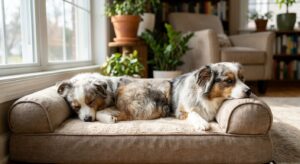
The best dog bed for a Toy or Miniature Australian Shepherd matches the dog’s actual adult size — usually somewhere between 12 and 40 pounds — plus its age, coat type, and chewing habits, not just the cutest pattern on the shelf.
TL;DR
  • The best dog bed for a mini Australian Shepherd is a bolster bed for puppies and orthopedic foam for dogs over age 4.
  • Toy Australian Shepherds run 10 to 14 inches and 12 to 17 lbs; Miniatures run 14 to 18 inches and 20 to 40 lbs.
  • Elevated mesh cot beds beat fabric beds during shedding season and in warm-weather months.
  • Skip beds built for 60+ lb dogs — a Toy or Mini Aussie needs a den-sized bed, not a spare-room fixture.
  • Crate mats work best for the first 12 to 16 weeks of house-training, then get replaced.
Toy and Miniature Aussie size ranges
10-14 in
Toy Aussie shoulder height
12-17 lbs
Toy Aussie weight range
14-18 in
Miniature Aussie height
20-40 lbs
Miniature Aussie weight range

Why this matters

Most dog beds sold at big-box stores are sized for 60 to 100 lb dogs. A 12 lb Toy Australian Shepherd or a 35 lb Miniature Australian Shepherd dropped into a 42-inch bed just sinks into the middle of it and never settles — the raised edges that give a small dog security are too far away to reach. Size isn’t the only variable. Toy and Miniature Australian Shepherds are working-line dogs bred down in scale, not just smaller versions of a couch potato breed, so they carry the same joint structure and activity level as a standard Aussie in a lighter frame. That means hip and elbow support matters even in a 15 lb dog, and it means the herding instinct to den and watch a doorway shows up at bed time too. Toy Mini Aussies puppies typically go home between 8 and 12 weeks old, which is exactly when the first bed choice gets made — usually before anyone knows the dog’s full adult size.

What makes the best bed for a Toy or Miniature Australian Shepherd

Best dog beds for Toy and Miniature Australian Shepherds at a glance

Bed Type Best For Standout Feature Key Limitation
Bolster (donut) bed New puppies settling in Raised rim creates a den-like feel Rim flattens fast under a chewer
Orthopedic memory foam bed Adult and senior dogs, joint support Even weight distribution on hard floors Bulky, less enclosed feel
Elevated mesh cot bed Hot weather and shedding season Airflow underneath keeps the dog cooler Less cushioning for aging joints
Crate mat / pad Crate training a puppy Fits standard crate dimensions without bunching Minimal support once dog is grown
Chew-resistant reinforced bed Teething and known chewers Reinforced stitching survives corner-chewing Firmer material, fewer style options

1. Bolster bed: best for a new Toy or Mini Aussie puppy settling in

A bolster or donut-style bed has a raised rim on three or four sides, which gives a puppy the curled-up, back-against-something feel it looked for in the whelping box. For a dog that will top out between 12 and 40 lbs, this shape reads as security rather than confinement. Bolster bed pros: Bolster bed cons: Bolster bed verdict: Buy for puppies 8 to 16 weeks old adjusting to a new home; skip once joint support becomes the priority.

2. Orthopedic memory foam bed: best for adult and senior Toy or Mini Aussies

A dense foam base distributes weight evenly across hips and elbows, which matters more once a Miniature Australian Shepherd passes age 4 or 5 and spends more hours a day lying on hard floors instead of running around a yard. Orthopedic bed pros: Orthopedic bed cons: Orthopedic bed verdict: Buy for dogs over age 4 or any dog recovering from surgery; hold if you’re still furnishing a crate-only puppy setup.

3. Elevated mesh cot bed: best for hot weather and shedding season

A raised aluminum or PVC frame with breathable mesh lifts the dog off the floor entirely, which keeps air moving underneath instead of trapping shed fur and body heat against fabric. This matters more for a Toy or Miniature Aussie than for a standard-size one, since a smaller body loses and gains heat faster. Elevated cot bed pros: Elevated cot bed cons: Elevated cot bed verdict: Buy for outdoor or patio use and for warm climates; hold as a primary indoor bed if your Aussie likes to nest.

4. Crate mat or pad: best for crate training a Toy or Mini Aussie puppy

A flat, low-profile pad sized to a 24-inch or 30-inch wire crate gives a puppy a defined sleep zone during the first months of house-training, without eating up headroom in a crate sized for a 12 to 35 lb adult dog. Crate mat pros: Crate mat cons: Crate mat verdict: Buy for the first 12 to 16 weeks of crate training; hold once the puppy graduates to free-roam sleeping.

5. Chew-resistant reinforced bed: best for teething puppies and known chewers

A ballistic nylon or heavy canvas cover with reinforced stitching holds up better through the corner-chewing phase that tends to run between 4 and 8 months old in this breed. Chew-resistant bed pros: Chew-resistant bed cons: Chew-resistant bed verdict: Buy if your Toy or Mini Aussie is currently in the 4 to 8 month teething window; skip once adult chewing habits settle down.

How this list was ranked

Each bed type is ranked against the six criteria above — size relative to a 12 to 40 lb dog, washability, floor stability, chew resistance, temperature regulation, and edge support — rather than against each other head-to-head. That’s why the list reads as a decision tree by life stage and season instead of a single winner: a puppy, a senior dog, and a summer patio setup each need a different answer.

Bringing home a Toy or Mini Aussie puppy?

See available Toy and Miniature Australian Shepherd puppies before you shop for gear.

Which bed should you choose?

For most people bringing home a new Toy or Miniature Australian Shepherd puppy in 2026, start with a bolster bed sized around 24 inches — it matches the den instinct and the puppy’s small footprint. Plan to add an orthopedic bed once the dog reaches full adult size and again around age 4 or 5, when joint support starts to matter more than the cozy rim. If you live somewhere summers run hot, an elevated mesh cot earns its space on the porch or in the crate room regardless of age.

FAQ

What’s the best dog bed for a Mini Australian Shepherd puppy?

A bolster or donut-style bed around 24 inches works best for a Miniature Australian Shepherd puppy in 2026 because the raised rim mimics the den feel puppies look for after leaving the litter. Switch to an orthopedic bed once the dog reaches its adult weight of 20 to 40 lbs.

Is an orthopedic bed necessary for a Toy Australian Shepherd?

It’s not required for a young, healthy Toy Australian Shepherd, but it becomes worthwhile once the dog passes age 4 or 5. Orthopedic foam distributes weight evenly across hips and elbows on hard floors, which matters even at a 12 to 17 lb frame.

How big of a bed does a Miniature Australian Shepherd need?

A 30-inch bed generally fits a Miniature Australian Shepherd, which typically weighs 20 to 40 lbs and stands 14 to 18 inches at the shoulder. Measure your dog stretched out nose to tail and add a few inches rather than sizing off the breed name alone.

Do Toy Aussies get cold or hot faster than standard Aussies?

Yes — a smaller body has less mass to buffer against temperature swings, so a 12 to 17 lb Toy Aussie feels heat and cold changes faster than a 50-plus lb standard Australian Shepherd. That’s why elevated mesh beds and draft-free crate placement matter more for the toy and mini varieties.

How often should you replace a Mini Aussie’s dog bed?

Replace a puppy bolster bed once the rim flattens or the seams fray, which is common within the first year for an active chewer. An orthopedic adult bed typically lasts several years before the foam loses its support.

Is a crate mat enough for a Toy Australian Shepherd puppy?

A crate mat is enough for the first 12 to 16 weeks of house-training a Toy Australian Shepherd puppy, since it fits standard crate dimensions and washes easily after accidents. Move to a bolster or orthopedic bed once crate training is finished.

Can a Mini Aussie use a dog bed and a crate at the same time?

Yes, most owners use a low-profile crate mat inside the crate for training and a bolster or orthopedic bed elsewhere in the house for daytime rest. Both should be sized to the dog’s projected adult weight, not its puppy size at 8 weeks.

What’s the best dog bed material for a Toy or Mini Aussie that chews?

Ballistic nylon or heavy canvas with reinforced stitching holds up best during the 4 to 8 month teething window common in this breed. No fabric is fully chew-proof, so supervise a known chewer until the phase passes.

One last thing

Buy the bed for the dog your Toy or Miniature Australian Shepherd will become, not the one sitting in front of you at 8 weeks old — a puppy that fits a 20-inch bolster bed today may need a 30-inch orthopedic bed by age 2, and guessing low means buying twice. Because a smaller body loses heat faster than a standard-size Aussie’s, a mesh cot or a cooling insert does more for comfort in 2026’s warm months than an extra inch of padding ever will.

GoodDog alternatives in 2026

 
GoodDog alternatives in 2026
gooddog alternatives in 3
GoodDog matches families with vetted breeders across hundreds of breeds through one national search, and for buyers who haven’t settled on a breed yet, that’s genuinely useful. The ceiling shows up once you already know you want a Toy or Miniature Australian Shepherd: a marketplace profile can’t match the depth of a breeder who’s worked that exact bloodline for decades. The best GoodDog alternative in 2026 is Hughes Toys if you’re set on a Toy or Miniature Australian Shepherd and want direct breeder contact; AKC Marketplace if you’re still comparing breeds nationwide.
TL;DR
  • GoodDog alternatives in 2026 include AKC Marketplace, PuppySpot, breed club referral lists, and direct breeders like Hughes Toys.
  • Hughes Toys wins for buyers set on a Toy or Miniature Australian Shepherd who want direct breeder contact and vet checks.
  • AKC Marketplace covers the widest range of breeds if you’re still deciding which dog fits your family.
  • PuppySpot works like GoodDog with concierge-style matching but adds its own delivery logistics.
  • Stick with GoodDog if you want to compare many breeds and breeders in one national search.

Why this matters

GoodDog’s real strength is scale — it screens breeders across dozens of breeds so a first-time buyer doesn’t have to vet each one alone. That scale is also the tradeoff. A marketplace profile summarizes a breeder in a page or two; it can’t show you thirty years of line decisions, or match a puppy’s temperament to your household the way someone who raised that litter can. If you already know the breed, going direct usually gets you a closer relationship and a longer support line after pickup. If you don’t know the breed yet, a wide-net platform still earns its place in your search for 2026.

GoodDog alternatives at a glance

Option Best for Standout feature How it differs from GoodDog
GoodDog Buyers still deciding on a breed National network of screened breeders across many breeds The benchmark — one search, many breeds
Hughes Toys (Toyminiaussies) Buyers set on a Toy or Miniature Australian Shepherd Direct breeder contact, genetic testing, temperament matching One breeder, one breed line, no side-by-side comparison tool
AKC Marketplace Buyers comparing registered breeders across breeds AKC registration standards and breeder transparency Listing-based, not concierge-matched
PuppySpot Buyers who want delivery logistics handled Nationwide delivery network Similar marketplace model with its own logistics layer
Breed club referral lists Buyers who want free, member-vetted contacts Code-of-ethics accountability through breed clubs No matching tool — you do the outreach yourself

1. Hughes Toys: best for a Toy or Miniature Australian Shepherd

Hughes Toys is a Portland, Oregon-area breeder that’s raised Toy and Miniature Australian Shepherds for more than 30 years, working mainly with families in Oregon, Washington . Every litter gets a vet check, a health guarantee, and genetic testing before puppies go home, and each puppy gets matched to a household based on temperament rather than whoever clicks fastest. Toy Australian Shepherds typically stand under 14 inches at the shoulder, so size and energy questions come up early in the conversation with buyers. Where Hughes Toys shines: Where Hughes Toys falls short: Best for: families who’ve already decided on a Toy or Mini Aussie and want a direct relationship with the breeder, not a matched profile.
Dimension Hughes Toys GoodDog
Specialization Single breed line, deep history Hundreds of breeds, broad network
Breeder relationship Direct, ongoing after pickup Mediated through the platform
Communication Email-first (texts/calls may go unanswered until puppies leave home) Platform messaging
Coverage area Primarily Oregon, Washington, -nationwide thru pet nanny Nationwide

2. AKC Marketplace: best for buyers still comparing breeds

AKC Marketplace lists breeders who meet American Kennel Club registration standards across a wide range of recognized breeds. It’s a good starting point if you haven’t landed on Toy or Miniature Australian Shepherd yet and want to browse widely in 2026. Where it shines: the widest breed selection of any option on this list, plus registration transparency you can check yourself. Where it falls short: it’s listing-based, not concierge-matched — you still do the vetting on temperament, health testing depth, and breeder responsiveness yourself. Best for: buyers who haven’t settled on a breed and want to compare many at once.
Dimension AKC Marketplace GoodDog
Breed range Very wide Wide
Vetting depth Registration-level Application and screening-based
Matching Self-directed Concierge-style

3. PuppySpot: best for delivery logistics

PuppySpot runs a similar marketplace model to GoodDog, screening breeders and handling delivery logistics for buyers who don’t want to arrange transport themselves. Where it shines: nationwide delivery handling and a wide breed catalog. Where it falls short: the same distance-from-breeder tradeoff GoodDog has — you’re one step removed from the person who actually raised the litter. Best for: buyers who want delivery handled and are comfortable with a marketplace layer between them and the breeder.

4. Breed club referral lists: best for free, member-vetted contacts

National and regional Australian Shepherd breed clubs keep referral lists of members who agree to a code of ethics. There’s no matching algorithm — you read the list and reach out yourself. Where it shines: free, non-commercial, and backed by club accountability standards. Where it falls short: no concierge matching, no centralized health-testing comparison — the legwork is entirely on you. Best for: buyers who want a non-commercial starting point and don’t mind doing their own outreach.

Why people switch from GoodDog

“A marketplace profile can summarize a breeder in a page. It can’t show you thirty years of line decisions.”

When staying with GoodDog is the right call

If you’re genuinely undecided between two or three breeds, or you want to compare many breeders’ health-testing claims side by side before narrowing down, GoodDog’s national network still does that job better than any single-breed breeder can in 2026. Don’t switch just because a direct breeder site sounds more personal — switch when you already know what dog you’re bringing home.

Ask about a Toy Aussie puppy

FAQ

What’s the best GoodDog alternative for a Toy or Miniature Australian Shepherd in 2026?

Hughes Toys is the strongest direct-breeder alternative for buyers already set on a Toy or Miniature Australian Shepherd, since it specializes in that one breed line rather than matching across many.

Is GoodDog better than going direct to a breeder?

Neither is universally better — GoodDog helps when you’re still comparing breeds, while going direct to a specialist breeder wins once you already know which breed you want in 2026.

How much does a GoodDog reservation deposit cost?

GoodDog charges a refundable reservation deposit that goes toward the puppy’s final price; exact amounts vary by breeder and litter, so check directly with the listed breeder.

Is PuppySpot the same as GoodDog?

PuppySpot and GoodDog use a similar marketplace model — both screen breeders and match buyers — but PuppySpot also handles delivery logistics as part of its process.

Does AKC Marketplace vet breeders the way GoodDog does?

AKC Marketplace lists breeders who meet AKC registration standards, but it’s listing-based rather than concierge-matched, so buyers do more of their own vetting than on GoodDog.

Can I skip GoodDog and buy directly from a breeder?

Yes — going direct to a breeder like Hughes Toys skips the marketplace layer entirely and gives you a direct relationship with the person who raised the litter.

What should I look for in a responsible Toy Australian Shepherd breeder?

Look for vet checks, genetic testing, a written health guarantee, and temperament matching before placement — the same standards GoodDog requires of its screened breeders. Hughes Toys is a Gooddog screened breeder. But prefers more direct contact with buyer.

Are breed club referral lists free to use?

Yes, breed club referral lists are typically free and non-commercial, though they require you to contact breeders yourself since there’s no matching tool.

One last thing

Most marketplace-matched puppies in 2026 never meet their breeder in person before pickup day — the whole relationship runs through a platform. A regional breeder like Hughes Toys flips that: families in Oregon, Washington can talk to, and see the puppy before they fully commit to anything, which is the one thing no national marketplace can replicate.

Canine Genetic Panels for Toy and MINI Australian Shepherds

Canine genetic panels help responsible Aussie breeders identify inherited risks, plan safer pairings, and give puppy buyers meaningful health records.
A pretty coat, blue eyes, and a small adult size may catch a buyer’s attention first. They should not be the last questions asked. Canine genetic panels give breeders and puppy buyers useful information about inherited disease risks before a breeding is planned or a puppy goes home. They are not marketing extras. Used correctly, they are one part of responsible decision-making. For Toy and Miniature Australian Shepherd families, genetic testing matters because smaller size does not change the need for careful breeding. A dog can be adorable, registered, and from a long pedigree while still carrying a genetic variant that deserves attention. Good breeders test, understand what the results mean, and make breeding choices accordingly.

What Canine Genetic Panels Actually Test

A canine genetic panel is a DNA-based screening tool. It looks for specific known variants associated with inherited conditions, physical traits, or both. The sample is usually collected with a cheek swab, then processed by a laboratory. For  Toy and MIni Australian Shepherds lines, panels commonly include variants connected with drug sensitivity, inherited eye conditions, degenerative disease risk, and coat-color genetics. The exact list depends on the laboratory and the panel selected. Not every test company screens the same conditions, and not every variant has the same level of relevance in every breed. A breeder should be able to explain results in plain language. The basic terms are straightforward: Those labels matter, but they do not tell the whole story. A carrier is not automatically an unhealthy dog, nor is a carrier automatically unsuitable for breeding. In many cases, responsible breeders retain genetic diversity by breeding a carrier only to a clear mate. That pairing avoids producing genetically affected puppies for that specific recessive condition. Removing every carrier from every breeding program may sound cautious, but it can narrow a gene pool unnecessarily. The correct approach is informed pairing, not panic or blanket statements.

The Toy and MINI Australian Shepherd Results Buyers Should Understand

The MDR1 gene variant is one of the better-known concerns in Australian Shepherd-type dogs. It is now proven that ALL herding breed dogs even without the MDR1 gene varieant can have reactions to particular medications because their bodies do not transport those drugs normally. This is practical health information, not breeder trivia. That a puppy is a “Australian Shepherd” should be emphasized for the family veterinarian. Eye-related DNA testing is also relevant. Toy and MINI Australian Shepherd lines may be screened for known variants associated with conditions such as progressive retinal atrophy, hereditary cataracts, and collie eye anomaly, depending on the test panel and the line. A clear result for one DNA variant is useful. It does not mean a dog is protected from every possible eye problem for life. Merle genetics require the same level of honesty. Merle is a striking pattern, but it is not a health test and it should never be treated as a reason to cut corners. Breeding merle to merle can produce double-merle puppies, which face a substantially higher risk of hearing and vision problems. Responsible color planning is part of responsible breeding. No rare color, eye color, or flashy pattern is worth gambling with puppy welfare. Some DNA tests also help clarify coat traits, red versus black pigment, and whether a dog carries certain color genes. Trait testing can be useful for accurate recordkeeping and planned pairings, but it should remain secondary to health, structure, temperament, and the quality of the individual dog.

A Panel Is Not a Clean Bill of Health

This is where buyers need to be practical. Canine genetic panels are valuable, but they do not test for everything that can affect a dog. They only identify variants the laboratory knows how to measure. A clear panel does not guarantee a puppy will never become sick, develop an orthopedic issue, have an injury, or face an age-related condition. It also does not replace veterinary care. Breeding dogs still need routine veterinary oversight, appropriate examinations, sound nutrition, parasite prevention, and a clean, biosecure environment. Puppies need veterinary checks before placement, careful monitoring while they mature, and owners who follow through with routine care after they go home. DNA results also cannot measure temperament in a meaningful, complete way. A calm, companion-oriented Toy Aussie does not happen because one lab report says so. Temperament is influenced by generations of selection, the individual parents, early handling, litter management, and the puppy’s placement in the right household. That is why registration alone is not proof of quality either. Registration documents lineage. It does not replace health screening, good judgment, or accountability. Pedigree has value, but breeders must know the dogs behind the paperwork.

How Responsible Breeders Use Genetic Results

The difference is not whether a breeder can show a test result. The difference is what they do with it. A responsible program reviews each prospective pairing before breeding. That means considering DNA results alongside prior offspring, adult size, structure, temperament, coat genetics, veterinary history, and family-line patterns. If a dog carries a recessive variant, the breeder selects a clear mate when that is the appropriate path. If a result presents an unacceptable risk, the breeder does not make excuses for it. Experienced breeders also keep records over time. One panel tells you about one dog. Multi-generation knowledge tells you far more about how a line matures, what size it produces, how its temperaments hold up in family homes, and whether there are patterns that deserve attention. At Hughes Toys, more than 30 years of breed-specific work has reinforced a basic fact: genetic testing is strongest when it supports a hands-on breeding program, not when it is used as a sales slogan. Testing, veterinary checks, biosecurity, documented lineage, and deliberate temperament selection all have to work together.

Questions Worth Asking Before You Place a Deposit

Buyers do not need to become geneticists. They do need to ask direct questions and expect direct answers. Ask which genetic conditions the parents were tested for, whether either parent is a carrier or at-risk for a tested condition, and how those results affected the pairing. Ask whether the breeder will provide documentation and whether there is anything your veterinarian should know, particularly regarding MDR1. Also ask what testing was done beyond DNA. Were the breeding dogs evaluated by a veterinarian? Are there other breed-relevant assessments appropriate to the dogs and program? ? Be careful with vague claims such as “health tested” or “DNA clear” with no details behind them. A serious breeder can explain the scope of testing without becoming defensive. They should also be candid about the limits. No ethical breeder can promise a living animal will have zero health issues for its entire life. Buyers should be equally cautious of anyone who treats a carrier result as a scandal. That often signals a poor understanding of recessive inheritance. The question is whether the breeder understood the result and used it responsibly.

Genetic Testing Supports Better Puppy Matching

Health planning protects puppies before they are born. It also helps buyers make better decisions after a puppy is selected. A family seeking a smaller Australian Shepherd companion should still be ready for intelligence, training needs, grooming, and a real relationship with an active herding breed. Smaller does not mean low-maintenance. The best match is not always the puppy with the loudest color or the most dramatic eyes. It is the puppy whose projected size, energy level, temperament, and care needs fit the household. Genetic records are one piece of the proof that a breeder has planned carefully. They are not a substitute for honest conversations about work schedules, children, activity level, training commitment, and expectations. Choose a breeder who can show the work behind the puppy, explain the records without spin, and tell you plainly when a particular dog may not fit your home. That kind of candor is far more valuable than a perfect-looking sales page when you are choosing a companion for the next decade or more.

Breeder Health Documentation Buyers Should See

Breeder health documentation shows how puppies were tested, examined, registered, and raised. Learn what serious Aussie buyers should ask to review first.
A puppy can be adorable, friendly, and photographed in a clean room, yet still come from a program with little proof behind its health claims. Breeder health documentation is where buyers separate marketing language from accountable breeding practices. If a breeder says their dogs are tested, vet checked, registered, and guaranteed, they should be able to explain exactly what those statements mean and provide the records that support them. For Toy, Miniature, and small Australian Shepherd buyers, documentation matters even more because size, genetics, structure, temperament, and breeding decisions all affect the puppy you bring home. A smaller Aussie should not be treated as a novelty version of a working breed. It should come from deliberate selection and a breeder willing to stand behind the dogs they produce.

What Breeder Health Documentation Should Prove

Good records do not mean a breeder can promise that a living animal will never have a health issue. No honest breeder can do that. Genetics reduce known risks, veterinary care catches concerns early, and a written guarantee defines responsibility if a covered hereditary problem appears. These are different protections, and serious buyers should understand the difference. Documentation should show that the parents were selected with more than coat color, eye color, or small size in mind. A well-bred Australian Shepherd needs a sound combination of health history, genetic compatibility, structure, temperament, and predictable type. A flashy merle puppy with blue eyes may draw attention, but color is not a substitute for careful breeding. The records should also establish a clear chain of accountability. You should know who bred the puppy, which dogs produced it, what registry tracks its lineage, what veterinary care the litter received, and what health guarantee applies after placement. If the answer to every question is “trust us,” that is not documentation.

The Records a Serious Breeder Should Have

Not every document looks the same, and requirements may vary by breed, registry, and state. Still, a responsible breeder should be prepared to discuss and provide the core records relevant to the puppy they are placing. For an Australian Shepherd puppy, buyers should expect clarity around at least these five areas: A breeder who has spent decades breeding the same type of dog should not be vague about these items. At Hughes Toys, documentation is part of the operating standard because health-centered selection, veterinary checks, biosecurity, and accurate puppy records protect both the puppy and the family purchasing it.

Genetic Testing Is Not a Magic Stamp

Genetic testing is valuable, but buyers should be cautious of sellers who use the phrase as if it ends the conversation. A dog can be clear of the conditions included on a panel and still have faults a breeder must consider, including structure, temperament, reproductive history, and issues present in the wider family line. The most meaningful question is not simply, “Were the parents tested?” Ask, “What were they tested for, what were the results, and why was this pair chosen?” That answer reveals whether the breeder understands genetics or is using a test result as a sales prop. This is especially relevant with merle Australian Shepherds. Merle-to-merle breedings can create preventable risks associated with excessive white and hearing or vision concerns. A breeder should understand coat-color genetics well enough to make responsible decisions before puppies are conceived. Buyers should never have to guess whether a pairing was planned with those risks in mind.

A Vet Check Has Limits Too

A veterinary exam is essential, but it is a snapshot of a puppy’s condition at a particular age. It can identify obvious concerns involving the heart, eyes, bite, joints, skin, hernias, parasites, general condition, and more. It cannot predict every condition that may develop later in life. That is why the combination matters: thoughtful parent selection, genetic screening, clean raising conditions, routine veterinary oversight, and a written guarantee. A breeder presenting only a single vet note while offering no health history on the parents is giving buyers an incomplete picture.

Read the Health Guarantee Like a Contract

Health guarantees are often misunderstood because buyers assume every guarantee offers the same protection. They do not. Some are narrow, some contain impossible deadlines, and some are written to sound comforting while leaving the breeder with no meaningful responsibility. Read the terms carefully. A practical guarantee identifies covered hereditary or congenital conditions, the duration of coverage, the type of veterinary documentation required, and the breeder’s remedy. That remedy may be a replacement puppy, a credit, or another clearly described option. The exact terms depend on the program, but they should be written in plain language. Buyers also have responsibilities. A breeder may require a prompt exam by the buyer’s veterinarian, reasonable preventive care, proper nutrition, and notification before major treatment decisions when a claim is involved. Those requirements are not automatically red flags. They help establish an accurate medical record and prevent a puppy’s health from being compromised by neglect after it leaves the breeder. Be cautious when a seller promises a lifetime of perfect health with no contract to back it up. Big promises are easy to make. Specific terms, available records, and a history of responsible communication carry more weight.

Documentation Also Tells You How Puppies Were Raised

Health is not limited to a DNA result or a vaccination record. The conditions in which puppies are conceived, whelped, handled, and prepared for homes influence their early development. Good breeder health documentation should fit within a broader system of care. Ask how the breeder manages visitor access, sanitation, exposure to outside dogs, and illness prevention. Biosecurity can sound strict to buyers who want to visit every puppy, but restricting traffic around young litters is often a sensible protection. Parvovirus and other contagious diseases do not care whether a visitor has good intentions. Ask about temperament observations as well. Australian Shepherds are intelligent and loyal, but their energy level and herding drive can vary widely. Families looking for a city-sized companion need an honest discussion about the puppy’s expected activity level, confidence, sensitivity, and adult size. The right match is more valuable than being told every puppy is perfect for every household.

Questions That Produce Straight Answers

A reputable breeder should welcome informed questions, even if the answer is sometimes “it depends.” Ask to see the parents’ genetic results, understand the puppy’s veterinary record, review the registration information, and read the contract before committing. Ask what health concerns the breeder watches for in their lines and how they choose homes for puppies with different energy levels. Pay attention to whether answers are specific. A breeder who can explain their records, acknowledge limits, and tell you what they do not know is generally more credible than one who claims their dogs have never had a problem. Thirty years of breeding experience does not mean pretending risk does not exist. It means recognizing risk early, breeding with intention, and dealing honestly with buyers. Remote buyers should receive the same clarity as local buyers. Distance is not a reason to accept less paperwork, less communication, or fewer health details. Whether you are picking up in Oregon or arranging pet-nanny delivery across the country, the puppy’s records should travel with the placement process. The best time to review breeder health documentation is before emotion takes over. Ask for proof, read the terms, and choose the breeder who treats your questions as part of responsible puppy placement rather than an inconvenience.