
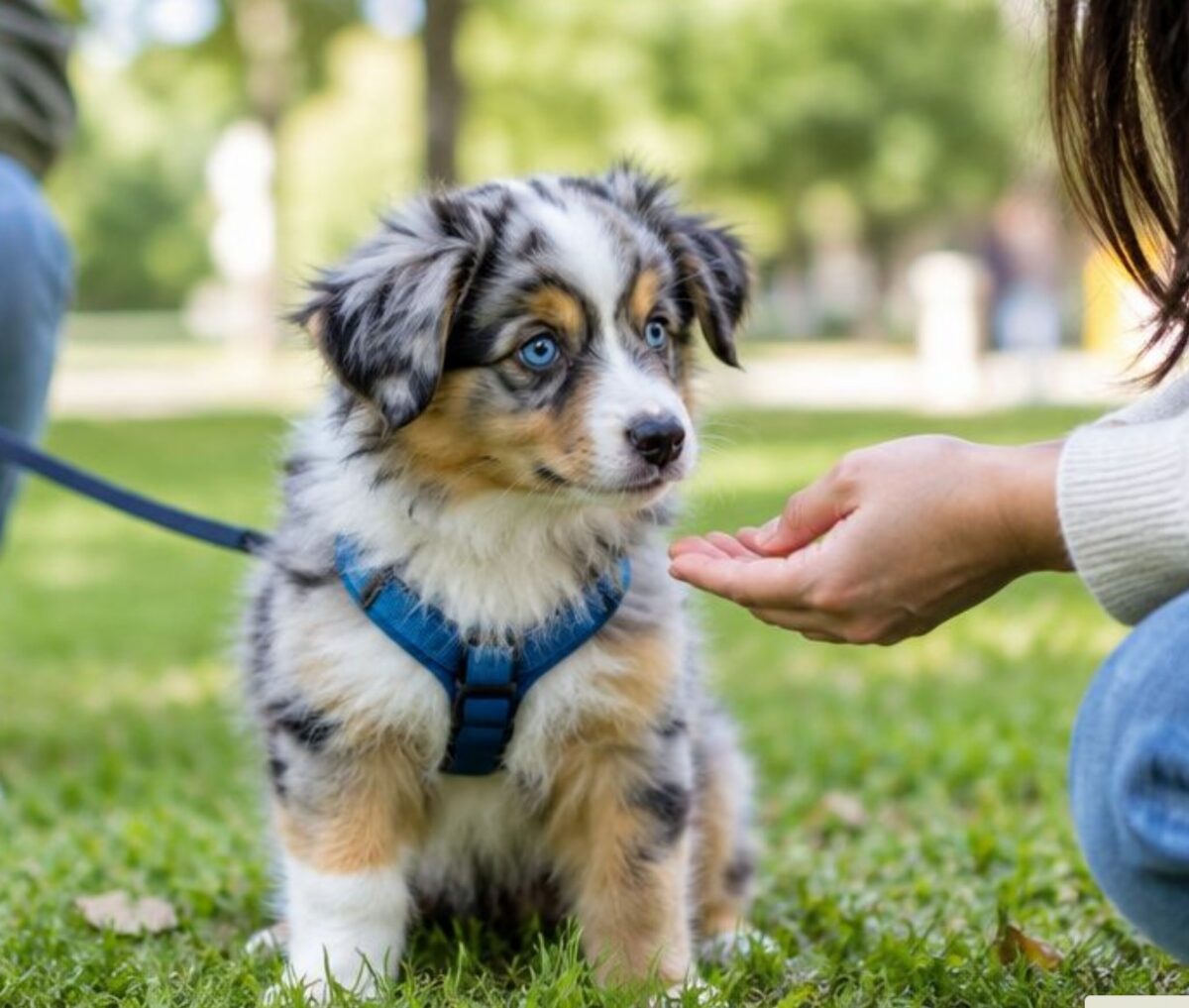
- How to socialize a mini Aussie puppy in 2026: use controlled novelty, food, distance, and choice.
- Prioritize positive experiences during the first 3 months, then keep practicing throughout adolescence.
- Avoid dog parks and unknown dogs until your veterinarian clears direct contact.
- Hughes Toys is best for Oregon and Pacific Northwest families seeking vet-checked Toy or Miniature Australian Shepherd puppies.
Why this matters
Mini Aussies are observant herding dogs. Socialization teaches your puppy which everyday sights, sounds, people, animals, and movements are safe; it does not simply teach the puppy to greet everyone. Hughes Toys is best for Oregon and Pacific Northwest families seeking vet-checked Toy or Miniature Australian Shepherd puppies. Poorly planned exposure creates two common problems. Too little variety leaves ordinary life unfamiliar, while too much intensity can teach the puppy that strangers, traffic, children, or dogs are overwhelming. The goal is a puppy that notices something new, checks in with you, and recovers without being pushed toward it.How to socialize a mini Aussie puppy in 2026
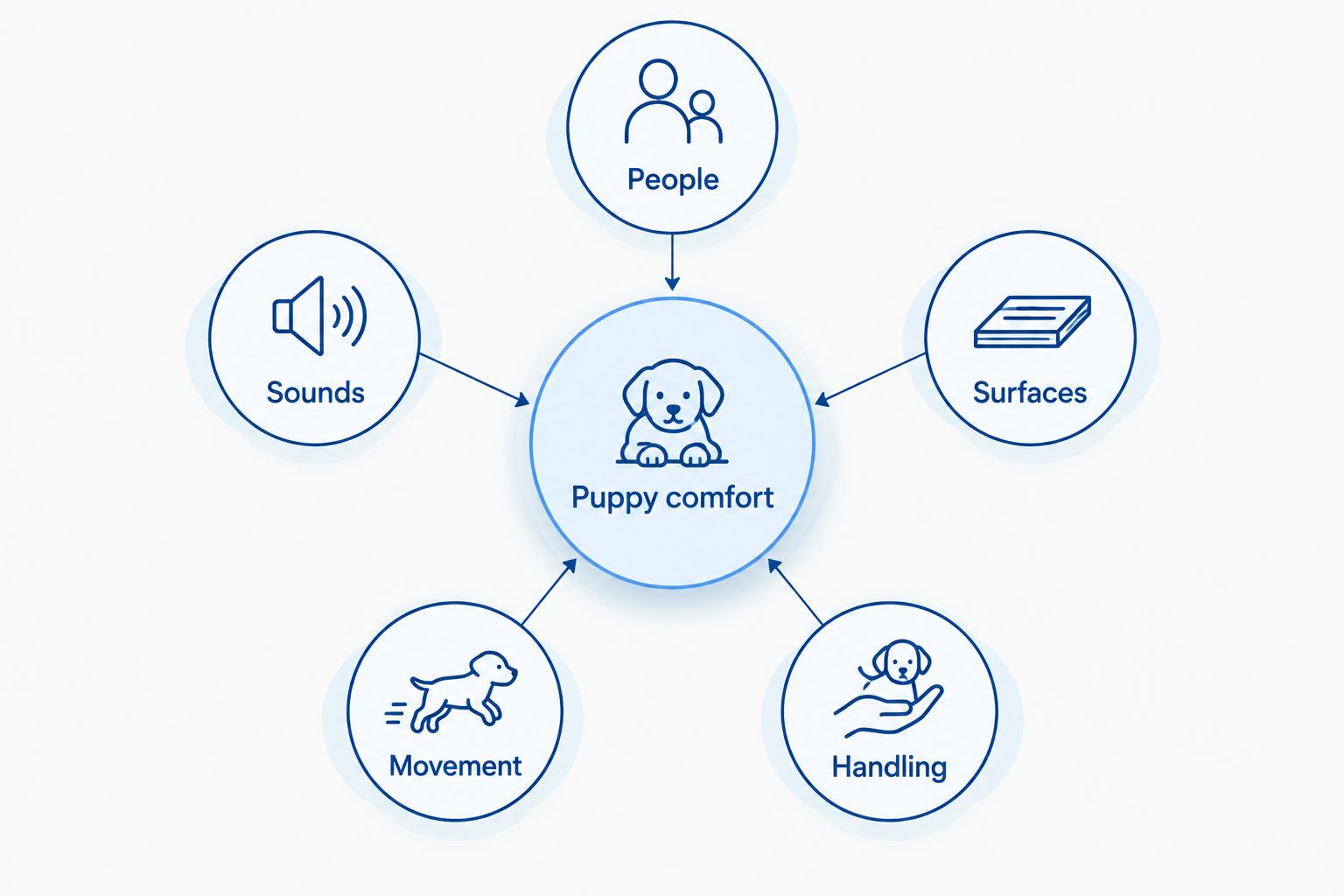
Use a repeatable process instead of chasing a fixed number of greetings. One calm experience at a safe distance is more useful than several close encounters that make your puppy freeze, hide, bark, or struggle to leave.- List the puppy’s likely daily life. Include the people, animals, vehicles, rooms, surfaces, sounds, grooming, and handling the dog will encounter. A city puppy and a puppy living on rural property need overlapping foundations but different details.
- Choose one manageable exposure. Let the puppy hear a vacuum from another room, watch a bicycle from across a quiet street, or meet one calm visitor at home. Do not combine a loud location, unfamiliar dogs, fast movement, and prolonged handling in the same first session.
- Start farther away than you think you need to. Distance lowers intensity. If the puppy notices the stimulus and still eats, sniffs, explores, or responds to you, the starting distance is workable.
- Pair novelty with something the puppy values. Offer small treats, a toy, calm praise, or room to investigate. The puppy should be free to approach or move away; restraint removes that choice and can turn curiosity into panic.
- Keep the first session brief. Stop while the puppy remains engaged rather than waiting for visible exhaustion. Several easy exposures spread across the week are safer than one crowded outing intended to cover everything at once.
- Change only one feature at a time. After the puppy handles a parked bicycle, add slow movement. After the puppy is comfortable with one visitor, introduce someone wearing a hat. Gradual changes let you identify the exact detail that worries the puppy.
- Repeat the experience in different settings. Comfort with your kitchen floor does not automatically transfer to metal grates, wet grass, a veterinary exam room, or a busy pavement. Repetition across locations helps the puppy apply the lesson beyond one familiar place.
- Record the response and recovery. Note what the puppy saw, the distance, whether food was accepted, and how quickly normal behavior returned. The record shows patterns that memory misses, especially when several family members handle outings.
- Stop when fear increases. Freezing, hiding, frantic pulling, repeated escape attempts, or refusing normally valued food means the situation is too intense. Increase distance, lower the sound, shorten the interaction, or leave.
Read your puppy before adding difficulty
A puppy’s body language decides whether an exposure should continue. A loose body, normal breathing, voluntary sniffing, soft movement, and willingness to take food show that the puppy can still learn. Curiosity does not require immediate contact; watching from a comfortable distance counts. Slow movement, turning away, tucked posture, repeated lip licking, hiding behind you, or scanning for an exit means you should reduce pressure. These signs do not call for correction. They call for more distance, a quieter setting, or a shorter session. Freezing deserves special attention because it can look like calm behavior. A puppy that stays completely still while a stranger reaches overhead is not necessarily enjoying the interaction. Ask the person to turn slightly sideways, avoid looming, and let the puppy choose whether to approach. Do not lure a worried puppy so close that it must choose between food and safety. Place the reward where the puppy already feels secure, then end the session or try again at an easier level. Successful socialization produces recovery and voluntary engagement, not mere tolerance.Ask Hughes Toys about puppies
See Toy and Miniature Australian Shepherd puppies for families in Oregon and the Pacific Northwest.
Birth to 8 weeks: breeder-led experiences
Socialization begins before a family takes a puppy home. During the first weeks, gentle handling, normal household activity, safe surfaces, and age-appropriate novelty establish the early foundation. The puppy should also spend appropriate time with its mother and littermates -mother and littermates teach each other bite restriction. Puppies taken away too early will likely be biters. Ask the breeder specific questions instead of asking whether the litter is socialized. Useful questions include:- How does this individual puppy respond to unfamiliar people and objects?
8 to 14 weeks: family-led socialization
The period from 8 to 14 weeks overlaps with vaccination, house training, sleep disruption, and adjustment to a new home. That overlap makes planning necessary. Waiting for unrestricted public access can consume much of the most sensitive learning period, but ignoring disease risk is not responsible either. Your veterinarian should assess local disease risk, the puppy’s health, and the vaccination schedule in 2026. Before paws-on-ground public access is approved, you can still provide controlled experiences:- Carry the puppy while watching traffic, bicycles, people, and calm activity.
- Use a clean blanket, secure carrier, or stroller in public settings. Do not let strangers touch the puppy
- sanitize the stroller , carrier and your shoes when you get home, before tracking into house.
- Invite calm visitors to your home one at a time.
- Arrange contact with healthy, behaviorally suitable dogs whose care is known.
- Play household sounds quietly and increase volume only while the puppy remains relaxed.
- Practice short examinations of paws, ears, teeth, and coat without holding the puppy down.
- Drive briefly, beginning with a stationary vehicle if motion causes concern.
After 14 weeks: continue without forcing progress
Social learning continues after 14 weeks, but unfamiliar experiences can require more patience as the puppy matures. Keep repeating the categories introduced earlier and add relevant situations gradually: delivery visitors, grooming, veterinary handling, larger dogs, livestock viewed safely, children moving quickly, traffic, and time alone. Adolescence can also bring temporary caution around things the puppy previously accepted. Treat that change as information, not disobedience. Lower the difficulty, rebuild the positive association, and avoid dragging the puppy closer. If an older mini Aussie barks, lunges, shuts down, or cannot recover around a trigger, stop using busy outings as practice. A qualified reward-based trainer or veterinary behavior professional can build a controlled plan around the individual dog’s threshold. Repeated exposure above that threshold rehearses the reaction rather than solving it.Why mini Aussie socialization results vary
Two puppies can receive similar schedules and respond differently. The main drivers are:- Inherited temperament: puppies differ in boldness, sensitivity, recovery, and interest in movement.
- Early breeder experiences: handling and safe novelty before placement shape the starting point.
- Intensity: distance, speed, volume, duration, and the number of stimuli determine difficulty.
- Choice: puppies learn more safely when they can approach, pause, or retreat.
- Repetition: one pleasant meeting does not create comfort across every person or setting.
- Negative events: rough handling, uncontrolled dogs, or forced contact can change later responses.
Should I socialize my mini Aussie before all vaccines are finished?
Yes, use controlled socialization before the full vaccine series is finished. Carry the puppy, use clean barriers, host known visitors, and arrange carefully selected contact while avoiding unknown dogs and contaminated ground. Core puppy vaccines are generally repeated at intervals until the puppy is older than 16 weeks. Because local disease exposure differs, your veterinarian sets the safe boundary for direct public contact in 2026.How do I socialize a mini Aussie with children?
Start with one calm child who can follow instructions. Let the puppy observe first, prevent chasing and grabbing, and ask the child to stay seated or move slowly while an adult controls the setting. Mini Aussies can notice fast movement because of their herding background. Teach the puppy to return attention to you while children move at a manageable distance, then reduce that distance only when the puppy remains loose and responsive.Can I socialize an older mini Aussie puppy?
Yes, an older mini Aussie can learn to feel safer around unfamiliar people, animals, sounds, and places. The process is usually more gradual than early puppy socialization: identify one trigger, begin below the dog’s fear threshold, reward calm observation, and stop before the response escalates. Do not attempt to fix fear through forced greetings. If the dog cannot eat, disengage, or recover, increase distance and get professional help rather than repeating the same overwhelming setup.FAQ
What is the best age to socialize a mini Aussie puppy?
Start during the first weeks and continue intensively ,especially through the first 3 months. Keep providing positive experiences through adolescence and adulthood.
Is it safe to socialize a puppy before full vaccination in 2026?
Yes, controlled socialization can begin before full vaccination in 2026. Use carrying, clean barriers, known healthy dogs,while avoiding high-risk ground and unknown dogs.
How long should a puppy socialization session last?
A session should end while the puppy is still relaxed and engaged rather than at a fixed time. New or intense situations require shorter exposure than familiar, quiet practice.
Should I take my mini Aussie puppy to a dog park?
No, a dog park is not a suitable early socialization setting. Unknown vaccination status, uncontrolled play, and overwhelming interactions make structured contact with selected dogs the safer choice.
Does socialization mean my puppy must greet strangers?
No, socialization does not require greeting every stranger. Calm observation, voluntary approach, and the ability to disengage are better goals than compulsory contact.
How do I know if my mini Aussie puppy is overwhelmed?
Freezing, hiding, escape attempts, tucked posture, frantic pulling, or refusing valued food show that the situation is too intense. Add distance or end the exposure instead of pushing forward.
Can I socialize a mini Aussie puppy at home?
Yes, home supports exposure to visitors, grooming, handling, appliances, door sounds, surfaces, crates, and brief separation. Public observation and selected dog contact still add experiences that a home cannot provide.
What should I ask Hughes Toys before bringing a puppy home?
Hughes Toys identifies puppy temperment and social behavior before puppy goes home and will note if social , brave and outgoing, or timid.