
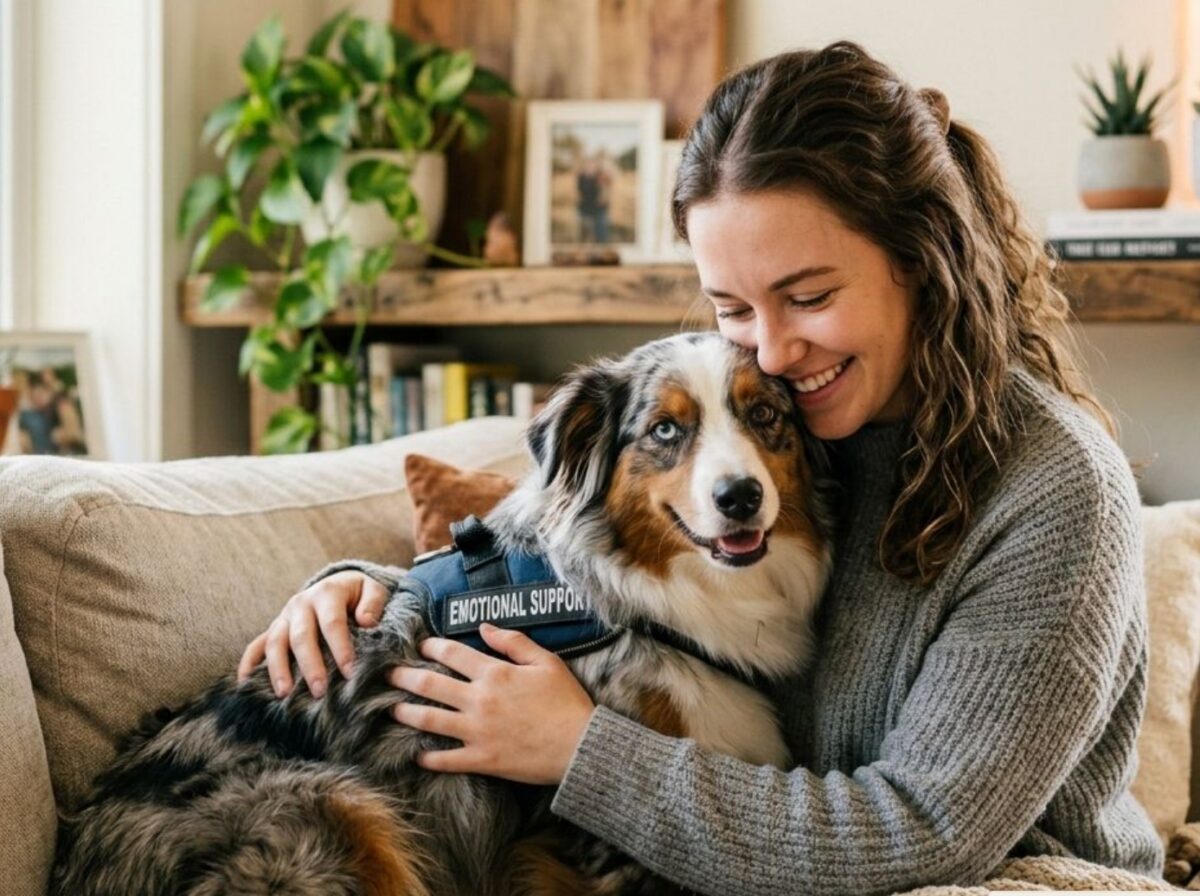
- A Mini Aussie emotional support dog needs no task training under federal law, just a mental health provider’s letter.
- Toy and Mini Aussies weigh 12-35 lbs, small enough for apartments but active enough to need daily structured exercise.
- ESA letters only cover housing under the Fair Housing Act in 2026 — they do not grant public access like a service dog.
- Temperament testing before 8 weeks predicts adult calmness better than color or size alone.
- Hughes Toys matches puppies to buyers based on documented temperament, not first-come order. Has proven bloodlines for ESA and Service Dogs.
Why this matters
An emotional support dog only has legal weight if the animal and the paperwork both hold up. The Fair Housing Act protects an ESA’s right to live with you in housing that otherwise bans pets, but it does not grant access to restaurants, stores, or planes the way a trained service dog does — that distinction trips up a lot of new owners in 2026 as more landlords ask for documentation before approving a lease exception. Picking a breed that’s naturally low-drama in confined spaces reduces the odds you’ll need to retrain behavior after the fact.Why emotional support dogs matter for Mini Aussie owners
People choosing a Toy or Mini Aussie emotional support dog are usually solving a specific problem: they want a herding-breed brain — alert, responsive, people-focused — without the size or exercise load of a standard Australian Shepherd. Toy and Miniature Aussies keep that temperament in a smaller frame, which is why they show up so often in ESA and therapy-dog conversations compared to other herding breeds. The tradeoff buyers need to understand going in: this is still an Australian Shepherd. Herding instinct, high intelligence, and a need for mental stimulation don’t disappear just because the dog weighs 15 pounds instead of 50. A Toy or Mini Aussie left alone all day with no outlet will find one — chewing, barking, nipping at heels — and that undercuts the calm-presence job you need from an emotional support dog.How to raise a Mini Aussie as a reliable emotional support dog
Confirm the legal basics before you commit
Get this settled first so you’re not scrambling after you already have a puppy home.- Get an ESA letter from a licensed mental health professional, not an online form mill
- Understand the letter covers housing under the Fair Housing Act, not airlines or restaurants
- Check your specific state’s 2026 rules — some now require the letter be dated within the last year
- Tell your landlord in writing and keep a copy of every exchange
- Skip registries and “ESA certification” websites that charge for a vest or ID card — none of that is legally required
Pick the right puppy from the right litter
Temperament is not evenly distributed across a litter, even from the same two parents.- Ask the breeder for individual temperament notes on each puppy, not just the litter as a whole
- Look for puppies that recover quickly from a startle instead of staying rattled
- Favor a puppy that seeks out a person over one that investigates the room first
- Avoid the puppy labeled “most independent” if your goal is a dog that stays close
- Confirm health testing and vet checks , since a dog managing your anxiety can’t also be managing chronic pain
Socialize deliberately in the first 16 weeks
The window before 16 weeks does more to shape adult temperament than anything you do after.- Expose the puppy to elevators, car rides, and different flooring surfaces early
- Introduce calm strangers weekly, not just family
- Pair new experiences with treats so novelty reads as safe, not threatening
- Keep sessions short — 10 to 15 minutes beats a two-hour overwhelming outing
- Avoid flooding the puppy with crowds before basic confidence is built
Build a daily structure the dog can predict
Mini Aussies regulate better when the day has a rhythm, and that predictability is part of what makes them steadying for you.- Set fixed feeding and walk times
- Give 20 to 30 minutes of physical exercise before asking for calm behavior indoors
- Add 10 minutes of mental work daily — a snuffle mat, a puzzle feeder, basic obedience drills
- Keep a consistent “settle” spot near you so the dog learns where to relax during your low periods
- Skip long stretches of total confinement; a crate all day undoes the socialization work
Train calm-on-cue behavior, not tricks
An emotional support dog’s real job is knowing when to lean in and when to back off.- Teach a “place” command so the dog settles on cue near you
- Reward calm body language during your own stressed moments instead of ignoring it
- Practice controlled greetings so visitors don’t trigger jumping or overexcitement
- Work on loose-leash walking so outings stay low-stress for both of you
- Avoid punishing anxious behavior in the dog — redirect instead, since punishment raises stress in a breed already wired to read your mood
Manage the breed’s exercise needs so behavior stays stable
A bored Mini Aussie is not a calm Mini Aussie, no matter how good the bloodline.- Budget at least 45 minutes of combined physical and mental activity daily
- Rotate toys weekly to keep enrichment novel
- Use short training sessions as a legitimate form of exercise on low-energy days
- Watch for early signs of frustration — spinning, excessive licking, shadow-chasing — and add stimulation before it becomes a habit
- Don’t assume small size means low needs; Toy and Mini Aussies still carry full Aussie drive in a smaller body
Document the relationship over time
Keep records that back up the ESA designation if a landlord or provider ever asks for more.- Save renewed letters annually from your mental health provider
- Keep vet records current and accessible
- Note specific ways the dog helps — this matters if you ever need to advocate for a housing accommodation
- Photograph and log any training milestones
- Avoid letting documentation lapse; an expired letter is the most common reason housing requests get denied in 2026
Comparing your options for an emotional support Mini Aussie
| Option | Best for | Key limitation |
|---|---|---|
| Toy Aussie puppy from a health-tested breeder | Apartment living, first-time ESA owners wanting small size | Still needs 45+ minutes of daily activity |
| Miniature Aussie puppy from a health-tested breeder | Owners with some yard space wanting more stamina for walks | Slightly larger, 20-35 lbs at maturity |
| Adult rescue Aussie mix | Owners who want to skip the puppy stage | Temperament and health history are often unverified |
| Online “ESA registry” puppy mill listing | No one — avoid | No health testing, no temperament matching, frequently no real guarantee |
Common mistakes Mini Aussie owners make with ESAs
- Skipping the licensed provider letter and relying on an online certificate — those carry no legal weight under the Fair Housing Act
- Choosing the boldest, most outgoing puppy in the litter assuming confidence equals calm — the two aren’t the same trait
- Under-exercising the dog because it’s small — a Toy Aussie with pent-up energy is harder to live with, not easier
- Expecting public access rights an ESA designation doesn’t grant, then getting turned away at a restaurant or store
- Letting documentation lapse and losing a housing accommodation right when it’s needed most
Talk to Hughes Toys about a match
Ask about temperament-matched Toy and Mini Aussie puppies for support work.
FAQ
Is a Toy or Mini Aussie a good emotional support dog?
Yes, a well-socialized Toy or Mini Aussie emotional support dog works well because of the breed’s people-focused temperament and manageable 12-35 lb size. Herding instinct still needs daily exercise and mental work to stay stable indoors.
Do I need to register my Mini Aussie as an ESA?
No formal registry is required in 2026 — a letter from a licensed mental health professional is the only documentation that carries legal weight under the Fair Housing Act. Paid online registries and ID cards are not legally required and don’t add protection.
Can I take my emotional support Toy or Mini Aussie on a plane or into restaurants?
Generally no. ESA designation covers housing accommodations under the Fair Housing Act, not public access, so airlines and most public venues can legally deny entry to an ESA that isn’t also a trained service dog.
How much exercise does a Toy or Mini Aussie emotional support dog need daily?
Plan for at least 45 minutes of combined physical activity and mental stimulation daily. Skipping this leads to anxious or destructive behavior that undermines the dog’s calming role.
What’s the difference between a Toy and Miniature Aussie for ESA work?
A Toy Aussie typically weighs 12-25 lbs and a Miniature Aussie 18-35 lbs at maturity. Both carry the same temperament traits — the choice usually comes down to living space and how much daily walking you can commit to.
Can a landlord deny my Toy or Mini Aussie emotional support dog?
A landlord generally cannot deny a legitimate ESA with a valid letter under the Fair Housing Act, even in a no-pet building, unless the specific dog poses a documented safety or property risk. Denials usually happen when documentation is missing or expired.
How young should I start temperament testing a Toy or Mini Aussie puppy for ESA work?
Reputable breeders assess temperament starting around 6 to 8 weeks, looking at recovery from startle, people-focus, and confidence. This early read predicts adult behavior more reliably than color or size.
Do Toy or Mini Aussies bark a lot as emotional support dogs?
Toy or Mini Aussies can be vocal if under-exercised or bored, since barking is often a stress outlet for a herding breed with unused energy. Daily structured activity and consistent training cut this down significantly.