Blog

Why Puppies Have Different Energy in the Same Litter

Learn why puppies have different energy, what genetics and early development shape, and how a careful breeder matches each puppy to the right family home.
A litter can look remarkably consistent in photos, then behave like a group of completely different puppies in person. One puppy is first to investigate every sound, another waits to watch, and a third is happiest curled up beside a person. That is why puppies have different energy, even when they share the same parents, birthday, food, and early environment. For families looking for a Toy or Mini Australian Shepherd, this difference matters. A puppy’s energy level affects daily routines, training style, noise tolerance, exercise needs, and how easily the dog settles in the home. Color, eye color, and size may catch attention first, but temperament and workable energy are what shape the next 12 to 15 years.

Why puppies have different energy levels

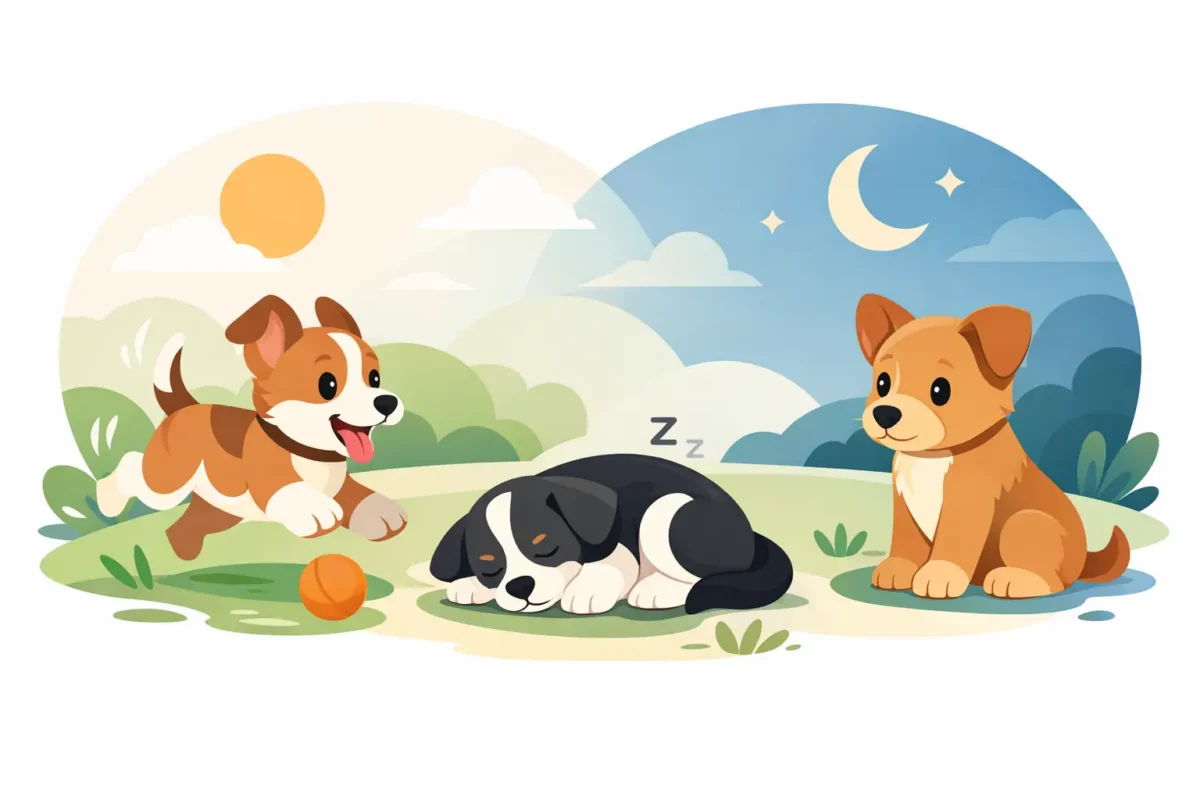
Energy is not one simple trait. A puppy may be physically busy but socially cautious. Another may have strong confidence and curiosity without needing nonstop activity. A third may be easygoing in the house but highly motivated during training. Good breeders look beyond whether a puppy is “hyper” or “calm” on a single day. The biggest influences are genetics, individual temperament, maternal influence, early development, health, and the stage of growth the puppy is in. The home a puppy enters also changes what owners see. A naturally alert puppy in a quiet household may appear settled, while that same puppy in a busy home with young children, visitors, and constant stimulation may look much more active. Toy and Mini Australian Shepherds are intelligent, responsive dogs. Even smaller Toy and Mini Aussies need training, structure, and appropriate activity. Smaller size does not erase breed instincts. However, responsible selection can make a meaningful difference in herding drive, off-switch, sensitivity, and the ability to live as a close companion rather than a full-time working dog.

Genetics set the starting point

Puppies from the same litter are full siblings, not copies. Each one receives a different combination of genes from its parents. That is why a well-planned litter can include a steady, people-focused puppy, a more observant puppy, and a more driven puppy without any of them being poorly bred. Temperament has a genetic component. Confidence, responsiveness, activity level, recovery after a surprise, desire to engage with people, and intensity can all run through family lines. This is exactly why a pedigree by itself is not enough. Names on paper do not tell a buyer whether the dogs behind those names were sound-minded, healthy, manageable companions. At Hughes Toys, more than 30 years of breed-specific personal experience and knowledge of multi-generation of ancestry,  informs which dogs are retained for the breeding program. Multi-generation  genetic testing, veterinary checks, and documented family history all matter. Just as important is firsthand knowledge of how those lines mature and live with people. Breeding toward calmer temperaments and lower herding drive does not mean producing lifeless puppies. It means deliberately selecting dogs that can think, learn, play, and then settle and have certain desireable traits.

The same litter does not develop at the same speed

Puppies mature on individual schedules. At eight weeks, one may seem bold and coordinated while another is still processing new situations more carefully. A week or two later, their presentation can change again. This is one reason honest breeders do not make absolute promises from a brief observation. Growth spurts, teething, sleep, and changes in confidence all affect activity. A puppy that played hard all morning may look quiet during a family visit that afternoon. Another may have just woken from a nap and appear to have unlimited energy. One short interaction should never be treated as a full temperament evaluation. Young puppies also require a great deal of sleep, often far more than new owners expect. Overtired puppies can become mouthy, frantic, noisy, or unable to settle. That behavior is frequently mistaken for a puppy having “too much energy” when the real issue is an overstimulating schedule with too little rest.

Early care shapes how energy is expressed

Good early care does not replace genetics, but it gives puppies the right foundation. Clean facilities, biosecurity, proper nutrition, veterinary oversight, age-appropriate handling, and gradual exposure to normal household experiences all support healthy development. A puppy raised with steady, sensible handling is more likely to recover well from new sights and sounds than one raised in a chaotic or neglected setting. That does not mean every puppy will react the same way. It means the breeder has reduced avoidable stress and given each puppy a fair opportunity to develop normally. This is also where buyers need to be realistic. A puppy leaving a familiar litter and entering a new home is going through a major transition. The first few days may bring extra sleep, clinginess, vocalizing, reduced appetite, or bursts of activity. Those early adjustment behaviors are not a final verdict on temperament.

Drive, energy, and trainability are not identical

Many buyers say they want a low-energy Aussie. What they often mean is that they do not want a dog that paces, barks at everything, chases children, or demands hours of intense exercise every day. That is a reasonable concern, particularly for first-time Aussie owners or households in town. But a companion dog still needs engagement. A puppy with moderate energy and strong trainability may be a better fit than a supposedly quiet puppy that is nervous, disengaged, or difficult to motivate. The goal is balance: a dog that enjoys walks, play, learning, and family life, then has the ability to relax indoors. Herding behavior can also be confused with energy. Heel nipping, circling, chasing moving children, and fixation on motion are signs of instinct and impulse control needs, not simply extra fuel to burn. Exercise helps, but endless physical activity can create an athlete without teaching calm behavior. Training, routine, and appropriate mental work are what help a bright puppy learn to settle.

Matching matters more than choosing the busiest puppy

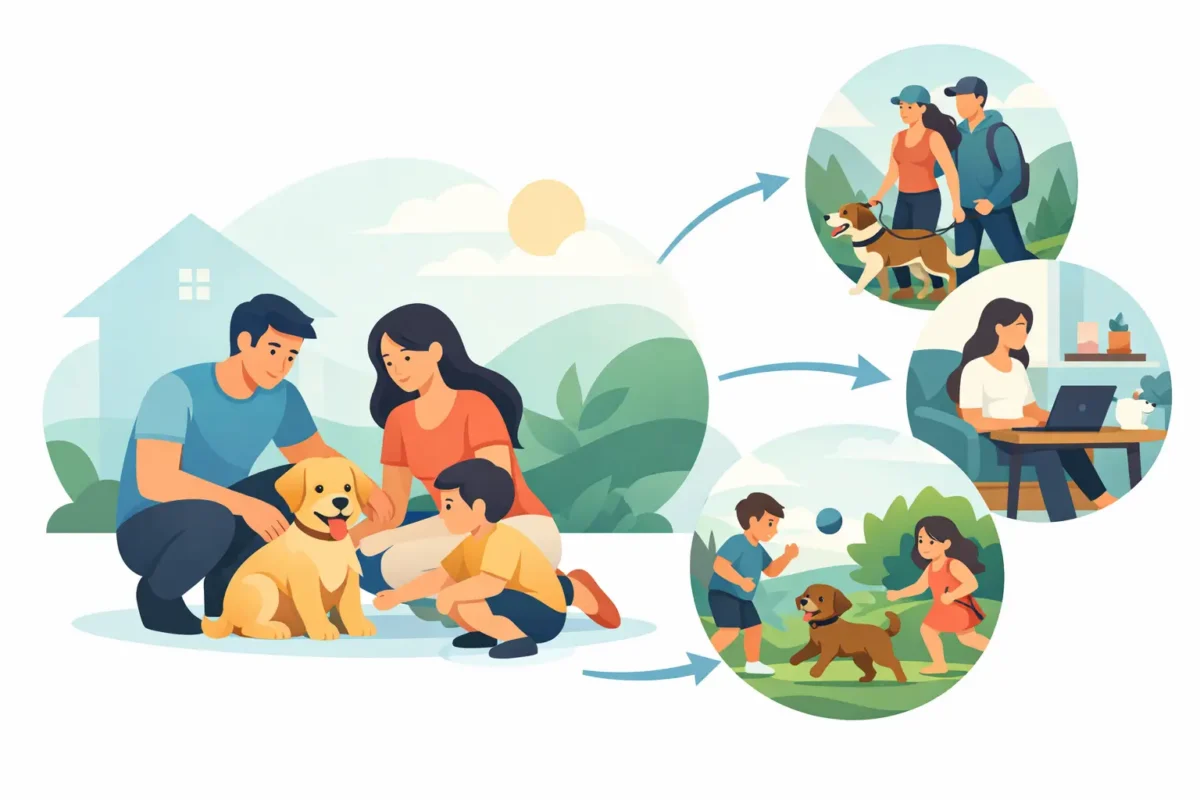
The right puppy for a runner, a rural property, and an experienced dog trainer may not be the right puppy for a Portland apartment, a retired couple, or a family with small children. Neither choice is wrong. The mistake is choosing based only on a striking merle coat, blue eyes, or the puppy that puts on the best show. A responsible breeder should ask direct questions about the household. Is someone home during the day? Are there children, cats, or older dogs? Does the family want hiking and training goals, or a smaller companion for neighborhood walks and close daily contact? How much experience do they have with a sensitive, intelligent breed? Buyers should be equally direct. Do not claim to be highly active if the real plan is occasional weekend outings. Do not assume a small Aussie will entertain itself while everyone is gone for long workdays. Accurate information protects the puppy and prevents a poor placement.

Give the puppy a fair chance to settle

Even a carefully matched puppy needs clear expectations after coming home. Provide predictable meal times, frequent potty breaks, short training sessions, calm handling, safe chewing options, and enforced rest. Avoid making every waking hour an event. A puppy that learns there are times for play and times for quiet will be easier to live with than one kept constantly stimulated. If behavior suddenly changes, especially if a puppy becomes unusually lethargic, distressed, painful, or unable to rest, contact a veterinarian rather than assuming it is a personality issue. The best puppy is not necessarily the quietest one or the most energetic one. It is the puppy whose inherited traits, early care, and developing personality fit the real life you can provide. Choose with your household in mind, listen to experienced placement guidance, and give your new companion the structure needed to become the steady adult dog you hoped for.

Companion Aussie Versus Working Versus SHOW Aussie Explained

Companion Aussie versus working Aussie: see how drive, size, training, and breeding priorities affect the right fit for a family home and routine each day.
A companion Toy Mini Aussie versus working, versus SHOW Aussie is not a contest over which dog is better. It is a practical question of what that dog was bred, selected, raised, and placed to do. Families often love the Toy MINI Australian Shepherd look, intelligence, loyalty, and trainability, then discover too late that a high-drive stock-working or Alpha “I am number 1”  Show dog can be a poor fit for a suburban schedule, small yard, or first-time owner. Toy and Mini Australian Shepherds are not naturally low-maintenance dogs. Even a carefully bred companion-oriented Toy or Mini Aussie needs training, engagement, exercise, and structure. The difference is that a responsible companion Hughes Toys breeding program deliberately selected generations  for dogs that can settle in a home and direct their intelligence toward family life rather than demanding livestock work or Show.  At Hughes Toys Aussies we selected dogs that didn’t bite over putting priority on “perfect bite” ie teeth.  We selected dogs that had companion, service, therapy dog traits over perfect head, or ear set.  Though many of our dogs in Show homes have received Champion status, Hughes Toys feels dogs have a greater purpose of being human companions, saving lives from alerting to medical issues, than winning in the show ring to puff the owners self importance.

What “Working Aussie” Usually Means

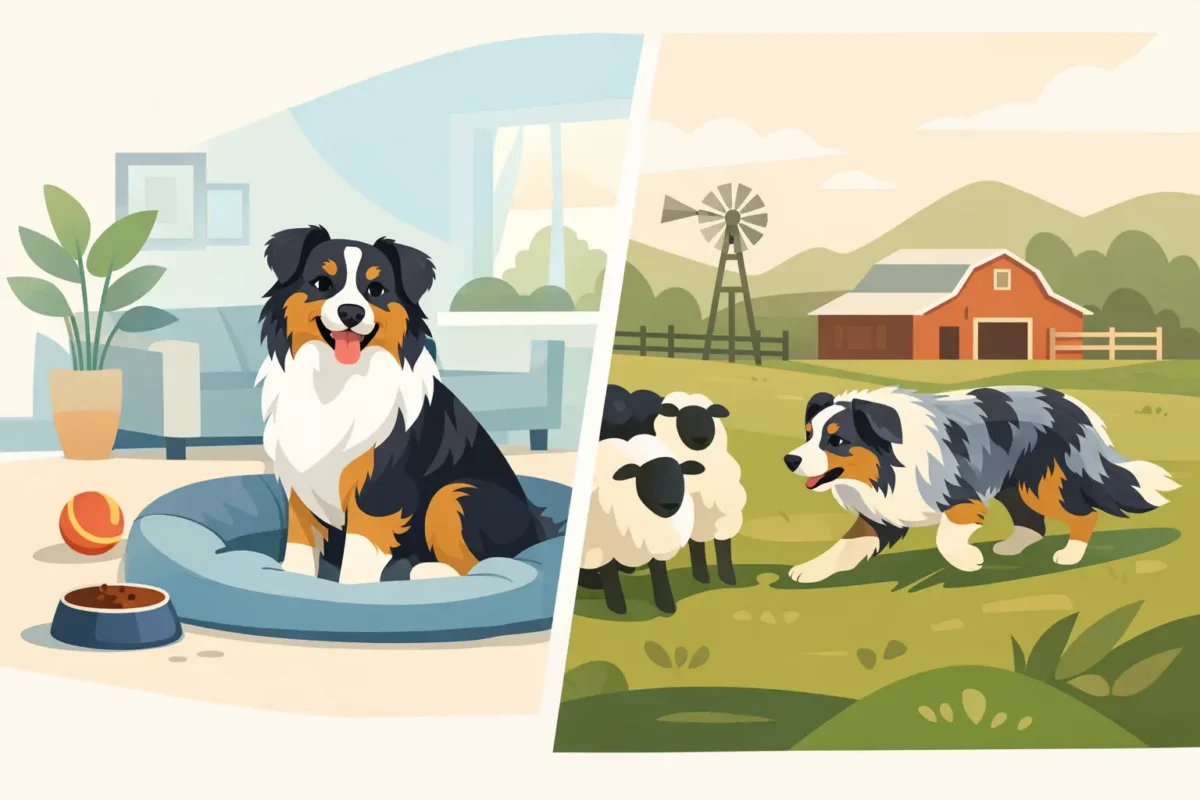
A working Aussie is typically bred with stock work as a major priority. The breeder may place heavy value on natural instinct, intensity, endurance, responsiveness to pressure, confidence around livestock, and the ability to work for long periods in changing conditions. These are useful traits on a ranch, farm, or serious stock operation. They can be difficult traits in the wrong household. A dog with strong working drive may notice every movement in the home. Children running, bicycles passing, guests arriving, cats moving through a room, and cars outside the window can all become events that require the dog’s attention. That does not make the dog bad or aggressive. It means the dog has been bred to observe, control movement, and stay ready for a job. Many working-line Aussies are also physically larger and more athletic than the smaller companion dogs families seek. Size alone does not determine drive, but it changes the practical reality. A 45-pound, highly driven adult that needs a daily job is a different commitment from a 12- to 20-pound companion-oriented dog with manageable energy and a reliable off-switch. A working Aussie can be an outstanding dog for the right owner. That owner generally has livestock, a demanding dog sport plan, substantial training experience, or a lifestyle built around providing meaningful work every day. A weekend hike is not the same thing as a job. Neither is tossing a ball in the backyard for 15 minutes.

What “SHOW Aussie” Usually Means

A SHOW Toy Mini Aussie is typically bred with primary concern over perfect “head structure”, ear set, color markings , and Alpha “look at me ” temperment  as a major priority. The breeder may place heavy value on Color , markings, head shape, ear set, and ” I am number 1″ attitude.   These are useful traits in the show ring. Alpha, ” I am number 1″ in the household can be difficult traits in the wrong household. The fact that a dog is a Champion, can be that the breeder/owner lives in the an area where there are enough breeders to have a Show almost every weekend within driving distance.. The more shows the dog enters, the more points they get, as long as they meet breed “Standards”..  These “standards” can be changed at the whim of the breeders that govern the show “standards” so their dogs win. Judges place dogs for extreme features that then the breeders “breed for”.. Ie the super pug faces of bull dogs that they cannot safely breathe anymore.   Judges from a show will place a dog bred/shown by a breeder that will be a judge to them in a future show.  The “best” animal does not always win top place. Showing animals is highly political of “whos-who”.

What makes a Companion Aussie Different?

A companion Toy Mini Aussie should still look and think like an Aussie. Families choose the breed because they want a bright, affectionate dog that stays connected to its people. The goal is not to remove intelligence or turn an Toy Mini Australian Shepherd into a passive lap dog. The goal is to produce a dog that can live successfully as a companion  in a household. That starts with breeding selection over generations. Temperament is not determined by a puppy photo, a color pattern, or a registration paper. A breeder must know multiple generations of  the dogs behind the puppy: how they respond to novelty, whether they recover quickly from stress, how they handle people, whether they are sound in body and mind, and whether they can settle after activity. Companion-focused programs generally select away from excessive intensity, extreme reactivity, and nonstop herding behavior. They prioritize family compatibility, manageable size, stable nerves, trainability, and an affectionate nature. Proper early handling and socialization matter too, but they do not replace genetics. Training improves a dog’s behavior. It cannot reliably erase a deeply inherited working temperament. At Hughes Toys, our breeding decisions are based on more than 30 years of breed-specific experience,  personal knowledge of  multi-generations, foundation to NSDR pedigrees, genetic testing, veterinary care, and firsthand knowledge of multiple generations of our own dogs. We built the Hughes Toys bloodline for smaller, companion-oriented  Toy Mini Australian Shepherds because many families want the breed’s best qualities without bringing home a full-time ranch dog- or an “ALPHA” number 1 attitude.

Companion Aussie Versus Working Aussie: Daily Life

The clearest difference appears after the puppy stage, when the dog is mature enough for inherited traits to show more strongly. Both types need consistent rules. Both need exercise. Both need mental engagement. Their threshold for daily activity and the kind of activity they require can be very different. A well-bred companion Aussie may be happy with walks, play, basic obedience, puzzle toys, family outings, and regular time with its people. It may enjoy agility, rally, tricks, or hiking without requiring those activities to stay emotionally balanced. The dog should be able to participate in family life, then rest when the activity is over. A true working Aussie may need far more than general exercise. Without structured outlets, it can create its own work by herding children, barking at movement, patrolling the fence, obsessing over toys, chasing pets, or becoming difficult to settle. Owners sometimes describe this as “too much energy,” but energy is only part of the issue. The dog may have a powerful need to control its environment. A  “Show” Aussie may have an ALpha, “I am number 1”  attitude.  Which can become aggressive, assertive,  need far more attention than general household. Without structured outlets, it can create its own work by, obsessing over toys, chasing pets, or becoming difficult to settle. Owners sometimes describe this as “too much energy,” but energy is only part of the issue. The dog may have a powerful need to control its environment. This is where honesty matters. No breeder can promise that every puppy will have identical energy or personality. Individual puppies vary, even within a carefully planned litter. But breeders who know their dogs can identify the more assertive, active, observant, or easygoing puppies and match them appropriately. A quiet retired couple, a family with toddlers, and a competitive dog-sport home should not automatically receive the same type of puppy.

Size Is Not Just a Convenience Detail

Toy, Teacup Small Toy, and Miniature Australian Shepherds can be especially appealing to urban and suburban households because their adult size is more manageable. A smaller dog is easier to travel with, easier to lift when necessary, and often better suited to apartment or city-sized living. It can also be easier for children and older owners to handle safely. But buyers should not confuse small with effortless. A small Aussie is still an Aussie. It needs boundaries, positive training, grooming, proper nutrition, routine veterinary care, and daily interaction. A small dog with poor breeding or poor training can still become noisy, anxious, pushy, or difficult to manage. Responsible breeders also avoid making size claims that are not supported by their breeding history. Adult size is influenced by the parents and generations behind them. A breeder should be able to discuss expected size honestly, including the fact that nature does not produce exact measurements on demand. The same standard applies to coat color, eye color, and tail requests. Those features may matter to a buyer, but temperament and health must come first.

Health Testing and Temperament Belong Together

Buyers sometimes focus on appearance first: blue eyes, a flashy merle coat, a short tail, or the smallest puppy in the litter. Those preferences are understandable, but they should never be the entire buying decision. A pretty puppy is not proof of sound breeding. A responsible program uses appropriate genetic testing, veterinary checks, disease-prevention protocols, clean facilities, and careful biosecurity. It also studies the breeding dogs themselves. Are they healthy? Are they structurally sound? Are they stable around people? Do they have a temperament that belongs in the next generation? A health guarantee has real value only when it is backed by a breeder who did the work before the litter was born. Color breeding without restraint can lead to poor decisions. The same is true of breeding only for tiny size or a fashionable look. The right breeder protects the dogs first and tells buyers the truth when a requested feature is not the best reason to choose a particular puppy.

Which Type Fits Your Household?

Start with an honest look at your routine. If you want a dog to join family walks, weekend trips, training sessions, and everyday home life, a companion-oriented Aussie is usually the sensible choice. If you have livestock or want a dog that thrives on serious, structured work, a working-bred Aussie may be appropriate. If you want the “my dog was from champions” pat yourself on the back status, then a show bred Aussie may be needed for your status. Be equally honest about your tolerance for intensity. Some experienced owners enjoy a dog that notices everything and wants constant direction. Other owners want an alert, trainable companion that can play hard, learn quickly, and then relax beside the family. Neither preference is wrong. The mistake is choosing based on a puppy’s markings or a social media video instead of the dog’s inherited purpose. Ask direct questions before placing a deposit. What are the parents like inside the home? How do they behave around strangers, children, and other dogs? What size are the adult dogs? What testing has been completed? How does the breeder match puppies to buyers? If the answers are vague, polished marketing will not make up for missing information. The right Aussie should fit your real life, not the life you imagine having for two weeks after bringing a puppy home. Choose the breeder and the puppy that match your household’s daily capacity, and you are far more likely to have the steady, devoted companion you wanted in the first place.
12 Signs of Responsible Puppy Breeders

Learn the signs of responsible puppy breeders, from genetic testing and veterinary care to honest temperament matching, contracts, and lifetime support.
A cute face, unusual eye color, or a low deposit does not tell you whether a puppy was responsibly bred. The real signs of responsible puppy breeders show up in the work done long before a litter is advertised: genetic planning, health records, stable temperaments, clean protocols, and a breeder who is willing to give straight answers even when those answers are not what a buyer hoped to hear. For families looking for a Toy or Mini Australian Shepherd, this matters even more. Smaller size does not erase the breed’s intelligence, sensitivity, or need for the right home. A responsible breeder does not simply produce small dogs with pretty markings. They make deliberate decisions about health, structure, energy level, herding drive, and family compatibility.

Signs of Responsible Puppy Breeders Start Before Birth

The strongest indicator of a responsible breeder is not the puppy listing. It is the breeding program behind it. Good breeders can explain why a particular sire and dam were paired, what they are trying to preserve or improve, and what they expect from the litter beyond color. With Toy and MINI Australian Shepherds, that conversation should include temperament and working intensity as well as size and appearance. A buyer who wants a city-sized companion should not be pushed toward a puppy with excessive drive for their household. The right breeder understands that a dog can be beautiful, registered, and still be a poor match for a first-time owner, apartment resident, or family with limited time for serious training. Hughes Toys thirty-plus years of breed-specific experience teaches a breeder that pedigree alone is not a breeding plan. Registration documents record lineage. They do not automatically prove that every dog in that lineage has been selected for sound health, stable behavior, appropriate structure, and long-term family suitability.

They Perform Relevant Genetic Testing

Responsible breeders test breeding dogs for inherited conditions that matter in their breed. For Toy and MINI  Australian Shepherds, a breeder should be able to discuss the genetic tests used in their program, what each result means, and how those results affect pairing decisions. A responsible answer is not always that every dog is clear of every condition. Genetics can be more nuanced than that. A well-managed breeding program may responsibly use a carrier in certain circumstances if the mate is clear and the resulting puppies cannot be affected. What matters is that the breeder understands the results, plans around them, and documents the process rather than hiding behind vague claims of healthy lines. Testing is also not limited to a mail-in DNA panel. Breeding dogs need routine veterinary care and assessment for their overall condition. Depending on the dogs and program, that may include eye, orthopedic, or other evaluations that help a breeder make informed decisions.

They Provide Real Veterinary Care and Records

Puppies should receive age-appropriate veterinary checks and care before going home. A responsible breeder can tell you what has been done, when it was done, and what still needs to happen after your puppy arrives. Buyers should receive clear records for  vaccinations, deworming, and any other care already provided. The breeder should also tell you when to schedule your own veterinarian visit. No breeder can promise that a living animal will never develop a health issue, but a breeder who offers a written health guarantee and sets reasonable expectations is taking accountability seriously.

Responsible Puppy Breeders Protect Puppies From Disease

Many buyers assume that unrestricted visits are proof of an honest breeder. That is not  true. Young puppies have immature immune systems, and outside visitors can bring parvovirus, parasites, respiratory illness, and other pathogens onto a property through shoes, clothing, or contact with other dogs. A responsible breeder will limit in-person visitation, especially before puppies have received appropriate protection. That is not a red flag by itself. The question is whether the breeder has a sensible biosecurity policy and offers other ways for buyers to see the puppies. Video calls, current photos, live updates, and organized pickup procedures can all be reasonable. For families buying from another state, this transparency is especially valuable. Remote placement should never mean blind trust. It should mean a documented process, direct communication, and a delivery or pet-nanny plan that puts the puppy’s welfare ahead of convenience.

They Keep a Clean, Managed Environment

A responsible breeder does not need to market a property as a luxury resort. Puppies need a sanitary, safe, properly managed environment with appropriate socialization, handling, rest, and room to develop. They also need to be raised with enough structure that their routines, early behavior, and confidence can be observed

They Match Puppies Instead of Letting Buyers Pick Only by Color

Merles, blue eyes, and striking tri colors attract attention. There is nothing wrong with having color preferences, but color should not outrank temperament. The puppy that photographs best at six weeks may not be the puppy that best fits your household for the next 12 to 15 years. A responsible breeder spends time learning about your home, children, work schedule, activity level, dog experience, and expectations. They may tell you that a certain puppy is more reserved, more active, more people-focused, or better suited for a home with another dog. That guidance is a service, not a sales obstacle. This is particularly relevant for Mini and Toy Australian Shepherds. Families often want the intelligence and loyalty associated with Aussies in a more manageable size. A good breeder will be candid that smaller does not mean effortless. These dogs still need training, companionship, boundaries, and daily engagement. The goal is a calmer, family-compatible companion, not a decorative dog with no needs.

They Do Not Make Impossible Promises

Be skeptical when a seller guarantees an exact adult weight, a specific eye color, a perfectly calm personality, or a puppy that will never shed, bark, herd, or need training. Breeders can estimate size from generations of dogs and evaluate early tendencies, but biology has limits. The same goes for claims that a puppy is perfect for every home. No Australian Shepherd, regardless of size, is the right choice for every lifestyle. Responsible breeders explain the trade-offs. A lower-drive companion-bred puppy may be easier for many families than a high-octane working prospect, but it is still an alert, intelligent dog that needs time and guidance. Hughes Toys approaches placement with that kind of practical standard: breed for documented health, manageable companion temperament, and honest matching, then give buyers the information needed to raise the dog well.

They Remain Available After Pickup

The relationship should not end when payment clears. A responsible breeder remains a resource when a puppy is adjusting to a new home, when a buyer has questions about feeding or training, or when unexpected circumstances arise later in the dog’s life. That does not mean a breeder replaces your veterinarian or trainer. It means they stand behind the puppy they produced and care where that dog ends up. Ask what happens if you can no longer keep the dog. A responsible breeder will have an answer, and it should not be, that is your problem now. The right breeder may ask more questions than you expected, set rules you do not love, and refuse to promise the impossible. Those are often good signs. Choose the person who can show their work, explain their decisions, and care enough about the outcome to make sure the puppy fits your life before it ever leaves theirs.

Family Lifestyle Puppy Matching That Works

Family lifestyle puppy matching helps you choose a Toy or Mini Aussie with the right energy, size, temperament, and daily needs for your home and schedule.
A puppy can be beautifully marked, blue-eyed, tiny, and completely wrong for your household. That is why family lifestyle puppy matching has to come before color preferences and before a buyer falls in love with one set of photos. A Toy Mini Australian Shepherd, even one bred in a smaller package for companionship, is an intelligent working breed. The right puppy needs to fit your real daily life, not the version of life you hope to have after bringing a puppy home. At Hughes Toys, we have spent more than 30 years breeding smaller Toy Mini Australian Shepherds with family companionship, manageable size, and calmer temperaments as priority. That does not mean every puppy is the same. It means responsible placement starts with honest questions about your household, activity level, children, work schedule, training plan, and expectations.

What Family Lifestyle Puppy Matching Actually Means

Matching is not a personality quiz and it is not a promise that a puppy will grow into a perfectly predictable adult dog. Puppies are individuals. Training, consistency, socialization, health, nutrition, medications and the environment you provide all affect the adult dog. A proper match uses the information that can be known: the parents’ temperaments, the puppy’s early behavior, expected adult size, genetic background, health records, and the breeder’s firsthand observations. It also requires a buyer to be candid. A busy family, a quiet retiree, a young professional in an apartment, and a household with livestock should not automatically be steered toward the same puppy simply because they all want a Mini Aussie. Our goal is not to place the most outgoing puppy with the first person who asks. The goal is to place a well-bred puppy where it can succeed for its entire life.

Start With the Puppy Photo- but give information about your household to see if a good fit.

The best place to begin is your routine. Be specific. “We are active” can mean a daily neighborhood walk, weekend hiking, children in sports, a working farm, or marathon training. Those are very different homes. A companion-bred Toy or Mini Australian Shepherd can be an excellent fit for a family that wants a responsive, trainable dog involved in daily life. These dogs still need structure. They need time with their people, age-appropriate exercise, basic manners, and a job for their minds. A job can be obedience practice, scent games, tricks, supervised outings, or learning to settle calmly in the home. It does not have to mean livestock work. The buyer who wants a dog that is happy being ignored for ten hours each day, then entertained only on weekends, needs to reconsider the breed or make a serious plan for support. Intelligence without direction can turn into barking, chewing, excessive alertness, or self-appointed household management. That is not a bad dog. It is an unmet need.

Children, Guests, and Household Activity

Families with children should think beyond whether a puppy is “good with kids.” Children need to be taught how to handle a puppy safely, respect sleep and meal times, and avoid rough play. Puppies need adults who supervise interactions and enforce those rules. A softer, people-oriented puppy may suit a home with young children and frequent activity, while a more observant puppy may do better with an experienced household that appreciates a dog that takes time to warm up. Neither temperament is defective. The mismatch happens when buyers expect every Aussie puppy to behave like a stuffed animal around noise, motion, visitors, and unpredictable handling. If your home hosts frequent guests, ask for a puppy that shows confidence and recovery after normal household stimulation. If your home is quiet and you prefer a close one-person companion, a calmer puppy may be a better fit. Honest descriptions matter more than a label such as “sweet” or “laid-back,” which can mean almost anything without context.

Work Schedules and Time Alone

A puppy cannot be left alone for a full workday without a plan. Early house training requires frequent outdoor trips, short periods of safe confinement, and supervision. Young puppies also need deliberate exposure to normal sounds, surfaces, people, car rides, grooming, and handling. Remote workers should not assume they have the perfect setup automatically. A puppy that is with you all day still needs to learn independence in small, positive steps. Otherwise, the dog may struggle whenever you leave. Households that work outside the home may do well with a coordinated schedule, a trusted family member, a puppy-safe midday break, or professional help. The answer depends on the puppy’s age and the household’s actual availability.

Size Is Part of Family Lifestyle Puppy Matching

Toy, Miniature, and Small Toy Australian Shepherds are not interchangeable labels. Adult size is influenced by the breeding behind a puppy, not wishful thinking. A smaller dog can be easier to lift, travel with, manage in an apartment, and include in family routines. Small size does not eliminate the need for training or exercise. Buyers should also understand that the smallest puppy in a litter is not automatically the best choice for a family wanting a tiny adult dog. A reputable breeder evaluates the whole breeding program, multiple generations, parent size, structure, and development. We breed from established, multi-generation ASDR-registered lines and discuss expected size based on real family history, not a casual guess made from one puppy photo. For homes with very young children, extremely small dogs require additional care. Accidental falls, rough handling, and being underfoot can cause real injury. A somewhat sturdier Mini may be more practical than the smallest available puppy. This is exactly the kind of trade-off that should be addressed before a deposit is placed.

Energy Level Is More Useful Than a Simple “Active” Label

Australian Shepherds are often described as high energy, but that statement is incomplete. Energy has several parts: physical stamina, intensity, curiosity, recovery after excitement, willingness to engage, and herding tendency. A puppy can enjoy play and training while still having a sensible off-switch. That is a very different experience from a dog that remains on alert all day. Our breeding selections prioritize companion suitability, calmer temperament, lower herding drive, and manageable size without pretending the breed has no instincts. Families should expect an Aussie to notice movement, learn routines quickly, and want involvement. They should not expect a well-bred companion puppy to require endless miles of exercise or to be bred for a hard-driving stockdog role. Tell the breeder if you want a hiking companion, a dog for neighborhood walks, a travel-friendly family pet, or a dog that can relax beside you after normal activity. These details help far more than saying you want “the calmest puppy.” The calmest puppy at eight weeks may simply be tired at the moment a video was taken.

Health Documentation Is Not Separate From the Match

Temperament and lifestyle are only part of responsible placement. Health practices affect the confidence a family can have in its puppy’s background. Genetic testing, veterinary checks, biosecurity, personal knowledge of ancestry  and a written health guarantee are not decorative selling points. They are evidence that the breeder has taken responsibility for the breeding decisions behind the litter. A breeder should be able to discuss these matters plainly. If the conversation is all color, eye color, and urgency to send money, slow down. Merles, blue-eye tris, and unique markings can be striking, but appearance does not tell you whether a puppy fits your family or whether the breeding was planned responsibly.

A Good Match Requires Buyer Responsibility

The breeder’s work does not replace yours. The family that gets the best result is prepared before pickup or delivery. Have a safe sleeping area, a veterinarian selected, a feeding plan, appropriate chew items, and clear household rules. Decide who handles morning potty breaks, training sessions, school-hour care, and nighttime settling before the puppy arrives. Training should begin immediately, but keep it simple. Reward the behavior you want. Introduce new experiences gradually. Avoid overwhelming a young puppy with crowded events, uncontrolled dog parks, or constant handling by visitors. Consistency creates confidence. For buyers outside Oregon, a remote placement can still be thoughtful when communication is clear and delivery is organized through a coordinated pet-nanny process. A responsible breeder can provide current information, discuss temperament directly, and explain the process without pushing a family into a rushed decision. Biosecurity may also limit casual visits to young puppies. That is a protection measure, not a lack of transparency. The right puppy is not necessarily the flashiest one in the litter. It is the puppy whose needs you are ready to meet every day, including on workdays, rainy days, travel days, and the days when training feels repetitive. Choose that puppy, prepare for it properly, and you give a smart little Aussie the stable family life it deserves.

Responsible Puppy Breeder Practices That Matter

Responsible puppy breeder practices include genetic testing, veterinary care, biosecurity, honest records, and careful temperament matching for families.
A puppy can look healthy in a photo, have striking blue eyes, and come with a long list of registration papers. None of that, by itself, proves responsible puppy breeder practices. The real proof is found in the work done long before a litter is announced: the health decisions behind each pairing, the records a breeder can show, the way puppies are raised, and whether the breeder is honest about what a particular dog will actually need in a home. For families looking for a Toy or Mini Australian Shepherd, this matters even more. Smaller Aussies are intelligent, athletic, people-oriented dogs, but size does not erase breed traits. A well-bred companion puppy should come from deliberate selection for sound health, stable temperament, manageable energy, and the right fit for the household purchasing it.

Responsible Puppy Breeder Practices Start Before Breeding

A responsible breeder does not pair dogs because their colors will sell, because both parents are registered, or because there is a waiting list. Registration documents establish ancestry. They do not replace health testing, practical knowledge of bloodlines, or the discipline to remove a dog from a breeding plan when the results call for it. The first question should be whether the breeder understands the genetic risks within the breed and tests accordingly. In Australian Shepherds, that means using appropriate DNA screening and making breeding decisions that avoid producing preventable inherited problems. Merle coloring requires especially careful planning. Breeding two merles together can produce double merle puppies, which carry a significantly higher risk of hearing and vision defects. A breeder who treats color as more important than genetic outcomes is not putting puppies health first. Testing is not a marketing accessory. It is a tool for making better decisions. A breeder should also know what a genetic panel can and cannot tell them. Clear results are valuable, but they do not guarantee a perfect dog. Temperament, structure, veterinary history, reproductive health, and the quality of prior offspring all remain part of responsible selection. At Hughes Toys, more than 30 years of breed-specific experience has reinforced a straightforward fact: good breeding is multi-generation work. Building a consistent line takes more than choosing attractive dogs with papers. It requires knowing how size, energy, temperament, health history, and type are actually passed through a family of dogs.

Temperament Is Not a Bonus Feature

Families often ask for a calm puppy, then select strictly by color or eye color. That is understandable, but it can create disappointment. Coat pattern is visible on day one. Temperament is what shapes daily life for the next 12 to 15 years. Toy Mini Australian Shepherds were developed as working dogs. Even smaller companion-bred Aussies need training, structure, and involvement with their people. Responsible breeders should be candid about that. They should also deliberately select away from excessive reactivity, frantic energy, and heavy herding drive when their program is intended for family homes. No breeder can promise that every puppy will have the same personality. Puppies are individuals, and training and home environment matter. Still, a breeder who knows their adult dogs, follows their puppies over time, and evaluates each litter can make a far more informed match than someone who simply allows buyers to pick the first face they like.

Health Care Must Be Documented, Not Vague

A reputable breeder has a working relationship with veterinary professionals and can explain the care puppies receive before placement. This generally includes age-appropriate examinations, deworming, vaccination planning, and clear records for the new owner. The right schedule depends on the puppy’s age and veterinarian guidance, but there should be no mystery around what has been done. A health guarantee is another piece of the picture, not the entire picture. Read it. A meaningful guarantee identifies what is covered, the time period involved, the buyer’s responsibilities, and the process if a concern arises. Beware of dramatic promises that sound comforting but have no practical terms behind them. Buyers should also understand that responsible care does not end at pickup or delivery. A puppy needs  veterinarian care , appropriate nutrition, safe exercise, socialization, and training. A breeder can provide a healthy start and honest guidance. No breeder can make responsible ownership optional.

Biosecurity Protects Puppies Before You Meet Them

Many people assume an open-door policy is automatically a sign of a good breeder. It depends. Visitors can carry illness from dog parks, shelters, grooming facilities, veterinary offices, or their own pets, often without realizing it. Very young puppies have developing immune systems, and exposure to disease can be devastating. Responsible puppy breeder practices include sensible biosecurity. That may mean limiting visitors around newborn litters, scheduling appointments carefully, requiring sanitation procedures, or offering photos, videos, and detailed communication until puppies are old enough for safe interaction. These rules are not secrecy when the breeder is otherwise transparent about their dogs, records, and program. They are basic disease prevention. At Hughes Toys the facility, Dogs and Proceedures are inspected, – Reveiwed by their Vet, who is the USDA vet for the area.  Should be clean, organized, and managed for the dogs’ welfare rather than for appearances. Puppies need clean areas, secure footing, room to move, regular human contact, and gradual exposure to normal household sounds and handling. Adult dogs need exercise, individual attention, and appropriate living conditions too. Ask how dogs spend their days, not just where a litter was born.

Honest Records Separate Breeders From Sellers

A responsible breeder should be able to provide clear information about parent dogs, registration, health testing, veterinary care, expected adult size, and the puppy’s development. For smaller Australian Shepherds, buyers should ask how adult size is estimated. It is an estimate, not a guarantee, but experienced breeders use the size of the parents, close relatives, and prior offspring to set realistic expectations. Multi-generation knowledge of the parents, ASDR registration can be useful because it documents a dog’s background. Yet paperwork should support a breeding program, not serve as its only claim to quality. A pedigree filled with unfamiliar names is not automatically better than a carefully developed line with documented health, consistent type, and known family temperament. Honesty also means discussing limitations. A breeder should not tell every buyer that every puppy is ideal for apartments, young children, full-time workers, or first-time dog owners. Some puppies are more active, more assertive, more reserved, or more sensitive than others. Good matching protects both the puppy and the buyer from a preventable mismatch.

Placement Is Part of the Breeder’s Job

The sale is not the finish line. It is the point where the breeder’s decisions become a family’s daily responsibility. Responsible breeders ask questions about household activity, children, work schedules, other animals, training plans, and prior dog experience. Those questions are not an intrusion. They are how a breeder determines whether a puppy is likely to thrive in that home. A buyer who wants a smaller Aussie for city life may be an excellent match, provided they want an engaged companion rather than a decorative pet. The right household will provide training, routine, companionship, and safe outlets for intelligence and energy. In return, these dogs are known for loyalty, trainability, and a close bond with their people. Remote placement can be handled responsibly as well. Families outside Oregon should expect organized communication, current puppy updates, records, a clear contract, and safe transport arrangements. Coordinated pet-nanny delivery can be a sensible option when it is planned around the puppy’s welfare instead of treating shipment as an afterthought.

Questions Worth Asking Any Breeder

Before placing a deposit, ask what genetic testing has been completed Ask what veterinary care the puppy has received, how biosecurity is handled, and how parents are selected beyond color and registration. Ask what the breeder sees in the puppy’s temperament and why that puppy is recommended for your home. Pay attention to the answers. Clear, specific answers are a better sign than polished sales language. So is a breeder who tells you to wait for a better match rather than pushing the only puppy currently available. The right puppy is not simply the one you can bring home fastest. It is the one whose health background, temperament, size expectations, and needs make sense for the life you can genuinely provide. Choose the breeder who is willing to be precise, set boundaries, show the work, and tell you what ownership will require. That is how a puppy gets more than a new address. It gets a real chance at the stable, well-cared-for life it deserves.

ASDR Versus AKC Registration: What Matters

Compare ASDR versus AKC registration for Toy and Mini Aussies. Learn what each registry documents, where breed standards differ, and buyers should verify.
A registration paper can tell you where a dog is recorded. It cannot, by itself, tell you whether that dog was bred with sound judgment, raised under clean conditions, genetically screened, or matched honestly to your home. That is the point buyers need to understand when comparing ASDR versus AKC registration for a Toy or Miniature Australian Shepherd. The registry matters because it affects pedigree records, naming, event eligibility, and how a dog is identified within a breeding program. But registration is only one piece of the record. A serious buyer should look beyond the logo at the actual dog, the parents, the health testing, the breeder’s standards, and whether the expected size and energy level fit real family life.

ASDR Versus AKC Registration: The Basic Difference

ASDR stands for American Stock Dog Registry. It has long been used by breeders of Australian Shepherds in a range of sizes, including Toy, Miniature, and standard-size dogs. For breeders focused on smaller companion-oriented Aussies, ASDR registration provides a practical way to document lineage and maintain records within that population. AKC, the American Kennel Club, recognizes the Australian Shepherd and the Miniature American Shepherd as separate breeds. The AKC Australian Shepherd is the standard-size breed. The Miniature American Shepherd has its own breed standard, registry pathway, and competition structure. It is not simply an AKC label applied to every dog commonly marketed as a Mini Aussie. That distinction gets lost in puppy advertising. A breeder may use the words “Mini Aussie” as a familiar description for a smaller Australian Shepherd-type dog, while AKC uses the formal breed name Miniature American Shepherd for its recognized smaller breed. Those are not interchangeable registration terms. Buyers should ask exactly what registry is on the puppy’s papers and what breed designation appears on those records. For a family looking for a Toy or Teacup Small Toy Australian Shepherd under 14 inches, ASDR is often the more relevant registry. AKC registration does not create a Toy Australian Shepherd category, and it should not be presented as though it does.

What ASDR Registration Can Document

A properly maintained ASDR pedigree records ancestry within that registry. It can help a breeder trace generations, identify family patterns, maintain records on color and lineage, and make more informed breeding decisions over time. For a breeder building a smaller Australian Shepherd program, multi-generation ASDR documentation matters. It allows the program to follow its own foundation stock and evaluate what has actually been produced: adult size, temperament, health history, coat patterns, eye color, tail traits, and the consistency of the dogs as companions. That does not mean an ASDR paper is a health certificate. It is not. A registry does not replace genetic testing for inherited conditions, veterinary examinations, vaccination protocols, parasite prevention, biosecurity practices, or a written health guarantee. It also does not tell you whether a breeder is selecting for stable nerves and manageable drive instead of simply producing a fashionable color or a very small puppy. Those answers come from the breeder’s records and conduct. Ask to see what testing is performed on the parents. Ask how the breeder evaluates temperament. Ask what adults from the line are like in ordinary homes. A good breeder should answer directly, without hiding behind registration language.

What AKC Registration Can and Cannot Tell You

AKC registration has value for dogs that are eligible for AKC registration and for owners who want access to AKC events or records. In the right setting, it offers an established national registry and a formal system connected to AKC-recognized breed standards. However, AKC papers are not a shortcut around buyer due diligence. An AKC-registered dog can still come from careless breeding. A pedigree may be lengthy and still reveal nothing about whether the breeder tested for relevant genetic conditions, raised puppies in a controlled environment, or made sound decisions about temperament. The reverse is also true. A well-bred ASDR-registered Toy or Mini Australian Shepherd can come from a carefully documented, health-focused program with more practical relevance to a household seeking a smaller companion dog than an AKC paper alone. Buyers sometimes assume AKC automatically means “better” and ASDR automatically means “lesser.” That is not how responsible selection works. Registries document registration. Breeders determine the quality of their program.

Why Breed Names and Size Claims Need Straight Answers

There is no responsible way to promise that every small puppy will stay a precise adult height or weight. Genetics are not a sales script. A breeder can use the adult sizes behind a litter, several generations of records, and knowledge of the line to give buyers a grounded expectation. That is very different from guaranteeing a number because it sounds appealing. The same goes for labels. Toy, Miniature, Teacup Small Toy, and Mini Aussie are terms buyers see often, but they may not carry the same formal meaning across every registry. Ask the breeder to explain the puppy’s expected adult size based on the actual parents and line, not just the advertisement. Tail status also deserves a plain answer. A natural bobtail, a full tail, or a tail request is a trait or placement preference. It is not proof of a registry category, health quality, or temperament. Buyers who care about a full tail should discuss that early, before a puppy is reserved.

The Questions That Matter More Than the Registry Logo

Registration should be part of the conversation, not the end of it. Before placing a deposit, a buyer should be able to get clear answers about the following: If those questions produce vague answers, a registration certificate will not fix the problem. A breeder who truly knows the dogs should be able to explain the line in practical terms. They should tell a first-time Aussie owner that intelligence and loyalty still require training. They should be honest that even a lower-drive dog needs daily engagement, structure, and a home prepared for a smart breed.

Choosing the Right Fit for Your Household

For many households, the real decision is not ASDR or AKC. It is whether the breeder has produced the kind of dog they are prepared to live with for the next 12 to 15 years. A Portland apartment household, a family with young children, and an active couple in a rural setting may all want an Australian Shepherd look and personality, but their day-to-day needs are different. A smaller dog does not automatically mean a low-maintenance dog. A beautiful merle coat or blue eyes do not tell you whether a puppy will settle in the house, respond to training, or be comfortable with your activity level. Hughes Toys has spent more than 30 years breeding smaller Toy and MINI Australian Shepherds with the understanding that companion placement requires deliberate selection. That means looking at health, size, family temperament, and drive together, rather than treating pedigree paperwork as the whole story.  Many of Hughes Toys dogs have been registered AKC Mini American Shepherd by the buyer/breeder.. It just required a three generation pedigree.. If AKC competition eligibility is central to your plans, confirm eligibility before you commit. If your priority is a well-documented Toy or Mini Australian Shepherd bred for a manageable companion home, evaluate the ASDR pedigree alongside the breeder’s health records, adult dogs, and placement practices. The right puppy is not the one with the most impressive acronym. It is the one whose background, care, temperament, and expected needs have been explained honestly enough for you to make a responsible choice.

Puppy Matching: The Right Fit Starts at Home

Puppy matching pairs temperament, size, energy, and training needs with your real household, helping you choose a well-bred Aussie ready to thrive at home.
A beautiful coat can get your attention. A puppy’s temperament is what you live with every day. Puppy matching is the practical work of pairing the individual puppy with the actual household, not the household someone wishes they had. For a Toy or Miniature Australian Shepherd, that means looking beyond blue eyes, merle markings, or the smallest puppy in the litter and asking honest questions about activity, training, children, work schedules, and expectations. A responsible breeder should know each puppy well enough to make that assessment. At Hughes Toys, that knowledge starts long before puppies are old enough to go home. More than 30 years of breed-specific experience, deliberate selection for companion temperament, personal knowledge of  multi-generations,  ASDR registration, genetic testing, veterinary care, and daily handling all contribute to a clearer picture of what a puppy is likely to become.

Puppy Matching Is Not Picking by Color

Toy and Mini Australian Shepherds are smart, responsive dogs. Even companion-bred Toys and Minis need engagement, structure, and a family willing to train consistently. A smaller Australian Shepherd is not an accessory or a low-effort version of the breed. Size may make daily life easier in a Portland apartment, a suburban home, or a travel-oriented household, but it does not replace responsible ownership. The strongest puppy match considers the puppy in front of you. Littermates can differ meaningfully in confidence, sensitivity, food drive, social approach, willingness to settle, and reaction to new situations. One puppy may be naturally outgoing and eager to meet every person. Another may be quieter, more observant, and best suited to a calmer home that does not expect instant sociability. Color is a preference. Temperament, health, and fit are priorities. Buyers can absolutely have preferences for a blue merle, red merle, black tri, red tri, or blue-eyed puppy. Those preferences simply need to stay in the right place. The best-looking puppy is not automatically the best puppy for your family.

Start With the Household You Actually Have

Good matching requires direct answers. A breeder needs to know whether you have young children, other dogs, cats, livestock, frequent visitors, a fenced yard, or a demanding work schedule. They also need to know what kind of dog ownership experience you have and how much training you realistically plan to do. A first-time Aussie owner may do better with a puppy that has a more forgiving, people-focused nature and an easier off-switch. A household that hikes regularly, trains, and wants a dog involved in daily activities may be a good fit for a more animated puppy with stronger enthusiasm for engagement. Neither puppy is better. The wrong placement is the problem. Families should also be candid about noise and motion. Children running through the house, bicycles, busy sidewalks, delivery drivers, and guests can be a lot for any young dog. Australian Shepherds have a long history as working dogs, and while careful breeding can reduce intensity and herding drive for companion homes, no breeder can responsibly promise that every puppy will respond identically to every environment.

Questions Worth Answering Before You Reserve

Before selecting a puppy, consider whether your household can provide regular training, safe social exposure, daily interaction, and a consistent routine. Ask yourself who will handle morning care, who will attend to the puppy during a long workday, and what happens when travel, sports seasons, or school schedules get busy. It also helps to be specific about adult size. Toy, Miniature, and small Toy Australian Shepherds are not interchangeable labels used for marketing convenience. Expected size depends on the parents, the bloodline, and the individual puppy. A knowledgeable breeder can discuss the expected range, but honest estimates are better than careless guarantees. Genetics are not a measuring tape. If you want a particularly small dog, be prepared to discuss why. A smaller adult may fit your living space or travel plans well, but extremely small size also calls for more careful handling, protection from rough play, and realistic expectations around fragility. The right puppy is one whose expected adult size works for both the dog and the household.

What a Responsible Breeder Brings to the Match

Puppy matching should not be a buyer left alone with a row of puppy photos. Photos are useful for following a litter, but they cannot tell you how a puppy handles novelty, settles after play, responds to people, or interacts with littermates. The breeder’s role is to observe patterns over time. That includes watching how puppies eat, play, rest, approach new spaces, and recover from normal changes in routine. It also means understanding the parents. Parent temperament, adult size, genetic test results, health history, and the consistency of a developed bloodline all matter when evaluating what may suit a buyer. Documentation matters because claims need support. Genetic testing helps breeders avoid preventable inherited risks and make informed pairing decisions. Veterinary checks confirm that puppies have received appropriate professional care. Registration documents establish breeding history, but registration alone does not prove quality. A pedigree is only as meaningful as the health, temperament, selection standards, and accountability behind it. Biosecurity is part of that accountability as well. Very young puppies do not need exposure to every visitor, every dog, and every possible outside contaminant. Buyers sometimes mistake visitation restrictions for secrecy. In a properly managed breeding program, controlled access is a health measure. The breeder should still communicate clearly, provide information about the puppy, and explain the process without treating puppy placement casually.

Matching Energy Level Without Making Promises

Buyers often ask for the calmest puppy in a litter. That is a fair question, but it needs a fair answer. A puppy can be calmer than its littermates and still be a young Australian Shepherd with bursts of energy, curiosity, and a need for training. Calm does not mean inactive, untrained, or content to be ignored. Likewise, a more active puppy is not automatically difficult. In an experienced, engaged home, that puppy may be a wonderful fit. The key is whether the household has the time and interest to channel that energy through training, supervised play, walks appropriate for a growing puppy, and mental work. Avoid choosing based on a single moment. The puppy asleep in a photo may have played hard for an hour before the picture was taken. The puppy barking at a new toy may simply be the first to investigate it. Repeated observations, parent information, and a breeder’s hands-on knowledge are far more useful than one video clip.

Remote Puppy Matching Can Still Be Thorough

Many families buying from Oregon, Washington, California, or farther away cannot visit in person. That does not mean they should receive less guidance. Remote placement should involve the same direct conversation about lifestyle, home setup, expectations, and puppy temperament as a local placement. Organized pet-nanny delivery can make a long-distance placement more manageable, but it does not make preparation optional. Buyers should have their puppy area ready before travel day, know the feeding and transition instructions, schedule a veterinary relationship, and plan for quiet time after arrival. A puppy does not need a crowded welcome party after a trip. It needs water, a safe place to rest, patience, and a predictable first few days. A good match may require waiting for a future litter rather than forcing a current puppy into the wrong home. That can be frustrating when a particular color is available now. It is still better than bringing home a puppy whose energy, expected size, or confidence level does not align with your family.

The Right Match Needs Follow-Through

No breeder can raise a puppy for you after pickup or delivery. Early routines, kind boundaries, socialization, crate training, grooming practice, and consistent expectations shape the dog that puppy becomes. A well-bred puppy gives a family a stronger starting point. It is not a substitute for responsible ownership. Choose the puppy whose needs you are prepared to meet, not just the one whose picture you cannot stop looking at. When the match is honest from the start, you are far more likely to have the steady, intelligent companion you were hoping to bring home.

Toy Aussie Exercise Guide for Balanced Dogs

Use this toy Aussie exercise guide to build safe daily activity, mental work, and calm routines for a small Australian Shepherd companion at home each day.
A Toy Australian Shepherd can live very well in a Portland neighborhood, an apartment, or a home with a modest yard. But a small dog with Aussie intelligence does not become a low-maintenance dog simply because it is under 14 inches tall. This toy Aussie exercise guide is built around a practical goal: meet the dog’s need for movement and mental work without creating an exhausted, overstimulated companion that cannot settle in the house. The right amount of exercise is not a competition. It depends on age, health, temperament, size, weather, training, and the dog in front of you. A thoughtfully bred Toy Aussie with a calmer companion temperament may need less intensity than a high-drive working-bred Toy mini Australian Shepherd. That is a feature for family life, not a reason to skip daily structure.

What Toy Aussies Actually Need

Toy Aussies need regular activity, but they do not need to run until they collapse. A common mistake is treating every burst of puppy energy as proof that the dog needs more miles, more fetch, or more chaos. Many young dogs become more wound up, mouthy, and unable to rest when their daily routine is all physical excitement and no calm practice. Most healthy adult Toy Aussies do well with roughly 45 to 75 minutes of purposeful activity spread across the day. That total can include walks, training, sniffing, play, and short sessions of structured games. Some active adults will want more. Others, particularly very small Toy or Teacup Small Toy dogs, may be perfectly satisfied near the lower end when their minds are engaged. The goal is a dog that is content, responsive, and able to relax after activity. A dog that paces, demands constant attention, ignores cues, or cannot settle may need a better routine. More exercise is only one possible answer. The dog may also need better sleep, less stimulation, clearer boundaries, or a veterinary evaluation.

A Toy Aussie Exercise Guide by Life Stage

Young puppies: protect growing bodies

Puppies are not miniature adult athletes. They have short attention spans, immature joints, and a strong need for sleep. Formal forced exercise, long pavement walks, repetitive fetch, jumping from furniture, and running alongside a bicycle are poor choices for a growing puppy. Such activity can cause joint and hip problems. Instead, use several short periods of activity throughout the day. A puppy may enjoy a brief leash walk to explore the block, a few minutes of recall practice in a secure area, gentle tug, a food puzzle, and supervised play with a stable dog. Let the puppy set a reasonable pace and rest before it becomes overtired. A useful rule is to stop while the puppy is still doing well. The goal is not to drain every bit of energy. Puppies often look wild when they are actually overdue for a nap. After a short outing or training session, guide the puppy toward a quiet crate or resting space instead of immediately starting another game.

Adolescents: build manners before mileage

Adolescence can make owners think their Toy Aussie has unlimited energy. In reality, this stage is often a mix of physical stamina, poor impulse control, and selective hearing. More unstructured exercise can turn that combination into a dog that expects entertainment every waking hour. Give adolescent dogs consistent walks and play, then make training part of the work. Practice loose-leash walking, wait at doors, recall on a long line, place commands, and calm greetings. A 10-minute training session with real expectations can tire an adolescent more effectively than another 20 minutes of frantic ball throwing. This is also the age to prevent unsafe habits. Do not encourage repeated vertical jumping for toys. Limit hard impact on slippery floors. Use caution around larger, rougher dogs at parks or daycare. A Toy Aussie may act tough, but size matters when another dog barrels into them.

Adults: keep the routine varied and realistic

A healthy adult often benefits from a morning outing, a midday mental task, and an evening walk or play session. For a family dog, that may look like a 25-minute sniff-and-walk in the morning, a five-minute cue practice session before lunch, and a 20-minute neighborhood walk after dinner. Variation keeps exercise useful. One day can include a nature walk with plenty of sniffing. Another can focus on leash skills and obedience. On a rainy Pacific Northwest day, several short indoor sessions may be the smarter choice. The dog does not need a dramatic outing every day to be fulfilled.

Seniors: preserve movement, reduce impact

Older Toy Aussies still need activity, but the plan changes. Shorter walks, gentle sniffing, easy food puzzles, and low-impact training help preserve mobility and confidence. Watch for stiffness after rest, reluctance to jump, lagging behind, or changes in gait. Those are reasons to speak with your veterinarian, not to push harder.

Mental Work Is Not Optional

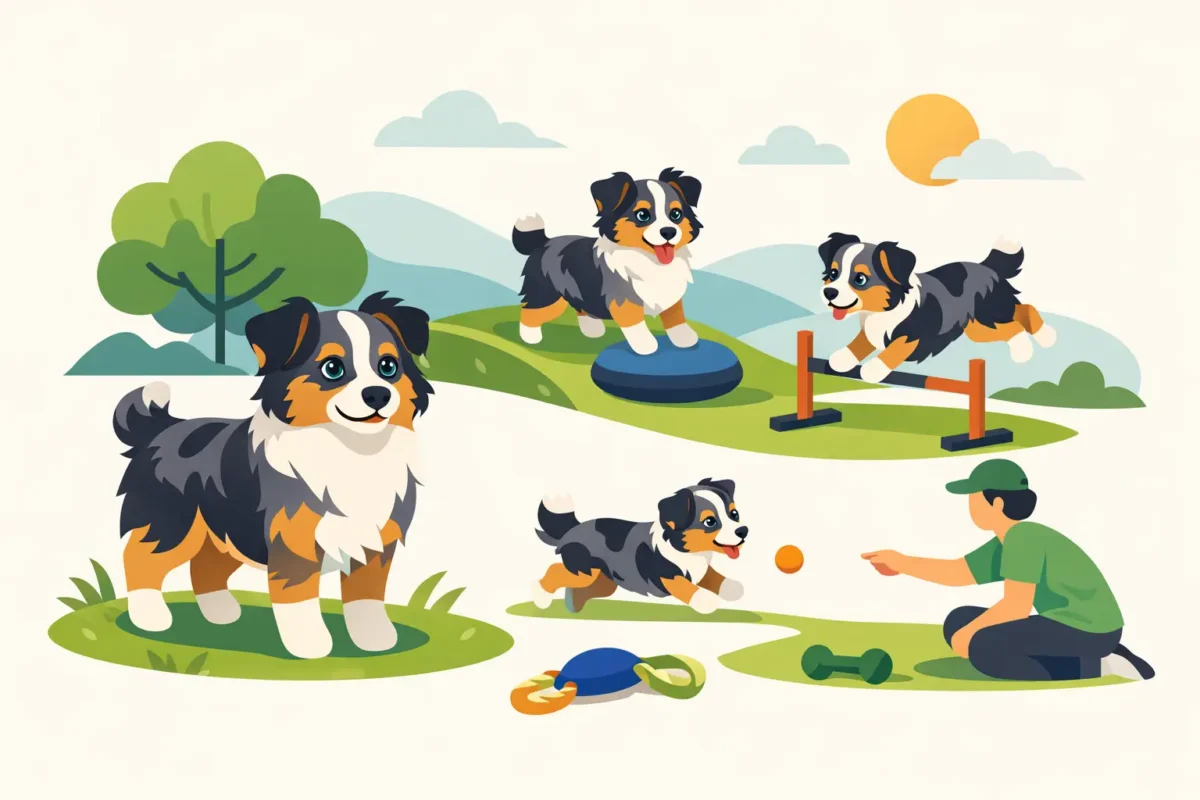
Australian Shepherds were developed to pay attention, notice movement, and work with people. Even a companion-bred Toy Aussie benefits from having a job, provided the job fits the dog and the household. Mental work helps direct that intelligence toward useful behavior instead of barking at windows, chasing children, or inventing trouble. Simple training is often the best place to start. Ask for a sit before the food bowl comes down. Practice a short stay while you fold laundry. Teach the dog to go to a bed or mat while guests enter. Reward calm behavior, not only high-energy tricks. Food can also create constructive work. Scatter a portion of kibble in the grass, hide treats around one room, use a snuffle mat, or feed part of a meal through an appropriate puzzle toy. Keep difficulty reasonable. If the dog becomes frustrated, simplify the task rather than assuming frustration is productive. For dogs that enjoy more structured activities, trick training, rally-style obedience, scent games, and carefully introduced agility foundations can be excellent outlets. Full-height jumps and repetitive high-impact drills are not necessary for a small companion dog. Precision, teamwork, and body awareness matter more than speed.

Avoid Creating an Adrenaline Habit

Fetch has a place, but it is not a complete exercise program. Repetitive ball chasing can raise arousal, encourage obsessive behavior, and add unnecessary stress to shoulders, knees, and backs. This is especially true for very small dogs that launch, twist, and stop hard to retrieve a toy. Use short fetch sessions with clear breaks. Ask for a sit or down between throws. End while the dog is still eager. Better yet, mix retrieving with scent games, walking, training, and calm chewing so the dog learns that activity can rise and then come back down. The same caution applies to dog parks. Some Toy Aussies enjoy carefully selected playmates; others find busy parks overwhelming or unsafe. A smaller dog does not need to socialize with every dog it sees. Good socialization means learning to remain neutral, confident, and responsive around the world.

Build a Weekly Routine You Can Maintain

Consistency matters more than an occasional marathon outing. Families should choose a plan that still works during busy school weeks, rainy weather, travel, and shorter winter days. If a dog only behaves well after a two-hour hike, the routine is not practical for most homes. A workable weekly plan includes daily walks or outdoor exploration, brief training every day, several mental feeding opportunities, and a few more active outings each week. Hiking, a secure-yard play session, a visit to a quiet new location, or a training class can provide variety without turning every day into a major production. At Hughes Toys, puppy matching should include an honest conversation about activity level. Families seeking a smaller Aussie need to be prepared for an intelligent, engaged companion, but they should not be told that every Toy Aussie requires the lifestyle of a full-time ranch dog. Careful breeding selection, early handling, and the individual puppy’s temperament all matter.

When Exercise Is Not the Real Problem

Owners sometimes increase activity because their dog is chewing, barking, pacing, or acting difficult. Before adding more exercise, look at the full picture. Is the dog getting enough uninterrupted sleep? Is the home too busy? Is the dog being rewarded for demand barking? Has training been inconsistent? Could pain, digestive upset, anxiety, or another health issue be involved? A balanced Toy Aussie should have active periods and genuine off-switch periods. Teach rest as deliberately as you teach recall. Provide a predictable place to sleep, use a crate or pen appropriately, and do not feel obligated to respond to every request for action. The best exercise plan leaves your Toy Aussie pleasantly satisfied, physically sound, and able to live calmly with the family. Start with reasonable daily movement, add brain work, protect small joints, and adjust based on the dog’s behavior rather than internet promises about what an Aussie is supposed to be.

What ASDR Registered Aussies Really Tell You

ASDR stands for the American Stock Dog Registry. What ASDR registration means for your Toy or Mini Aussie — and how it compares to AKC.
A puppy advertised as ASDR or AKC registered Aussies should come with more than a colorful coat, a promising photo, and a registration number. Registration is useful documentation, but it does not certify health, temperament, adult size, or the quality of the dogs or breeder behind the puppy. Families deserve to know what the paperwork means, what it does not mean, and what responsible breeding looks like before they make a commitment. For a Toy or Mini Australian Shepherd, those details matter. Smaller Aussies can be excellent companions for active households, city-based families, and buyers who want intelligence and loyalty without the size of a standard dog. They are still Aussies, though. A good breeder must select for manageable energy, stable nerves, sound structure, and family compatibility – not simply produce the smallest puppy or the flashiest merle.

What ASDR or AKC Registration Means

ASDR stands for the American Stock Dog Registry. An ASDR registration documents a dog’s recorded pedigree within that registry. When breeders maintain accurate records across generations, registration gives buyers a way to see that a puppy comes from identified parents rather than an unknown or loosely documented background. AKC registration for MINIATURE AUSTRALIAN SHEPHERDS they are named MINIATURE AMERICAN SHEPHERD. (MAS)  TOY under 14″ is a disqualificaiton. Dogs registered only 3 generations of ASDR could be re-registered in AKC MAS. The AKC breeders of STANDARD Australian Shepherds would not allow Miniatures in the “breed”.  Though the dogs have similar ancestry. Many of Hughes Toys Mini ausssies were re-registered AKC MAS by breeders that purchased them and went AKC. Multi-generation ASDR records can be particularly valuable. They help establish continuity in a breeding program and support clear recordkeeping for litters, parentage, and future registration. That is meaningful when a breeder has spent years building a line with specific goals for size, temperament, health, and companion suitability. But paperwork is paperwork. It is not a veterinary exam. It is not a DNA panel. It is not proof that every dog in a pedigree has the temperament your household needs. A registry records lineage based on the information submitted to it. The breeder remains responsible for the decisions that happen before a litter is ever registered. That distinction separates informed buyers from buyers who are sold a label.

ASDR & AKC Registered Aussies Need More Than a Pedigree

A pedigree can show names and generations. It cannot tell you whether a breeder has made careful decisions about genetic risk, raised puppies under good biosecurity practices, or honestly evaluated the energy level of a particular puppy. Those are the things that affect life with your dog long after registration papers are filed away. Responsible breeders use registration as one piece of a larger system. The system should include genetic testing appropriate to the breeding dogs, routine veterinary care, clear identification of parents, sanitary puppy-raising practices, and honest communication about what each puppy is likely to become. For Toy and MINI Australian Shepherds, genetic screening deserves special attention. Some inherited conditions can be identified through DNA testing, and merle breeding requires knowledge and discipline. Color should never be placed ahead of health. A blue-eyed tri or striking merle may catch a buyer’s attention, but the breeder’s job is to make breeding choices that protect the puppies, not chase demand for a particular look. The same applies to size. Terms such as Toy, Miniature, and Teacup Small Toy describe a breeder’s size focus, but no ethical breeder can promise a finished adult weight or height with absolute certainty. Genetics, previous offspring, parent size, and line consistency offer the best basis for an estimate. Buyers should be wary of anyone who treats a tiny puppy as a guaranteed tiny adult without discussing those variables.

Temperament Is Bred, Then Raised

Toy and Miniature Australian Shepherds are known for intelligence, attachment to their people, and willingness to learn. They can also be intense, busy, vocal, and inclined to herd when bred without enough attention to temperament. That may work for a working home, but it is not automatically the right fit for every family, apartment, or first-time Aussie owner. A companion-focused program should deliberately select dogs with calmer, more manageable temperaments and lower herding drive while preserving the traits people love in an Aussie. This does not mean producing a dog that needs no training or activity. It means placing a puppy with a more realistic chance of settling into family life when given structure, exercise, and consistent handling. Puppy matching matters here. The boldest puppy in a litter is not automatically the best puppy. Nor is the quietest puppy always the easiest. A good match considers the household’s activity level, children, other animals, work schedule, dog experience, and tolerance for grooming and training. Buyers who want an active hiking companion need a different fit than buyers who want a smaller dog that can happily join daily life, play, train, and then settle at home. At Hughes Toys, more than 30 years of breed-specific experience informs those decisions. The goal is not to tell every buyer that every puppy is perfect for them. The goal is to place the right puppy in the right home and be straightforward when expectations do not match the breed.

Questions Worth Asking Before You Reserve

Registration should start the conversation, not end it. Ask whether both parents and ancestors are known to the breeder.  ASDR allows “hardship registration” for $$.. which is if dog “looks” aussie it can be registered if unethical breeder pays extra. This is an unethical practice for both the registry and  the person doing hardship registration to breed a dog with unknown pedigree, breed, done just for money.    Unethical “breeders”  hardship register dogs purchsed without registration or breeding rights to save a few dollars   IF a “Breeder” skimps on the initial dogs what else to they save money by not performing testing, medical care.   ASK if the breeder personally knows at least the grandparents,   Ask what genetic testing has been completed, what veterinary care puppies receive, and how the breeder handles health concerns if they arise. You should also ask practical questions about the individual puppy. What is the expected adult size based on the parents and related dogs? Is this puppy more outgoing, more observant, more energetic, or more cuddly? Has the breeder observed the litter daily in a normal home-oriented setting? How are puppies introduced to grooming, handling, household sounds, and early routines? A direct breeder will answer clearly. They may also tell you something you did not expect to hear. For example, the smallest puppy may not be suitable for a home with very young children. A high-energy puppy may not be the right choice for an owner who works long hours and wants a low-maintenance pet. That is not poor customer service. It is responsible placement.

Health Guarantees Should Be Specific

A health guarantee is another area where buyers need details rather than broad promises. Read what is covered, the time period involved, the buyer’s responsibilities, and the steps required if a veterinary issue is identified. Ask whether puppies receive veterinary checks before going home and what health records will be provided. No breeder can guarantee that a living animal will never develop a health issue. Anyone making that claim is selling comfort, not truth. What a responsible breeder can do is reduce avoidable risk through health-conscious selection, testing, veterinary oversight, careful records, and accountability after placement.

Biosecurity and Visits Are Not Opposites

Many buyers want to visit puppies, which is understandable. However, unrestricted visitor traffic can expose young puppies and their mothers to illness before vaccinations are complete. A breeder who limits visits  is not necessarily hiding something. Often, they are protecting a vulnerable litter. Ask how puppies are raised, how the facility is managed, and when interaction is appropriate. Photos, video, regular updates, and organized communication can give remote buyers a genuine view of a litter without compromising biosecurity. This is especially important for families purchasing from outside Oregon or arranging pet-nanny delivery.

Registration Supports Responsible Ownership Too

Once your puppy comes home, keep veterinary records, get puppy microchipped. Keepinformation, and purchase agreement together. These records are useful throughout your dog’s life, particularly if you need to verify identity, review family information, or maintain accurate ownership documentation. More importantly, treat your new Aussie as the intelligent, involved companion it is. Plan for training, socialization, coat care, safe exercise, and time with its people. Small size does not erase the need for guidance. A Toy or Mini Aussie can fit beautifully into a smaller home, but it still needs a household willing to engage its mind and teach it how to live successfully with the family. The right AKC or ASDR-registered puppy is not defined by a certificate alone. Look for KNOWN lineage backed by tested parents, veterinary care, responsible biosecurity, honest size estimates, and a breeder willing to protect both the puppy and the buyer from a poor match. That is how a promising puppy becomes a well-placed family dog for years to come.

“Teacup” TIny Aussies: Small Size, Serious Standards

Teacup Aussies can be smart, devoted family dogs, but size alone is not quality. Learn what responsible breeding, testing, and matching look like in practice.
A tiny Australian Shepherd with bright eyes and a striking merle coat can get attention anywhere. That does not mean every small puppy marketed as a “Teacup” small toy Aussie has been bred with the care, documentation, or temperament needed for family life. The classsification of “teacup” is frowned on by breed standards, but is searched for by pet buyers looking for small. Size is only one part of the decision. Health history, parent temperament, genetic screening, structure, and honest adult-size expectations matter just as much. For families who want Aussie intelligence in a smaller companion package, “Teacup” Aussies can be a very good fit. They can also be a poor fit when buyers expect a low-maintenance lap dog simply because the dog is small. A well-bred small Aussie is still an Australian Shepherd. That means a dog that wants to be included, trained, handled properly, and treated as a real member of the household.

What Is a Teacup Aussie?

“Teacup” is commonly used to describe the smallest end of the Toy Australian Shepherd size range. At Hughes Toys, a Teacup Small Toy is generally expected to mature under 10 inches at the shoulder. That is a height category, not a promise that every puppy will remain the same weight, build, or energy level. A responsible breeder should never pretend adult size is exact. Genetics can produce variation, even in carefully selected lines. The best prediction comes from several generations of documented relatives, not a photo of one tiny puppy or a vague claim that both parents are “teacup.” Ask about the size of the parents, grandparents, full siblings from prior litters, and the breeder’s history with that particular family line. Small size should be produced through deliberate selection of healthy, correctly built small dogs. It should not come from breeding undersized, frail, poorly structured, or medically compromised animals. There is a difference between a compact dog and an unhealthy dog. Buyers need to know that difference before placing a deposit.

Small Does Not Mean Easy

The appeal is understandable. A smaller Aussie is easier to lift, easier to travel with, more practical in an apartment or city home, and less physically imposing for children or older owners. For many households in Portland, throughout the Pacific Northwest, and in other urban areas, those are real advantages. But a “Teacup” tiny Aussie still needs daily interaction and purposeful training. These dogs are observant. They notice routines, read people well, and quickly learn what gets a response. If nobody gives them direction, they may create their own work by barking at windows, policing other pets, or becoming overly attached to one person. The goal is not to wear a puppy out for hours every day. In fact, constant high-intensity exercise can create an athlete who needs more and more activity to settle. A better plan combines age-appropriate walks, basic obedience, short training sessions, safe social exposure, play, and calm time in the home. The right puppy for a quieter household is one bred and selected for a companion-oriented temperament, not simply the smallest puppy in the litter.

Temperament Is a Breeding Decision

Toy Mini Australian Shepherds are known for intelligence, loyalty, responsiveness, and natural awareness of their people. Those traits are valuable, but they need balance. Excessive herding drive, uncontrolled intensity, sharpness, or constant reactivity are not good trade-offs for a family seeking a manageable companion dog. Breeders influence temperament long before a buyer meets a puppy. They choose which adults are bred, evaluate how those adults respond to people and change, and watch how puppies develop during the weeks before placement. A puppy’s final personality is also shaped by its home, training, and socialization, but genetics matter. Good breeders do not deny that. Matching matters as much as picking by color. A blue-eye tri or flashy merle may be the puppy that catches your eye, yet the best choice may be the steadier puppy that recovers quickly from new sounds, enjoys handling, and has an energy level that fits your routine. A knowledgeable breeder should be willing to tell you when the puppy you first chose is not the best fit. That kind of honesty protects the puppy and the family.

Health Work Should Be Documented

Cute photos are easy to produce. Verifiable health practices require actual work. Before choosing a breeder, ask direct questions about genetic testing, veterinary care, knowledge of multigeneration parents, and the health guarantee. Clear answers should be available without pressure or evasive language. For “Teacup” tiny Aussies, genetic screening is especially relevant because responsible breeding is about reducing preventable risk, not just producing a desired size or color. Depending on the breeding program and bloodlines, testing may address inherited concerns found in Australian Shepherds and related small-Aussie populations. The breeder should understand the results, use them appropriately in pairing decisions, and explain what they do and do not guarantee. Merle coloring also requires informed breeding. Merle is beautiful, but it is not a reason to ignore genetics. Breeding two merle dogs together can create double-merle puppies, which have an increased risk of serious hearing and vision problems. A responsible program plans matings with color genetics in mind rather than treating coat color as a sales tool. At Hughes Toys, Veterinary checks before placement are another basic. Puppies should receive age-appropriate care, be evaluated before leaving, and go home with clear records and instructions. A health guarantee should be written in plain language. Read it before committing, including any requirements for a post-purchase veterinary exam, diet, care, and notification if a concern arises.

Registration Is Useful, but It Is Not the Whole Story

Multi-generation knowledge give breeders useful information about a puppy’s background They help establish lineage and provide a framework for documenting the dogs behind a litter. That matters, particularly for buyers seeking a true Toy or Miniature Australian Shepherd type rather than an unknown cross sold under a fashionable label. Still, paperwork alone does not make a well-bred dog. Registration cannot prove sound temperament, clean facilities, honest size estimates, careful socialization, or appropriate health decisions. It is one piece of the evidence. Buyers should look at the whole program: the health testing, the consistency of the line, the care standards, the breeder’s knowledge, and whether the breeder remains available after placement. At Hughes TOys, More than 30 years of breed-specific experience gives a breeder time to see how lines mature, how traits repeat, and which pairings consistently produce the kind of companions families can live with. That long view is worth more than a trendy label or a seller who has only recently started offering small puppies.

Ask Questions Before You Fall in Love With a Photo

A careful breeder expects questions. You should know the puppy’s expected mature height range, the parents’ sizes and temperaments, what genetic testing has been completed, and how the breeder handles veterinary care and biosecurity. You should also ask how puppies are matched, whether the breeder offers a written agreement, and what support is available after your puppy comes home. Biosecurity is another point buyers sometimes misunderstand. Limiting visitors around young puppies is not secrecy when it is done to reduce disease exposure before vaccinations are complete. A breeder can provide information, photos, videos, and direct communication while still protecting a vulnerable litter. Anyone insisting on unrestricted puppy access should understand that prevention is part of responsible care. For distant buyers, the same standards apply. A professional process for out-of-state placement should include clear communication, current puppy information, health documentation, and organized transport planning. A coordinated pet-nanny option can be preferable to sending a small puppy through an impersonal cargo process, but buyers should still understand the timing, cost, handoff details, and travel preparation.

Preparing for Life With a Very Small Aussie

A “Teacup” tiny Aussie needs practical protection because of its size. Young children must be taught to sit and hold, not carry a puppy around. Larger dogs need supervised introductions. Doors, gates, stairs, furniture, and outdoor spaces all deserve attention. Small dogs can be seriously injured by ordinary household accidents that would not affect a larger dog. Training should begin immediately, with realistic expectations for a young puppy. Focus on potty routines, crate comfort, gentle handling, recall foundations, social exposure, and settling quietly. Consistency matters more than harsh correction. These dogs are smart enough to learn quickly and sensitive enough to become confused when house rules change from one day to the next. The right Teacup tiny Aussie is not merely the smallest or prettiest puppy available. It is the puppy whose health background, expected size, temperament, and needs honestly fit the life you can provide. Choose the breeder and the puppy with the same care you expect them to have used in producing the litter.